Syntagma Square
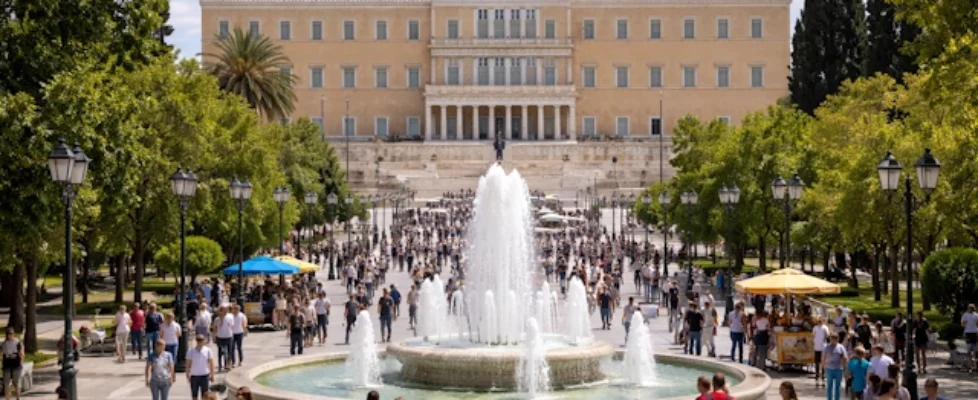
Syntagma Square or Constitution Square is the main square in Athens and has a metro station, the Greek Parliament building, hotels, cafes, and a post office.

Syntagma Square: The Beating Heart of Modern Greece
Syntagma Square—Πλατεία Συντάγματος in Greek—is more than a central plaza in Athens. It is the symbolic, political, and emotional core of the modern Greek state. Located directly in front of the Old Royal Palace, which has housed the Greek Parliament since 1934, the square has served for nearly two centuries as the stage upon which the nation’s most defining moments have unfolded. Today, it remains a vibrant crossroads where history, civic life, and everyday Athenian rhythms converge.
Syntagma: A Square Born from Revolution and Reform
The name “Syntagma” means “Constitution,” and it commemorates the historic uprising of September 3, 1843, when citizens and the military demanded that King Otto grant Greece its first constitution. This event marked a turning point in the young nation’s political development, transforming the square into a symbol of democratic aspiration. The uprising was not merely a protest but a foundational moment that shaped the political identity of modern Greece.
The square itself was designed in the 1830s by Bavarian architect Michael Koch as part of King Otto’s vision for a modern European capital. Its neoclassical layout, broad open space, and alignment with the royal palace were intended to project stability and grandeur. Over time, however, the square evolved from a royal forecourt into a public arena where Athenians could gather, celebrate, and challenge authority.

The Parliament and the Tomb of the Unknown Soldier
Dominating the north side of the square is the Hellenic Parliament building, originally constructed as the Old Royal Palace. Its austere neoclassical façade overlooks the plaza, reinforcing the square’s role as the country’s political center. At its base lies the Tomb of the Unknown Soldier, guarded by the Evzones—elite presidential guards whose ceremonial changing of the guard has become one of Athens’ most iconic spectacles. See our full page about the Changing of the Guard in Athens.
A Hub of Movement and Connection
Ask any Athenian, and they will tell you that Syntagma Square is the city’s true center. Distances to towns across Greece are measured from this point, and its metro station—one of the busiest in the country—connects major lines that weave through the capital. The square is also within walking distance of many of Athens’ most important landmarks, including the Acropolis, the Ancient Agora, the National Garden, and the Temple of Olympian Zeus.
This centrality makes Syntagma not only a transportation hub but also a natural meeting point. Whether people are heading to work, shopping on Ermou Street, or strolling toward Plaka, they often pass through the square. Its fountains, benches, and shaded areas offer a moment of rest amid the city’s bustle.
A Stage for History: From the 19th Century to Today
Syntagma Square has witnessed nearly every major political and social upheaval in modern Greek history. Beyond the 1843 uprising, it was a focal point during the “Dekemvriana” of 1944, a series of violent clashes that marked the beginning of the Greek Civil Wars. In more recent decades, the square has hosted mass demonstrations, labor strikes, and public celebrations.
During the economic crisis of the 2010s, Syntagma became the epicenter of nationwide protests. Thousands gathered to voice frustration over austerity measures, unemployment, and political instability. The square’s steps, fountains, and open spaces transformed into a living forum for debate, solidarity, and dissent. This role as a civic arena underscores the square’s enduring importance in Greek public life.
Architecture, Atmosphere, and Urban Life
Despite its heavy political symbolism, Syntagma Square is also a place of everyday joy and movement. Its layout combines open plazas with landscaped areas, creating a balance between formality and relaxation. The central fountain, often illuminated at night, serves as a visual anchor. Surrounding the square are luxury hotels, cafés, restaurants, and shops that contribute to its lively atmosphere.
The square’s design encourages both transit and lingering. Office workers cross it briskly during the day, while families, tourists, and street performers animate it in the evenings. During holidays, the square becomes a festive space filled with lights, music, and public events.
The National Garden: A Green Refuge Next Door
Adjacent to the square lies the National Garden, a lush 38-acre park commissioned by Queen Amalia in the 19th century. Its shaded pathways, ponds, and botanical variety offer a peaceful escape from the city’s intensity. Many visitors pair a visit to Syntagma with a stroll through the garden, enjoying the contrast between the square’s civic energy and the garden’s tranquility.
Syntagma as a Gateway to Athens
One of the square’s greatest strengths is its proximity to so many of Athens’ cultural treasures. From Syntagma, visitors can easily reach:
-
Ermou Street, one of the city’s main shopping avenues
-
Plaka, the historic neighborhood at the foot of the Acropolis
-
Monastiraki, known for its flea market and vibrant street life
-
Kolonaki, an upscale district filled with boutiques and galleries
-
The Zappeion and Panathenaic Stadium, key sites in modern Olympic history
This makes Syntagma not just a destination but a starting point—a gateway to exploring the layers of Athens.
A Square That Reflects the Greek Spirit
What makes Syntagma Square so compelling is the way it encapsulates the Greek experience. It is a place where ancient ideals meet modern realities, where political expression coexists with everyday life, and where the weight of history blends with the spontaneity of the present.
The square’s ability to transform—hosting protests one day and celebrations the next—reflects the resilience and dynamism of the Greek people. It is a space that invites participation, whether through civic engagement, cultural exploration, or simple enjoyment of the city’s pulse.
Why Syntagma Square Matters
Syntagma is more than a landmark. It is a living symbol of Greece’s democratic journey, a crossroads of culture and community, and a testament to the enduring vitality of Athens. Whether you are watching the Evzones, meeting friends by the fountain, or simply passing through on your way to another part of the city, Syntagma Square offers a glimpse into the soul of Greece.


