A Brief History of Athens from the first people to live on the Acropolis through the Golden Age of Pericles to the first king of modern Greece and the military junta.
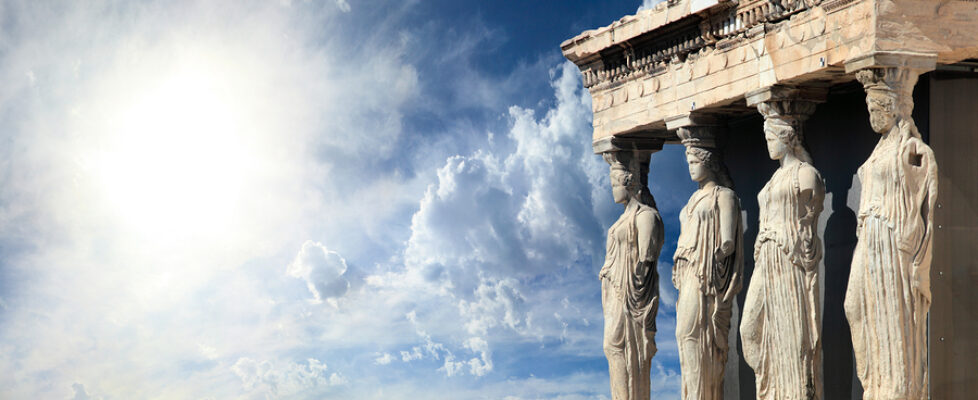
The Erechtheion at the Athens Acropolis
If there’s one thing Athens has in abundance, it’s history. This is a brief history of Athens, picking out only some of the key points in the city’s story.
There were people living here, on and around the Acropolis, some 5000 years ago. By the 6th century BC it was a flourishing and forward-thinking city, and had introduced a revolutionary form of democratic governing system with decisions made by elected citizens. As yet no women or slaves could vote, but nevertheless the system was as enlightened as any in the world.
The Golden Age of Pericles
Democracy worked. Little over a hundred years later an era known as the Golden Age of Pericles began. Pericleswas probably the greatest statesman that Athens has ever seen, and it’s thanks to his vision that the Parthenon on top of the Acropolis was built, and many other fine buildings. He encouraged the arts and philosophy too, and this was the time when Sophocles, Aeschylus and Euripides were all working. European drama was being not just born but developing, its boundaries already being pushed by experimentation.
Alexander the Great
Statue of Alexander the Great
After the death of Pericles and a period if unrest, Alexander the Great was born and Greece had the most powerful and extensive Empire it has ever known. But all empires eventually wane, and by 200BC the Romans has arrived and were to rule for 500 years. Their legacy is everywhere, including the Roman Agora, or marketplace, and Hadrian’s Arch, still standing almost 1900 years later.
After the Romans Athens saw the Franks and the Venetians taking control, and then the most significant of all – the Turks. This detested period lasted from 1453 until the start of the War of Independence in 1821.
The First Modern King of Greece
In 1832 King Otto of Bavaria became the first king of the modern Greek state. Why Bavaria? Because the new country was still considered unstable, especially when its first Prime Minister Ioannis Kapodistrias was assassinated in Nafplion. Russia, Britain and France had all been involved in the birth of modern Greece, and it was through them that a suitable ruler was found and Greece became a monarchy.
The Military Junta
It remained one until 1967, when a military junta seized power and King Constantine fled into exile. The Colonels ruled with military ruthlessness until 1974, when the people of Athens, particularly its young students, said ‘enough is enough’ and overthrew the dictatorship. There was no triumphant return for the exiled king, however, as a referendum saw a majority vote for a return to a Greek republic. The monarchy was booted out.
Athens in More Recent Times
In 1981 Greece joined the then European Community, now the European Union, and changes started to happen. The city of Athens became much more European in outlook. Its young people travelled more, and brought back with them a desire for some of the style, the fashions, the food and the wine that they had experienced elsewhere. In 1985 Athens was Europe’s first ever Cultural Capital – fittingly, as the idea of Cultural Capitals had been hatched by the Greek actress-turned-politician, Melina Mercouri.
In 2004 the Olympics came to Athens and brought with it a new airport, a new Metro system, new hotels, new attractions and many other boosts to the city.
Irakleio’s Historical Museum is officially called the Historical Museum of Crete and contains the only work by El Greco that is still on his native island.
Historical Museum of Crete
Where is Irakleio’s Historical Museum?
If you walk west along the waterfront from the Venetian Port you will reach Irakleio’s Historical Museum in about five minutes. It’s on the left in a handsome neoclassical building dating from 1903.
Map )c) Google Maps
Highlights of Irakleio’s Historical Museum
For an overview of the history of both Crete and Irákleio, a visit to this small but informative museum is a must. Highlights include the study of Nikos Kazantzakis and the only work by El Greco still on his native island.
At the ticket desk be sure to pick up one of the leaflets, available in Greek, English or German, which gives a map of the museum and a brief note of what is in each room. Most of the displays also have information displays in both Greek and English, although on some the details given are fairly basic.
First Room
In the first room, to your right as you enter, the information panels are anything but basic. They cover in some detail four of the major periods in Crete’s history, and correspond to four shelves of objects from those periods: the First Byzantine (330-827/8), the Arab Occupation (827/8-961), the Second Byzantine (961-1204) and Venetian Rule (1204-1669.
The major display in this room is a wonderful 1:500 scale model of Irakleio in 1645, when it was known as Chandax. This is the name given to the city when the Arabs made it the island capital in the early 9th century, possibly from the Arabic words Rabdh el-Khandaq, the Fortress of the Moat. On the walls beside it maps show the development of the city over the years, and note the buttons beneath the displays which illuminate the relevant parts of the model.
Scale Model of Irakleio in Irakleio’s Historical Museum
Around Irakleio’s Historical Museum
The museum tour continues behind the ticket desk, with the rooms spread on several levels. Room 2 is the Ceramics Room and has some beautiful bowls and plates imported from Italy during the Venetian period. These are cleverly displayed side-by-side with locally-made pottery from the same period, clearly showing the Italian influence on local designs. There are also some lovely, delicate jugs and bowls from the Arab Occupation of the island.
The rest of the ground floor has several rooms containing Byzantine items, Venetian coats of arms and carvings (note the fountain from a 17th-century Palazzo in Room 6), with stairs leading up to the second level.
El Greco Painting
The Monastery of St Catherine beneath Mount Sinai in Egypt’s Sinai Desert by El Greco
The highlight of Level B is undoubtedly the small dimly-lit room containing El Greco’s painting of The Monastery of St Catherine beneath Mount Sinai in Egypt’s Sinai Desert. This, his only work to remain on Crete, was painted in 1570 and some background to the work is given in extracts from books about it which are also on display.
Cretan Icons
Elsewhere on this floor are several icons from the Cretan school, the more typical style of Greek art, and at the rear one room is given over to the struggle for independence against the Turks.
Nikos Kazantzakis
The major display on Level C is the writer Nikos Kazantzakis’s study from when he lived in Antibes 1948-57, complete with manuscripts of his works, his library of books, and copies of his own books translated into many languages around the world.
Folklore Collection
The museum’s top floor contains a folklore collection based on the theme of the life cycle of birth, marriage and death. The museum has a fine collection of weavings, embroidery, old costumes, household items, musical instruments and many other objects.
Hidden Gems
Slightly overshadowed by the other displays in the first room are some cabinets in the centre containing objects, including fascinating glass and clay hand grenades, found on a galleon that sank in 1669.
One to Miss
The Emmanuel Tsouderos room, opposite the Nikos Kazantzakis room, is unlikely to appeal unless you have a deep interest in Greek politics.
Must See
El Greco’s painting, Monastery of St Catherine beneath Mount Sinai in Egypt’s Sinai Desert.
The Changing of the Guard in Athens takes place outside the Parliament building at the top of Syntagma Square and is a must-see for visitors.
The Changing of the Guard in Syntagma Square
Witnessing the Changing of the Guard
In the heart of Athens, amidst the bustling rhythm of a modern European capital, a timeless spectacle unfolds several times a day – the Changing of the Guard ceremony. More than just a military ritual, it’s a vibrant tapestry woven with history, national pride, and a uniquely Athenian flair.
For visitors and locals alike, witnessing the Evzones, Greece’s elite presidential guard, perform their meticulously choreographed duties is an unforgettable experience, a powerful link to the nation’s past and present.
Where is the Changing of the Guard?
The primary stage for this captivating performance is Syntagma Square, or Constitution Square, the beating heart of Athens. Dominating the eastern side of the square stands the Hellenic Parliament Building, a majestic edifice that once served as the Royal Palace. It’s in front of this historic structure, specifically at the Tomb of the Unknown Soldier, that the most elaborate and frequently witnessed changing of the guard takes place.
The square itself is a hub of activity, a convergence point for major avenues, public transport, and a constant flow of Athenians and tourists. This setting adds to the ceremony’s grandeur, placing it at the crossroads of daily life and national significance.
Changing of the Guard in Athens
When is the Changing of the Guard?
The Changing of the Guard at the Tomb of the Unknown Soldier occurs hourly, 24 hours a day, 7 days a week. Every hour on the hour, a pair of Evzones, standing as silent sentinels, exchange places with their comrades. While these hourly changes offer a consistent glimpse into the Evzones’ distinctive drill, the most impressive and popular ceremony takes place on Sunday mornings at 11:00 AM.
This larger-scale event features a full marching band and a greater number of Evzones, making for a truly impressive experience. The rhythmic thump of their hobnailed boots, the precise swinging of their arms, and the vibrant colors of their traditional uniforms create a mesmerizing display that draws considerable crowds. Arriving early on Sundays is highly recommended to secure a good viewing spot.
History of the Changing of the Guard
The history of the Changing of the Guard ceremony is intrinsically linked to the history of the building it protects. The Hellenic Parliament Building, a neo-classical masterpiece, was originally commissioned by King Otto, the first king of Greece, and served as the Royal Palace from 1843 until 1935. Following the abolition of the monarchy and the establishment of the Hellenic Republic, the building was converted into the seat of the Greek Parliament in 1935.
The tradition of a ceremonial guard protecting the nation’s most important institutions, whether a palace or a parliament, is a common thread in many countries. In Greece, however, this tradition took on a uniquely national character with the establishment of the Evzones.
The Tomb of the Unknown Soldier, unveiled in 1932, further solidified the importance of the guard, transforming their duty into a solemn tribute to all Greek soldiers who have fallen in the defense of their homeland. The ceremony, therefore, is not merely a display of military discipline, but a living memorial, a continuous act of remembrance and national pride.
Changing of the Guard in Athens
The Evzones
At the heart of the ceremony are the Evzones, an elite light infantry unit of the Hellenic Army. Their name, meaning “well-girt” or “lightly armored,” hints at their historical role as agile and formidable fighters. What truly sets them apart, however, is their iconic and elaborate traditional uniform. This uniform is not merely decorative; it is deeply symbolic, a tangible link to the various regions and historical struggles of Greece.
Key elements of their unusual uniforms are:
The Foustanella: Perhaps the most recognizable element is the foustanella, a white kilt-like garment with 400 pleats. Each pleat is said to represent one year of Ottoman rule over Greece, making it a powerful symbol of national resilience and liberation.
The Farion: On their heads, they wear the farion, a red felt cap with a long black tassel. This cap is often adorned with the Greek national emblem.
The Doulamas: Depending on the season and specific occasion, the Evzones wear different jackets. The winter uniform features a heavy, dark blue woolen jacket, while the summer uniform includes a lighter, khaki-colored one. Both are intricately embroidered.
The Krossia: The black fringes on their sleeves, known as krossia, are another distinctive feature.
The Tsarouchia: Their footwear, the tsarouchia, are perhaps the most fascinating and challenging part of the uniform. These heavy, red leather clogs are adorned with a large black pompom at the toe. Each shoe weighs approximately 3 kilograms (6.6 pounds) and is fitted with 60 nails in the sole, which produce the characteristic rhythmic sound during their synchronized march. The meticulous polishing of the tsarouchia is a constant and demanding task for the Evzones.
The White Stockings and Garters: Completing the ensemble are white woolen stockings held up by black garter belts.
The precision with which the Evzones execute their movements, from the slow, deliberate “parade step” to the high-kicking “skipping” step, is a testament to their rigorous training and discipline. Their movements are designed not only for ceremonial purposes but also to allow them to maintain alertness and blood circulation during long periods of motionless duty.
Explore the legacy of Aeschylus, Sophocles, Euripides, and Aristophanes and discover how these great Greek dramatists shaped Western drama and storytelling.
Great Greek Dramatists
The Masters of Greek Classical Drama
The sunlight beating down on the stone tiers of the Theater of Dionysus in Athens wasn’t just illuminating a performance; it was witnessing the birth of Western storytelling. In the 5th century BCE, the Greeks transformed simple choral hymns into a complex, visceral, and intellectually demanding art form. At the heart of this cultural explosion were four titans: Aeschylus, Sophocles, Euripides, and Aristophanes.
These dramatists didn’t just write plays; they constructed the moral and psychological architecture of Western civilization. Their works explored the tension between divine will and human agency, the corruption of power, and the absurdity of the human condition—themes that remain as urgent today as they were two and a half millennia ago.
Aeschylus: The Father of Tragedy
Before Aeschylus, drama was largely a dialogue between a single actor and a large chorus. Aeschylus changed the course of history by introducing a second actor. This seemingly simple shift allowed for actual dialogue and conflict between characters, moving the focus from narration to action.
Aeschylus was a soldier-poet who fought at the Battle of Marathon, and his work carries the weight of a man who seen the fragility of empires. His masterpiece, The Oresteia—the only complete trilogy to survive from antiquity—traces a bloody cycle of revenge within the House of Atreus. Through the characters of Agamemnon, Clytemnestra, and Orestes, Aeschylus explores the transition from primitive eye-for-an-eye justice to the rule of law and the establishment of the jury system.
His style is grand, linguistic, and deeply concerned with the “Moira” (Fate) and the gods. In his hands, tragedy was a civic tool used to remind the citizens of Athens that pride (hubris) inevitably leads to ruin (ate).
Sophocles: The Master of Irony and Structure
If Aeschylus gave tragedy its bones, Sophocles gave it its heartbeat. Sophocles added a third actor, further reducing the role of the chorus and allowing for more intricate character development. He is perhaps the most perfect of the dramatists in terms of plot construction and the use of dramatic irony.
In his most famous work, Oedipus Rex, Sophocles creates a psychological thriller where the protagonist is the detective hunting a murderer, only to realize that the criminal is himself. Aristotle later cited Oedipus Rex as the supreme example of tragedy. Sophocles’ characters are often noble figures caught in an impossible vice between their own integrity and an indifferent universe.
In Antigone, he pits the unwritten laws of the gods against the laws of the state, a conflict that has served as the blueprint for civil disobedience throughout history. Sophocles shifted the focus from the cosmic struggles of Aeschylus to the internal struggles of the individual, making the suffering of his heroes feel devastatingly personal.
Euripides: The Iconoclast and Realist
While Sophocles showed men as they ought to be, Euripides showed them as they are. He was the rebel of the trio, frequently criticized in his own time for his unconventional depictions of the gods and his focus on the marginalized—women, slaves, and the defeated.
Euripides was a master of psychological realism. In Medea, he portrays a woman driven to infanticide not by some abstract divine madness, but by the very human engines of betrayal, rage, and social isolation. His plays often utilized the Deus ex Machina (God from the machine) to resolve complex plots, a technique that some saw as a critique of the gods’ arbitrary interference in human lives.
His work is characterized by a deep skepticism and a proto-feminist sensibility. Plays like The Trojan Women are among the most powerful anti-war statements ever written, focusing not on the glory of the victors, but on the agonizing grief of the survivors. Euripides paved the way for the Hellenistic New Comedy and the later development of the modern novel.
Aristophanes: The Prince of Old Comedy
Drama was not all tears and blood. The Great Dionysia festival also featured Old Comedy, and its undisputed king was Aristophanes. If the tragedians looked at the stars and the depths of the soul, Aristophanes looked at the gutters and the marketplace.
Aristophanes used biting satire, surreal fantasy, and ribald toilet humor to mock the politicians, philosophers, and even his fellow dramatists. In The Frogs, he depicts a contest in the underworld between Aeschylus and Euripides to see who is the better poet. In The Clouds, he famously lampoons Socrates, depicting him as a head-in-the-clouds charlatan.
His most enduring work, Lysistrata, features a sex strike by the women of Greece to force their husbands to end the Peloponnesian War. Despite the laughs, Aristophanes was a deeply political writer; his plays were a vital part of Athenian democracy, acting as a checks and balances system that used ridicule to puncture the egos of the powerful.
Great Greek Dramatists
Other Great Greek Dramatists: Menander and Beyond
While the Big Four dominate the conversation, it is essential to acknowledge those who shaped the later stages of Greek drama.
Menander (c. 342–290 BCE) was the leading figure of New Comedy. Unlike the political satire of Aristophanes, Menander’s plays focused on domestic life, romantic complications, and stock characters like the grumpy old man or the clever slave. His work heavily influenced the Roman playwrights Plautus and Terence, who in turn influenced Shakespeare and Molière. Without Menander, the modern sitcom might not exist.
We should also remember Thespis, the semi-legendary figure who is credited with being the first person ever to step out of the chorus and speak as an individual character. Though none of his works survive, his name lives on in the word thespian.
Finally, there is Phrynichus, an early contemporary of Aeschylus. He is famous for his play The Capture of Miletus, which moved the entire Athenian audience to tears by depicting a recent military defeat. The Athenians actually fined him for reminding them of their misfortunes, proving that from its very inception, Greek drama had the power to shake the foundations of a city.
The Legacy of the Stage
The genius of the Greek dramatists lies in their discovery of the Universal. When we watch a play by Sophocles or Euripides today, we do not see dusty relics of a dead civilization. We see our own reflection.
We see the danger of the echo chamber in The Bacchae; we see the struggle for justice in The Eumenides; and we see the absurdity of war in Lysistrata. These writers understood that humans are essentially political animals who are simultaneously capable of divine nobility and horrific cruelty.
By creating a space—the theater—where a community could collectively witness these truths, the Greek dramatists did more than entertain. They taught us how to empathize, how to question authority, and how to face the inevitable tragedies of life with dignity. Their voices continue to echo from the stone tiers of the past, reminding us that the human drama is a play that never truly reaches its final act.
See Greece tells the story of Alexander the Great, the son of Philip II of Macedonia, who gave Greece the greatest empire it has ever known.
Statue of Alexander the Great on the Thessaloniki Waterfront at Sunset
Greece is rightly proud of the King of Macedonia, Alexander the Great (356-323 BC), as the Greek Empire was at its mightiest during his reign. By the time of his death his armies had conquered lands throughout the Middle and Near East, as far as the Punjab, and down into Egypt, where he founded the city of Alexandria and where he is somewhere thought to be buried – although he actually died in Babylon.
Philip of Macedonia
Statue of Alexander the Great in Thessaloniki
Alexander’s father, Philip II of Macedonia, was already extending his Empire and gave his son, who was born in Alexander the Great, the very best start in life. He had the finest teachers, including Aristotle, and he was commanding part of the Macedonian Army by the age of eighteen. Two years later his father Philip was assassinated as he prepared to invade Persia, and it cannot be certain that Alexander did not actually have a hand in this.
Alexander immediately took command of the Macedonian troops, and in 334 BC took an army of some 35,000 of them across the Hellespont (now the Dardanelles) and although outnumbered they defeated the Persian Army allegedly with the loss of only 110 of their own men. He had already swiftly put down rebellions in some of the Greek city-states, notably Thebes, which he burned to the ground.
From Persia he turned his attention to the Middle East, conquering Damascus, then Palestine, and finally marching into Egypt. Here he was welcomed for liberating the country from the Persians, and in 331 BC he founded Alexandria, having by this time complete control of the Eastern Mediterranean. Not satisfied with his, he headed for India, where he won more victories but at the cost of great numbers of men.
The Death of Alexander the Great
Alexander the Great was back in Babylon in 323 BC, turning his attentions to conquering more of Arabia and further west into North Africa, when he was taken ill with a fever after a banquet and died eleven days later. His body was taken in a gold casket to Alexandria, but his burial place has never been firmly established. Some recent archaeological digs claim to have found his tomb in the Egyptian desert, but without convincing proof.
Alexander the Great’s Legacy
There is no doubt that Alexander was indeed one of the greatest leaders in history, noted for his tactical ability, his charisma in leading his men and inspiring bravery in his troops, and for his own bravery too. Like all such leaders, though, he had his ruthless side and didn’t hesitate to eliminate potential rivals just as swiftly and as brutally as he wiped out his enemies.
It is also said that he had a vision not merely to conquer the world but to unite both East and West in one large harmonious Empire. Certainly the cities he founded were all civilised and cultured places, and he fervently spread Greek culture and language while taking an interest in the cultures of the lands he conquered. He might well even be regarded as the most important Greek who ever lived.
Angelokastro is a 13th-century hilltop fortress with breath-taking views near Paleokastritsa on the Greek island of Corfu in the Ionian Islands.
The Fortress of Angelokastro on Corfu
Perched precariously on a 305-meter-high (1,001 feet) cliff on the northwestern tip of Corfu, Angelokastro—the “Castle of Angels”—stands as one of the most significant Byzantine fortresses in Greece. For centuries, it served as a silent sentinel, guarding the Ionian Sea and providing a literal and metaphorical “rock” for the people of Corfu. Today, its ruins offer some of the most dramatic panoramic views in the Mediterranean, but beneath the crumbling stones lies a history of defiance and strategic brilliance.
Inside Angelokastro
Angelokastro: A History of “The Impregnable”
The exact origins of Angelokastro are shrouded in the mists of the early Middle Ages. Archaeological evidence suggests that the site was inhabited as early as the 5th to 7th centuries AD, likely as a small lookout post or a rudimentary Christian settlement. However, the fortress we see today began to take shape in the 12th and 13th centuries.
The castle’s name is often attributed to Michael I Komnenos Doukas (known as Michael Angelos), the Despot of Epirus, who captured Corfu in 1214. His son, Michael II, is credited with further fortifying the peak to protect the island’s western frontier after the Byzantine Empire lost its territories in southern Italy.
By 1386, the fortress came under the control of the Republic of Venice. Recognizing its strategic value, the Venetians designated Angelokastro as the official capital of Corfu from 1387 until the 16th century. It became the seat of the Proweditore Generale del Levante, the commander of the Venetian fleet. Throughout this era, the castle was part of a “defensive triangle” with the castles of Kassiopi in the northeast and Gardiki in the south, ensuring no enemy ship could approach the island undetected.
The Fortress of Angelokastro on Corfu
The Ultimate Refuge: A Fortress That Never Fell
What makes Angelokastro truly legendary is its record in battle: it was never conquered. Despite its isolation, it weathered countless sieges by pirates, Genoese mercenaries, and the formidable Ottoman Empire.
During the Great Siege of 1537, an Ottoman force of 25,000 soldiers attempted to take the fortress. While much of the island suffered, the garrison at Angelokastro—led by a handful of local Corfiots and Venetian soldiers—successfully repulsed the invaders. Similar feats occurred in 1571 and during the second Great Siege in 1716.
The fortress was designed specifically to serve as a refuge for the local peasant population. When the signal fires from the peak warned of approaching sails, villagers from the surrounding olive groves would abandon their homes and scramble up the steep path, bringing their livestock and supplies with them.
Ingenious Water Supply: To survive long sieges, the defenders relied on three massive underground cisterns carved into the rock. These tanks collected rainwater, ensuring the population wouldn’t be forced to surrender by thirst.
Churches in the Clouds: Within the walls, the spiritual needs of the refugees were met by the Church of the Archangel Michael, built atop the ruins of an Early Christian basilica. There is also a unique chapel dedicated to Agia Kyriaki, built directly into a cave, which still houses 18th-century frescoes.
The Hermit’s Caves: Beyond the military barracks, the site contains small cells carved into the cliffside, used by monks who sought solitude while performing the duty of watching the horizon for enemy sails.
The Fortress of Angelokastro on Corfu
How to Get to Angelokastro: Routes and Distances
Angelokastro is located near the village of Krini. The final approach involves a narrow, winding road that is not for the faint of heart, but the reward is incomparable.
How to Get to Angelokastro: Routes and Distances
1. From Paleokastritsa (The Scenic Shortcut)
If you are staying in the popular resort of Paleokastritsa, Angelokastro is almost literally “above” you, though the road takes a circuitous route to reach the summit.
Distance: Approximately 9.2 km (5.7 miles).
Driving Time: Roughly 15–20 minutes.
Route: Drive inland from the bay toward the main road (GR-24) and follow the signs for Lakones and Krini. You will climb through the famous “Bella Vista” viewpoints, which offer a bird’s-eye view of the heart-shaped bays of Paleokastritsa. Once you pass through the narrow streets of Krini, the road leads directly to a small parking area at the foot of the castle.
2. From Corfu Town (The Cross-Island Trek)
Traveling from Corfu Town takes you across the lush center of the island, transitioning from the Venetian urban architecture to the rugged limestone cliffs of the west.
Distance: Approximately 28 km (17.4 miles).
Driving Time: Roughly 45–55 minutes.
Route: Take the main road westward toward Paleokastritsa. Before reaching the coast, look for the right-hand turn toward Lakones or Makrades. This route will take you through the traditional “handicraft” villages of the hills before arriving at Krini.
Pro Tip: The road between Lakones and Krini is exceptionally narrow—often only wide enough for one car. If you encounter a bus or a local truck, you may need to reverse into a “pocket” or pull-off area. Driving during the early morning or late afternoon is recommended to avoid heavy traffic and the midday heat.
Tips for Visiting Angelokastro
The climb from the parking lot to the citadel takes about 10 to 15 minutes on a steep, stone-stepped path. It is essential to wear sturdy shoes, as the stones are worn smooth and can be slippery even in dry weather. It isn’t easy for anyone with mobility problems.
Entrance Fee: Typically just a few euros.
The View: From the summit, you can see the entire bay of Paleokastritsa, the Diapontia Islands to the north, and on clear days, the mountains of the Greek mainland and the coast of Albania.
Photography: The best light for photography is in the late afternoon, as the sun begins to dip toward the Ionian Sea, illuminating the fortress walls in a golden hue.
As the sun sets over the Ionian, casting long shadows across the ancient battlements, it is easy to see why the Byzantines believed this place was protected by angels. It remains a testament to Corfiot resilience—a jagged crown on an emerald island that refused to bow to empires.
See Greece lists Greece’s UNESCO World Heritage Sites from the first, Bassae, to the latest, Zagori, plus the Acropolis, Delphi, Mycenae and more.
Rhodes Old Town
How many UNESCO World Heritage Sites there are in the whole of Greece? A quick look at the UNESCO website shows that there are 19 of them as of the end of 2025. Reading down the list made us appreciate how lucky we’ve been to have seen almost all of them, in our years of travel around Greece. We’ll have to put Patmos and Chios on our travel plans for this year – two we’re missing!
Bassae
The Temple of Apollo Epikourios at Bassae on the Peloponnese in Greece
The first to be included on the list, which began in 1978, was the remarkable Temple of Apollo Epicurius at Bassae (or Vassae). This was added in 1986. It’s in a remote spot in the Peloponnese, and we were fortunate enough to see it while researching a guidebook to Mainland Greece. It’s covered in a huge canopy to protect it during restoration work, but you can peek inside it. See our full page on the Temple of Bassae.
Acropolis
The Acropolis in Athens was added to the list in 1987. Read more about it here.
Delphi
Ruins of Apollo Temple at Delphi
Delphi was also added to UNESCO’s list in 1987. Read our page about Delphi here.
In 1990 it was the turn of Delos and the monasteries of Daphni, Ossios Loukas and Nea Moni on Chios to join Greece’s ever-growing list of World Heritage Sites.
Samos
In 1992 UNESCO recognised the ancient sites of Pythagoreion and Heraion on Samos.
Vergina
Royal Tombs at Vergina
In 1996 the Archaeological Site and Royal Tombs at Vergina joined the list.
Patmos, Mycenae, and Tiryns
The Lion Gate at Mycenae
1999 saw three more places in Greece added to UNESCO’s list. They were the archaeological sites of Mycenae and Tiryns, along with the Historic Centre (Chorá), the Monastery of Saint-John the Theologian, and the Cave of the Apocalypse all on Patmos.
Old Town of Corfu
Narrow Streets of the Old Town of Corfu
2007 was the year that the lovely Old Town of Corfu was added to UNESCO’s list. Anyone who’s spent time wandering round its streets will understand why.
Philippi
The Ancient Site at Philippi in Macedonia
The addition of Philippi to UNESCO’s list in Greece was in 2016.
Zagori Cultural Landscape
Stone Bridge in Zagoria
Greece’s newest cultural site of Zagori was added in 2023 and was recognised for its traditional stone-built villages (Zagorochoria) and arched bridges nestled in the Pindus Mountains.
The archaeological site of Vergina in Macedonia is famous for the royal tombs which were the burial place of King Philip II, father of Alexander the Great.
Royal Tombs at Vergina
The Royal Tombs at Vergina: Echoes of Ancient Macedonia
The Royal Tombs at Vergina, officially known as the Archaeological Site of Aigai (the ancient capital of Macedon), stand as one of the most significant archaeological discoveries of the 20th century. Located in Macedonia and approximately 75 kilometers (47 miles) west of Thessaloniki, this UNESCO World Heritage site offers a profound glimpse into the wealth, artistry, and funerary customs of the early Macedonian kingdom, most famously linked to the lineage of Alexander the Great. The discovery, particularly the unearthing of a cluster of undisturbed royal tombs beneath the “Great Tumulus” in 1977 by archaeologist Manolis Andronikos, caused a global sensation comparable to the discovery of Tutankhamun’s tomb.
The Historical Context: Aigai, the First Capital
Before the discovery of the tombs, the location was known as the village of Vergina. However, the excavations convincingly identified the site as Aigai, the original and sacred capital of the Macedonian kings of the Argead dynasty, which included Philip II and his son, Alexander the Great. Although the capital was later moved to Pella, Aigai remained the ancestral heart and the royal burial ground of the dynasty. This is where Philip II was assassinated in 336 BCE while attending the wedding of his daughter, making it the fitting location for his lavish burial.
Statue of Alexander the Great on the Thessaloniki Waterfront at Sunset
The Great Tumulus and the Royal Tombs at Vergina
The most crucial part of the site is the Great Tumulus, a massive, man-made earthen mound—originally about 12 meters high and 100 meters wide—that covered and protected a cluster of four Macedonian tombs. Unlike nearly all other tombs in the region, two of these royal tombs remained unlooted through the centuries, providing an unprecedented collection of ancient Greek art and artifacts. The tombs themselves are monumental, subterranean structures, built in the sophisticated architectural style of the “Macedonian tomb,” featuring impressive barrel-vaulted chambers and elaborate façades.
The Burials of the Royal Cluster
While scholarly debate has persisted over the exact occupants of each tomb, recent osteological studies combined with historical evidence have led to increasingly accepted identifications: Tomb I (The Tomb of Persephone): This tomb was unfortunately looted in antiquity, though not completely stripped. It is known for a stunning wall painting depicting the Abduction of Persephone by Hades. Current research suggests it likely contains the remains of King Philip II of Macedon, father of Alexander the Great, along with his young wife Cleopatra Eurydice and their newborn child. Skeletal evidence of a healed knee injury on the male remains aligns with historical accounts of Philip’s lameness. Tomb II (The Unlooted Tomb): This grand, barrel-vaulted tomb was found completely intact. While initially attributed to Philip II, a significant body of evidence, including the skeletal analysis, now points to its occupants being Philip III Arrhidaeus (Alexander the Great’s half-brother) and his warrior wife, Adea Eurydice. Its sheer wealth suggests a burial of immense status. It is famous for its painted Doric façade featuring a masterful hunting scene that captures the dynamic art of the late Classical period. Tomb III: Also found undisturbed, this smaller but richly furnished chamber is widely accepted to be the burial of Alexander IV, the teenage son of Alexander the Great and Roxana, who was assassinated around 310 BCE.
Royal Tombs at Vergina
What You Will See on a Visit to Vergina
A visit to Vergina is a unique and deeply moving experience, as the tombs and their treasures are presented in situ, within an innovative underground museum that serves as an environmental protection shell for the monuments. The museum essentially reconstructs the original Great Tumulus, allowing the visitor to walk into the heart of the ancient burial mound.
1. The Museum of the Royal Tombs of Aigai
The core of the experience is the subterranean museum, which is intentionally dimly lit to protect the sensitive artifacts and to enhance the sense of solemnity and discovery. You will walk a circuit around the original tombs, whose magnificent façades emerge from the darkness. The Tomb Façades: You will see the actual entrance façades of the monumental tombs, particularly the well-preserved Doric façade of Tomb II, with its vibrant, large-scale fresco of a hunting scene—one of the few surviving examples of Greek wall painting. The Royal Treasures: The adjacent exhibition rooms display the stunning wealth of grave goods recovered from the undisturbed tombs, particularly Tombs II and III. Highlights include:
The Golden Larnakes (Caskets): The most iconic finds are the two golden caskets used to hold the cremated remains. One, bearing the emblem of the sixteen-rayed “Vergina Sun” or Star of Macedon, contained the male remains, and the other, a smaller one, contained the female remains, both wrapped in exquisite purple and gold-woven fabric. The Gold Wreaths: These are among the most beautiful artifacts, meticulously crafted gold wreaths, including a wreath of oak leaves and acorns found with the male remains, and a wreath of myrtle leaves found with the female remains. Royal Armor and Weapons: The exhibit showcases ceremonial armor, including gilded greaves (one custom-fitted for a shorter, possibly injured leg), a large shield with a gold-and-ivory veneer, iron helmets, and swords. Ivory Miniatures: Delicately carved ivory miniature heads, believed to be portraits of the royal family, including figures possibly representing Philip II and Alexander the Great.
Silver and Bronze Vessels: A vast collection of elaborate silver tableware, bronze vessels, and funerary gifts used in the burial rites and feasting.
2. The Rest of the Archaeological Site (The Polycentric Museum of Aigai)
Beyond the Great Tumulus, your ticket grants access to the wider archaeological park, which is part of the integrated Polycentric Museum of Aigai.
The Monumental Palace of Philip II: Once the largest and most impressive building of Classical Greece, the palace is undergoing extensive restoration. Visitors can explore the ruins, including the remains of its lavishly decorated porticoes and halls.
The Theatre: Located near the palace, this is the spot where Philip II was assassinated.
The Royal Cluster of the Temenid Dynasty and other Necropoleis: The site contains over 500 tumuli and earlier burial clusters, offering a comprehensive view of Macedonian burial practices from the Iron Age to the Hellenistic period.
The archaeological site of Aigai is a powerful testimony to the birth of the Hellenistic world, providing the only truly unplundered Macedonian royal tombs ever found. It connects the visitor directly to the world of Philip II and the dynasty that produced Alexander the Great.
The ancient site of Pella in Macedonia, Greece, is famous for its mosaics and was also the birthplace of both King Philip II and his son, Alexander the Great.
Archaeological Site of Pella in Macedonia
The archaeological site of Pella in Macedonia is a monumental testament to the power, wealth, and cultural sophistication of the ancient Kingdom of Macedon. Located in the modern-day region of Central Macedonia, this expansive site was not merely a city but the very heart of a burgeoning empire, most famously known as the birthplace of Alexander the Great. Its ruins offer a unique window into the Hellenistic world, showcasing advanced urban planning and an artistic tradition that set the stage for one of history’s most transformative eras.
The Rise of a Royal Capital
Pella’s strategic importance began to crystallize at the end of the 5th century BC, when King Archelaus I (or perhaps Amyntas III) made the pivotal decision to relocate the Macedonian capital from the traditional royal center of Aigai (modern Vergina). This move was driven by both political and economic foresight.
Pella, situated on a fertile plain with access to the Thermaic Gulf via the River Ludias, was ideally placed to foster trade and facilitate the expansionist views of the Macedonian rulers. Though the sea access has long since silted up, the city’s original coastal position was key to its commercial success and connection to the broader Greek world.
Under the subsequent reigns of Philip II and his son, Alexander the Great, Pella reached its zenith. Philip II, the brilliant military strategist and diplomat, transformed Macedon into the preeminent power in ancient Greece, and Pella became the undisputed political and cultural focus of his kingdom.
It was within the royal palace complex that the young Alexander was tutored by the philosopher Aristotle, an intellectual pairing that profoundly shaped the mind of the man who would go on to conquer a vast empire.
A Model of Hellenistic Urbanism
Archaeological Site of Pella in Macedonia
One of the most remarkable features of the Pella archaeological site is its sophisticated urban design. The city was meticulously laid out on a grid system, known as the Hippodamian plan, characterized by broad, colonnaded streets intersecting at right angles, dividing the city into large, uniform blocks (or insulae). This ordered layout, a hallmark of advanced Hellenistic city planning, speaks to the ambition and centralized control of the Macedonian monarchy.
The center of civic life was the Agora, a colossal marketplace and administrative hub. Excavations have revealed a vast complex, nearly 70,000 square meters in size, surrounded by public buildings, workshops, and shops that supplied all of Western Macedonia. The presence of public archives, identified by the recovery of scores of clay seals from public documents, confirms its role as the administrative engine of the kingdom.
North of the city stood the Palace of Pella, a monumental complex on a hilltop overlooking the city, which served as both a grandiose royal residence and the administrative center of the kingdom. Although much of the structure has been lost to time, archaeological work continues to reveal its enormous scale and architectural grandeur.
Artistic Brilliance: The Pella Mosaics
While much of the city’s monumental architecture lies in ruins, the domestic dwellings of Pella’s elite have yielded some of the most spectacular artistic finds in the Greek world: the pebble mosaics. Created from tiny, naturally colored river pebbles, these floors adorned the reception rooms and andrones (banquet rooms) of the city’s wealthiest homes, such as the famous House of Dionysus and the House of the Abduction of Helen.
The mosaics are celebrated for their dynamic composition, masterful shading, and dramatic mythological and hunting scenes. The most famous include:
The Deer Hunt Mosaic: Depicting two nude figures—likely Alexander the Great and his companion Hephaestion—engaged in a dramatic hunt, this work showcases extraordinary skill and is signed by the artist, Gnosis. Dionysus Riding a Panther: A vibrant depiction of the god of wine, garlanded and riding triumphantly.
These exquisite floorings not only betray the great wealth of Pella’s inhabitants but also provide invaluable evidence of Greek painting and artistic trends in the 4th and 3rd centuries BC, a period for which painted art is often poorly preserved.
Pella’s Decline and Modern Rediscovery
Pella’s golden age ended abruptly with the Roman conquest of Macedon in 168 BC. The city was sacked and its treasury transported to Rome, marking the beginning of its political decline, which was accelerated by the rise of nearby Thessaloniki as the new provincial capital.
Although activity continued, and Pella remained a significant point on the Via Egnatia, a devastating earthquake in the 1st century BC ultimately sealed its ruin, leading to its eventual abandonment in favor of a smaller Roman colony on a nearby plateau.
Systematic excavations began in the mid-20th century, revealing the sheer scale of the ancient capital. Today, the Archaeological Site of Pella is complemented by the Archaeological Museum of Pella, a modern repository that houses the vast collection of artifacts unearthed from the site. The museum’s exhibits—including the preserved mosaics, intricate gold jewelry, bronze helmets, cult statues, and the marble head considered a portrait of Alexander the Great—bring the daily and public life of this incredible metropolis vividly to life.
Pella remains a vital site for the study of ancient Greek civilization, cementing its place as an essential destination for anyone seeking to understand the foundations of the Hellenistic world.
What was daily life as a Minoan like on Crete, living in palaces like the ones at Knossos, Malia, Phaistos, and Zakros, and what were their religious beliefs?
The Throne Room at Knossos Minoan Palace
Greece may be the birthplace of the Olympic Games, but long before the first torch was carried through a stadium in classical times, Cretan athletes awed the crowds by turning somersaults over the horns of charging bulls.
Europe’s First Civilisation
Crete was the home of Europe’s first civilisation, which flourished here from around 3000 BC until 1100 BC. Amazingly, it lay hidden until, the 20th century, when the English archaeologist Sir Arthur Evans began excavating Knossos.
He called this ancient race the Minoans, after the mythical Greek King Minos. It seems, however, that Minos was a title, not a personal name, rather like the Egyptian Pharoah, and at least 22 rulers bore this name.
These priest-kings built impressive palaces – Knossos, Phaistos, Malia, and Zakros are the largest discovered to date – where they presided over a rich, artistic culture that was highly ritualistic
Bull-Leaping
Minoan vase showing bull-leaping
The Minoans loved games and athletic contests. Bull-leaping satisfied both their appetite for sport and their religious obligation. The athletes would grab a charging bull by the horns, somersault over its back, and land on their feet with arms raised in victory. Both men and women took part in these dramatic feats, which required great courage, agility, and skill.
Impossible? Spanish bullfighters claim that it is, and some scholars believe that the bull-leaping scenes featured in Minoan frescoes may be only symbolic. Indeed, bulls had a strong religious significance in Minoan society. They represented virility and were depicted on vases and in figurines, and enormous sculpted ‘horns of consecration’ adorned the palace walls.
Minoan vase showing bull-leaping
Ceremonial drinking vessels called rhytons were carved in the shape of a bull’s head. In sacrificial rites thought to be connected to agricultural cycles, a bull was captured and bound, its throat cut, and its blood drained into these sacred cups. This ritual honoured the bull and connected the Minoans to its divine life force.
Bull-leaping, whether or not it actually occurred, may have symbolised the triumph of man over the unpredictable forces of nature.
Life as Art
Much of what we know about the Minoans has been gleaned from their beautiful artworks. Impressive frescoes once decorated the walls of the palaces showing, people, animals, and scenes of daily Minoan life.
The paintings, incorporating movement and sensuality, were skilfully executed in vibrant colours made from plants, minerals, and shellfish. The artists painted women’s skin white and men’s red. We therefore know from the frescoes that women played an important role in society.
Exquisite sculptures, pottery, mosaics, and decorative arts suggest that the Minoans lived an ancient version of the ‘good life’. Their palace homes had roof terraces, light wells, baths, and sophisticated plumbing systems. They were well fed, with huge granaries and giant vessels, called pithoi, to store wine and olive oil.
The Minoans were also great seafarers, trading their agricultural produce far and wide to acquire copper and tin to make bronze, and gold, silver and precious stones to make jewellery and works of art.
One of the most curious facts about their palaces is that they were built without fortifications, suggesting the Minoans lived peacefully and did not fear enemies. At their height, the Minoans are thought to have numbered over two million people, a figure four times greater than the population of Crete today!
Catastrophic Ending
This great civilisation came to a sudden end around 1450 BC when some unknown catastrophe occurred that destroyed all the palaces at the same time. Many scholars believe that the volcanic eruption on the nearby island of Santorini created a deluge of tidal waves, earthquakes, and fires on Crete, which could explain the charred remains found at some of the palaces.
Others favour theories of outside invaders, such as the Mycenaeans, or an internal rebellion against the palace rulers. Whatever the cause, within about 200 years the Minoans had all but disappeared, though the reason may always remain a mystery.
The Legend of the Minotaur
The Minotaur
Poseidon, god of the sea, sent King Minos a white bull, but when he later requested that it be sacrificed, Minos could not bring himself to kill the beautiful animal. In revenge, the angry god caused the king’s wife, Pasiphae, to fall in love with the bull and their mating produced the Minotaur, a hideous creature with a bull’s head and a man’s body.
Minos kept the monster in a labyrinth beneath the palace, and every nine years fourteen youths were shipped from Athens and fed to the Minotaur.
When Theseus, son of the king of Athens, heard of this he vowed to stop the slaughter. Volunteering to be one of the victims, he entered the palace and then seduced Minos’s daughter, Ariadne, who gave him a sword and a ball of thread to enable him to find the bull, kill it, and then retrace his way out of the labyrinth.
The Snake Goddess
The Snake Goddess
Another potent Minoan religious figure was that of the Snake Goddess, a woman holding a snake in each hand. Her bare breasts symbolised fertility while the snake, which sheds its skin, symbolises healing and rebirth.
The Double Axe
The double axe was also a dual symbol, representing both the waxing and the waning of the moon and the religious and political power of the priest-king.
The Minoan Ages
Chronologically, archaeologists break down the Minoan civilisation into four main periods:
Pre-Palace Period (2600-1900 BC). Bronze Age culture develops on Crete. Old Palace Period (1900-1700 BC). First Minoan palaces are built but are destroyed by earthquakes. New Palace Period (1700-1450 BC). Grand new palaces are built and the civilisation reaches its height before a great catastrophe, possibly a tsunami, destroyed all the palaces simultaneously. Post Palace Period (1450-1100 BC). After the destruction, Minoan civilisation declines as the Mycenaeans move in.
See Greece’s guide to visiting Phaistos or Faistos, the site of one of the finest Minoan palaces on Crete and where the mysterious Phaistos Disc was found.
Phaistos Minoan Palace
The Minoan Palace at Phaistos in southern Crete is felt by many to be a far more enjoyable site to visit than the better-known Knossos. It stands on a hill overlooking the fertile Messara Plain, and the fact that it has not been reconstructed like Knossos allows visitors to reconstruct the Palace in the best possible way: in the imagination. To see the large Central Court, the royal apartments, the Grand Staircase and the nondescript spot where the fabulous Phaistos Disc was found all make for a memorable experience.
The Approach to Phaistos
The approach to Phaistos is part of its charm, especially if you have already seen Knossos. There are no parking attendants here trying to lure you into their parking lots, just a small car park at the end of a zig-zag climb up a little hill. You then walk along the approach to the site to buy a ticket, little knowing what lies ahead. You enter the site beyond the very good bookshop, souvenir store and café, and are greeted with a good overall view of the layout.
Phaistos Minoan Palace
The History of Phaistos
It is thought that good views were also part of the original attraction of Phaistos for its inhabitants, with the Palace constructed in a way that makes the most of them. Prior to that there were other people enjoying the setting, as deposits have been found going back to Neolithic and Early Minoan periods (3000-2000BC). The views have probably changed very little since then, though the buildings have.
The first palace on the site dated from about 1900BC and is known as the Old Palace, with some of its remains still here. It was destroyed and repaired twice before its ultimate destruction in an earthquake in 1700BC, to be replaced by the New Palace, which remained in use until 1450BC and the end of the Minoan civilisation. The Old Palace remains are mostly on the western edge of the site, overshadowed by the much finer remnants of the New Palace.
Phaistos Minoan Palace
Exploring the Palace
The first open space you come to, the West Court, is a good place to try to picture the palace as it would have been. Go down into the Court and look towards the easily-recognisable Grand Staircase. To the right of this are the remains of the western façade of the palace, which was built to bask in the glow of the setting sun. To the north of the court is the theatre area, and to the south some large storage pits, used principally for grain.
If you climb the Grand Staircase – and unlike at Knossos, you can — then to the right are the store rooms that were actually within the palace, holding more grain and also oil, in the vast storage jars or pithoi that can be seen in almost every museum on Crete. It is not known for sure if the commodities stored at the palace were given to the royal family by way of a tithe, or if the building acted as a secure storage area for everyone in the area to use.
Phaistos Minoan Palace
The Central Court
To the east of this storage area you will enter the impressive Central Court, a vast open area whose paving dates from 1900-1700BC. If you walk to the southern end of this then there are good views over the plain, still a fertile source of grain and oil today. It is the largest and most fertile of all the plains in Crete, producing huge crops of olives, of citrus and other fruit, and many types of vegetable.
To the north of the Central Court the area becomes a little confusing, as the remains are on two levels, but beyond the small South Court which you may be able to identify are the royal apartments. There are many chambers and ante-chambers here, one set of rooms belonging to the king and another to the queen.
If you continue walking past these almost to the edge of the site, you can turn right and see on your right the walls and foundations of a row of small buildings. These were the palace archives, where the Phaistos Disc was found, a small object that preserves its secrets, just as the palace of Phaistos preserves its own air of mystery and beauty.
The Phaistos Disc
The Phaistos Disc in Irakleio’s Archaeological Museum
Only about 6 inches in diameter, the Phaistos Disc is one of the most important and intriguing items ever found on Crete. It dates from 1700-1600BC and was uncovered in 1903. Baked in clay, the disc has spirals of pictograms on either side, including flowers, people and animals. No-one has ever cracked the code, but the most favoured belief is that it was a religious object of some kind, with the symbols perhaps being the words to a prayer or hymn. You can see it on display in the Irakleio Archaeological Museum.
The Battle of Crete during World War 2 took place with an airborne invasion over Maleme on the north coast of the island.
Battle of Crete: Maleme Military Cemetery
The events that took place on Crete during World War 2 were among the most dramatic anywhere in Europe, and inspired several books. Notable among these was Ill Met By Moonlight by W Stanley Moss, which tells of the heroic – if not foolhardy – kidnapping of the German Head of Command, General Karl Kreipe, by British and Greek resistance fighters working together.
This took place on 26th April, 1944, when Moss, aided by soldier and subsequently travel writer Patrick Leigh Fermor (both disguised as Germans) captured Kreipe and drove him in his staff car through 24 German military posts and away into the Cretan mountains.
Sir Winston Churchill
However, the most dramatic event began on 20th May, 1941, when the largest airborne invasion in military history took place in the skies over Crete. The island had been a refuge for Allied troops being pushed back as the Germans moved through Greece, as the British Prime Minister and war leader, Sir Winston Churchill, regarded it as an impregnable island fortress. With 32,000 Allied troops there in the Spring of 1941, it seemed a safe place to recover and regroup.
The Battle for Crete
German Military Cemetery near Maleme
Hitler had other plans. He had already tried several sea attacks against Crete, all of which had been driven back. He knew the strategic importance of the island, with its access to the east and west of the Mediterranean, and to the North African coast. He therefore launched his massive airborne attack, flying tens of thousands of troops over northwestern Crete, who parachuted down, most thickly in the skies over Maleme. Here was a vital airstrip that the Germans had to take in order to secure safe landing for even more troops, backed up in the skies.
It was a bloody time, as the Allies combined with the brave Cretan villagers and fought off the paratroopers with whatever weapons they could lay their hands on: pitchforks, clubs, knives, guns, axes. Women, children, even priests joined in the battle, and there are still people around today who can tell you exactly what it was like to be there.
It was to no avail, though, as the vast numbers of Germans were ultimately too much for the local defenders, although the Battle of Crete raged for ten days. Eventually, having taken that crucial Maleme airstrip, the German troops swept through Crete as they had swept through Greece, forcing the Allies to retreat even further, and eventually evacuate the island, mostly to the safe haven of Alexandria in Egypt.
German Reprisals
German reprisals were swift and brutal. In many villages they would round up the men, shooting ten of them for every German that had been killed. Nor were the women and children spared. But the Cretans are an incredibly proud people, much more so even than the average Greek, and the resistance fighting against the German invaders continued throughout the war. Today there are poignant reminders in countless towns and villages – memorials to the Cretan people who gave their lives for the freedom of their island.
The Achilleion Palace is one of the most visited sights on Corfu and contains a museum and impressive gardens with wonderful views over the coast.
Achilleion Palace
For the culture-loving and history-loving visitor to Corfu in the Ionian Islands, the first stopping off point south of Corfu Town is the Achilleion Palace. It’s not to everyone’s taste with its mish-mash of styles, but you cannot deny that it is unique. It was also ‘a monstrous building’, according to the British writer Lawrence Durrell, who grew up on Corfu with his brother Gerald, the naturalist and writer.
The Achilleion Palace is one of the most visited sights on Corfu, and it is easy to see why. The main house is an impressive white and cream building sitting on top of a hill, there are some fascinating historical artifacts inside, and the gardens with their collection of statuary and fine views over the coast top off an enjoyable visit.
The Dying of Achilles
The most impressive statue is The Dying of Achilles, a colossal work that dominates the far end of the gardens. The house takes its name from Achilles, who in Greek mythology was the greatest of all warriors and whose mother had made him immortal by dipping him into the waters of the River Styx. He was immortal, of course, except for the heel by which his mother had lowered him into the water: the Achilles heel.
Achilleion Palace Staircase
History of the Achilleion Palace
The story of Achilles became an obsession of the Empress Elizabeth of Austria, for whom the Palace was built as a summer home in 1890-91. There are statues of Achilles dotted around the grounds and paintings of him inside the house, and if she were still alive today no doubt she would be using an Achilles mouse mat.
The Palace was partly planned for Elizabeth to retreat to, to take her mind off the political upheavals of the Hapsburg Court, and her personal problems back in Austria. She only got a few years of solace here, though, as she died in 1898, assassinated by an Italian anarchist, which perhaps helps explain why there is an air of sadness and melancholy lingering in the house.
The Achilleion Palace Today
Achilleion Palace Gardens
The ground floor is now open as a museum, with a small but enjoyable enough collection of paintings, smaller statues, furniture, costumes and personal items from the Palace’s past. It has certainly had a colourful history since the Empress passed on, having been used among other things as a hospital during World War I, as a location for the James Bond movie For Your Eyes Only and until 1997 the site of the island’s only casino.
Achilleion Palace Gardens
Today the gardens are perhaps its best feature, being attractive and well-maintained with palm trees, roses, prickly pears, callow lilies and many more plants and trees. And at the end there is that splendid view, looking down from some 152 meters (500 feet) above the sea. No wonder everyone poses for photos here, beneath the watchful eye of Achilles.
Top Tips
There isn’t a car park so park by the roadside where you can, but preferably well away from the entrance as tour buses often park here and can make turning and leaving difficult.
The Palace is immensely popular with coach parties so if you prefer to visit at quieter times try to get there soon after it opens. Few coach parties make it that early!
Must See
The view from the far end of the gardens.
The Kaiser’s saddle in one of the ground floor rooms, a rotating oak saddle-shaped stool.
The See Greece travel guide to Ancient Olympia in the Peloponnese of mainland Greece, home to the original Olympic Games.
Ancient Olympia on the Peloponnese in Greece
Olympia attracted athletes and spectators from all over Greece to take part in the Olympic Games, which were held every four years without interruption for over 1,000 years.
History of Ancient Olympia
The games were first officially held at Olympia in the Peloponnese in 776BC and contests ranged from chariot races to poetry and music, but it is the running track here which is the site’s greatest attraction to many of today’s visitors. Temples and other buildings may have crumbled, but the simple running track with its starting and finishing lines still intact seems to put us in more direct touch with the Ancient Greeks as people just like us.
Ancient Olympia on the Peloponnese in Greece
Entering the Stadium
Walking down the entry tunnel and under an arch that dates back to the 3rd century BC takes you right into the stadium itself. Stand in the centre of the stadium, which was built in the 4th century BC, and it is easy to imagine the 20,000 spectators sitting all around and cheering the contestants on. Their prize for the winners was traditionally a branch from a sacred olive tree, but perks from their home towns were certainly also available.
Lighting the Olympic Torch
Ancient Olympia on the Peloponnese in Greece
This is the stadium where the Olympic torch is lit every four years and then carried around the world to the host city of the next Olympics.
There is much more of interest at the site than simply the stadium, however. It’s surprising how large the site is, a reminder that it was the ancient equivalent of modern Olympic villages, catering for the arrival of thousands of competitors, and their entourages.
Great Temple of Zeus
Ancient Olympia on the Peloponnese in Greece
The remains of the Great Temple of Zeus (5th century BC) show the effects of an earthquake in the 5th century AD which threw its columns to the ground. It was the centre of the site and the same size as the Parthenon in Athens, giving an indication of its importance.
At the opposite end of the scale is the studio of the sculptor Pheidias, who worked here on making the statue of Zeus for the temple. Pheidias is also the man who was behind the work on the Parthenon in Athens. Across from the studio is the Leonidaion, which is the guesthouse where VIPs would stay.
Behind this is the Bouleuterion, which was a meeting house where the equivalent of today’s International Olympic Committee would hold their meetings. It’s also where the competitors would swear to uphold the Olympic rules, before making their way into the stadium.
Ancient Olympia Site Museum
A cup inscribed with the name of Pheidias was found on the site and is on display in the excellent site museum, which rivals museums in places like Athens and Delphi. It was the cup which helped archaeologists identify the location of the workshop, and tools from there are also on display. There are also well-lit displays of some fine statues, as well as bronze heads, helmets and a gallery of items directly connected with the Olympic Games. These include a bronze discus, stones used by weightlifters and some starting blocks which pre-date the existing stadium.
Hermes of Praxiteles in the Museum at Ancient Olympia
The star attraction in the museum is the Hermes of Praxiteles, a glorious marble carving of the messenger of the gods, sculpted by Praxiteles and considered to be one of the finest Classical statues to have survived the centuries.
The Pentathlon
One of the most important events at the original Olympic Games was the pentathlon, which was added to the list of events in 708BC. It combined discus, javelin, jumping, running, and wrestling. The exact order in which the events were held is unknown, but ancient texts reveal that wrestling was always the last in the line-up.
The ultimate victor needed to excel in speed, strength, skill, and endurance, accounting for each event’s own peculiarities.
For the discus throw, the athlete stood facing the opposite direction of his intended target (a delineated area of 40-60 degrees) holding the discus along the outer edge with the tips of his fingers. He then quickly rotated through 540 degrees and released it, flinging it as far as possible into the marked area.
The javelin was made of wood with a metal tip, and had a leather handle attached in the middle for increased accuracy.
For the long jump, the Olympians used lead ot stone weights, called halteres, to help lengthen their jump. By swinging the halteres backward in mid-jump, the shift of momentum carried them further.
The fundamentals of running were very much the same for the ancient athletes as they are today, but the foot events weren’t always so streamlined. The hoplitodromos, for example, required the competitors to race in military armour that weighed about 40-60 pounds (18-27 kg).
Ancient wrestling, too, was somewhat similar to today, except that the men were naked. Biting and genital grabbing were not allowed, although the competitors did try to give themselves a strategic edge by coating themselves in lard.
The ruined Byzantine city of Mystras sits on the top and the slopes of a hill that juts out from the plain and is one of the most remarkable places in Greece.
Mystras in the Peloponnese
A wander around this magical Byzantine city in the Peloponnese is a sheer delight. Its setting is spectacular, on a hill rising from a plain at the edge of the Taygetos Mountains, which thrust down into the Mani. Atmospheric ruins sprawl over the top and slopes of the hill, with enough remaining to give a good idea of what life must have been like for the 42,000 people who lived here in the 15th century.
History of Mystras
View of Modern Sparta and Mount Taygetus from Mystras in the Peloponnese in Greece
The city was founded in 1249 by the Franks, who had taken control of Greece at the start of the 13th century. It owes its existence to Guillaume II de Villehardouin, who planned Mystras as the third of his strongholds in this region, the others being Monemvasia, and Tigani in the Inner Mani. He saw Mystras as a replacement for nearby Sparta, which lies in the plain.
Mystras fell to the Byzantines in 1262, but the new town that grew up in and around the fortress began to flourish. It developed as a notable centre of artistic excellence, attracting painters from as far afield as Italy and Constantinople (Istanbul).
Mystras in the Peloponnese
Entrances to Mystras
There are two entrances to the site. Approaching from Sparta, you first come to the lower entrance. The second entrance is at the top of the hill, and both have parking. There is no particular advantage to either of them, although if you don’t enjoy a lot of climbing you might want to explore the lower slopes first before driving to the top and then looking around there.
Whichever you choose, a map is essential and there’s a decent one in the guide we recommend, the Bradt Guide to the Peloponnese, which we recently helped to update. It’s a real labyrinth and you can’t explore it all without some doubling back.
Mystras in the Peloponnese
The Mitropolis
If you begin at the bottom and turn right you come almost at once to the Mitropolis, the cathedral, which dates to 1309, making it the oldest church in Mystras. Inside are some 14th-century frescoes and, conspicuous on the floor, a stone with the Byzantine double-headed eagle carved into it. On this spot the man who was to become the last Byzantine emperor, Constantine XI Paleologus, was given the title of Despot of the Morea in 1443. He became emperor in 1449 and ruled until 1453.
Mystras in the Peloponnese
Mystras: Convents and Monasteries
Beyond the Mitropolis is the convent of Pantanassa, whose few remaining nuns are the only people still living in Mystras. They sell refreshments and their own handicrafts at busy times of the year. Not surprisingly, the church of this working convent is the best preserved in Mystras. Built in 1365, it was the last to be constructed in this walled hillside town.
Turn left at the bottom entrance to reach the Perivleptos Monastery. The church here has particularly fine 14th-century frescoes around the dome which, in accordance with Byzantine convention, carries an image of Christ Pantokrator (the Almighty or All-Powerful).
Mystras in the Peloponnese
Kastro
The dominant feature at the top of the site is the castle, or Kastro, though first you come to the Palace Chapel of Agia Sofia with its stunning marble floors. Below here it is possible to walk around the castle keep, which gives wonderful views over the ruined city. This dramatic spot is where the German writer and scientist Goethe (1749-1832) set the meeting between Faust and Helen of Troy in his famous play, Faust.
Mystras in the Peloponnese
Despots’ Palace
In addition to the Kastro, there is also the Despots’ Palace. The first Byzantine rulers here were the Despots of Morea, Morea being the name for this whole region of Greece. The palace has survived well over the centuries. One wing dates from the original Frankish days, and another was added in the 14th century. This section includes a throne room that was used for the coronation of several Byzantine kings. The palace has been closed for extensive renovation for many years with no note of when it might re-open, though when it does it will certainly add even more glory to the remarkable site of Mystras.
The Temple of Bassae in Messenia in the Peloponnese of Greece is a UNESCO World Heritage Site and one of the most important archaeological sites in Greece.
The Temple of Apollo Epikourios at Bassae in the Peloponnese
The Temple of Bassae (or Vassae) is also known as the Temple of Apollo Epicurius. The name Bassae is an Ancient Greek word meaning ‘the little vale in the rocks’. It was the first place in Greece to be included on UNESCO’s list of World Heritage Sites, even ahead of the Acropolis.
Bassae is one of the least visited of the many important archaeological sites in the Peloponnese. It’s in a remote setting in Messenia, about a 20-minute winding drive south of the mountain village of Andritsaina. It’s a rugged part of the country, and visiting here is real Greek travel. We spent the night in Andritsaina and drove straight to the Temple of Bassae after breakfast. It is a truly remarkable place.
Andritsaina
Andritsaina is somewhere between a town and a village, with a population of about 2,000 people. Although it’s not on the well-trodden tourist trail, it does have a few small hotels and tavernas. It’s well worth a night’s stay before or after visiting Bassae, for some hearty mountain food, and some great views.
Andritsaina stands at an elevation of 705 m (2,313 ft), with the Temple of Bassae even higher at 1,131 m (3,711 ft). It’s only a few miles from Andritsaina to the temple.
Map (c) Google Maps
Visiting the Temple of Bassae
What’s unusual about the temple is that it is considered so precious that a huge protective covering has been erected over it, to shield it from the elements, while excavation and conservation work is carried out. It’s a very strange experience, as from the outside it looks a bit like a circus tent, and you feel privileged to pop your head inside and see the temple itself.
It’s also a very dramatic experience, and the intimacy of being inside the tent with the temple makes the well-preserved building seem all the more impressive and imposing.
History of the Temple of Bassae
The temple was built in the 5th century BC and dedicated to Apollo Epikourios (Apollo the Helper). It’s believed to have been designed by the architect Iktinos, who was one of the two architects responsible for the Parthenon in Athens.
The temple was used up until about the 4th or 5th century AD, when the Romans closed what they regarded as pagan temples in Greece. It’s unusual in that it has examples of all three styles of Greek columns: Doric, Ionic, and Corinthian. In fact the Corinthian capital here is the oldest known example in Greece.
As with the Parthenon in Athens, the temple was plundered by the British, including the magnificent frieze. This is now on display in the British Museum in London, alongside the Parthenon Marbles. Is it too much to hope that one day it will be returned and put back in its right place on the Temple of Bassae?
Architectural Significance
Three Classical Orders: It is unique among ancient Greek temples for incorporating all three classical architectural orders: Doric (for the exterior peristyle), Ionic (for the interior columns), and the earliest known surviving example of a Corinthian capital (on a single column in the center of the interior).
Architect: The temple is traditionally attributed to Iktinos, the famous architect who also designed the Parthenon in Athens, though this attribution is sometimes debated by modern scholars.
Unusual Orientation: Unlike most Greek temples that are oriented east-west, the Temple of Bassae is oriented north-south, believed by some to be for cultic reasons, such as aligning with the summer solstice sunrise.
Design: Built between approximately 420 and 400 BC, it combines archaic features (such as its elongated shape with a 6×15 column ratio) with the serenity of the Classical Doric style and daring innovations, marking a turning point in temple architecture.
See Greece’s guide to Ancient Eretria, the most important historical site on Evia, a city that at one time fought with Chalkida for dominance of the island.
Eretria on Evia
Eretria, a coastal gem on the Greek island of Evia, offers a rich tapestry of ancient history, stunning archaeological remains, and a museum that brings its storied past to life—making it a must-visit for history lovers and curious travelers alike.
📍 Eretria: Location and Setting
Eretria Location Map (c) Google Maps
Eretria is located on the western coast of Evia, directly across the South Euboean Gulf from the region of Attica. It’s about a half-hour drive from Chalkida. This strategic position made Eretria a vital maritime hub in antiquity, connecting it to the Greek mainland and the broader Mediterranean world. Today, the modern town of Eretria sits atop the ruins of its ancient predecessor, offering visitors a unique blend of seaside charm and archaeological intrigue.
🏛️ Historical Overview
Eretria on Evia
Prehistoric and Early Settlements
The earliest traces of human activity in Eretria date back to the Neolithic period (3500–3000 BC), with pottery shards and stone tools discovered on the Acropolis and surrounding plains. During the Early Helladic period (3000–2000 BC), a small settlement emerged on the plain, featuring granaries and kilns. However, flooding forced inhabitants to relocate to the Acropolis during the Middle Helladic period (2000–1600 BC). By the Late Helladic period (1600–1100 BC), the site was sparsely populated and likely served as an observation post.
Archaic to Classical Period
Eretria truly flourished during the Greek Dark Ages and Archaic period, emerging as a powerful city-state alongside its rival, Chalcis. The city played a pivotal role in the Greek colonization movement, founding colonies in Italy (Pithekoussai and Cumae), Halkidiki, and the Black Sea region. Eretria’s influence extended to the development of the Greek alphabet, adapted from Phoenician script around the 8th century BC—a foundational moment for Western literacy.
Eretria’s military and political might were evident in its control over nearby islands like Andros, Tenos, and Ceos, and its involvement in the Lelantine War against Chalcis. The city also contributed ships to the Trojan War, as mentioned by Homer in the Iliad.
Persian and Roman Destruction
In 490 BC, Eretria was destroyed by the Persians during the Greco-Persian Wars. Though it recovered, the city faced further devastation in 198 BC when it was plundered by the Romans, and again in 87 BC during the Mithridatic Wars, leading to its decline.
🏺 Archaeological Site Highlights
Eretria on Evia
The ancient city of Eretria lies beneath the modern town, with many structures excavated and partially restored:
Sanctuary of Apollo Daphniforos: This central temple complex dates from the 8th to 5th century BC, with preserved foundations and sculptural fragments from its Doric temple (520–490 BC).
Monumental Fountain: Located southeast of the temple, this 4th-century BC structure features a colonnade and served as a public water source.
City Walls: Remnants of Eretria’s classical fortifications (4th century BC) still trace the coastline and descend from the Acropolis.
Heroon: A Geometric-period burial site (750–680 BC) near the western gate, containing aristocratic graves and votive offerings.
House with Mosaics: A luxurious 4th-century BC residence showcasing intricate floor mosaics, located along the city’s main artery.
Theater: Built in the 5th and 4th centuries BC, the theater is one of Eretria’s most iconic landmarks, offering insight into ancient performance culture.
Sanctuaries and Public Buildings: These include the Temple of Dionysus, sanctuary of Isis, Thesmophorium, and sanctuary of Artemis, as well as gymnasiums, baths, and banquet halls.
Macedonian Tombs: These elaborate burial structures reflect the city’s Hellenistic period and its connections to Macedonian culture.
🖼️ Archaeological Museum of Eretria
Located near the excavation site, the Archaeological Museum of Eretria is a treasure trove of artifacts that span millennia. It houses finds from Eretria itself, as well as nearby sites like Lefkadi and Amarynthos.
Museum Highlights:
Polychrome Antefixes: Decorative roof tiles featuring mythological motifs, including Gorgons.
Statues and Sculptures: Notably, a statue of a youth from the gymnasium, now displayed in the National Archaeological Museum in Athens.
Pottery and Votive Offerings: Items from domestic and funerary contexts, including cups, figurines, and ceremonial vessels.
Architectural Fragments: Columns, capitals, and sculptural reliefs from temples and public buildings.
Funerary Artifacts: Grave goods from aristocratic burials, including jewelry, weapons, and inscriptions.
The museum provides context for the ruins and helps visitors visualize the grandeur of ancient Eretria.
🧭 Tips for Visiting Eretria
Visiting Eretria is both educational and scenic. Here are some tips to make the most of your trip:
Best Time to Visit: Spring and early autumn offer pleasant weather and fewer crowds.
Getting There: Eretria is accessible via ferry from Oropos on the mainland or by car from Chalkis, the capital of Evia.
Local Attractions: Beyond the archaeological site, enjoy Eretria’s beaches, cafés, and waterfront promenade.
Guided Tours: Consider joining a tour led by experts from the Swiss School of Archaeology, which has been excavating the site since 1964.
Nearby Sites: Visit Amarynthos, known for its sanctuary of Artemis, and Lefkandi, another important prehistoric site.
Dining and Accommodation: Eretria offers a range of traditional tavernas, boutique hotels, and guesthouses with views of the gulf.
🌟 Why Eretria Matters
Eretria’s legacy is woven into the fabric of Greek civilization—from its role in colonization and alphabet development to its architectural and artistic achievements. Though often overshadowed by more famous sites like Athens or Delphi, Eretria offers a quieter, more intimate encounter with antiquity.
Whether you’re a history buff, a curious traveler, or someone seeking a scenic escape, Eretria delivers a compelling blend of culture, heritage, and natural beauty.
Modern Eretria
Eretria on Evia
In the centre of the modern town can be seen the foundations of the Temple of Apollo, and the site of the agora. The modern town now sprawls along the coast as one of the island’s main resorts, given its proximity to Chalkida, but while the remains of the ancient city ought to be seen, the modern town is not the most appealing place to stay on Evia. There are far lovelier towns and resorts all around the island.
The Athens Agora or ancient market is a must-see site and one of the best things to do in Athens with its restored arcade building, the Stoa, and its museum.
The Athens Agora
After the Acropolis and National Archaeological Museum, the market place of ancient Athens, or Athens Agora, is another ‘must see’. It features some good remains and a fine, small museum.
The Ancient Agora of Athens: Heart of a Civilization
Location and Origins
Nestled beneath the northwest slope of the Acropolis, the Ancient Agora of Athens was the beating heart of Athenian life. The word agora in ancient Greek means “gathering place” or “assembly,” and that’s precisely what it was—a vibrant hub where politics, commerce, philosophy, and daily life converged. Established in the 6th century BCE, the Agora evolved from a simple open space into a complex urban center that reflected the dynamism of Athenian society.
The Ancient Agora in Athens
Architectural Grandeur and Layout
The Agora wasn’t just a dusty square—it was a sprawling complex of stoas (covered walkways), temples, altars, law courts, and public buildings. The layout was centered around the Panathenaic Way, a sacred road that cut through the Agora and led to the Dipylon Gate, the main entrance to the city. This road was used during the Panathenaic Festival, a grand celebration held every four years in honor of Athena, the city’s patron goddess.
Among the most iconic structures were:
Temple of Hephaestus: One of the best-preserved ancient Greek temples, dedicated to the god of metalworking and craftsmanship.
Stoa of Attalos: A reconstructed colonnaded building that now houses the Museum of the Ancient Agora.
Altar of the Twelve Gods: A central religious site and a reference point for measuring distances in Athens.
Royal Stoa (Stoa Basileios): Where the king archon conducted official duties and religious ceremonies.
Bema: A speaker’s platform used for public addresses and legal proceedings.
Political Powerhouse
The Agora was the epicenter of Athenian democracy. Citizens gathered here to discuss laws, vote on issues, and hold trials. It was home to the Bouletarion, where the Council of 500 met to prepare legislation for the Assembly. The law courts, often held in open-air spaces, allowed ordinary citizens to serve as jurors—a radical idea that laid the foundation for modern democratic systems.
The Stoa in the Athens Agora
The Stoa of Zeus, another key structure, wasn’t just a religious site—it was also a place where Socrates and other philosophers debated ideas, questioned norms, and shaped the intellectual legacy of the Western world.
Commercial and Social Life
Beyond politics, the Agora was a bustling marketplace. Merchants sold everything from olive oil and pottery to textiles and food. Artisans worked in nearby workshops, and citizens mingled in the stoas, exchanging gossip, news, and philosophical musings. It was a place where rich and poor, young and old, citizens and foreigners crossed paths.
The Mint, located in the Agora, produced bronze coinage, though not the famed Athenian silver coins. This economic activity was vital to Athens’ prosperity and its role as a Mediterranean powerhouse.
The Athens Agora
Intellectual and Philosophical Legacy
Few places in history have hosted such a concentration of intellectual energy. The Agora was the stomping ground of Socrates, Plato, and Aristotle. Socrates, in particular, is said to have spent much of his time here, engaging passersby in dialogue and challenging them to think critically. His method—asking probing questions to reveal contradictions—was born in the Agora’s open spaces.
This tradition of inquiry and debate helped shape the Western philosophical canon, making the Agora not just a physical space but a symbol of free thought and civic engagement.
The Athens Agora
Turbulent Times and Resilience
The Agora’s history wasn’t all sunshine and symposiums. It was destroyed multiple times, including by the Persians in 480 BCE, the Romans, and the Herulians, a Scandinavian tribe, in 267 CE. Each time, it was rebuilt, reflecting the resilience of Athenian society.
Under Roman rule, the Agora saw new additions, including the Library of Pantainos, which served not just as a repository of books but also as a multifunctional civic space. The Romans also added basilicas, nymphaea, and other structures that blended Greek and Roman architectural styles.
Religious Significance
Religion permeated every corner of the Agora. Temples dedicated to Zeus, Apollo, Athena, and Ares dotted the landscape. The Panathenaic Way itself was a sacred route, and the Temple of Hephaestus remains one of the most revered religious sites from antiquity.
The Agora wasn’t just a place for worship—it was a sacred space where civic and spiritual life intertwined. Rituals, sacrifices, and festivals were common, reinforcing the idea that public life in Athens was deeply rooted in divine order.
In the Athens Agora
The Athens Agora Today
Today, the Ancient Agora of Athens is a stunning archaeological site that offers a window into the past. Visitors can walk the same paths as Socrates, stand where jurors once deliberated, and marvel at the enduring beauty of classical architecture.
The Agora Museum, housed in the reconstructed Stoa of Attalos, provides context and artifacts that bring the site to life. From pottery shards to inscriptions, the museum paints a vivid picture of daily life in ancient Athens.
Accessible via the Monastiraki and Thiseio metro stations, the Agora is a must-visit for anyone interested in history, philosophy, or the roots of democracy.
In the Athens Agora
Conclusion: More Than Just Ruins
The Ancient Agora of Athens was more than a marketplace—it was the soul of a civilization. It embodied the ideals of democracy, free speech, commerce, and community. Its legacy continues to inspire modern societies striving for civic engagement and intellectual freedom.
Standing in the Agora today, one doesn’t just see ruins. One sees the footprints of thinkers, the echoes of debates, and the spirit of a people who dared to shape the world with ideas.
The Athens Acropolis has the city’s most iconic building, the Parthenon, along with other historic buildings and is where the Elgin Marbles were taken from.
The Parthenon on the Acropolis in Athens
Akro poli means ‘upper city’, and many Greek towns have an acropolis, such as Lindos on Rhodes. Athens has the most famous, capped as it is by the Parthenon. Whether you see it in daylight when approaching from the airport, at night from your hotel balcony, or up close when you visit, the Parthenon dominates the Athens skyline, a constant reminder of the Golden Age of ancient Greece.
Sometimes people get confused with the names. The Acropolis is the whole area of the upper city, and the rock on which all the buildings at the top stand. The Parthenon is the name of the main temple, the one that you can see from everywhere.
Getting to the Athens Acropolis
This Way to the Acropolis!
You can reach the entrance to the Acropolis by walking up one of the two approaches to the western end. The more atmospheric of the two is through the Plaka district where you will spot occasional hand-written signs directing you up through the steep and winding streets. Local shopkeepers are also used to being asked directions, as the route is not always obvious. The approach from the pedestrianised Dionysiou Areopagitou street is perfectly straightforward.
On the Athens Acropolis
The Parthenon in Athens
Evidence of a settlement on the southern slopes of the Acropolis dates the first habitation in Athens to about 3000 BC. The buildings that remain date mainly from the 5th century BC, when ancient Athens reached its pinnacle during the period that is referred to as the Golden Age of Pericles.
Pericles hired the finest workers of the day, including the master sculptor Pheidias. He was the main artistic director of the Parthenon, the temple and the first building to be raised on the site. The great architect Iktinos was probably responsible for its overall design and construction.
It’s now one of the well-known facts about the Parthenon that it has no straight lines in its construction, the apparent symmetry being created by gently tapering columns and steps. The building is designed using repeated ratios of 9:4, for such aspects as the gap between columns in relation to the width of a single column, or the width of the building in relation to its height.
Originally, the focus of the building was a 40-foot-high (12 m) golden statue of the goddess Athena, after whom the city is named. A model of the Parthenon as it would have looked then can be seen in the National Archaeological Museum.
Building the Athens Acropolis
The Athens Acropolis
The building took nine years to construct, was finished in 438 BC, and is made from marble quarried locally. Flecks of iron in the chosen marble give the building its wonderfully warm golden glow in the evening light.
Several other buildings on top of the Acropolis are worth a closer look. To the right, soon after you enter, is the small temple of Athena Nike, added in 427-424 BC to celebrate victories by the Athenians in their wars with the Persians. Athena Nike means Athene of Victory. The Parthenon was dedicated to a different aspect of the goddess, Athena Promachos, Athena the Champion. In 1686 the temple was destroyed by the Turks who were then occupying Greece. It has been reconstructed twice since then, most recently in 1936-1940.
The Turks wreaked havoc on the Acropolis, including building a mosque inside the Parthenon, which was left to fall into ruin before parts of it were sold off to Lord Elgin (see box below on the Elgin Marbles). The Turks also used the building as a weaponry store, which resulted in further damage when the arsenal exploded after being fired upon. This happened in 1687 and removed the roof of the Parthenon.
First Olive Tree in Athens
The Erechtheion at the Athens Acropolis
Over to your left as you approach the Parthenon from the entrance is the Erechtheion, added between 421 and 395 BC and partially reconstructed in 1827. It is said that the first olive tree in Athens sprouted on this spot when the goddess Athena touched the ground with her spear. An olive tree has been kept growing here since 1917 as a symbol of this legend.
The building includes the Porch of the Caryatids, where the supporting columns have been sculpted in the shapes of six maidens. Those you see today on the site are copies. Five of the originals are in the Acropolis Museum. The sixth was carried off by Lord Elgin.
The Elgin Marbles
The Elgin Marbles in the British Museum
In 1801 Thomas Bruce, the Earl of Elgin, was the British Ambassador to the Porte, which was the name of the Turkish government that was then in control in Athens. The Turks were using antiquities from the crumbling Acropolis as building materials.
Lord Elgin was allowed to save some stones and sculptures, which he ended up selling to the British government, who handed them to the British Museum in 1816. The most famous of these, the friezes from the Parthenon, became known as the Elgin Marbles, although the Greeks refer to them more appropriately as the Parthenon Marbles.
The Greeks have wanted the friezes back virtually ever since they gained their independence in 1832. Pressure was increased in the 1980s by the Greek Minister of Culture, Melina Mercouri, and the campaign continues.
When the new Acropolis Museum opened in 2009, it had a special viewing area giving terrific views of the Acropolis and the Parthenon, and showing how wonderful the building would look if the friezes were returned. T
he British Museum had always argued that the friezes could not be returned because there was no suitable place in Athens where they could be safely displayed. That argument is no longer valid, but the friezes remain in London.
The See Greece guide to Epidavros in the Peloponnese, one of the top archaeological sites in Greece and famous for its ancient theatre.
Ancient Theatre at Epidavros in the Peloponnese
To see Epidavros (or Epidaurus) empty is impressive enough, and if you are lucky enough to attend one of the summer performances here, the effect is truly magical. The theatre is used to put on performances during the Athens and Epidavros Festival every summer.
Because much of Epidavros appears overgrown, many visitors do not take the trouble to explore it, leaving after a look at its most famous feature, the theatre. Look for the signs that direct you to the various remains, and if you can arm yourself with a map, and go first to the museum and not straight to the theatre, you’ll have a much more rewarding visit.
Epidavros Theatre
Ancient Theatre at Epidavros in the Peloponnese
The theatre was built in the 4th century BC, and has 55 rows of seats, capable of holding 14,000 people. The stage is 65 feet (20m) in diameter. It’s hard to believe that such a huge structure lay buried and undiscovered until excavations began in the late 19th century.
It was finally restored in 1954 and it’s worth noting that the first 34 rows of the auditorium are all original. Imagine these very same seats being used by people living almost 2,500 years ago. The audience, especially those higher up, look out across the stage and the site of Epidavros to the mountains beyond. It’s a spectacular setting.
The God of Healing
Ancient Theatre at Epidavros in the Peloponnese
There is much more to Epidavros than the theatre, which wasn’t built purely for aesthetic reasons or to show drama. The site was dedicated to the God of Healing, Asklepios, the son of Apollo. He learned his healing skills from the centaur, Charon, and he was so gifted at healing that he is said to have had the power to bring people back from the dead. However, he was himself killed by a thunderbolt from Zeus, the King of the Gods, as he feared that Asklepios was becoming too powerful.
There was a temple dedicated to Asklepios at Epidavros and it contained a statue of the God made from gold and ivory. Little of the temple is visible today but there are ongoing excavations here and Epidavros may be revealed as a much more important site than we already know it to be.
Ancient Site of Epidavros in the Peloponnese
Epidavros Museum
People brought their health problems to Epidavros, where medical practitioners were based, and the museum on the site contains examples of the kinds of medical instruments used. Drama played a part as a kind of catharsis or purging in some of the healing processes recommended in those days.
The museum also contains records of cures alleged to have taken place here, as well as more conventional vases and statuary recovered during the excavation work.
Ancient Theatre at Epidavros in the Peloponnese
Around the Site of Epidavros
Spread around the site of Epidavros are also the remains of the guesthouses where visitors stayed, a bath-house, and a gymnasium, showing that physical exercise was as important in some cures back then as it is today. The Greeks were firm believers in having a healthy mind in a healthy body. This small nation gave the word not only the greatest philosophers and dramatists but also the Olympic Games and the father of medicine, Hippocrates, who was from the island of Kos.
Ancient Site of Epidavros in the Peloponnese
The Tholos
Another important building is the circular tholos, which was designed by the same architect who built the theatre, Polykleitos. Its purpose isn’t known for sure, though it might have been home to the sacred serpents which were used in some rites, or it may have been where the rites were carried out.
One theory is that it might have worked as a shock therapy for people who had mental illness. Patients were made to crawl through the concentric passages inside until they reached the central area and were in pitch blackness surrounded by snakes. It sounds guaranteed to produce a shock, if not a cure. It also sounds like a scene from Indiana Jones.
Ancient Theatre at Epidavros in the Peloponnese
The Stadium
Near the tholos and about 400 yards (365m) northwest of the theatre are the remains of the 5th-century BC stadium. Some of the seating and the starting and finishing lines for races can still be seen. It would have been used during the major festival in honour of Asklepios, which was held every four years.
Some Epidavros Fun Facts
The theatre’s main stage, or orchestra, had an altar at its centre.
The back row of seating is about 74 feet (23m) above the ground.
There are 36 sets of steps leading up from the ground to the back row of seats.
Behind the stage there was a reception hall, called a skene, which provided an additional performing space for the actors.