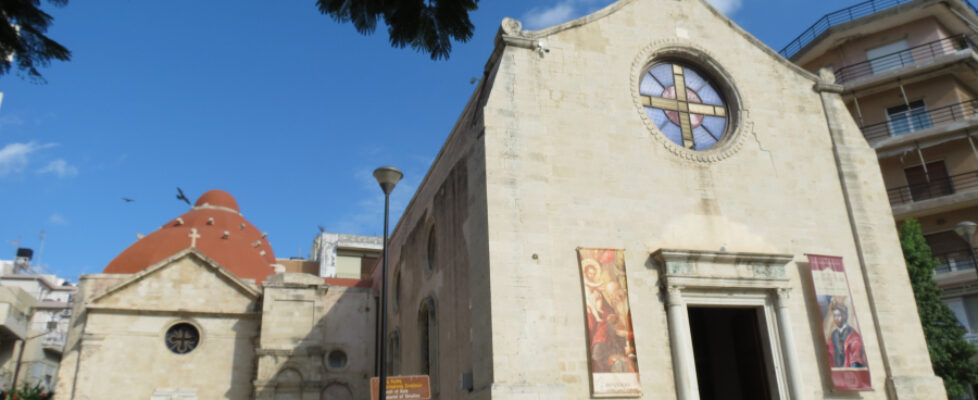
Irakleio’s Icon Museum in the church of Ayia Aikaterini is a small but impressive collection from the world’s best icon painters.
Irakleio’s Icon Museum
Cretan icon painters were considered the best in the world, and here in Irakleio‘s Icon Museum you can see some of the finest works by one of the great masters of the art, Michael Damaskinos, as well as other beautiful religious items.
The museum is contained in the small church of Ayía Aikateríni, rather dwarfed by the nearby large cathedral of Áyios Mínas, but step inside its doors and you find this excellent collection of icons, not to mention religious vestments, Bibles, illuminated manuscripts, coins and frescoes. Its official name is the Museum of St Catherine.
Church of Ayia Aikaterini
The collection features some of the best items on the island, rescued from or donated by churches and monasteries all over Crete. The church that houses them was built in 1555, but the seating has been removed to expose the marble floors and provide space for the display cabinets in the aisles and around the sides. Icons grace the walls.
Irakleio’s Icon Museum
Michael Damaskinos
The ticket desk is just inside the door, and on the wall opposite are six hugely impressive 16th century icons, the work of Michael Damaskinos. Damaskinos was the only Cretan painter of his era to rival the talents of El Greco himself. Like the Master, Damaskinos went to Venice, but afterwards he returned to his native island and the six icons hanging here are considered to be among his finest works.
The icons depict various Biblical events such as The Adoration of the Magi, The Last Supper and The Burning Bush. They were all painted in the period 1582-91 for the Moní Vrontísiou (Vrontisiou Monastery) northwest of Záros. In 1800 they were brought to Irakleio to save them from destruction by the Turks. They have a liveliness, a depth of image and of colour that makes them appear as if they were done yesterday.
Irakleio’s Icon Museum
Other Exhibits in Irakleio’s Icon Museum
In the central aisle are two cases containing Byzantine coins and holy manuscripts. On the left aisle is a series of large icons saved from mountain chapels and monasteries, mostly from the 15th and 16th centuries, and anonymous. Note the nearby case of lovely illuminated manuscripts dating from the 16th century and from the Monastery of Epanosiphi and, opposite these, the ornately carved wooden Bishop’s Throne from the Monastery of Kera.
Last Judgement
There are more icons as you approach the high altar, including a very vivid 17th century Last Judgement, where naked souls are cast down into hell where they are being eagerly greeted by evil devils throwing them into the fiery furnace.
Following round to the left of the altar the collection broadens out to include some brightly-coloured frescoes and a large stone iconostasis. Two cases contain some chalices, Bible covers and a holy cross.
Leaving Irakleio’s Icon Museum
On leaving the church, walk across the Platia to see the small church of Áyios Mínas, if open, and the large 19th century cathedral of the same name, with its elaborate metal chandeliers, beautiful painted ceilings, and vast stone pulpit.
Church of Ayios Minas (left) and Cathedral (right)
Top Tips
The opening hours do change so check the website
With no air-conditioning the building can get very hot and stuffy, so visit early in the day if possible.
Hidden Gem
In what would be the south chapel of the church, look for the exceptional icon of Lady of the Kardiotissa from the Monastery of Kera. The Virgin, dressed in red, has sorrowful eyes that seem to stare right into your soul.
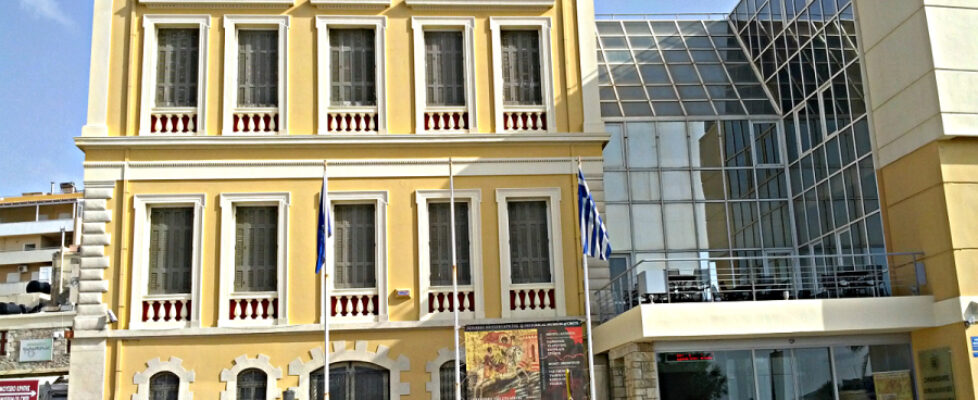
Irakleio’s Historical Museum is officially called the Historical Museum of Crete and contains the only work by El Greco that is still on his native island.
Historical Museum of Crete
Where is Irakleio’s Historical Museum?
If you walk west along the waterfront from the Venetian Port you will reach Irakleio’s Historical Museum in about five minutes. It’s on the left in a handsome neoclassical building dating from 1903.
Map )c) Google Maps
Highlights of Irakleio’s Historical Museum
For an overview of the history of both Crete and Irákleio, a visit to this small but informative museum is a must. Highlights include the study of Nikos Kazantzakis and the only work by El Greco still on his native island.
At the ticket desk be sure to pick up one of the leaflets, available in Greek, English or German, which gives a map of the museum and a brief note of what is in each room. Most of the displays also have information displays in both Greek and English, although on some the details given are fairly basic.
First Room
In the first room, to your right as you enter, the information panels are anything but basic. They cover in some detail four of the major periods in Crete’s history, and correspond to four shelves of objects from those periods: the First Byzantine (330-827/8), the Arab Occupation (827/8-961), the Second Byzantine (961-1204) and Venetian Rule (1204-1669.
The major display in this room is a wonderful 1:500 scale model of Irakleio in 1645, when it was known as Chandax. This is the name given to the city when the Arabs made it the island capital in the early 9th century, possibly from the Arabic words Rabdh el-Khandaq, the Fortress of the Moat. On the walls beside it maps show the development of the city over the years, and note the buttons beneath the displays which illuminate the relevant parts of the model.
Scale Model of Irakleio in Irakleio’s Historical Museum
Around Irakleio’s Historical Museum
The museum tour continues behind the ticket desk, with the rooms spread on several levels. Room 2 is the Ceramics Room and has some beautiful bowls and plates imported from Italy during the Venetian period. These are cleverly displayed side-by-side with locally-made pottery from the same period, clearly showing the Italian influence on local designs. There are also some lovely, delicate jugs and bowls from the Arab Occupation of the island.
The rest of the ground floor has several rooms containing Byzantine items, Venetian coats of arms and carvings (note the fountain from a 17th-century Palazzo in Room 6), with stairs leading up to the second level.
El Greco Painting
The Monastery of St Catherine beneath Mount Sinai in Egypt’s Sinai Desert by El Greco
The highlight of Level B is undoubtedly the small dimly-lit room containing El Greco’s painting of The Monastery of St Catherine beneath Mount Sinai in Egypt’s Sinai Desert. This, his only work to remain on Crete, was painted in 1570 and some background to the work is given in extracts from books about it which are also on display.
Cretan Icons
Elsewhere on this floor are several icons from the Cretan school, the more typical style of Greek art, and at the rear one room is given over to the struggle for independence against the Turks.
Nikos Kazantzakis
The major display on Level C is the writer Nikos Kazantzakis’s study from when he lived in Antibes 1948-57, complete with manuscripts of his works, his library of books, and copies of his own books translated into many languages around the world.
Folklore Collection
The museum’s top floor contains a folklore collection based on the theme of the life cycle of birth, marriage and death. The museum has a fine collection of weavings, embroidery, old costumes, household items, musical instruments and many other objects.
Hidden Gems
Slightly overshadowed by the other displays in the first room are some cabinets in the centre containing objects, including fascinating glass and clay hand grenades, found on a galleon that sank in 1669.
One to Miss
The Emmanuel Tsouderos room, opposite the Nikos Kazantzakis room, is unlikely to appeal unless you have a deep interest in Greek politics.
Must See
El Greco’s painting, Monastery of St Catherine beneath Mount Sinai in Egypt’s Sinai Desert.
Museums in Rhodes Town include an archaeological museum, Byzantine museum, a museum of decorative arts, and exceptional collections of modern Greek art.
Museum of Modern Greek Art in Rhodes Town
There are several museums in Rhodes Town that are well worth a visit, and if you are staying on Rhodes you should plan to spend at least one day in Rhodes Town, but preferably two or three.
Archaeological Museum
Archaeological Museum of Rhodes
Rhodes’s Archaeological Museum is located in the old Hospital of the Knights, a rather severe, but impressive, 15th-century Gothic building. A steep staircase leads to the magnificent infirmary hall with its central colonnade, the capitals of which are carved with heraldic devices.
The smaller side chambers of the upper gallery contain some fine artefacts including the celebrated, yet unglamorous, Marine Venus, a sea-eroded 4th-century BC statue of Aphrodite, which inspired the writer Lawrence Durrell to call his book about Rhodes, Reflections on a Marine Venus.
In other chambers are superb Rhodian amphorae, some fine Attic pottery pieces, and Mycenaean jewellery. Look for the 4th-century gravestone of Kalliarista and its touching epigram inscribed by her husband, as well as the tiny vases and bowls that formed a child’s funerary gifts. Beyond the upper gallery is a sunlit sculpture garden.
Rhodes is the proud guardian of one of the finest collections of modern Greek art in existence. The collections are housed in separate galleries. Two are in the Old Town; the Municipal Art Gallery, which contains a collection of fine engravings, while the second, the smaller Centre of Contemporary Art, exhibits and promotes work by contemporary artists.
Pride of place goes to the splendid Nestoridion Melathron, housed in the one-time Olympic Hotel at the heart of New Town’s hotel district. The building has been thoroughly modernised and contains superb collections from the 1860s to the present day. The displays include an extensive number of paintings and prints, together with sculptures and drawings by celebrated Greek artists.
Nestoridion Melathron, 1 Haritou Square, mgamuseum.gr
Centre of Contemporary Art, 179 Sokratous Street
Decorative Arts Collection of Rhodes
Decorative Arts Collection of Rhodes
The Decorative Arts Collection of Rhodes is housed in a ground floor room that was once part of the armoury of the Knights of St John. It is more of a folk art museum than its name implies, and has a charming and colourful collection of domestic goods from the 16th to the early 20th century.
These include folk costumes from the islands of Symi and Astypalaea, carved and painted chests and bedsteads, carved wall cupboards and other furnishings. There is a large collection of ceramics and fabrics, including carpets and such distinctive items as embroidered bed tents.
The Byzantine Museum is housed in the splendid Church of Panagia tou Kastrou, the Virgin of the Castle. This 11th-century building has had a remarkable history. Originally it was the Byzantine Cathedral of Rhodes and had a classic Byzantine ‘cross-in-square’ form, with a central dome. The church was converted to a Roman Catholic cathedral by the Knights of St John, who replaced the dome with a barrel vault and cross vaults.
During the Turkish occupation of Rhodes the building was converted into a mosque complete with minaret, removed during the Italian reconstruction. Today, the church contains a few Byzantine and post-Byzantine icons and wall-paintings, sculptures and mosaic fragments.
Located within the Palace of the Grand Masters, this is an outstanding collection of artefacts that leads you through a series of displays from the Stone Age settlement of Rhodes through the classical to the Roman period. Among the many exhibits is a fine head of the Sun God Helios, Rhodes’ mythic founder.
A mosaic floor of the Middle Hellenistic period displays a superb ‘New Comedy Mask’ that you would swear was a painting rather than an intricate mosaic. Look out for the little bronze figures of bulls and grasshoppers. There are splendid collections of pottery and household goods from all periods displayed in an imaginative way.
Discover the Athens Museum of Cycladic Art, home to world-famous prehistoric figurines & ancient Greek treasures in the stunning Neoclassical Stathatos Mansion.
Athens Museum of Cycladic Art
In the elegant Athens neighborhood of Kolonaki, where the bustle of central Athens gives way to leafy streets and Neoclassical facades, stands the Museum of Cycladic Art. While Athens is often defined by the monumental scale of the Parthenon, this museum celebrates the beauty of the miniature and the abstract. It is home to one of the most important private collections of prehistoric art in the world, specifically focusing on the enigmatic marble figurines of the Cyclades islands.
The museum is a masterclass in how ancient history can feel strikingly modern. Its clean lines and minimalist presentation mirror the very artifacts it houses, creating an experience that feels less like a dusty archive and more like a contemporary art gallery.
Athens Museum of Cycladic Art
History of the Athens Museum of Cycladic Art
The museum owes its existence to the vision of Nikolaos and Dolly Goulandris. In the early 1960s, the couple began collecting Greek antiquities with a particular fascination for the 3rd millennium BC culture of the Cyclades. At the time, these primitive marble idols were not as widely appreciated as Classical Greek statues, but the Goulandris couple recognized their unique aesthetic value.
As their collection grew, it gained international acclaim, eventually touring major institutions like the National Gallery in Washington, D.C. In 1981, following the death of Nikolaos, Dolly Goulandris established the Nicholas P. Goulandris Foundation. The museum officially opened its doors on January 26, 1986. Today, it has grown from a private passion project into a world-class institution dedicated to the study and promotion of Aegean and Cypriot civilizations.
Athens Museum of Cycladic Art
Where Is the Athens Museum of Cycladic Art?
The museum is uniquely split between two distinct but interconnected buildings on Neophytou Douka Street, just a short walk from Syntagma Square and the National Garden.
1. The Main Building: Designed by architect Ioannis Vikelas in 1985, this modern structure features a facade of glass and white marble—materials synonymous with the Cyclades. It houses the permanent collections across four floors.
2. The Stathatos Mansion: One of Athens’ most beautiful Neoclassical landmarks, this 1895 mansion was designed by the Bavarian architect Ernst Ziller. Originally the home of Otto and Athena Stathatos, it now serves as the museum’s wing for temporary exhibitions. The two buildings are joined by a sleek, glass-roofed corridor that allows visitors to transition between the 19th and 20th centuries in a single walk.
Athens Museum of Cycladic Art
What to See: The Permanent Collections
The museum is organized chronologically and thematically, leading visitors through the evolution of art in the Eastern Mediterranean. 1. Cycladic Art (The Star Attraction)
Located on the first floor, this is the museum’s heart. Here, you will find over 350 objects from the Early Cycladic period (3200–2000 BC).
• The Figurines: These are the world-famous idols—flat, marble figures with folded arms and tilted heads. Their lack of facial features (originally painted with bright colors) and abstract geometry famously inspired 20th-century masters like Picasso, Modigliani, and Brancusi.
• The Cup-bearer: One of the most famous pieces in the collection is a rare seated male figure holding a cup, a masterpiece of 3rd-millennium BC sculpture.
• The Dove Vase: A stunning marble plate adorned with 16 carved doves, representing the incredible craftsmanship of a society that worked without metal tools.
Athens Museum of Cycladic Art
2. Ancient Greek Art: A History in Images
The second and fourth floors transition into the historical periods of Greece.
• Daily Life: The fourth floor is particularly engaging for families and casual history buffs. It uses artifacts to reconstruct ‘Scenes from Daily Life in Antiquity’, covering themes like marriage, childhood, athletics, and war.
• Technology and Trade: You can see intricate gold jewelry, bronze helmets, and both black- and red-figure vases that tell stories of gods and heroes while showcasing the technological leaps made in pottery and metallurgy.
Athens Museum of Cycladic Art
3. Cypriot Antiquities
The third floor houses one of the largest collections of Cypriot art outside of Cyprus.
• Cultural Crossroads: Because Cyprus sat at the intersection of the Greek, Egyptian, and Near Eastern worlds, the art here is remarkably eclectic. Look for the unique plank-shaped terracotta figurines and the elaborate limestone sculptures that show a distinct blend of Eastern and Western styles.
Visiting the Athens Museum of Cycladic Art
The Museum of Cycladic Art is designed to be accessible. Each floor features high-tech interactive screens that explain the social context of the items on display—how they were made, who used them, and why.
Athens Museum of Cycladic Art Cafe
The Cycladic Café
No visit is complete without a stop at the museum’s café. Tucked away in the atrium of the main building, it’s an architectural gem in its own right. With a floating ceiling that allows natural light to filter through and walls of lush greenery, it offers a serene escape from the city. The menu focuses on modern Cycladic flavors, making it a perfect spot for a light lunch.
Athens Museum of Cycladic Art Shop
The Museum Shop
If you are looking for a souvenir that isn’t a plastic magnet, the museum shop is one of the best in Athens. It sells high-quality replicas of the Cycladic figurines made by master craftsmen, as well as contemporary jewelry and design objects inspired by ancient forms.
Why It Matters
The Athens Museum of Cycladic Art proves that old does not mean outdated. By focusing on the purity of form and the early roots of human creativity, it offers a bridge between the prehistoric past and modern aesthetic sensibilities. Whether you’re an art student or a curious traveler, the museum provides a quiet, profound space to reflect on the beginnings of Western art.
Explore the Athens Byzantine and Christian Museum, a journey through 25,000 artifacts, stunning icons, and the historic Villa Ilissia.
Athens Byzantine and Christian Museum
In the heart of modern Athens, tucked away on the grand Vassilissis Sofias Avenue, lies one of the city’s most significant yet tranquil cultural treasures: the Byzantine and Christian Museum. While many visitors flock to the Acropolis to witness the glory of Classical antiquity, this museum offers a profound journey into the millennium that followed—the era of the Byzantine Empire and the subsequent centuries of Christian art.
Housed in a 19th-century mansion and a sophisticated underground complex, the museum preserves over 25,000 artifacts dating from the 3rd to the 20th century. It is not merely a collection of religious objects; it is a narrative of how the Greek-speaking world transitioned from the pagan Roman Empire to a Christian superpower, and finally into the modern Greek state.
Athens Byzantine and Christian Museum
Location and Origins
The museum’s physical setting is as storied as its contents. It is located in the Villa Ilissia, a stunning complex built in 1848 for Sophie de Marbois-Lebrun, the Duchess of Plaisance. Born in Philadelphia and married to a French statesman, the Duchess was a colorful and influential figure in early modern Athens. Her villa, designed by the renowned architect Stamatios Kleanthis, is a masterpiece of Neoclassical and Romantic styles, featuring marble revetments and arched porticos that overlook what was once the banks of the Ilissos River.
The museum itself was founded in 1914, emerging from the efforts of the Christian Archaeological Society. After being moved between several temporary locations, it finally found its permanent home in the Villa Ilissia in 1930. In 2004, to coincide with the Athens Olympics, the museum underwent a massive expansion. While the Duchess’s original villa still stands as a focal point, the majority of the collection is now housed in a vast 12,000-square-meter underground wing, designed to lead visitors on a chronological and thematic journey through time.
Athens Byzantine and Christian Museum
The Collections: A Thousand Years of Transformation
The museum’s permanent exhibition is divided into two major sections: The Byzantine World (4th–15th century) and From Byzantium to the Modern Era (15th–20th century).
1. From Antiquity to Byzantium
As you descend into the exhibition space, the first section explores the birth of Byzantine art. This was a period of monumental shift, as the Roman Empire became Christianized.
Architectural Fragments: You will see massive marble capitals, lintels, and floor mosaics from early Christian basilicas. One of the highlights is a reconstruction of a 5th-century Christian Basilica, which helps visitors visualize the scale and grandeur of early places of worship.
Early Christian Sculpture: Notable exhibits include the Good Shepherd and Orpheus statuettes from the 4th century. These are fascinating because they show how early Christians borrowed pagan imagery to represent their new faith—Christ is depicted as a young, beardless shepherd in a style nearly indistinguishable from Classical Roman art.
Athens Byzantine and Christian Museum
2. The Byzantine World (The Golden Age)
This section delves into the height of the empire, where art was almost entirely focused on the divine. The museum’s collection of Byzantine Icons is world-renowned.
Icons and Wall Paintings: Visitors can view rare 13th- and 14th-century icons that showcase the evolution of the Byzantine style—the move away from realistic depth toward a two-dimensional, spiritual abstraction characterized by golden backgrounds and elongated figures.
Minor Arts and Everyday Life: Beyond the icons, there are displays of intricate jewelry, bronze lamps, and pottery. These items remind us that Byzantium was not just a church; it was a living society with bustling markets and high-fashion tastes.
The Tree of Life Relief: Look for the 9th-century marble relief carving of the Tree of Life, a beautiful example of mid-Byzantine decorative sculpture.
Athens Byzantine and Christian Museum
3. From Byzantium to the Modern Era
After the Fall of Constantinople in 1453, Greek culture did not disappear; it evolved under Ottoman and Venetian rule.
The Cretan School: A major highlight of this section is the display of icons from the Cretan School, where the Byzantine tradition met the influence of the Italian Renaissance. You can see the works of master painters who influenced (or were influenced by) artists like El Greco.
The Ionian School: This represents a further shift toward Western European styles, with icons that use oil paints and three-dimensional perspective, reflecting the cultural life of the Ionian Islands.
Athens Byzantine and Christian Museum
What to See: The Visitor Experience
The museum is designed for slow exploration. Unlike the crowded halls of the National Archaeological Museum, the Byzantine and Christian Museum offers a meditative atmosphere.
The Garden of the Duchess
Before or after your tour of the galleries, spend time in the Museum Gardens. This urban oasis features three small themed outdoor exhibitions:
The Well-Cistern: An exploration of how Athens managed its water supply from antiquity to today.
Paradise: A garden layout reflecting the Byzantine concept of Paradise as a walled garden of peace.
The River Ilissos: A tribute to the river that once flowed past the villa.
Athens Byzantine and Christian Museum
Highlights Not to Miss
The Episkopi Wall Paintings: An entire 17th-century frescoed church interior from Evrytania has been relocated and reconstructed inside the museum, allowing you to step inside a historical place of worship.
Manuscripts and Textiles: The museum houses delicate illuminated manuscripts and liturgical vestments (Epitaphioi) embroidered with gold and silver thread, showcasing the incredible craftsmanship of Byzantine nuns and monks.
The Cafe-Bistro: Often cited as one of the best museum cafes in Athens, it sits in the garden and offers a perfect spot to process the centuries of history you’ve just witnessed.
Athens Byzantine and Christian Museum Cafe-Bistro
Practical Information
Address: 22 Vassilissis Sofias Avenue.
Getting There: Take the Metro (Line 3) to Evangelismos. The museum is just a two-minute walk from the station.
Accessibility: The underground wing is fully accessible via elevators and ramps, and there is a tactile route available for blind visitors.
The Athens Byzantine and Christian Museum is more than just a repository of religious art; it is a bridge between the ancient world and the modern Greek identity. It captures a millennium of survival, faith, and artistic innovation that defined the Eastern Mediterranean.
The best things to do in Athens include top archaeological sites like the Acropolis and must-see attractions such as the National Archaeological Museum.
Statue of Zeus at the National Archaeological Museum in Athens
What are the best things to do in Athens? What are the top must-see sites and attractions, which you shouldn’t miss? If you only have one or two days in the Greek capital, what places and museums should be top of your list? Well, here’s our list of what we think are the best things to do.
The first two are essential, and then we list the rest of the museums and markets, the archaeological sites and places like the Plaka in rough order of importance. Everyone’s different though, so there can never be a definitive list.
We’ve limited ourselves to a Top Ten, as if we didn’t then we’d go on to list 20-30 things you must see and do. But here are our top recommendations.
The Two Best Things to Do in Athens
The Acropolis
The Erechtheion at the Athens Acropolis
The Greek word Acropolis is usually translated as ‘upper town’ or ‘high city’, and it was on this rock that Athens began its life. The Parthenon and several other buildings were constructed here in the 5th century BC, a Golden Age in the development of Athens. The sight of the ancient Parthenon still rising above the modern city is inspiring, and a visit here is definitely the top thing to do in Athens. See our full page about the Athens Acropolis.
The National Archaeological Museum
The Little Jockey Sculpture at the National Archaeological Museum in Athens
Many national museums around the world are filled with wonderful riches, but usually they are items from all around the globe – including many from Ancient Greece. The museum in Athens is exceptional in that it only has Greek items, and despite the many that have been plundered and ended up in the world’s other great museums, here is still the largest collection of ancient Greek artifacts in the world. See our full page all about the National Archaeological Museum.
The Rest of the Best Things to Do in Athens
There are many more things to do and see in Athens, including more fine museums. You could easily compile a list of the top ten museums, and every one would be a gem. However, if you have to prioritise how you spend your time, here are our suggestions for what should be top of your list.
Acropolis Museum
The Acropolis Museum
The Acropolis Museum opened in 2009 and is one of the most exciting museums in the city. It’s below the Parthenon and shows finds from the Acropolis site, as well as fascinating explanations on how that remarkable building was constructed.
Glass floors reveal what was found below, when the museum itself was being excavated, while on the upper floors the museum has been designed to give fabulous views of the Parthenon and other buildings of the Acropolis. It shows what the Parthenon would look like if the controversial Elgin Marbles, now held in London’s British Museum, were returned to their original home.
Museum of Cycladic Art
Museum of Cycladic Art in Athens
This is one museum we always try to visit when we’re in Athens, as the displays are timeless and never cease to delight us. They cover many centuries of ancient Greek art and include vases, glassware and other items, but the main attractions are the beautiful objects from the Cycladic civilisation of 3000–2000BC. Some of the small statues seem to float in their display cabinets, as subtle lighting brings out their shape and texture. Little wonder their graceful shapes inspired many modern artists, and it will be hard to resist taking home one of the beautiful copies from the museum shop. See our full page about the Athens Museum of Cycladic Art.
The Benaki Museum
The Benaki Museum, established in 1930, is housed in the beautiful neoclassical Benakis family mansion and is considered one of Greece’s foremost cultural institutions. Its main building is known as the Museum of Greek Culture and offers a unique journey through Greek history, showcasing over 100,000 artifacts from the prehistoric era all the way to modern times, including Byzantine icons, historic costumes, and Ancient Greek masterpieces. See our page all about the Benaki Museum.
The Ancient Agora of Athens
The Athens Agora
The old market of Athens, below the Acropolis, is an atmospheric place that first became a market in the 6th century BC. It’s easy to imagine it populated by people buying and selling goods from shops and stalls, and talking politics, or about sport or the day’s gossip. For more information visit our full page all about the Athens Agora.
The Central Market
Plenty of Fruit at the Athens Food Market
As well as seeing the Ancient Market, you should try and see the modern Central market, just south of Omonia Square. It’s a real slice of modern Greek life, with butchers, fishmongers, fruit and vegetable stalls, people selling olives, nuts, and all kinds of other produce. If you feel hungry then a meal at one of the market restaurants will be an experience like no other meal in the city – and one of the cheapest eats you’ll have. For a suggestion see our page on Where to Eat in Athens and Piraeus.
Mount Lycabettus
Mount Lycabettus
Mount Lycabettus is the other large hill you can see in the centre of Athens, after the Acropolis. There is one main reason for either walking or taking the funicular up to the top, and that is the view you get over the city – and especially across to the Acropolis. On a clear day you will even be able to see down to the port of Piraeus, and the Aegean Sea beyond. It’s a great place for an evening meal with a view.
The Plaka
The Plaka
Many people deride the Plaka district, on the north side of the Acropolis, because it is undeniably touristy. But if you are on a short visit you should still see it, especially in the evening when the restaurants are in full swing. Be careful where you eat as there are plenty of tourist traps, but there are plenty of decent eating places too. The streets are also filled with souvenir shops, with some good arts and crafts alongside the trinkets, and some interesting food and drink shops as well.
Monastiraki Flea Market
The Monastiraki Market in Athens
Like a visit to the Central Market, a visit to the flea market near Monastiraki Square on a Sunday morning is an authentic Athenian experience. You can explore the streets around here any day of the week and find a fascinating mix of souvenir and junk shops, but on Sunday morning the place is really packed as people go looking for bargains before enjoying a Sunday lunch in their favourite taverna..
Syntagma Square
The Changing of the Guard in Syntagma Square
Athens’ main square has always been a meeting and rallying point, as well as a hub for the city. It stands in front of the Parliament Building, where the Sunday morning Changing of the Guard is a big attraction, and here too is one of the main Metro stations, cafes and bars, and some of the city’s best hotels like the King George and the Hotel Grande Bretagne.
The best things to do on Symi include visiting the several museums, climbing to Symi Castle for the view and taking an excursion to the Monastery of Panormitis.
Symi in the Dodecanese
Best Things to Do on Symi
Symi Town
Symi Town is made up of its lower harbour area, known as Gialos, and the upper, older town known as Chorio. Gialos is, understandably, the busiest part of the town. The harbour is broad and long, framed by rising land to either side and overlooked by tiers of pastel-coloured houses with elegant pediments.
Ferries and excursion boats mostly dock at the west quay which is lined with cafes, tavernas, shops, and workshops. The harbourside road leads on from here past hotels and houses to the settlement of Harani, where small boatyards maintain the tradition of Symi boatbuilding.
The Harbour at Symi in the Dodecanese
Chorio
The older district of Chorio rises dramatically from the east side of the harbour to where a line of old windmills punctuates the skyline and the ruined castle of the Knights of St John, occupied by the Church of Megali Panagia, crowns the highest point.
The best way to approach Chorio is to climb the magnificent stone staircase, the Kali Strata, where the atmospheric 19th-century mansions line the lower stairs, some abandoned, some now being restored.
From higher up the Kali Strata you enter a fascinating world where tempting alleyways lead off to either side into a maze of occupied and unoccupied houses linked by stairways and narrow passages, the whole punctuated with open terraces and squares.
Map (c) Google Maps
Nautical Museum
This museum is down in Gialos and occupies a handsome neoclassical building. It’s not a huge collection but does tell you a lot about Symi’s grand nautical history, with both shipbuilding and sponge-fishing being big parts of the island’s past. There are model ships, old maps, diving suits, paintings, and other items on display.
Archaeological and Folklore Museums
These two museums are side by side in Chorio and overlap a little in their contents. Still, for a tiny island it’s impressive to have these historical and cultural displays to see, showing the rich history of the place. At one time Symi had a bigger population than neighbouring Rhodes, which is hard to believe as today
Symi Castle
The View from Symi Castle
There isn’t a lot that remains of Symi Castle but it’s an enjoyable walk to get up there, through the upper town, and you do get the perfect view of Symi harbour far below. Inside the castle remains is the Church of Megali Panagia.
Pedio
The small village of Pedio (or just Pedi) lies on the south side of the high promontory that flanks Symi Town. It still retains its engaging character as a fishing village from where small boats work the inshore waters. There is a narrow shingly beach on the waterfront, and it takes half an hour to walk along the path across the rocky hillside from the south end of the village to the pleasant sandy beach of Agios Nikolaos.
A 20-minute walk along a path from the north end of the village leads to the shingle beach of Agios Marina. Both beaches become very busy in summer, as crowded water-taxis arrive from Symi Town.
The Harbour at Symi in the Dodecanese
Monastery of Panormitis
The Monastery of Panormitis (Moni Taxiarchas Michael Panormitis) lies at the far southern tip of Symi and is an extremely popular destination for excursion boats. It can be reached by road from Symi Town, but this involves a hard six-hour walk or by taxi. The most convenient – and dramatic – approach is from the sea into the horseshoe-shaped bay that lies in front of Panormitis below pine-covered hills.
The 18th-century monastery is a huge building, almost Venetian in style. Its tall, baroque bell tower dominates the long white facade of the main building. The inner courtyard contains the free-standing church, which has a superb carved wooden altar screen and numerous gold and silver lamps, as well as a silver-leafed representation of the Archangel Michael, patron saint of Symi and protector of sailors. Here you can visit a small Byzantine Museum and there is also a museum of folklore.
Athens’ Benaki Museum is one of the city’s top museums with an outstanding collection, especially of Greek and Egyptian artefacts, in a beautiful mansion.
Owl Bracelet in the Benaki Museum in Athens
The Benaki Museum, nestled in the heart of Athens, Greece, stands as a pivotal cultural institution, offering visitors a rich and comprehensive journey through the country’s vibrant history and artistic heritage, while also extending its gaze to neighboring cultures.
History of the Benaki Museum
Founded by Antonis Benakis in 1930, the museum was originally housed in the family’s neoclassical mansion on Vasilissis Sofias Avenue. Benakis, a passionate collector and philanthropist, envisioned a museum that would not only showcase Greek art and culture but also serve as a bridge between East and West, reflecting Greece’s unique geographical and historical position.
Main Benaki Museum Building
The main building on Vasilissis Sofias Avenue remains the museum’s central hub and houses its most extensive collection, tracing the evolution of Greek civilization from the prehistoric era to the 20th century. This core collection is meticulously organized, guiding the visitor through millennia of history and artistic expression.
The journey begins with artifacts from the Prehistoric period, including Neolithic pottery and tools, offering glimpses into the earliest settlements and cultures that flourished on Greek soil.
Moving forward, the collection delves into the Ancient Greek period, featuring exquisite examples of pottery, sculpture, and metalwork from the Geometric, Archaic, Classical, and Hellenistic eras. These pieces not only demonstrate the technical mastery of ancient craftsmen but also provide invaluable insights into the daily life, beliefs, and societal structures of ancient Greece.
The Adoration of the Magi by El Greco In the Benaki Museum in Athens
The Roman and Byzantine Periods
The Roman period in Greece is also well-represented, illustrating the cultural exchange and continuity that characterized this era. The collection transitions seamlessly into the Byzantine period, a cornerstone of the Benaki Museum’s holdings. Here, visitors can admire a stunning array of icons, manuscripts, textiles, and decorative arts that reflect the spiritual depth and artistic sophistication of the Byzantine Empire. T
he collection highlights the enduring legacy of Byzantine art and its profound influence on subsequent artistic developments in the region. Following the fall of Constantinople, the museum’s exhibits explore the Post-Byzantine period, showcasing the resilience of Greek culture under Ottoman rule. This section features religious art, folk costumes, and everyday objects that speak to the preservation of Greek identity and traditions during this challenging time.
Greek War of Independence
Death of Markos Botsaris by Marsigli Filippo In the Benaki Museum in Athens
The journey continues into the Neo-Hellenic period, covering the years leading up to and following the Greek War of Independence in 1821. This part of the collection includes historical artifacts, portraits of national heroes, and examples of the emerging artistic styles that reflected Greece’s newfound independence and its connection to Western European movements.
20th Century Exhibits
Finally, the main building’s collection concludes with exhibits from the 20th century, featuring paintings, sculptures, and other artworks by prominent Greek artists, bringing the narrative of Greek art and history up to more recent times. The breadth and depth of this collection make the main Benaki Museum an essential starting point for understanding the multifaceted tapestry of Greek culture.
Benaki Museum Outposts
Beyond its central location, the Benaki Museum has expanded its reach through a network of satellite galleries and museums, each dedicated to specific collections or themes. This decentralized structure allows the museum to showcase its diverse holdings more effectively and provide more focused visitor experiences.
Benaki Museum of Islamic Art
Benaki Museum of Islamic Art
Among these outposts, the Benaki Museum of Islamic Art stands out as a particularly significant institution, highlighting the rich cultural interactions between Greece and the Islamic world throughout history.
Housed in a beautifully restored neoclassical building in the historic Kerameikos area of Athens, the Benaki Museum of Islamic Art is a testament to the artistic achievements of Islamic civilizations from the 7th to the 19th centuries.
The collection, one of the most important in the world, spans a vast geographical area, including regions from Spain and North Africa to the Middle East, Persia, and India. The exhibits are arranged chronologically and thematically, guiding visitors through the development of Islamic art across different dynasties and cultural centers.
The collection features an impressive array of artifacts, including exquisite ceramics with intricate geometric patterns and calligraphic inscriptions, finely crafted metalwork such as astrolabes and ewers, delicate textiles and carpets, and illuminated manuscripts and miniatures. Highlights include rare examples of early Islamic pottery, intricate Mamluk metalwork, and vibrant Ottoman tiles.
The museum’s setting, within a traditional Athenian mansion with internal courtyards, provides a serene and atmospheric backdrop for viewing these remarkable objects. The Benaki Museum of Islamic Art serves as a vital reminder of the shared history and artistic exchange between Greece and its eastern neighbors, challenging simplistic narratives and fostering a deeper appreciation for the interconnectedness of cultures.
Other Branches
While the Islamic Art Museum is a major outpost, the Benaki Museum complex includes several other notable branches, each contributing to the museum’s mission of preserving and presenting diverse aspects of culture.
The Ghika Gallery, located in the former home of the renowned Greek artist Nikos Hadjikyriakos-Ghika, is dedicated to 20th-century Greek art, focusing on the intellectual and artistic circles of the period.
The Pireos Street Annex, a modern industrial space, hosts temporary exhibitions, showcasing contemporary art and cultural events. The Benaki Museum of Toys, housed in a charming building in the Faliro area, delights visitors with its extensive collection of toys, games, and childhood artifacts from Greece and around the world.
The Delta House, the former residence of Antonis Benakis’s sister, Penelope Delta, a celebrated children’s author, is another historical property under the museum’s care, often used for cultural events and educational programs.
Collectively, the Benaki Museum and its outposts form a dynamic and multifaceted cultural institution. They not only serve as custodians of invaluable historical and artistic treasures but also play an active role in the cultural life of Athens and Greece. Through its permanent collections, temporary exhibitions, educational programs, and research activities, the Benaki Museum contributes significantly to the understanding and appreciation of Greek culture in its broader historical and geographical context.
It stands as a vital link to the past, a vibrant center for the present, and a beacon for the future of cultural heritage in Greece. A visit to the Benaki Museum complex offers an unparalleled opportunity to delve deep into the soul of Greece and explore its fascinating connections with the wider world.