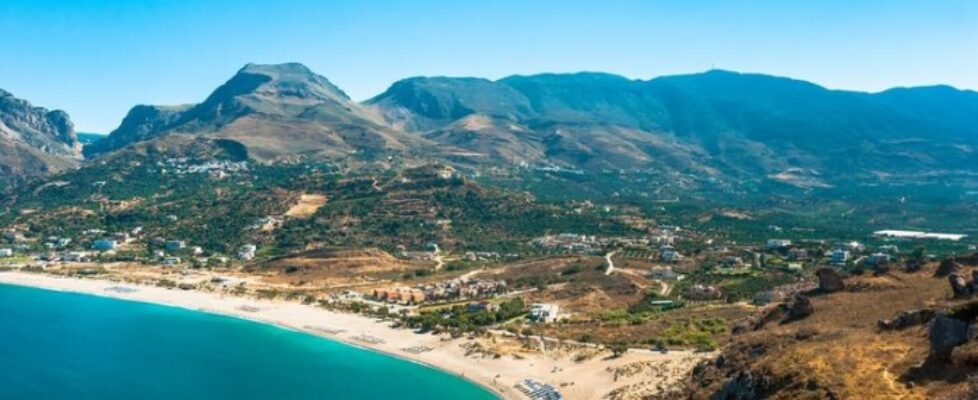
See Greece chooses ten of the best beaches on Crete including the beautiful beaches at Vai and Elafonisi.
Plakias, one of the best beaches on Crete
Choosing the best beaches on Crete is an impossible job, as Greece’s largest island has hundreds of them. Some are always incredibly busy, and you can’t blame people for flocking to the beautiful settings of beaches like Vai and Elafonisi, on opposite corners of the island.
You can also find quiet coves and little beaches down tracks, which you can enjoy in solitude. You’ll have to find those for yourself, though. Here we’ve listed our top ten personal favourite beaches, that are either extremely scenic or have some unusual feature about them. We list our top ten Crete beaches in strictly alphabetical order.
Ayia Galini
The long strip of beach has more rocks than sand, but is pleasantly lined with tavernas. Although the town can get busy it is a real delight off-season.
Balos Beach
Balos Beach on Crete
This beach by Balos Lagoon is one of the most photographed on the island. It’s about 56 kms (35 miles) northwest of Chania and has soft white sand and a Caribbean feel to it.
Elafonísi
Elafonisi Beach
The vast beach here has even been called the best beach in Greece. It’s usually busy but there’s acres of space on its mix of pink and white sand. Lots of shallow waters too. It’s in the southwest of the island, just over an hour’s drive west of Palaiochora.
Falassarna
In the northwest corner of Crete, this soft sand beach has plenty of facilities including windsurfing in summer. It’s actually made up of five different beaches, and has been voted the best beach on Crete and even one of the best in Europe.
Istro Beach
This long sandy beach is one of the best beaches close to the town of Agios Nikolaos. It’s usually busy but it’s also big and has beautifully clear water. There are several other beaches nearby, both sand and pebble, so you can choose between them.
Matala
Matala Beach
Matala Beach, on the southern coast of Crete, is famous for its striking sandstone cliffs carved with ancient caves. Once a haven for hippies in the 1960s, it blends history with a relaxed seaside vibe. The sandy beach and clear waters attract swimmers, while tavernas and sunsets add to its distinctive charm.
Plakiás
Plakias Beach on Crete
Plakias Beach, on the south coast of Crete, is a long, sweeping stretch of sand and pebbles facing the Libyan Sea. Known for its clear, deep waters and steady breezes, it’s popular for swimming and windsurfing. Backed by mountains and a relaxed village, it offers a quieter, more laid-back atmosphere than northern resorts.
Préveli Beach
Preveli Beach
This lovely sandy beach is near the monastery of the same name, at the foot of the Kourtaliotikos Gorge. Here a river flows into the sea, and the beach is backed by palm groves, giving it a tropical feel. Don’t forget to dress respectably if you also plan to visit the monastery.
Rethymnon
Crete’s third-largest town, Rethymnon, has one of the best long beaches on the north coast, running for several miles. There are numerous other beaches within easy reach, too, both east and west of the town.
Vái Beach
Vai Beach
Vai Beach is famous for its unique natural palm forest—the largest in Europe—fringing golden sands and clear turquoise waters. Located on the east coast near Crete’s north-eastern tip, it feels almost tropical. Visitors enjoy swimming, sunbathing, and scenic views, though it can get busy during peak summer months.
The largest of the Greek islands, Crete has one UNESO World Heritage Site but it is spread over six places.
The Ruins of Knossos on Crete
As of 2025, the island of Crete is home to one official UNESCO World Heritage Site: the Minoan Palatial Centres.
While this counts as a single entry on the UNESCO list, it is a “serial property,” meaning it is composed of six distinct archaeological sites scattered across the island. These sites were collectively inscribed in July 2025 during the 47th session of the World Heritage Committee. They represent the peak of the Minoan civilization, which flourished between 1900 and 1100 BCE and is widely considered the first advanced urban society in Europe.
The Six UNESCO Palatial Centres
Each of these six locations offers a unique perspective on Minoan life, from mountain retreats to bustling maritime ports.
1. Knossos: The Labyrinthine Heart
The Ruins of a Temple at Knossos
Located just a few kilometers south of the modern capital, Irakleio, Knossos is the largest and most famous of the Minoan palaces. It spans approximately 20,000 square meters and was the ceremonial and political heart of the Minoan world. See our full guide to Knossos.
Key Features: The site is famous for its “Throne Room,” the Central Court used for public gatherings, and the vibrant (though reconstructed) frescoes like the Bull-Leaping Fresco and the Prince of the Lilies.
Innovation: Knossos featured advanced engineering, including multi-story buildings, light wells for natural illumination, and a sophisticated terracotta pipe drainage system that provided running water and sanitation.
Mythology: This is the legendary site of the Labyrinth, designed by Daedalus to hold the Minotaur, and the seat of the powerful King Minos.
2. Phaistos: The Architect’s Jewel
Phaistos Minoan Palace
Situated on a hill overlooking the fertile Messara Plain in southern Crete, Phaistos is often praised for having the most impressive architectural layout and the most beautiful natural setting of all the palaces. See our full page on Phaistos.
Key Features: The palace is organized around a grand central courtyard with monumental staircases. Unlike Knossos, Phaistos has not been extensively reconstructed with concrete, allowing visitors to see the original stone masonry as it was found.
Discovery: This is where the famous Phaistos Disc was discovered—a clay disc featuring 241 symbols in a spiral, which remains one of the world’s most famous undeciphered scripts.
History: The site shows two distinct phases: the “Old Palace,” destroyed by an earthquake around 1700 BCE, and the “New Palace” built directly on top of the ruins.
3. Malia: The Commercial Crossroads
Malia Palace
Located on the northern coast, Malia is the third-largest palace and provides a clearer look at how a Minoan town functioned, as the ruins of the surrounding residential neighborhoods are well-preserved. Don’t miss our full Malia page.
Key Features: Malia is known for its massive pithoi (giant storage jars) and its industrial areas. A unique feature is the Kernos of Malia, a large circular stone table with small cups around its edge, likely used for liquid offerings or religious rituals.
Artifacts: The world-famous “Gold Bees of Malia” pendant, a masterpiece of Minoan jewelry, was found in a nearby necropolis.
Role: Its proximity to the sea suggests it was a vital hub for maritime trade and the collection of agricultural surplus from the surrounding plains.
4. Zakros: The Gateway to the East
Kato Zakros on Crete
Tucked away in a remote bay at the easternmost tip of Crete, Zakros was the last of the four major “classic” palaces to be discovered. Because it was never looted in antiquity, it has yielded an incredible wealth of artifacts.
Key Features: The palace is smaller than the others but follows the same sophisticated plan. It is unique for its “Lustral Basin”—a sunken room used for ritual cleansing—and its royal apartments that feature built-in drainage.
Trade Hub: Excavations here revealed luxury items from ancient Egypt and the Near East, such as ivory, elephant tusks, and precious stones, proving that Zakros was Crete’s primary gateway for eastern Mediterranean trade.
Environment: It is located at the end of the “Valley of the Dead,” a gorge where the Minoans buried their deceased in caves.
5. Kydonia: The Urban Mystery
Kydonia is unique because the ancient Minoan palatial center lies directly beneath the modern, bustling city of Chania. Specifically, the site is located on the Kastelli Hill overlooking the old Venetian harbor.
Key Features: Much of the site remains unexcavated because it is covered by modern buildings, but the portions that have been uncovered show monumental walls and high-quality masonry.
The “Seal of the Ruler”: One of the most important finds here is a seal impression showing a powerful male figure standing atop a multi-story building, which has provided deep insights into Minoan leadership.
Linear B: Kydonia was a major center in the later “Post-palatial” period, and numerous clay tablets with Linear B script have been found here, linking the site to the later Mycenaean administration.
6. Zominthos: The Mountain Stronghold
High in the foothills of Mount Psiloritis (Mount Ida) at an altitude of nearly 1,200 meters, Zominthos is the only Minoan palace located in a mountainous region rather than a coastal plain.
Key Features: It is a massive, well-preserved multi-story building with over 100 rooms. The architecture is exceptionally sturdy to withstand the harsh mountain winters, utilizing local stone and thick timber beams.
Religious Significance: Zominthos likely served as a seasonal administrative center and a “way station” for pilgrims traveling from Knossos to the Ideon Andron (the sacred cave where Zeus was said to be born).
Economics: The site was a hub for managing mountain resources, specifically wool production from sheep and the harvesting of medicinal mountain herbs and timber.
The Tentative List
While they are not yet full World Heritage Sites, Greece has officially proposed the following for future inclusion:
The Fortress of Spinalonga: A Venetian fortress that later became one of Europe’s last active leper colonies. It is praised for its historical architecture and its poignant human story.
Samaria Gorge: Currently a Biosphere Reserve, but undergoing the process to be listed as a natural World Heritage Site due to its unique biodiversity and geological importance.
Explore the legacy of Aeschylus, Sophocles, Euripides, and Aristophanes and discover how these great Greek dramatists shaped Western drama and storytelling.
Great Greek Dramatists
The Masters of Greek Classical Drama
The sunlight beating down on the stone tiers of the Theater of Dionysus in Athens wasn’t just illuminating a performance; it was witnessing the birth of Western storytelling. In the 5th century BCE, the Greeks transformed simple choral hymns into a complex, visceral, and intellectually demanding art form. At the heart of this cultural explosion were four titans: Aeschylus, Sophocles, Euripides, and Aristophanes.
These dramatists didn’t just write plays; they constructed the moral and psychological architecture of Western civilization. Their works explored the tension between divine will and human agency, the corruption of power, and the absurdity of the human condition—themes that remain as urgent today as they were two and a half millennia ago.
Aeschylus: The Father of Tragedy
Before Aeschylus, drama was largely a dialogue between a single actor and a large chorus. Aeschylus changed the course of history by introducing a second actor. This seemingly simple shift allowed for actual dialogue and conflict between characters, moving the focus from narration to action.
Aeschylus was a soldier-poet who fought at the Battle of Marathon, and his work carries the weight of a man who seen the fragility of empires. His masterpiece, The Oresteia—the only complete trilogy to survive from antiquity—traces a bloody cycle of revenge within the House of Atreus. Through the characters of Agamemnon, Clytemnestra, and Orestes, Aeschylus explores the transition from primitive eye-for-an-eye justice to the rule of law and the establishment of the jury system.
His style is grand, linguistic, and deeply concerned with the “Moira” (Fate) and the gods. In his hands, tragedy was a civic tool used to remind the citizens of Athens that pride (hubris) inevitably leads to ruin (ate).
Sophocles: The Master of Irony and Structure
If Aeschylus gave tragedy its bones, Sophocles gave it its heartbeat. Sophocles added a third actor, further reducing the role of the chorus and allowing for more intricate character development. He is perhaps the most perfect of the dramatists in terms of plot construction and the use of dramatic irony.
In his most famous work, Oedipus Rex, Sophocles creates a psychological thriller where the protagonist is the detective hunting a murderer, only to realize that the criminal is himself. Aristotle later cited Oedipus Rex as the supreme example of tragedy. Sophocles’ characters are often noble figures caught in an impossible vice between their own integrity and an indifferent universe.
In Antigone, he pits the unwritten laws of the gods against the laws of the state, a conflict that has served as the blueprint for civil disobedience throughout history. Sophocles shifted the focus from the cosmic struggles of Aeschylus to the internal struggles of the individual, making the suffering of his heroes feel devastatingly personal.
Euripides: The Iconoclast and Realist
While Sophocles showed men as they ought to be, Euripides showed them as they are. He was the rebel of the trio, frequently criticized in his own time for his unconventional depictions of the gods and his focus on the marginalized—women, slaves, and the defeated.
Euripides was a master of psychological realism. In Medea, he portrays a woman driven to infanticide not by some abstract divine madness, but by the very human engines of betrayal, rage, and social isolation. His plays often utilized the Deus ex Machina (God from the machine) to resolve complex plots, a technique that some saw as a critique of the gods’ arbitrary interference in human lives.
His work is characterized by a deep skepticism and a proto-feminist sensibility. Plays like The Trojan Women are among the most powerful anti-war statements ever written, focusing not on the glory of the victors, but on the agonizing grief of the survivors. Euripides paved the way for the Hellenistic New Comedy and the later development of the modern novel.
Aristophanes: The Prince of Old Comedy
Drama was not all tears and blood. The Great Dionysia festival also featured Old Comedy, and its undisputed king was Aristophanes. If the tragedians looked at the stars and the depths of the soul, Aristophanes looked at the gutters and the marketplace.
Aristophanes used biting satire, surreal fantasy, and ribald toilet humor to mock the politicians, philosophers, and even his fellow dramatists. In The Frogs, he depicts a contest in the underworld between Aeschylus and Euripides to see who is the better poet. In The Clouds, he famously lampoons Socrates, depicting him as a head-in-the-clouds charlatan.
His most enduring work, Lysistrata, features a sex strike by the women of Greece to force their husbands to end the Peloponnesian War. Despite the laughs, Aristophanes was a deeply political writer; his plays were a vital part of Athenian democracy, acting as a checks and balances system that used ridicule to puncture the egos of the powerful.
Great Greek Dramatists
Other Great Greek Dramatists: Menander and Beyond
While the Big Four dominate the conversation, it is essential to acknowledge those who shaped the later stages of Greek drama.
Menander (c. 342–290 BCE) was the leading figure of New Comedy. Unlike the political satire of Aristophanes, Menander’s plays focused on domestic life, romantic complications, and stock characters like the grumpy old man or the clever slave. His work heavily influenced the Roman playwrights Plautus and Terence, who in turn influenced Shakespeare and Molière. Without Menander, the modern sitcom might not exist.
We should also remember Thespis, the semi-legendary figure who is credited with being the first person ever to step out of the chorus and speak as an individual character. Though none of his works survive, his name lives on in the word thespian.
Finally, there is Phrynichus, an early contemporary of Aeschylus. He is famous for his play The Capture of Miletus, which moved the entire Athenian audience to tears by depicting a recent military defeat. The Athenians actually fined him for reminding them of their misfortunes, proving that from its very inception, Greek drama had the power to shake the foundations of a city.
The Legacy of the Stage
The genius of the Greek dramatists lies in their discovery of the Universal. When we watch a play by Sophocles or Euripides today, we do not see dusty relics of a dead civilization. We see our own reflection.
We see the danger of the echo chamber in The Bacchae; we see the struggle for justice in The Eumenides; and we see the absurdity of war in Lysistrata. These writers understood that humans are essentially political animals who are simultaneously capable of divine nobility and horrific cruelty.
By creating a space—the theater—where a community could collectively witness these truths, the Greek dramatists did more than entertain. They taught us how to empathize, how to question authority, and how to face the inevitable tragedies of life with dignity. Their voices continue to echo from the stone tiers of the past, reminding us that the human drama is a play that never truly reaches its final act.
Greek literature has influenced the world, from the works of Homer, called the world’s first novelist, through its great poets and dramatists to modern authors.
Homer and The Odyssey
The influence of Greece on the literature of the world has been profound and the country’s literary past resonates down through the centuries. Modern literature has its roots in Homer, and those roots still nourish Greece’s – and the world’s – literary tree. Arguably the greatest novel of the 20th century was Ulysses, by the Irish writer James Joyce, who based the plan for his complex and experimental book on Homer’s Odyssey.
Greek Literature: Travel Writing
It could be said that the Greeks invented travel writing, too, as the first such book was Hellados Periegesis (Description of Greece) by the historian and traveller Pausanias, who lived in the 2nd century AD and provided this guide for Roman visitors to Greece’s classical sites. Yes, tourism goes back that far! Pausanias’s book is as useful today as it was back then, as indeed are several books by historians that give us literary accounts of life in ancient Greece, notably the Histories by Herodotus (circa 484-425 BC) and The History of the Peloponnesian War by Thucydides (circa 460-400 BC).
Herodotus and Thucydides
Herodotus has been called the Father of History, and his book is regarded as the first major work of nonfiction, just as Homer produced the first major works of fiction. Herodotus’s book slightly predates Thucydides’s The History of the Peloponnesian War. It includes sections on the Persian Wars (490 and 481-479 BC) but also illuminates life in those days with accounts of legends, customs, beliefs, traditions, and everyday events that bring the period vividly alive once again.
The value of Thucydides’s book is immense for several reasons, not least because of the chronicle it gives of the war itself. Though Thucydides participated in the war as an Athenian commander, he also saw the value of recording events, and of trying to give an objective rather than partisan account. He interviewed combatants and quotes the speeches of the leaders in a manner that serves as a template to this day.
Greek Literature: Great Greek Poets
The great Greek poets, from Homer to Elytis, are described on our Great Greek Poets page.
Modern Greek Writers
Greece has many other fine writers that are perhaps less well-known to the outside world, simply because of the language they write in. The enterprising Athenian publisher Kedros has published a superb series called Modern Greek Writers, translating some contemporary works into English for the first time.
Greek writers still battle with the big themes, as shown by Dido Sotiriou (1909-2004) in her novel Farewell Anatolia. A best-seller in Greece since it was published in 1962, the book recounts the forced exchange of Greek and Turkish populations in 1923. Its publication in a Turkish translation in 1970 was welcomed as providing a greater understanding of the suffering on both sides, and in 1990 the author was awarded the highest literary award in Greece, the prize of the Academy of Athens.
Eugenia Fakinou (born 1945) is another female writer whose books deal with what it means to be Greek. Her first novel, Astradeni, has remained in print in Greece since it was published in 1982, and has also been translated into English. It tells a tale familiar to many Greeks, of a family forced by circumstance to leave its island home to move to Athens in search of a better life. The young girl who tells the story, Astradeni, depicts the changes with the bold and simple gaze of a child.
Petros Abatzoglou (1931-2004) wrote several novels and collections of stories, but for an outsider perhaps the most interesting would be What Does Mrs Freeman Want? It gives the Greek perspective on a pair of English tourists who come to soak up the sun, while the book’s narrator observes them and soaks up the ouzo.
There have been several great Greek poets, with two authors winning the Nobel Prize for Literature, the most famous being Sappho, Cavafy, Seferis and Elytis.
The Great Greek Poet Sappho
For such a small nation, Greece has produced an astonishing number of exceptional poets, including two winners of the Nobel Prize for Literature: George Seferis and Odysseus Elytis. The names of other great Greek poets like Sappho and Cavafy are known all over the world.
Sappho
Homer can justifiably be regarded as the father of all poetry, though he is far from being the only Greek figure of importance in the world of verse. Consider the female poet Sappho (650-c.590 BC), whose very name has entered the language in the term ‘sapphic’ to describe lesbian love. The word lesbian itself comes from the fact that Sappho was born on the island of Lesbos in the North-East Aegean. In fact there is no concrete evidence to prove that Sappho was herself a lesbian, and much to indicate the opposite.
Sappho is said to have been a lover of the male poet, Alcaeus (c.620-c.580 BC), to have married and had a child by another man, and to have committed suicide by throwing herself off a clifftop on the island of Lefkas due to unrequited love for a boatman. The belief in her lesbianism came from another poet, Anacreon (c.572-488 BC), who claimed that Sappho was sexually attracted to the women to whom she taught poetry.
Of the poetry itself only fragments survive from the nine books that she wrote, but she was so highly regarded that long after her death the philosopher Plato (c.428-347 BC) described her as being the tenth muse. You can find her Complete Poemshere.
Cavafy
Constantine P. Cavafy (1863–1933) stands as one of the most influential figures in modern Greek literature, yet he spent nearly his entire life in Alexandria, Egypt. Known as the poet of the city, his work serves as a bridge between the glorious Hellenistic past and the melancholic reality of the modern world.
Cavafy’s body of work is generally categorized into three distinct themes:
• Historical: He often ignored the classical Golden Age of Athens, preferring the complex, decaying empires of the Ptolemies and Byzantium. His poems capture pivotal moments of transition or impending doom.
• Sensual: Cavafy was remarkably honest for his time, writing evocative, elegiac poetry about desire and the lingering memory of brief encounters.
• Philosophical: He explored themes of regret, fate, and the dignity of failure, most famously in poems like ‘The City’ and ‘Ithaka’.
His style is distinctive for its economy and lack of artifice. He avoided the flowery metaphors typical of his contemporaries, opting instead for a dry, ironic, and precise tone. Interestingly, Cavafy never published a full book in his lifetime; he distributed his poems on broadsheets to a select circle of friends. Today, his voice remains hauntingly modern, reminding us that while empires crumble, human longing and the weight of history remain constant. You can find his Collected Poemshere.
George Seferis
George Seferis (1900–1971) stands as a monumental figure in 20th-century literature, serving as the first Greek to be awarded the Nobel Prize in Literature, in 1963. Born in Smyrna, he was a witness to the Asia Minor Catastrophe of 1922, an event that instilled a lifelong sense of displacement, loss, and wandering in his work.
Seferis’s poetry is defined by its modernist restraint and a profound dialogue between the ancient and contemporary worlds. Unlike the flowery rhetoric of earlier Greek poets, Seferis used a spare, precise vernacular. He famously blended Homeric myths with the gritty reality of modern exile, most notably in his masterpiece Mythistorema (1935), where the journey of Odysseus becomes a symbol for the modern Greek soul searching for its identity amidst a landscape of broken stones.
A career diplomat, Seferis lived much of his life abroad, eventually serving as the Greek Ambassador to the United Kingdom. This professional distance allowed him to observe his homeland with both intense longing and critical irony. In his final years, he became a symbol of moral resistance by publicly denouncing the military junta. His funeral in 1971 turned into a massive silent protest, cementing his legacy as the conscience of the nation.
Odysseus Elytis
Odysseus Elytis (1911–1996) was a towering figure of the Generation of the ’30s and the second Greek author to receive the Nobel Prize in Literature (1979). While his contemporary Seferis often dwelled on the shadows of history and exile, Elytis became the poet of light, transparency, and the metaphysical power of the Aegean Sea.
His early work was heavily influenced by Surrealism, which he adapted to the Greek landscape to create a solar metaphysics. For Elytis, the sun was not just a physical object but a moral force capable of revealing the purity of the world. His most celebrated work, Axion Esti (1959), is a monumental poetic cycle that blends the structure of the Orthodox liturgy with modern history and personal mythology. It famously captures the Greek spirit’s resilience through the horrors of World War II and the subsequent Civil War.
Elytis’s language is characterized by its sensual precision and a deep belief in the small miracles of existence—a pebble on a beach, the scent of wild thyme, or the glint of a wave. He sought to reconcile the physical beauty of the Mediterranean with a profound spiritual depth, asserting that poetry is a tool for attaining a state of grace.
See Greece lists Greece’s UNESCO World Heritage Sites from the first, Bassae, to the latest, Zagori, plus the Acropolis, Delphi, Mycenae and more.
Rhodes Old Town
How many UNESCO World Heritage Sites there are in the whole of Greece? A quick look at the UNESCO website shows that there are 19 of them as of the end of 2025. Reading down the list made us appreciate how lucky we’ve been to have seen almost all of them, in our years of travel around Greece. We’ll have to put Patmos and Chios on our travel plans for this year – two we’re missing!
Bassae
The Temple of Apollo Epikourios at Bassae on the Peloponnese in Greece
The first to be included on the list, which began in 1978, was the remarkable Temple of Apollo Epicurius at Bassae (or Vassae). This was added in 1986. It’s in a remote spot in the Peloponnese, and we were fortunate enough to see it while researching a guidebook to Mainland Greece. It’s covered in a huge canopy to protect it during restoration work, but you can peek inside it. See our full page on the Temple of Bassae.
Acropolis
The Acropolis in Athens was added to the list in 1987. Read more about it here.
Delphi
Ruins of Apollo Temple at Delphi
Delphi was also added to UNESCO’s list in 1987. Read our page about Delphi here.
In 1990 it was the turn of Delos and the monasteries of Daphni, Ossios Loukas and Nea Moni on Chios to join Greece’s ever-growing list of World Heritage Sites.
Samos
In 1992 UNESCO recognised the ancient sites of Pythagoreion and Heraion on Samos.
Vergina
Royal Tombs at Vergina
In 1996 the Archaeological Site and Royal Tombs at Vergina joined the list.
Patmos, Mycenae, and Tiryns
The Lion Gate at Mycenae
1999 saw three more places in Greece added to UNESCO’s list. They were the archaeological sites of Mycenae and Tiryns, along with the Historic Centre (Chorá), the Monastery of Saint-John the Theologian, and the Cave of the Apocalypse all on Patmos.
Old Town of Corfu
Narrow Streets of the Old Town of Corfu
2007 was the year that the lovely Old Town of Corfu was added to UNESCO’s list. Anyone who’s spent time wandering round its streets will understand why.
Philippi
The Ancient Site at Philippi in Macedonia
The addition of Philippi to UNESCO’s list in Greece was in 2016.
Zagori Cultural Landscape
Stone Bridge in Zagoria
Greece’s newest cultural site of Zagori was added in 2023 and was recognised for its traditional stone-built villages (Zagorochoria) and arched bridges nestled in the Pindus Mountains.
See Greece’s guide to the best beaches on Rhodes, including Rhodes Town, Lindos and Faliraki, with a list of facilities at each beach.
Lindos Town, Beach and Acropolis on Rhodes
Sun, history, and crystalline waters—Rhodes is an island that seems to have been designed by the gods specifically for beach lovers. As the largest of the Dodecanese islands, Rhodes offers a diverse coastline that shifts from cosmopolitan beach bars in the north to wild, wind-swept surf spots in the south.
Whether you are looking for a shallow bay for the kids, a hidden rocky cove for snorkeling, or a vibrant beach with music and cocktails, you will find it here. In this guide, we explore ten of the best beaches on Rhodes to help you plan your perfect Greek getaway.
Best Beaches on Rhodes
1. Tsambika Beach
Location: 26 km south of Rhodes Town (East Coast)
Widely considered the most beautiful sandy beach on the island, Tsambika is a broad stretch of golden sand framed by imposing rocky headlands. The water here is remarkably shallow and turquoise, making it a top choice for families with young children.
Facilities: This is a well-organized beach with several beach bars and tavernas serving fresh seafood and Greek staples.
Activities: You’ll find a range of watersports, including parasailing and jet skis. There is also an inflatable water park in the sea for children.
Pro Tip: For a breathtaking view, hike up the 300 steps to the Tsambika Monastery perched on the cliff above the beach before heading down for a swim.
2. Anthony Quinn Bay
Location: 15 km south of Rhodes Town, near Faliraki
Named after the actor who starred in The Guns of Navarone (which was filmed here), this bay is legendary for its emerald-green waters. It is a small, narrow cove surrounded by jagged rocks and pine trees that reach right down to the water’s edge.
Facilities: Due to its rocky nature, space is limited. There are sunbeds perched on stone platforms and a small canteen at the top of the stairs overlooking the bay.
Activities: This is arguably the best spot on the island for snorkeling and scuba diving thanks to the underwater rock formations and abundant fish life.
This nearly enclosed circular bay feels more like a giant swimming pool than the open sea. Situated right below the towering Acropolis of Lindos, the scenery is unmatched. According to legend, St. Paul landed here in 51 AD to preach Christianity to the Rhodians.
Facilities: There are two main beaches in the bay; both offer high-end sunbeds, umbrellas, and chic beach restaurants that serve cocktails and gourmet Mediterranean dishes.
Activities: The calm, crystal-clear water is perfect for leisurely swimming and paddleboarding.
4. Prasonisi Beach
Prasonisi Beaches on Rhodes
Location: 91 km south of Rhodes Town (Southern Tip)
Prasonisi is a unique geographical marvel. It is a small peninsula connected to the main island by two sandy strips, creating two separate seas: the Mediterranean on one side (calm) and the Aegean on the other (wavy).
Don’t Miss: Our piece on Easter on Rhodes, which includes a visit to Prasonisi.
Facilities: The area is somewhat remote but features several surf clubs, tavernas, and mini-markets.
Activities: This is the undisputed capital of windsurfing and kitesurfing in Europe. If you aren’t a surfer, it’s still worth the drive just to witness the spectacle of hundreds of colorful sails against the deep blue horizon.
5. Lindos Main Beach (Megali Paralia)
Lindos Beach and Acropolis
Location: Below the village of Lindos
If you want the classic “Greek Island” postcard view while you sunbathe, this is it. Megali Paralia (The Big Beach) offers soft golden sand and a stunning view of the white-washed houses of Lindos and the ancient Acropolis.
Facilities: Extremely well-organized with numerous cafes, changing rooms, and sunbeds.
Activities: You can rent pedal boats or join a boat trip that leaves from the small jetty to explore nearby caves.
6. Elli Beach
Location: Rhodes Town (Northern Tip)
For those staying in the capital, Elli Beach is a cosmopolitan hub within walking distance of the Old Town. It is a pebbled beach with incredibly clear, deep blue water, lined with trendy beach clubs and luxury hotels.
Facilities: High-quality beach bars, umbrellas, and restaurants. It is very accessible and usually bustling with energy.
Activities: Don’t miss the iconic diving platform (Trampolino) located about 100 meters out in the sea—it’s a rite of passage for visitors to jump from its levels.
7. Kallithea Springs
Location: 9 km south of Rhodes Town
While technically a thermal spa complex, Kallithea is home to several small, pebbly coves nestled between manicured gardens and Art Deco architecture. The “beach” here often consists of wooden decks built over the rocks, providing direct ladder access to the sea.
Facilities: There is an elegant cafe-restaurant within the springs complex. Entry to the Springs requires a small fee, which covers access to the historical site and the beach area.
Activities: The area is a favorite for diving schools because of the underwater caves and clarity of the water.
8. Agathi Beach
Location: 38 km southeast of Rhodes Town, near Haraki
Known to locals as “Golden Sand,” Agathi is a sheltered, cozy beach that remains relatively uncrowded compared to Lindos or Faliraki. It is framed by mountains and the medieval castle of Feraklos.
Facilities: There are three canteens on the beach providing snacks, drinks, and basic meals. Sunbeds and umbrellas are available for rent.
Activities: The sand is very fine and the water stays shallow for a long distance, making it perfect for family beach games and safe swimming.
9. Faliraki Beach
Location: 14 km south of Rhodes Town
Faliraki is the most organized and highly developed beach on the island. Stretching for over 4 kilometers, it offers something for everyone, from quiet corners to high-energy party spots.
Facilities: Every facility imaginable is here: shops, cocktail bars, international restaurants, and public showers.
Activities: This is the “action” beach. You can try bungee jumping, paragliding, and every type of towable water toy. It is also home to one of the largest water parks in Europe.
10. Afandou Beach
Location: 20 km south of Rhodes Town
If you prefer space and tranquility, Afandou is for you. It is one of the longest beaches on Rhodes, made up of small pebbles and sand. Because of its sheer size, it never feels crowded, even in the height of August.
Facilities: While some sections are organized with sunbeds and small canteens, large parts of the beach remain wild and free.
Activities: The water deepens quite quickly here, making it excellent for swimming laps. It’s also located right next to the Rhodes Golf Course.
Which Beach Should You Choose?
For Families: Tsambika or Agathi (shallow waters). For Couples: St. Paul’s Bay or Kallithea Springs (romantic settings). For Adventure: Prasonisi (windsurfing) or Anthony Quinn (snorkeling).
The best things to do on Corfu include visiting Palaiokastritsa, a day trip to Albania, seeing the Achilleion Palace, and the museums in Corfu Town.
Mount Pantokrator on Corfu
The best things to do on Corfu include visiting Palaiokastritsa, taking a day trip to Albania, seeing the Achilleion Palace and Corfu Town’s Old Fort, and also the Archaeological, Byzantine and Asian Art Museums in Corfu Town. A walk around the Old Town of Corfu Town is another must, including a visit to the church of Ayios Spiridon, the island’s patron saint.
To the south of Corfu Town is the beautiful view from Kanoni, and the villa of Mon Repos which now houses the Museum of Palaiopolis. In the north of the island is its highest point, Mount Pantokrator, and the drive up here is another of the best things to do on Corfu.
Best Things to Do on Corfu
The Achilleion Palace
Achilleion Palace Staircase
The Achilleion is an over-the-top palace that was built for the Empress Elizabeth of Austria in the 1890s. Over the years it’s been a hospital, a casino, and starred in a James Bond movie. Today you can tour its rooms and gardens, with their many statues. See our full page all about The Achilleion Palace.
Albania Day Trip
Gjirokaster in Albania
Several companies do day trips and overnight visits to Albania, or you can simply take a regular ferry across to the port of Saranda and organise things for yourself. We did a trip of a couple of days with Sipa Tours, though they have subsequently moved to Albania and organise exciting tours within Albania.
Archaeological Museum, Corfu Town
The Gorgon Frieze in Corfu Town’s Archaeological Museum
This isn’t one of the biggest archaeological museums in Greece but it’s worth visiting just to see the amazing Gorgon Frieze, a huge 6th-century BC pediment from a temple that is absolutely stunning when you enter the room and first see it.
Byzantine Museum, Corfu Town
Byzantine Museum in Corfu Town
This lovely little museum is in a 15th-century church and brings together some fine examples of Byzantine carvings, icons and other items, mainly from the 16th and 17th centuries but some as old as the 13th century. Corfu had a fine tradition of icon painting, as renowned artists from Crete would stay here on their way to work in Venice, and some of them settled or returned to Corfu.
Church of Ayios Spiridon, Corfu Town
The body of St Spiridon, the island’s patron saint, is preserved here in a silver casket to the side of the altar. The 15th-century church is in the heart of the Old Town, its spire easily visible, and a visit here will reveal a constant queue of people waiting to pay homage to the saint by kissing the casket.
Corfu Old Town
The narrow streets of Corfu’s Old Town are filled with everything from the kind of souvenir shops you find anywhere to craft workshops, wood carvers, food shops and cafes. It’s easy to get lost in the narrow, winding streets, but it’s worth getting lost and there’ll always be someone to help you find your way out again.
Kanoni
Mouse Island at Kanoni in Corfu Town
The view of Mouse Island from Kanoni is one of the most recognisable scenes on the whole island, familiar from many photos. Of course the photos don’t show you that the airport runway is just off to one side – but it’s still a beautiful spot.
Mon Repos and Palaiopolis
Mon Repos is a beautiful neoclassical villa situated amidst lush parkland in the Paleopolis area, south of Corfu Town. Built in 1831 for the British High Commissioner Sir Frederick Adam and his Corfiot wife, it later became a summer residence for the Greek Royal Family. Today, the estate belongs to the Greek state, housing the Paleopolis Archaeological Museum within the villa and offering the surrounding gardens and ancient ruins of the former city of Paleopolis as a public park.
Mount Pantokrator
View from Mt Pantokrator on Corfu
Dominating the northeast corner of the island, Mount Pantokrator is the highest point on Corfu at 2972ft/906m. You can drive all the way to the top, and visit the monastery there. Fabulous views, of course, and a lovely drive through rural Corfu.
Museum of Asian Art, Corfu Town
Palace of St Michael and St George in Corfu Town
Sometimes called the Museum of Asiatic Art, a visit here also lets you see inside the Palace of St Michael and St George, which houses the museum. This contains over 10,000 items collected in the Far East by a Greek diplomat, and all we can say is that he had incredibly good taste. For us this is one of the best Greek museums outside Athens.
New Fort and Old Fort, Corfu Town
The two forts both provide lovely views over the rooftops of Corfu Town, and out to sea. The New Fort dates from the 16th/17th centuries and is only called the New Fort because the Old Fort already existed when it was built. The Old Fort complex contains a small museum and a church built by the British, while the New Fort just has a small cafe.
Palaiokastritsa
Palaiokastritsa on Corfu
If you have to single one resort out on Corfu then it has to be Palaiokastritsa. It is incredibly beautiful, with high cliffs and several indented coves, a lovely monastery to visit, and even if you don’t stay there it is worth a day’s visit, at least, just to see it.
So there you have our personal choice of the Best Things to Do on Corfu.
The best drives in Greece chosen by See Greece include from Ioannina to Meteora, the Prespa Lakes, the Nestos Valley, the Amari Valley on Crete, and the Mani.
Choosing the best drives in Greece isn’t easy, as there are so many wonderful experiences, but we can at least say that we have driven over most of the Greek mainland and on many of the major islands, including Crete, so we have plenty of experience. The drive between Athens and Thessaloniki has some wonderful moments – and some awful ones too. Driving round the Pelion was also impressive. So too was… but we could go on choosing forever.
So here is our final choice of five of the best drives in Greece, in no particular order:
Best Drives in Greece
The Nestos Valley
River Nestos
The Nestos River marks the boundary between Thrace and Macedonia in north-eastern Greece, a part of the country where few foreign visitors other than the adventurous backpackers venture. It’s mainly a low-lying landscape of cotton fields and tobacco plantations, but to the north are the Rodopi Mountains that separate Greece from Bulgaria.
The two major towns at either end of the valley are Drama and Xanthi. Xanthi has a delightful eastern feel to it, letting you know that Turkey isn’t too far away, and some impressive mansions that once belonged to wealthy tobacco barons are one of the town’s most attractive features. Take the road north to Stavroupoli, where the main road meets the Nestos River and heads off into the foothills of the mountains. Or, in winter, sometimes doesn’t: winter snow can block this road, so watch for the warning road signs.
At any other time of year it’s a wonderful drive, partly through wooded areas, and passing by (or stopping to visit) several remote rural villages along the way. At Paranesti the road leaves the river valley (the river rises in Bulgaria), and instead heads south to run alongside the railway tracks and down into Drama – appropriately enough for this dramatic drive.
The Amari Valley
On Crete the tour buses head east from Irakleion to do the circular drive around the Lasithi Plateau. It is a beautiful drive, though the sheer numbers of tour buses and other drivers can spoil it a little. If you have your own wheels head west from Iraklion, and south to the Amari Valley, a much quieter but equally beautiful part of the island, also easily accessible from Rethymnon on the north coast or the resorts of Ayia Galini and Matala in the south.
From wherever you start, you can do a circular tour of the valley to get you back to base, or drive through the valley while heading from one coast to the other. Just be sure to include the town of Amari itself, the main one in the valley though no more than a large village, with a tiny main square where there’s the inevitable friendly taverna with a few rooms. Yerakari is another must-see, the centre of the cherry-growing trade in the valley. The whole of the Amari Valley is fertile and filled with orchards, olive groves and vineyards. Surrounded as it is by mountains, with the Psiloritis range to the east, it’s a fabulous place to tour and see the Crete that lies behind the tourist resorts.
See our detailed driving directions for this drive here.
From Ioannina to Meteora
The region of Epirus in north-west Greece is one of the most stunningly beautiful in the whole country… indeed, in the whole of Europe, in my opinion. There are pretty lakeside towns like Ioannina and Kastoria and the awe-inspiring Pindus Mountains. A drive east from Ioannina takes you through the mountains, over a high pass that can be closed in winter, and down into the region of Thessaly, and one of the most distinctive and magical sights in the world: the monasteries of Meteora.
Aerial View of Ioannina
The capital of Epirus, Ioannina, is one of our favourite towns. It has a character all its own, sitting on the shores of a lake in the middle of which is a small island called Nissi, which means ‘the island’. You could easily spend several days in and around Ioannina, and you should drive out on the road towards the Perama Caves – well worth stopping off to explore the cave network. The road then rises around the lake to give lovely views back of Ioannina, before winding upwards into the mountains.
Another essential stop is the mountain town of Metsovo, a ski resort in winter and another very distinctive Greek community. Beyond here is the Metsovon Pass, the highest in Greece at 1705m, but don’t set out on this drive in winter without checking the state of the roads. Even if the pass is open, the sharp bends and sheer drops can be dangerous for the driver unused to them.
At other times the rewards are enormous, not just here in the high mountains, but the descent into the lusher plains of Thessaly and, at the very end, the amazing sight of the monasteries of Meteora sitting on top of the rock formations jutting out of the plain. This has to be one of the best drives in Greece.
From Kastoria to the Prespa Lakes
Kastoria
This is only a short drive, but one that will live long in the memory. Like Ioannina, Kastoria is a pretty lakeside town of the kind not normally associated with Greece. There are handsome mansions, one of them now a folk museum, and a wealthy history because of its fur-trading past. Head north out of the town and you climb through woods and head towards Greece’s northern frontier. Greece’s brash holiday resorts seem to belong to another planet.
It’s only just over an hour or so until you start to descend, and round a corner you will get your first glimpse of the Prespa Lakes. The whole area here is a National Park, and there’s wildlife in abundance. There are small fishing communities on the shores of the lakes, and it is one of the most peaceful areas of Greece.
Prespa Lakes
A visitor centre in the main village of Ayios Germanos gives information about walks and wildlife, and you may be able to take a boat trip out onto the lakes with one of the local fishermen, if you ask around. In the middle of the Great Prespa Lake is the border point where Greece meets Albania and the new country of Macedonia. You can’t get much more off the beaten track than this.
Around the Mani The Mani in the extreme south of the Peloponnese is no longer the remote region it once was, and visitors have been quick to pick up on its rugged charms. To drive around the peninsula is to discover another very distinctive part of Greece, where tall, tower houses reach into the skies. These fortified houses were built to protect the families because of the feuds that went on in this wild west of a place for centuries. But don’t worry – they’ve calmed down a bit these days.
Coast of the Mani
The main town of the Inner Mani (the southernmost part of the peninsula) is Areopoli, so drive south from here and you will quickly come to the Diros Caves, where boats take visitors into the underground cave networks. Back on the road, the route is easy to follow as the main road is basically a circular route around the Inner Mani.
One turning to watch for is in Alika, where a right turn is signposted for Vathia. Take this diversion, as Vathia has some of the finest tower houses and you can continue on the road all the way to the end, which is Cape Matapan, the southernmost point of the Greek mainland.
Return to Alika and carry on along the main road, which then heads north up the eastern coast with fabulous coastal and mountain views. There are several small villages and some quiet beaches, with views across to the eastern-most of the three peninsulas that look like fingers dangling off the Peloponnese. The road eventually heads inland and crosses the Mani, back to Areopoli.
So there you have it: our best drives in Greece. For the moment, anyway, until we discover another one.
The best things to do on Crete include the Samaria Gorge, Minoan Palaces at Knossos, Malia and Phaistos, and seeing lovely towns like Hania and Rethymnon.
Samaria Gorge
The best things to do on Crete include hiking the longest gorge in Europe, seeing the remains of vast Minoan Palaces like Knossos, Phaistos and Malia, relaxing in pretty waterfront towns such as Hania, Rethymnon and Sitia, spending a day or more in Iraklion with its marvellous Archaeological Museum, and seeing religious sites like the haunting Arkadi Monastery and the beautiful frescoes in the church of the Panagia Kera. And that’s without even mentioning the beaches!
Best Things to Do on Crete
Here in alphabetical order is our list of the best things to do on Crete:
Agios Nikolaos
Agios Nikolaos
Agios (or Ayios) Nikolaos is one of the prettiest towns on Crete, renowned for its twin harbours. It is therefore very busy too, and the crowds can detract from the enjoyment of it, but it’s well worth seeing. It also has a good Archaeological Museum, and a little Folklore Museum, but its main appeal is the town itself. To learn more see our page all about Agios Nikolaos.
Arkadi Monastery
Arkadi Monastery
It’s an enjoyable drive up a twisty mountain road to get to one of the island’s most significant monasteries. In 1866 hundreds of Cretans were killed here by the occupying Turksh forces, including many Cretan resistance fighters. The monastery has therefore become a symbol of the islanders’ struggle for independence. Don’t miss the ossuary, where the skulls and bones of those who died are preserved and displayed. See our full page about the Arkadi Monastery for further information.
Gortys
Ancient Gortys
Gortys was a Greco-Roman city and the ruins, although small, sprawl pleasantly over fields and olive groves making it a lovely spot to explore. The 6th-century church of Ayios Titos is one of the main ruins, and nearby in what is thought to have been the agora, or market, is a truly unique find. Carved in about 500BC on huge stone blocks is what was the first Code of Law to have been written down in Europe.
Gournia
Gournia
The ruins at Gournia are interesting because they are of an ordinary working Minoan town, not one of the great palaces. The ruins are from about 1500BC and it’s really fascinating to walk among them and discover the houses and workshops. get to the top of the site for a good over-view, and when you do it remember that Gournia was originally four times as big as what you see in front of you. The rest has not yet been uncovered.
Hania
Hania Harbour
Hania, Crete’s second-largest city, is many people’s favourite place on Crete, and we’d find it hard to disagree. It has a really beautiful Venetian harbour, which is the perfect place for a drink or a meal especially in the evening when it bustles with people. The town has good shopping, several excellent museums, and some of the nicest hotels and best restaurants on the island. See our Hania page for more information.
Iraklion
Iraklion Port and Venetian Harbour
Try to spend at least a day in Iraklion, Crete’s capital, or preferably a few days. It’s a lively city with plenty of things to do, including the Archaeological Museum, its Venetian harbour, the Historical Museum, the Icon Museum, several interesting old churches, and plenty of good restaurants too.
Knossos
The Ruins of a Temple at Knossos
The Minoan Palace at Knossos is the biggest attraction on Crete, and well worth at least half a day of your time. There were once over 1,200 rooms here, and some of them have been recreated to give an impression of the scale and grandeur of the palace. The first palace was built here in about 2000BC, but that was destroyed in an earthquake 300 years later. Then an even greater palace was built, but that too was destroyed in 1450BC, possibly by the eruption of the volcano on Santorini causing a huge tidal wave. See our full page on Knossos.
Malia
Malia
Malia Palace is Crete’s third-largest Minoan Palace. It was built in about 1900BC, destroyed in an earthquake then rebuilt in about 1650BC. Its remains with a reddish tinge to the stone make a great place to wander around, and because it’s usually less crowded you have more time to make sense of the ruins.
Panagia Kera
Panagia Kera on Crete
This little Byzantine church is one of the most famous on Crete, known for its 14th- and 15th-century frescoes. They seem to cover every inch of the walls, and make a great impact when you first walk into the church.
Phaistos
Ancient Palace of Phaistos on Crete
The ruins of the Minoan Palace at Faistos are just as enjoyable, if not more so, than the more famous ruins at Knossos. They’re set on a hill overlooking a plain and the site is usually nowhere near as crowded as Knossos. Enjoy the central courtyard, royal apartments, the grand staircase, and the place where the famous Phaistos Disc was uncovered in 1903. This small disc was made in about 1700-1600BC and no-one has ever worked out what it’s spiralling series of pictograms are meant to be. It’s on display in the Irakleio Archaeological Museum. See also our full page all about Phaistos.
Rethymnon
Rethymnon’s Harbour at Night
Crete’s third-largest town has a busy modern side to it but also a great beach and a lovely little port area. It also has a huge Venetian fortress from the 1570s, thought to be the biggest ever built, a good Archaeological Museum, a Historical and Folk Art Museum, and some smart hotels and restaurants. To learn more see our full page all about Rethymnon.
SamariaGorge
Samaria Gorge
Walking the Samaria Gorge, the longest gorge in Europe, is one of the most exhilarating things you can do on Crete. The scenery is spectacular, and while it’s hot and tiring to cover the 11 miles (18kms), it can be done by anyone who’s reasonably fit. In fact it can get over-crowded in the summer, but nothing takes away from the sense of achievement when you reach the Libyan Sea at the southern end, having started from high up in the White Mountains.
Sitia
The Harbour at Sitia
This north-coast town is more visited by Greeks than foreign tourists and so maintains a laid-back and still-Greek feel to it. It has a lovely waterfront area with some very good eating places, and has an Archaeological Museum and a Folk Museum too. The drive to it along the coast from Ayios Nikolaos is one of the most beautiful drives on Crete.
See Greece picks the best time to visit Kefalonia, with a monthly summary of the weather, plus hotel prices and special events to help plan a visit.
Kefalonia Sunset
Kefalonia, the largest of the Ionian Islands in western Greece, is a paradise of stunning beaches, charming villages, and breathtaking landscapes. The island’s climate is typically Mediterranean, with hot, dry summers and mild, wet winters.
But when is the best time to visit Kefalonia? Let’s take a month-by-month look at the island’s weather, special events, and hotel prices to help you plan your trip.
Best Time to Visit Kefalonia Month-by-Month
January is the coldest month in Kefalonia, with average temperatures ranging from 41°F (5°C) to 55°F (13°C). Rainfall is quite high, averaging around 3.5 inches (89mm). Snowfall is rare but can occur in the higher elevations. Hotel prices are at their lowest, making it a great time for budget travelers. However, there are no significant events during this month.
February sees similar weather to January, with temperatures between 41°F (5°C) and 55°F (13°C), and rainfall averaging 3.1 inches (79mm). Snowfall is still possible in the mountains. Hotel prices remain low, and the island celebrates Carnival with parades and parties, a fun time for visitors.
In March, temperatures begin to rise, averaging between 44°F (7°C) and 59°F (15°C). Rainfall decreases to about 2.4 inches (61mm). The island celebrates Greek Independence Day on March 25th with parades and festivities. Hotel prices remain relatively low.
Kefalonia
April sees a significant improvement in weather, with temperatures ranging from 50°F (10°C) to 66°F (19°C) and rainfall dropping to 1.6 inches (41mm). Easter is a major event in Kefalonia, with processions, feasts, and fireworks. It usually takes place in April but not always, so check. Hotel prices start to increase.
May marks the beginning of the tourist season in Kefalonia. Temperatures range from 57°F (14°C) to 75°F (24°C), and rainfall is minimal at 0.8 inches (20mm). The island celebrates May Day with flower festivals. Hotel prices continue to rise.
June brings summer to Kefalonia, with temperatures ranging from 64°F (18°C) to 84°F (29°C) and rainfall at a mere 0.4 inches (10mm). Hotel prices are high, reflecting the start of the peak tourist season.
Fiskardo in Kefalonia
July is the hottest month in Kefalonia, with temperatures between 70°F (21°C) and 88°F (31°C). Rainfall is almost non-existent. The International Folklore Festival is a highlight of July, featuring traditional music and dance. Hotel prices are at their peak.
August continues the hot, dry trend with temperatures from 70°F (21°C) to 88°F (31°C) and minimal rainfall. The Feast of the Assumption on August 15th is a major event, with religious processions and celebrations. The International Music Festival takes place in August in Argostoli, attracting music lovers from around the world. Hotel prices remain high.
September sees a slight drop in temperatures, ranging from 64°F (18°C) to 82°F (28°C), and rainfall increases slightly to 0.8 inches (20mm). Hotel prices begin to drop.
Assos in Kefalonia
October brings cooler weather to Kefalonia, with temperatures between 57°F (14°C) and 73°F (23°C), and rainfall increasing to 2.8 inches (71mm). The island celebrates Ochi Day on October 28th, commemorating Greece’s resistance in WWII. Hotel prices continue to drop.
November sees a further drop in temperatures, ranging from 50°F (10°C) to 64°F (18°C), and rainfall increases significantly to 3.5 inches (89mm). There are no significant events in November, and hotel prices are low.
December brings the year to a close with temperatures between 44°F (7°C) and 59°F (15°C) and high rainfall at 4.3 inches (109mm). Christmas is celebrated with local traditions and festivities. Hotel prices remain low.
Kefalonia
Best Time to Visit Kefalonia Summary
In conclusion, the best time to visit Kefalonia depends on what you’re looking for. If you want hot, sunny weather and don’t mind the crowds, July and August are ideal.
If you prefer milder temperatures and fewer tourists, May, June, and September are great choices.
For budget travelers, the winter months offer the lowest hotel prices. But no matter when you choose to visit, Kefalonia’s beauty and charm are sure to captivate you.
See Greece picks the best things to do on Kefalonia, including beaches, caves, pretty villages, wineries, monasteries, museums and hikes.
Myrtos Beach on Kefalonia
Kefalonia, the largest of the Ionian Islands in western Greece, is a paradise of pristine beaches, charming villages, and fascinating historical sites. One of the best experiences on Kefalonia is simply exploring its diverse landscapes, from the towering Mount Ainos to the deep blue waters of the Ionian Sea.
Best Things to Do on Kefalonia
Start your adventure at Myrtos Beach, often hailed as one of the most beautiful beaches in the world. Its white pebbles, turquoise waters, and surrounding cliffs create a breathtaking panorama. It’s the perfect spot for sunbathing, swimming, or simply enjoying the view. It’s on the west coast about midway between Argostoli and Fiskardo.
For history buffs, the Archaeological Museum of Argostoli is a must-visit. It houses a rich collection of artifacts from the Mycenaean, Hellenistic, and Roman periods, offering a glimpse into Kefalonia’s ancient past. It’s located at 12 Kavvadias Street, Argostoli, and their phone number is +30 2671 028400.
The Melissani Cave on Kefalonia
Explore the fascinating Melissani Cave, a natural wonder filled with stalactites and stalagmites, and a lake that changes color with the sunlight. Boat tours are available, offering a unique way to experience this geological marvel. The cave’s not too far from Sami, on the east coast. Visit melissani-cave.com for more details.
Fiskardo in Kefalonia
Take a leisurely stroll around Fiskardo (or Fiscardo), a picturesque fishing village with colorful Venetian-style houses, waterfront cafes, and a bustling marina. It’s a great place to sample local cuisine and enjoy the laid-back island life, at the northern tip of the island. More information can be found at fiscardo.com.
For a taste of Kefalonia’s lively culture, visit the Korgialenio Historic and Folklore Museum in Argostoli. It showcases traditional costumes, household items, and photographs, providing a fascinating insight into the island’s rural life in the 19th and 20th centuries. The museum is located at 12 Rizospaston Voulevard, Argostoli, and their phone number is +30 2671 028400.
Cork Forest on Kefalonia
Hiking enthusiasts will love the Mount Ainos National Park, home to Kefalonia’s highest peak (1,628 meters/5,341 feet). The park offers several trails with stunning views of the island and the surrounding sea. It’s also home to the unique Kefalonian Fir tree. For more information, visit visitgreece.gr.
Experience the water sports at Makris Gialos Beach. From jet-skiing and parasailing to paddleboarding and snorkeling, there’s something for everyone. The beach is located in Lassi, in the south of the island.
Visit the Monastery of Agios Gerasimos, the patron saint of Kefalonia. This sacred site is a place of pilgrimage and offers a serene atmosphere amidst beautiful surroundings. It’s located at Omala, about a half-hour drive east of Argostoli, and their phone number is +30 2671 088911.
Explore the Drogarati Cave, a 150-million-year-old natural wonder known for its impressive stalactites and stalagmites. It’s also famous for its excellent acoustics, making it a unique venue for concerts. It’s a five-minute drive south from Sami. Visit greeka.com for more information.
Ithaca
Take a boat trip to the nearby island of Ithaca, the legendary home of Odysseus. It’s a great opportunity to explore another beautiful but much smaller Ionian island, with its own unique charm. Boat trips can be booked through various local operators and there are regular ferries from Sami and from Fiskardo.
Visit the Castle of Saint George, a 16th-century Venetian fortress offering panoramic views of the island. It’s a great place to learn about Kefalonia’s history and enjoy a scenic picnic. The castle is located near Peratata, a few kilometers east from Lassi.
For wine lovers, a visit to the Robola Wine Cooperative is a must. Here, you can learn about the island’s winemaking tradition, tour the vineyards, and sample the famous Robola wine. The winery is located at Omala, a half-hour drive east from Argostoli, and their phone number is +30 2671 082111.
Enjoy a relaxing day at Antisamos Beach, a stunning pebble beach with crystal clear waters, surrounded by lush greenery. It’s also the location of several scenes from the movie Captain Corelli’s Mandolin. The original book is set on Kefalonia.
Visit the Kefalonia Botanica, a beautiful garden showcasing the island’s diverse flora. It’s a peaceful place to enjoy a leisurely walk and learn about local plant species. The garden’s in Argostoli and their phone number is +30 2671 025930.
Take a bike tour around the island to explore its scenic countryside, charming villages, and hidden beaches. Several local companies offer bike rentals and guided tours. More information can be found at samitrekking.com..
Visit the De Bosset Bridge in Argostoli, the longest stone bridge over the sea in the world. It’s a great place for a leisurely walk, with beautiful views of the Koutavos Lagoon and the town.
Explore the ruins of the Ancient City of Sami, an important archaeological site dating back to the Paleolithic era. It’s a great place to learn about the island’s ancient history. The site is located near Sami, about halfway up the east coast, and more information can be found at greeka.com.
Tassia’s Restaurant in Fiskardo
Enjoy a traditional Greek meal at one of the island’s many tavernas. Try local specialties like Kefalonian meat pie, fresh seafood, local cheeses, and local wines. Our favourite eating spot is difficult to choose but it’s hard to beat Tassia’s on the harbour at Fiskardo with views across to Ithaca. We’ve eaten there several times and never been disappointed. Their phone number is +30 2674 041130.
Visit the Lighthouse of Saint Theodoroi, a distinctive circular building offering beautiful views of the sea. It’s a great place to watch the sunset. The lighthouse is a few kilometres north of Argostoli, about an hour’s walk. Just keep going till you run out of land!
Take a scuba diving trip to explore Kefalonia’s underwater world. The island’s clear waters are home to a rich marine life and several interesting dive sites. Several local companies offer diving courses and trips, including kefaloniadivingcenter.gr.
Visit the Natural History Museum of Kefalonia and Ithaca, a great place to learn about the island’s diverse flora and fauna. The museum is located at Davgata, a 15-minute drive north of Argostoli, and their phone number is +30 2671 085300.
Enjoy a horse riding tour through Kefalonia’s beautiful countryside, or along the beaches. It’s a unique way to explore the island’s scenic landscapes and traditional villages. More information can be found at kefaloniashorseridingstable.com..
Visit the Monastery of Panagia Atrou, one of the oldest monasteries in Kefalonia. It’s a peaceful place with beautiful frescoes and stunning views of the sea. The monastery is located near Poros on the east coast, and their phone number is +30 2674 072230.
Explore the Venetian-style Assos Castle, a 16th-century fortress offering panoramic views of the village of Assos and the sea. It’s a great place for a scenic hike. More details can be found here.
Finally, support the work of the Sea Turtle Protection Society in Argostoli, where you can learn about these fascinating creatures and the conservation efforts to protect them. Contact them through their website, and their phone number is +30 2671 022593.
See Greece lists the ten best museums in Athens, the top two being the National Archaeological Museum and the Acropolis Museum.
Outdoor Sculpture at the National Archaeological Museum in Athens
Athens has many fine museums, with our favourites including the National Archaeological Museum, the Acropolis Museum, the Benaki Museum, the Greek Folk Musical Instruments Museum. and the Museum of Cycladic Art. But there are many more fine museums, including the Jewish Museum, children’s museums, folk art museums, religious museums, art museums, and a very interesting war museum.
Ten Best Museums in Athens
National Archaeological Museum
Gold finds from Mycenae on display at the National Archaeological Museum in Athens
If you only have time to visit one museum when you’re in Athens then make it the National Archaeological Museum. It’s the finest collection of Greek art and artefacts in the world, and it’s one of those rare national museums whose collection is so rich that it doesn’t have anything on display from beyond the country’s own borders.
You should allow at least half a day to visit, though if you are pushed for time consider booking a guided tour before you go, which will make sure you don’t miss any of the highlights. For more information read our full page on the National Archaeological Museum in Athens.
Acropolis Museum
The Acropolis Museum
Time for two of the best museums in Athens? Make this the second one, after the National Archaeological Museum. It tells the fascinating story behind the building of the Acropolis, with marvellous views of the Acropolis and Parthenon across the road. In all it has over 4,000 items on display, all of them found on the Acropolis rock or the surrounding slopes. There are also glass floors in some of the rooms so that you can see the archaeological site on which the museum was built. For more information see the Acropolis Museum website.
Benaki Museum
The Adoration of the Magi by El Greco In the Benaki Museum in Athens
A short walk from Syntagma Square stands the grand mansion that once belonged to the Benakis family. It now houses the Benaki Museum, a spectacular collection of over 100,000 items covering Greek history. It began with the Benakis family’s own collection, but further acquisitions since it opened in 1930 have meant that satellite museums have been opened, showcasing Asian and Islamic art, leaving the main museum to concentrate on Greece. For more details see our full page devoted to the Benaki Museum.
Byzantine and Christian Museum
This is a little further on from the Benaki Museum, on the other side of the road. It isn’t the best-known of Athens’ museums, but it’s long been one of our favourites. That’s partly because of the buildings and the grounds, but also its displays of over 25,000 icons, paintings, frescoes, ceramics, manuscripts, and many other items. See our detailed page all about the Athens Byzantine and Christian Museum.
Goulandris Museum of Cycladic Art
Museum of Cycladic Art in Athens
This is also definitely on our list of the top museums in Athens, a few minutes further on from the Benaki Museum on the same side of the street. It dramatically and very effectively displays the graceful sculptures of the Cycladic civilisation, which influenced modern artists such as Picasso and Modigliani. In fact Picasso was the subject of one of the museum’s ongoing series of special exhibitions, which have included Ai Weiwei, El Greco, Dali, and Caravaggio. See our full page on the Athens Museum of Cycladic Art.
National Historical Museum
This museum is housed in what was the Greek Parliament Building from 1858 to 1934. That’s reason enough by itself for a visit, as you get to see the very grand debating chamber. Other highlights include a room devoted to Lord Byron, containing some of his belongings, and a vast archive of charming old photographs.
Museum of Greek Folk Musical Instruments
We both love music and play instruments so naturally we rate this as one of the best museums in Athens. However, we’ve also sent non-musician friends to visit and everyone has loved it. As with some of the other museums, one of the attractions is to see inside the building it’s housed in, in this case a Plaka mansion. It displays a collection of over 600 musical instruments spanning a period of about 300 years. The real fun thing is that the display cases have headphones so you can hear the instruments being played. They include bouzoukis, Cretan lyras, drums, flutes, and bagpipes. The museum doesn’t have a website but you can get all the information you need here.
Jewish Museum of Greece
This museum is housed in a neoclassical mansion, with the outside remaining as it was but the inside was completely and stylishly redone to house this collection of over 6,000 items. It tells the history of Jewish people in Greece, not flinching from the horrors of the holocaust when Athens, like other places in Greece, lost most of its Jewish population. There are also temporary exhibitions, a modern art gallery, and a comprehensive photographic archive. For further information visit the website of the Jewish Museum of Greece.
Museum of Islamic Art
This newer museum was purpose-designed to better display over 8,000 items of Islamic Art that were originally part of the main Benaki Museum collection, which didn’t have space to put everything on display. It’s in a neoclassical mansion not far from the Kerameikos cemetery. It’s a superb collection, one of the most important in the world, and the items are beautifully displayed. It covers Islamic art from India, Asia, the Middle East, Egypt and North Africa, Sicily, Spain and elsewhere. For information about visiting see the main Benaki Museum website.
War Museum of Athens
A war museum might sound like it could be a sombre experience, and in places it is, but it’s an enthralling place too. It tells the story of Greece through the lens of armed conflict, but it’s much more than a series of displays about wars and battles. Outside the entrance are some military vehicles old and new, and inside are model ships, weapons, miniature cities, temple friezes, and an engrossing telling of the role Greece played in World War II.
See Greece picks the best time to visit Corfu, with a monthly summary of the weather, plus hotel prices and special events to help plan a visit.
Corfu
Corfu in the Ionian Islands is a haven of lush greenery, stunning beaches, and enchanting history. Nestled in the Ionian Sea, it’s a destination that delights tourists with its unique blend of natural beauty and cultural heritage.
Its climate is typically Mediterranean, with mild winters and warm, sunny summers. The changing seasons offer a diverse range of experiences, making it a year-round destination. As such, understanding the weather, hotel prices, and special events is essential while planning your visit to determine the best time to visit Corfu.
Marbella Beach Hotel on Corfu
Best Time to Visit Corfu Month-by-Month
January in Corfu is a month that presents a mild winter climate. Average temperatures oscillate between 41°F (5°C) and 55°F (13°C), with an average rainfall of about 5.1 inches (130mm). Snowfall is uncommon, but it can give a special charm to the scenery when it does happen. Despite cold conditions, certain budget-friendly hotels are available due to fewer tourists.
February experiences similar weather to January, with average temperatures ranging from 41°F (5°C) to 57°F (14°C). Rainfall measures about 4.3 inches (110mm). The celebrated carnival of Corfu takes place in February, attracting tourists with colorful parades and festivities. Prices for accommodation remain low.
March heralds the onset of spring in Corfu. Temperatures average between 45°F (7°C) and 61°F (16°C), while rainfall reduces to approximately 3.5 inches (90mm). Orthodox Easter usually falls in either March or April, and is a significant event on the island, making it an appealing time to experience the local culture. Despite this, hotel prices tend to remain relatively affordable.
The Corfu Trail
April sees beautiful spring weather, with average temperatures between 50°F (10°C) and 68°F (20°C). Rainfall is about 2.4 inches (60mm). Corfu Easter celebrations, if not in March, can offer unique cultural experiences. Hotel prices start to increase slightly with the rising tourist influx.
In May, you can expect warmer weather, with average temperatures between 57°F (14°C) and 77°F (25°C). Rainfall is minimal, averaging only 1.6 inches (40mm). Green Corfu is exceptionally vibrant in May, and hotel prices, while climbing, remain modest compared to peak summer months.
June marks the official arrival of summer, with temperatures ranging from 68°F (20°C) to 84°F (29°C), and significantly reduced rainfall of about 0.8 inches (20mm). As summer festivals begin to take place, the island becomes livelier and hotel prices start to rise.
Glyfada Beach on Corfu
July is a peak summer month, featuring temperatures between 70°F (21°C) to 91°F (33°C) and minimal rainfall. The Corfu Beer Festival, a highlight of the summer, is a treat for beer enthusiasts. Accommodation rates, however, are at their highest.
August continues the summer heat with similar temperatures to July. The Varkarola Festival with its spectacular displays of music and fireworks is a significant event this month. Hotel prices remain high, consistent with the peak season.
September ushers in autumn with average temperatures still quite warm, ranging between 70°F (21°C) and 84°F (29°C). Rainfall begins to increase slightly to about 1.6 inches (40mm), and hotel prices start to drop, making it an excellent choice for budget-savvy travelers who are still aiming for good weather.
Corfu Beach
October offers a mix of warm and cool weather, with temperatures between 59°F (15°C) and 75°F (24°C). Rainfall increases to around 3.9 inches (100mm). The Corfu Wine Festival takes place in October, making it a great time for wine aficionados. Hotel prices continue to decrease with the departing summer crowds.
In November, temperatures typically range from 52°F (11°C) to 66°F (19°C), and the rainfall increases to about 6.3 inches (160mm). The island’s quiet atmosphere and affordable accommodation make it a good choice for travelers seeking tranquility.
December is the coolest month, with temperatures between 46°F (8°C) to 59°F (15°C) and high rainfall of about 7.1 inches (180mm). Christmas celebrations offer a unique festive charm to Corfu at this time. Hotel prices are generally lowest during this month, creating an opportunity for budget travel.
Palaiokastritsa on Corfu
Best Time to Visit Corfu Summary
Choosing the best time to visit Corfu depends largely on personal preferences. Those who enjoy the heat and don’t mind crowds should opt for the high summer season from June to August. This period offers the warmest weather, vibrant summer festivals, and best conditions for beach activities.
For travelers who prefer sunbathing without the bustling crowds, the shoulder seasons of May and September can be the best time. The weather is still warm, there are plenty of events, and accommodation rates are comparatively moderate.
Autumn, specifically October, can be an ideal choice due to its comfortable temperatures and the fun Corfu Wine Festival. The islands’ relaxed atmosphere and rich cultural experiences strike an appealing balance during this season.
Those who prefer cooler temperatures and tranquillity can opt for the winter months from November to February. It’s the time when you can enjoy easy-paced exploration and secure budget-friendly accommodation.
Make sure you pay attention to the shifting hotel prices. While luxurious accommodations might retain their pricing, budget-oriented and mid-range options often fluctuate depending on the season.
So, your choice of the best time to visit Corfu will depend greatly on the type of traveler you are: whether you thrive in the energy of peak seasons, or relish the peacefulness of off-peak times.
The best things to do in Athens include top archaeological sites like the Acropolis and must-see attractions such as the National Archaeological Museum.
Statue of Zeus at the National Archaeological Museum in Athens
What are the best things to do in Athens? What are the top must-see sites and attractions, which you shouldn’t miss? If you only have one or two days in the Greek capital, what places and museums should be top of your list? Well, here’s our list of what we think are the best things to do.
The first two are essential, and then we list the rest of the museums and markets, the archaeological sites and places like the Plaka in rough order of importance. Everyone’s different though, so there can never be a definitive list.
We’ve limited ourselves to a Top Ten, as if we didn’t then we’d go on to list 20-30 things you must see and do. But here are our top recommendations.
The Two Best Things to Do in Athens
The Acropolis
The Erechtheion at the Athens Acropolis
The Greek word Acropolis is usually translated as ‘upper town’ or ‘high city’, and it was on this rock that Athens began its life. The Parthenon and several other buildings were constructed here in the 5th century BC, a Golden Age in the development of Athens. The sight of the ancient Parthenon still rising above the modern city is inspiring, and a visit here is definitely the top thing to do in Athens. See our full page about the Athens Acropolis.
The National Archaeological Museum
The Little Jockey Sculpture at the National Archaeological Museum in Athens
Many national museums around the world are filled with wonderful riches, but usually they are items from all around the globe – including many from Ancient Greece. The museum in Athens is exceptional in that it only has Greek items, and despite the many that have been plundered and ended up in the world’s other great museums, here is still the largest collection of ancient Greek artifacts in the world. See our full page all about the National Archaeological Museum.
The Rest of the Best Things to Do in Athens
There are many more things to do and see in Athens, including more fine museums. You could easily compile a list of the top ten museums, and every one would be a gem. However, if you have to prioritise how you spend your time, here are our suggestions for what should be top of your list.
Acropolis Museum
The Acropolis Museum
The Acropolis Museum opened in 2009 and is one of the most exciting museums in the city. It’s below the Parthenon and shows finds from the Acropolis site, as well as fascinating explanations on how that remarkable building was constructed.
Glass floors reveal what was found below, when the museum itself was being excavated, while on the upper floors the museum has been designed to give fabulous views of the Parthenon and other buildings of the Acropolis. It shows what the Parthenon would look like if the controversial Elgin Marbles, now held in London’s British Museum, were returned to their original home.
Museum of Cycladic Art
Museum of Cycladic Art in Athens
This is one museum we always try to visit when we’re in Athens, as the displays are timeless and never cease to delight us. They cover many centuries of ancient Greek art and include vases, glassware and other items, but the main attractions are the beautiful objects from the Cycladic civilisation of 3000–2000BC. Some of the small statues seem to float in their display cabinets, as subtle lighting brings out their shape and texture. Little wonder their graceful shapes inspired many modern artists, and it will be hard to resist taking home one of the beautiful copies from the museum shop. See our full page about the Athens Museum of Cycladic Art.
The Benaki Museum
The Benaki Museum, established in 1930, is housed in the beautiful neoclassical Benakis family mansion and is considered one of Greece’s foremost cultural institutions. Its main building is known as the Museum of Greek Culture and offers a unique journey through Greek history, showcasing over 100,000 artifacts from the prehistoric era all the way to modern times, including Byzantine icons, historic costumes, and Ancient Greek masterpieces. See our page all about the Benaki Museum.
The Ancient Agora of Athens
The Athens Agora
The old market of Athens, below the Acropolis, is an atmospheric place that first became a market in the 6th century BC. It’s easy to imagine it populated by people buying and selling goods from shops and stalls, and talking politics, or about sport or the day’s gossip. For more information visit our full page all about the Athens Agora.
The Central Market
Plenty of Fruit at the Athens Food Market
As well as seeing the Ancient Market, you should try and see the modern Central market, just south of Omonia Square. It’s a real slice of modern Greek life, with butchers, fishmongers, fruit and vegetable stalls, people selling olives, nuts, and all kinds of other produce. If you feel hungry then a meal at one of the market restaurants will be an experience like no other meal in the city – and one of the cheapest eats you’ll have. For a suggestion see our page on Where to Eat in Athens and Piraeus.
Mount Lycabettus
Mount Lycabettus
Mount Lycabettus is the other large hill you can see in the centre of Athens, after the Acropolis. There is one main reason for either walking or taking the funicular up to the top, and that is the view you get over the city – and especially across to the Acropolis. On a clear day you will even be able to see down to the port of Piraeus, and the Aegean Sea beyond. It’s a great place for an evening meal with a view.
The Plaka
The Plaka
Many people deride the Plaka district, on the north side of the Acropolis, because it is undeniably touristy. But if you are on a short visit you should still see it, especially in the evening when the restaurants are in full swing. Be careful where you eat as there are plenty of tourist traps, but there are plenty of decent eating places too. The streets are also filled with souvenir shops, with some good arts and crafts alongside the trinkets, and some interesting food and drink shops as well.
Monastiraki Flea Market
The Monastiraki Market in Athens
Like a visit to the Central Market, a visit to the flea market near Monastiraki Square on a Sunday morning is an authentic Athenian experience. You can explore the streets around here any day of the week and find a fascinating mix of souvenir and junk shops, but on Sunday morning the place is really packed as people go looking for bargains before enjoying a Sunday lunch in their favourite taverna..
Syntagma Square
The Changing of the Guard in Syntagma Square
Athens’ main square has always been a meeting and rallying point, as well as a hub for the city. It stands in front of the Parliament Building, where the Sunday morning Changing of the Guard is a big attraction, and here too is one of the main Metro stations, cafes and bars, and some of the city’s best hotels like the King George and the Hotel Grande Bretagne.
The best things to do on Symi include visiting the several museums, climbing to Symi Castle for the view and taking an excursion to the Monastery of Panormitis.
Symi in the Dodecanese
Best Things to Do on Symi
Symi Town
Symi Town is made up of its lower harbour area, known as Gialos, and the upper, older town known as Chorio. Gialos is, understandably, the busiest part of the town. The harbour is broad and long, framed by rising land to either side and overlooked by tiers of pastel-coloured houses with elegant pediments.
Ferries and excursion boats mostly dock at the west quay which is lined with cafes, tavernas, shops, and workshops. The harbourside road leads on from here past hotels and houses to the settlement of Harani, where small boatyards maintain the tradition of Symi boatbuilding.
The Harbour at Symi in the Dodecanese
Chorio
The older district of Chorio rises dramatically from the east side of the harbour to where a line of old windmills punctuates the skyline and the ruined castle of the Knights of St John, occupied by the Church of Megali Panagia, crowns the highest point.
The best way to approach Chorio is to climb the magnificent stone staircase, the Kali Strata, where the atmospheric 19th-century mansions line the lower stairs, some abandoned, some now being restored.
From higher up the Kali Strata you enter a fascinating world where tempting alleyways lead off to either side into a maze of occupied and unoccupied houses linked by stairways and narrow passages, the whole punctuated with open terraces and squares.
Map (c) Google Maps
Nautical Museum
This museum is down in Gialos and occupies a handsome neoclassical building. It’s not a huge collection but does tell you a lot about Symi’s grand nautical history, with both shipbuilding and sponge-fishing being big parts of the island’s past. There are model ships, old maps, diving suits, paintings, and other items on display.
Archaeological and Folklore Museums
These two museums are side by side in Chorio and overlap a little in their contents. Still, for a tiny island it’s impressive to have these historical and cultural displays to see, showing the rich history of the place. At one time Symi had a bigger population than neighbouring Rhodes, which is hard to believe as today
Symi Castle
The View from Symi Castle
There isn’t a lot that remains of Symi Castle but it’s an enjoyable walk to get up there, through the upper town, and you do get the perfect view of Symi harbour far below. Inside the castle remains is the Church of Megali Panagia.
Pedio
The small village of Pedio (or just Pedi) lies on the south side of the high promontory that flanks Symi Town. It still retains its engaging character as a fishing village from where small boats work the inshore waters. There is a narrow shingly beach on the waterfront, and it takes half an hour to walk along the path across the rocky hillside from the south end of the village to the pleasant sandy beach of Agios Nikolaos.
A 20-minute walk along a path from the north end of the village leads to the shingle beach of Agios Marina. Both beaches become very busy in summer, as crowded water-taxis arrive from Symi Town.
The Harbour at Symi in the Dodecanese
Monastery of Panormitis
The Monastery of Panormitis (Moni Taxiarchas Michael Panormitis) lies at the far southern tip of Symi and is an extremely popular destination for excursion boats. It can be reached by road from Symi Town, but this involves a hard six-hour walk or by taxi. The most convenient – and dramatic – approach is from the sea into the horseshoe-shaped bay that lies in front of Panormitis below pine-covered hills.
The 18th-century monastery is a huge building, almost Venetian in style. Its tall, baroque bell tower dominates the long white facade of the main building. The inner courtyard contains the free-standing church, which has a superb carved wooden altar screen and numerous gold and silver lamps, as well as a silver-leafed representation of the Archangel Michael, patron saint of Symi and protector of sailors. Here you can visit a small Byzantine Museum and there is also a museum of folklore.
See Greece picks the best time to visit Rhodes, with a monthly summary of the weather, plus hotel prices and special events to help plan a visit.
Lindos Town and Acropolis on Rhodes
Rhodes, the largest of Greece’s Dodecanese islands, is a jewel in the Mediterranean with year-round mild weather. Historical sites, stunning beaches, vibrant nightlife, and charming villages, it’s no surprise that this island is a beloved destination for travellers worldwide.
But when is the absolute best time to visit Rhodes? Let’s explore the island’s climate month by month, including weather, special events, and hotel prices!
City Walls in Rhodes Old Town
Best Time to Visit Rhodes Month-by-Month
Starting with January, Rhodes, like the rest of Greece, is in its winter season. The average temperature is around 56°F (13°C) with an average rainfall of 5.9 inches (150 millimeters). They don’t usually experience snowfall. Hotel prices generally are at their lowest, appealing to budget-conscious travelers. For history enthusiasts, a winter visit can be more comfortable exploring ancient sites like the Acropolis of Lindos without large crowds or intense heat.
In February, temperatures slightly increase to an average of 57°F (14°C). The rainfall is around 4.7 inches (120 millimeters). February is similar to January in terms of pricing and low tourist numbers, with the added benefit of experiencing the Apokries, an engaging pre-lent carnival with traditional music and dancing adding color to the island’s streets.
March sees the arrival of spring, with temperatures hovering at an average of 60°F (16°C), and rainfall decreases to 3.5 inches (90 millimeters). The Independence Day celebrations on March 25th offer an impressive parade showcasing historical Greek costumes and military units. Hotel prices remain quite affordable.
Street in Lindos on Rhodes
April brings more warmth, having an average temperature of 66°F (19°C), and rainfall drops further to 1.6 inches (40 millimeters). Easter celebrations in Rhodes are quite a spectacle, with processions, traditional meals, and fireworks. Hotels start increasing their prices, anticipating the summer tourists.
In May, the temperature averages 73°F (23°C) with only 0.7 inches (18 millimeters) average rainfall, marking the start of the dry season. The Medieval Rose Festival during this month is worth attending, bringing back the medieval times with knight tournaments and street theatre. It’s a great time to be staying in the Old Town of Rhodes. Prices for hotels start to rise, though, due to the increase in visitor numbers.
June ushers in summer with an average temperature of 81°F (27°C) and average rainfall of 0.4 inches (10 millimeters). The Island Rhodes Marathon in mid-June attracts athletes and sports enthusiasts from all corners of the world, creating a unique atmosphere. Hotel prices further increase, marking the start of the high tourist season.
Rhodes Old Town
July is peak summer with daytime temperatures soaring to around 86°F (30°C). It’s virtually rain-free, with an average rainfall of 0.2 inches (5 millimeters). There are various beachside festivities during this month, with hotel prices being the highest. It’s recommended to book well in advance if you’re planning your trip during this time.
August continues the heat trend with an average temperature of 86°F (30°C) and minimal rainfall at 0.2 inches (5 millimeters). In early August, locals celebrate Dekapentavgoustos, The Assumption of the Virgin Mary, with religious processions and feasts. Accommodation costs remain high due to popular demand.
September welcomes the onset of autumn. The temperature drops slightly to 81°F (27°C), and the rainfall starts increasing, reaching up to 0.6 inches (16 millimeters). The International Street Theater Festival is a treat to experience with artistic performances from around the world. The hotel rates start declining after the summer rush.
Windmills at Mandraki Harbour on Rhodes
In October, temperatures cool down to 74°F (23°C) on average, and rainfall increases to 2.7 inches (70 millimeters). The festival of Panormitis, dedicated to the island’s patron Saint Michael, takes place in late October on neighbouring Symi, a short ferry ride away. Hotel prices continue to reduce, proving to be an attractive time for budget travellers.
November sees a further drop in temperature to an average of 65°F (18°C), and the rainfall is at its peak with 5.3 inches (135 millimeters). This is a quieter month with fewer events, but the serene landscapes and reduced hotel prices can attract those who enjoy off-peak travel.
December marks the beginning of winter, the temperatures decreasing to an average of 59°F (15°C) and a rainfall of 4.5 inches (115 millimeters). The festive mood is unforgettable, with Christmas and New Year celebrations. Hotel prices remain at their low end, making it a considerable time to enjoy a Mediterranean winter.
Rhodes Sunset
Best Time to Visit Rhodes Summary
In conclusion, the best time to visit Rhodes in Greece ultimately depends on your personal preferences. If you long for the warm sunshine and lively beach scene, then the summer months are a perfect choice.
However, if you’re looking to explore the rich history and culture at a more leisurely pace and lower budget, the shoulder seasons (spring and autumn), or even winter may be your best bet.
See Greece picks the best time to visit Zakynthos, with a monthly summary of the weather, plus hotel prices and special events to help plan a visit.
Zakynthos
Zakynthos in the Ionian Islands is a paradise known for its Mediterranean climate, with warm summers and mild winters. It’s a place where you can enjoy the sun, sea, and sand, but also explore historical sites, enjoy local cuisine, and participate in cultural events.
But when is the best time to visit Zakynthos? Let’s take a month-by-month look at the island’s weather, hotel prices, and special events.
Best Time to Visit Zakynthos: Month-by-Month
January is the coldest month in Zakynthos, with average temperatures ranging from 41°F (5°C) to 55°F (13°C). The average rainfall is around 3.9 inches (99mm), and snowfall is rare. Hotel prices are at their lowest, making it a good time for budget travelers.
February sees similar temperatures to January, with averages between 41°F (5°C) and 57°F (14°C). Rainfall averages at 3.1 inches (78mm). Hotel prices remain low, and while there are no major events, the island’s natural beauty is still a draw.
In March, temperatures start to rise, averaging between 45°F (7°C) and 60°F (16°C), with rainfall decreasing to 2.4 inches (61mm). Hotel prices remain relatively low, and the Zakynthos Carnival, a vibrant event filled with parades and parties, takes place.
April sees a significant increase in temperature, with averages between 50°F (10°C) and 66°F (19°C). Rainfall further decreases to 1.6 inches (41mm). Hotel prices start to rise slightly, but it’s still a good time to visit before the peak season. Greek Easter often falls in April, a very special time to visit Zakynthos.
May marks the beginning of the warm season, with temperatures ranging from 57°F (14°C) to 75°F (24°C). Rainfall is minimal at 0.8 inches (20mm). Hotel prices continue to rise, but it’s a great time to visit for the Zakynthos Flower Festival, a celebration of spring and nature.
June is a popular month to visit Zakynthos, with temperatures between 64°F (18°C) and 84°F (29°C). Rainfall is almost non-existent at 0.4 inches (10mm). Hotel prices are high, but the island’s beaches and waters are at their best.
July is the hottest month, with temperatures ranging from 70°F (21°C) to 89°F (32°C). Rainfall is minimal, and hotel prices are at their peak. The Zakynthos International Music Festival also offers a unique cultural experience.
August continues the heat, with temperatures between 70°F (21°C) and 88°F (31°C). Rainfall remains low, and hotel prices are still high. The island’s nightlife is best during this month, with numerous beach parties and music events.
September sees a slight decrease in temperature, averaging between 64°F (18°C) and 82°F (28°C). Rainfall is still low at 0.8 inches (20mm). Hotel prices start to decrease, making it a good time to visit for those looking for a balance between good weather and affordability.
October brings cooler temperatures, ranging from 57°F (14°C) to 73°F (23°C), and rainfall increases to 2.8 inches (71mm). Hotel prices continue to decrease, and the Zakynthos Autumn Festival, a celebration of local culture and cuisine, takes place.
In November, temperatures drop further to between 50°F (10°C) and 64°F (18°C), with rainfall increasing to 3.5 inches (89mm). Hotel prices are low.
December marks the beginning of winter, with temperatures between 45°F (7°C) and 59°F (15°C), and rainfall at its highest at 4.3 inches (109mm). Hotel prices are at their lowest, making it a good time for budget travelers.
Best Time to Visit Zakynthos: Summary
In conclusion, the best time to visit Zakynthos depends on what you’re looking for. If you’re after warm weather and don’t mind the crowds or higher prices, June to August is your best bet.
If you prefer milder weather, fewer tourists, and lower prices, consider visiting during the shoulder seasons of April to May or September to October.
And if you’re a budget traveler who doesn’t mind cooler weather and fewer events, the winter months of November to March could be for you. Regardless of when you choose to visit, Zakynthos is sure to offer a memorable experience.
The best things to do on Skiathos include seeing Skiathos Town, enjoying its beautiful beaches, hiking in the forests, and visiting ancient monasteries.
Skiathos Town
Best Things to do on Skiathos
Skiathos Town
If you’re not staying in Skiathos Town then it is well worth a day trip. It’s a pleasant place to wander round, do some shopping, visit the art galleries, and have lunch or a drink in one of the places lining the waterfront.
Papadiamantis Museum
You can also visit the Papadiamantis Museum. Alexandros Papadiamantis was an acclaimed writer of both fiction and poetry, born on Skiathos in 1851 in the house that was previously on this site. His father built the present house in 1860 and it is now a museum devoted to the author.
It’s worth seeing even if you haven’t read any of his books, several of which have been translated into English and are still available. He has been called the Dostoyevsky of Greece, and Skiathos features prominently in his work, though in his day it was a very different place, of course, and very poor.
Skiathos Town
Cathedral
Another place to see is the town’s cathedral, Trion Ierarhon, or the Church of the Three Bishops. It was built in 1846 and has some excellent icons, including the one which inspired the building of the Monastery of Panagia Kounistra (see below).
If you are in Skiathos Town, a great day out is to take a boat trip around the island. There are lots of options that stop off at different beaches on the way – and there are plenty of beaches on Skiathos to choose from!
Beaches
Skiathos
With dozens of beaches, Skiathos will keep beach bums happy for weeks. There are two dozen along the south coast alone, all easily reached in the summer by a regular bus service that stops at all of them. It does mean they get crowded, though.
One of the quieter ones is Mandraki Beach as it takes a bit of a walk from the bus stop to get to, and that reduces its appeal to some people, though others appreciate the walk through lovely woods. It’s about a 30-minute drive from Skiathos Town, has nice golden sand, and a taverna in summer.
There’s another bunch of beaches on the northeast coast, one of the best being Lalaria Beach. You can only reach it on a boat trip from Skiathos Town, and take provisions with you as there are no facilities. There’s also no shade. It’s the only beach on Skiathos that is made up of small pebbles rather than sand.
One word of warning: in the northeast you can get strong winds, so always ask about wind conditions before booking. If the wind is too strong the boats will take you to different beaches, and you won’t get your money back if they can’t get into Lalaria.
Skiathos is terrific if you like hiking, as 70% of the island is forested so there’s lots of shade. Bird life is abundant, as birds appreciate the shade too. In all there are 26 recognised hiking routes, and of course many more informal one. You can get lots of information on the Hiking Skiathos website, which is highly recommended.
Monasteries
Skiathos has several old monasteries that can be visited. The most notable is the Monastery of Evangelistria (the Annunciation), which is a 10-minute drive or an hour’s walk north of Skiathos Town. The monastery was founded in 1794 by monks who came from Mount Athos, and it is revered because it was used as a base for freedom fighters during the Greek War of Independence.
In 1807 they designed a new Greek flag, a precursor of today’s flag, which was made here at the monastery. You can still see the loom on which it was made, and this was the first place in Greece where the national flag was raised.
Panagia Kounistra
The Monastery of Panagia Kounistra is a 25-minute drive or a 2-hour hike to the west of Skiathos Town in a lovely location in the middle of a pine forest. Its name translates as The Swinging Virgin (!), as the story goes that in 1650 a monk found an icon of the Virgin Mary swinging from the branch of a pine tree, and it inspired him to build the church here. It’s noted for its fine frescoes and its wooden iconostasis. You can see the icon in the cathedral in Skiathos Town.
Skiathos easily has the best beaches in the Sporades, and some of the best in the Greek islands, ranging from busy and crowded to quiet and remote beaches.
Skiathos Beach
The excellent beaches are just one reason that holidaymakers flock to Skiathos, more so than the other Sporades islands. In fact it’s one of the busiest islands in Greece. This does mean that its beaches get very crowded, especially in the summer months, and that’s what a lot of people want. A crowded and busy beach means more facilities like watersports, beach bars, and tavernas.
The bus which goes around the island stops at the main resorts and main beaches, which is why some of them get so busy. Others are easily reached by car, so if you want a bit of privacy and quiet you should aim for the beaches that are hardest to get to, or have no easy road access.
Apart from hiking to them, you could also hire a boat as some beaches can only be reached by sea. Alternatively you could hire someone with a boat to take you there and call back for you later on. This can be a bit nerve-wracking, as the Greeks don’t exactly have a good reputation for punctuality, and you might begin to worry you’ll be stranded… but most are happy for you to pay them at the end, so you can be confident they will return for you.
Skiathos
Meltemi Wind
One problem the beaches on the north side of the island have is that this is the direction that the summer meltemi wind comes from. As well as being uncomfortable, they can prevent boats from sailing. If you book in advance on a boat to take you to Lalaria Beach, for example, because you want to see the best beach on Skiathos, and the meltemi blows up on the day you’re booked to travel, the boat may have to take you to another beach that is sheltered from the meltemi.
The meltemi wind mainly blows up in the afternoon, so even if there’s no wind in the morning, the boat owner will have checked the weather forecast in the afternoon, and if a strong wind is coming he can’t take the chance of leaving you stranded so he will have to make alternative arrangements. You can use a weather app yourself, or an app like Windfinder, to help you plan your beach visit.
Skiathos is said to have over 60 beaches in all, so that does mean that there are also quieter beaches in more remote parts of the island, so there should be a beach on Skiathos to suit everyone. Here are some to choose from, in alphabetical order.
Skiathos
Best Beaches on Skiathos
Aselinos Beach
Aselinos Beach is actually two beaches, Megalos (Big) and Mikro (Small), and they’re about a 25-minute drive from Skiathos Town around on the north-west coast. They’re both sandy beaches, and the bigger one has a bar and taverna, with the smaller beach being much quieter. Bear in mind that because of the hilly terrain, you can’t easily walk between the two beaches so pick your spot. If you want the quieter beach, take your supplies with you.
Kastro Beach
Kastro Beach is a small beach in the north of the island, a mix of sand and rocks, and with coves to explore. It’s just to the west of Lalaria Beach and some boats from Skiathos Town offer you the chance to make a visit to Kastro Beach before going on to Lalaria Beach. You might want to take this option as there’s a bar at Kastro Beach, and there’s also the ruins of an old town up the hill behind the beach.
Lalaria Beach
Lalaria Beach is at almost the northern tip of the island and is drop-dead gorgeous. With its rocky backdrop it’s often used in posters to help attract visitors to Skiathos for its beaches. The backdrop, though, means that there is no way to get down to the beach on foot so you’ll have to take a boat. Water-taxis take people there and back twice daily from Skiathos Town, though, so that’s not a problem. The trip takes about 40 minutes.
Lalaria Beach is made up of white sandy pebbles, which is very pretty but make sure you have something comfortable to lie on. You will also need to take all your provisions with you, as there’s nothing there. There’s no shade either, so take an umbrella, although in the afternoon the rocks start to shade the beach.
Maratha Beach
Maratha Beach is on Skiathos’s south-west coast and is about a 20-minute drive from Skiathos Town, or you could take the bus. It’s a 25-minute walk from Troulos (see below), so if you don’t want to take food and water with you it’s easy enough to get to Troulos to eat and drink. Maratha Beach does have a beach bar and sunbeds to hire.
Megas Gialos Beach
Despite the fact that it’s only a 10-minute drive from Skiathos Town, this remains a fairly quiet beach. You can also walk there in under an hour. There are no facilities so you’ll have to take everything with you, and it’s not far from the airport so does get some noise. It’s a mix of sand and pebbles and is also popular with nudists. It’s also popular with divers and snorkelers.
Troulos Beach
Troulos Beach is in the village of Troulos and is one of the most popular on the island. It’s a 15-minute drive west from Skiathos Town, or you can get there by bus. It’s also walkable, though it will take you two hours. It’s a sandy beach with umbrellas, loungers, watersports, and eating options.
Tsougrias Beach
Tsougrias Beach is an attractive beach on Tsougrias Island, which is just over 2 miles (3.5 kms) south of Skiathos Town, where you can get a boat to take you there and back. It has some small beach bars and sun beds and umbrellas you can rent.
Vromolimnos Beach
Vromolimnos Beach is on the south coast, which where most of the busiest and best Skiathos beaches are. This one is a 15-minute drive south-west from Skiathos Town, and is also on the local bus route. It has a taverna, sun beds to rent, and you can also rent surfboards, paddle boards, and water skis etc.
These are a good cross-section of some of the best beaches on Skiathos, but remember that there are several dozen more to discover!