See Greece recommends where to stay in Irakleio, the capital of Crete, including nearby beach resort hotels and accommodation in the city centre.
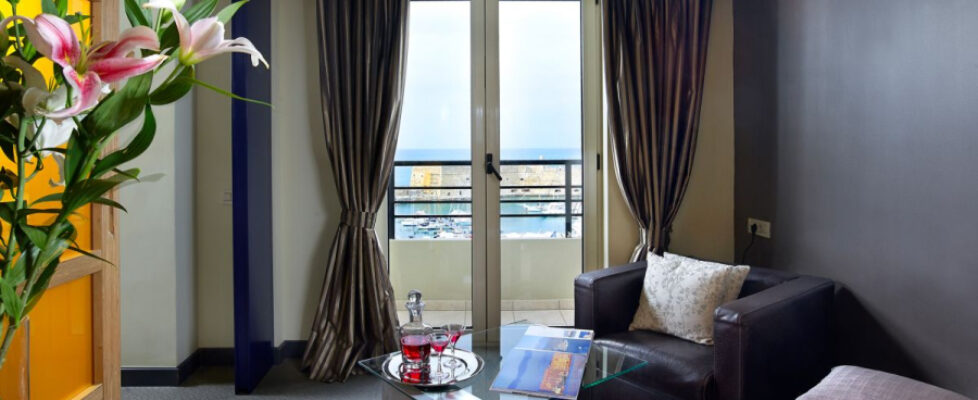
Lato Boutique Hotel in Irakleio
Wondering where to stay in Irakleio? Here are a few prime suggestions, from city centre hotels to nearby beach resorts, and ranging from budget to luxury. We can personally recommend every one of them. The list is only short but we can assure you it’s select.
Where to Stay in Irakleio
Apollonia Beach Resort and Spa
Apollonia Beach Resort near Irakleio
The upmarket Apollonia Beach Resort and Spa has its own beach, only 6 km (3.7 miles) west of the centre of Irakleio, and the local bus stops right outside the hotel entrance. It has rooms, bungalows and suites spread around the large gardens, and they all have either balcony or terrace, and all the facilities you would expect from a hotel of this standard. There are two outdoor pools, a children’s pool and a heated indoor pool, as well as numerous sports facilities including watersports, cycling and horse-riding. With two discos too, it’s ideal for children of all ages.
Check room rates and availability: expedia.com
Capsis Astoria Heraklion
Capsis Astoria Hotel in Irakleio
Right on Irakleio’s main square, the Capsis remains quiet inside and offers stylish accommodation that is not too expensive. All the rooms are bright and modern with a predominantly blue décor and lots of wood furnishings. They all have plenty of closet space, TV, phone, mini-bar, air-conditioning and ensuite facilities (baths not showers). The rooftop pool is open till 10pm and has great views over the city.
Check room rates and availability: expedia.com
Aquila Atlantis
Aquila Atlantis Hotel in Irakleio
The 5-star Aquila Atlantis is the best hotel in the centre of Irakleio, and though it has some 160 rooms and suites you would still be advised to book ahead in high season as it is popular with tour groups and business conferences. Close by the Archaeological Museum and only a short walk to most other city attractions, the Atlantis also has so many of its own facilities that you hardly need to leave it: gym, pool, laundry, bars, restaurant, shops, and even a rooftop garden.
Check room rates and availability: expedia.com
Candia Maris
Candia Maris Hotel near Irakleio
Only 3 km (1.9 miles) west of the city centre but with a quick and regular bus service into Irakleio, the Candia Maris makes an ideal base if you want to explore the city but also enjoy the beach and all the other hotel facilities. These include fitness centre, tennis and squash courts, three swimming pools plus one for children, watersports, indoor games room, three restaurants and four bars. The rooms are spacious and bright, and the rates very reasonable for a deluxe hotel of this class.
Check room rates and availability: https://www.candiamaris.gr
Kronos Hotel
Kronos Hotel in Irakleio
The simple and inexpensive family-run Kronos Hotel is friendly and clean and right on the waterfront road. This does mean some traffic noise at night in the front rooms, but you do get the bonus of a sea view. That aside, it offers excellent value accommodation in the centre of town. Downstairs is a lounge that doubles as the breakfast room, and a bar with a soft drinks cabinet. The rooms are a good size and have everything needed for a few nights’ stay: balconies, phone, TV, wardrobes, ensuite facilities.
Check room rates and availability: expedia.com
Lato Boutique Hotel
Lato Boutique Hotel in Irakleio
The modern lobby to the stylish Lato Boutique Hotel is immediately welcoming, with lots of space and marble décor. A wall of water at one end is very eye-catching, and off the lobby is a bar, restaurant and a lounge with an old-fashioned fireplace. Ask for one of the rooms on the upper floors, as some of these have impressive views of Irakleio, but all rooms have phone, TV, mini-bar, air-conditioning, and bathroom with both bath and shower.
Check room rates and availability: expedia.com
Here are some of the things you’ll see when walking around Irakleio, the capital of Crete, including churches, squares, and the beautiful Venetian Loggia.
The Venetian Loggia in Irakleio
Platia Eleftherias
Its name translates as ‘Liberty Square’, and this large open space at the top of Dedalou Street, provides freedom from the sometimes claustrophobic feel of the city. Traditionally this square was the centre of the city, and though the ring of rushing traffic around the edge has somewhat dampened its appeal, locals still frequent it for an evening stroll. There are shady benches beneath the palms and acacias, and a string of cafés and restaurants alongside.
Áyios Títos
Church of Agios Titos in Irakleio
Áyios Títos sits back from the main road on a lovely square. With its sky-blue ceiling and dome, three-tiered carved wood chandelier and modern stained-glass windows, it has a light, airy feel in contrast to most of the churches you’ll visit on the island. Built during Byzantine times, it was the seat of the Metropolitan (bishop) of Crete. During the Turkish occupation it was converted into a mosque, and was entirely rebuilt following its destruction in an earthquake in 1856.
When the Turkish population left Crete in 1923, it was reconsecrated to the Apostle Titus, Crete’s first bishop. His remains had been kept here for 700 years until the Venetians took them to Venice in 1669. They were returned in 1966, and the saint’s skull now lies in a gold reliquary.
Venetian Loggia
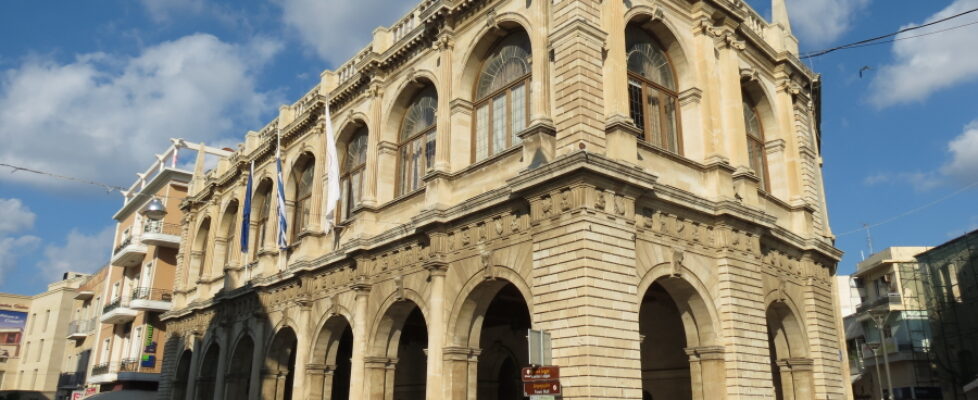
The Venetian Loggia in Irakleio
This is Irákleio’s most handsome building after the fortress. Built in 1628 by Francisco Morosini, it was a place of meeting and recreation for the Venetian nobility. Its Palladian style combines Doric order on the lower floor with Ionic on the upper floor.
The ground floor porch, with its elegant arches, is decorated with medallions of famous Cretans. The loggia is part of a larger building with once held the Venetian armoury, and now houses the Town Hall. It stands opposite the Morosini Fountain.
Áyios Márcos
The Church of St Mark was first built in 1239 and was the church of the Duke, ruler of the island. It became a cathedral in Venetian times and, like most other Irákleio churches, it was converted into a mosque by the Turks. Unlike the others it was not reconsecrated after their departure and in 1923 it became the National Bank.
Now restored to its original form, with a striking colonnaded porch and marble doorway, it is used as a concert hall and art gallery. The arched ceiling, fat pillars and stone walls of the interior make a superb display space for changing exhibitions of contemporary art.
Platia Venizelou
This small central square is one of the liveliest in the capital and a popular focal point for tourists and locals alike. It is named for the great Cretan statesman, Eleftherios Venizelos, who became prime minister of Greece. Also known as Lion Square or Fountain Square, its centrepiece is the Morosini Fountain.
This regal work was built in 1628 by Francisco Morosini, the Venetian governor of the city. A 16 km (9.9 miles) aqueduct brought water from the mountains to the fountain. The four stone lions supporting the central basin have great character and are even older; dating to the 14th century, they are thought to have come from another fountain. The curvaceous marble base is decorated with marine carvings of mermaids, tritons and other figures.
The square has plenty of cafés and restaurants where you can have a coffee, an ice cream or the custard-filled Cretan speciality, bougátsa. It’s a perfect vantage point on the passing scene, but if you prefer a quieter retreat try the adjacent El Greco Park, behind the yellow sub-post office. It has pretty gardens and a children’s playground at one end.
Platia Kornarou
Irákleio’s street market ends at Platia Kornarou. This small, quiet square is a pleasant place to stop for a break. The stone kiosk in the centre, which once housed a Turkish fountain, has been converted into a small café. Beside it is the Bembo Fountain, named after the Venetian commander Zanne Matteo Bembo, who first supplied the town with running water. It was erected in 1588 and incorporates the torso of a Roman statue from Ierápetra.
Irakleio’s Icon Museum in the church of Ayia Aikaterini is a small but impressive collection from the world’s best icon painters.
Irakleio’s Icon Museum
Cretan icon painters were considered the best in the world, and here in Irakleio‘s Icon Museum you can see some of the finest works by one of the great masters of the art, Michael Damaskinos, as well as other beautiful religious items.
The museum is contained in the small church of Ayía Aikateríni, rather dwarfed by the nearby large cathedral of Áyios Mínas, but step inside its doors and you find this excellent collection of icons, not to mention religious vestments, Bibles, illuminated manuscripts, coins and frescoes. Its official name is the Museum of St Catherine.
Church of Ayia Aikaterini
The collection features some of the best items on the island, rescued from or donated by churches and monasteries all over Crete. The church that houses them was built in 1555, but the seating has been removed to expose the marble floors and provide space for the display cabinets in the aisles and around the sides. Icons grace the walls.
Irakleio’s Icon Museum
Michael Damaskinos
The ticket desk is just inside the door, and on the wall opposite are six hugely impressive 16th century icons, the work of Michael Damaskinos. Damaskinos was the only Cretan painter of his era to rival the talents of El Greco himself. Like the Master, Damaskinos went to Venice, but afterwards he returned to his native island and the six icons hanging here are considered to be among his finest works.
The icons depict various Biblical events such as The Adoration of the Magi, The Last Supper and The Burning Bush. They were all painted in the period 1582-91 for the Moní Vrontísiou (Vrontisiou Monastery) northwest of Záros. In 1800 they were brought to Irakleio to save them from destruction by the Turks. They have a liveliness, a depth of image and of colour that makes them appear as if they were done yesterday.
Irakleio’s Icon Museum
Other Exhibits in Irakleio’s Icon Museum
In the central aisle are two cases containing Byzantine coins and holy manuscripts. On the left aisle is a series of large icons saved from mountain chapels and monasteries, mostly from the 15th and 16th centuries, and anonymous. Note the nearby case of lovely illuminated manuscripts dating from the 16th century and from the Monastery of Epanosiphi and, opposite these, the ornately carved wooden Bishop’s Throne from the Monastery of Kera.
Last Judgement
There are more icons as you approach the high altar, including a very vivid 17th century Last Judgement, where naked souls are cast down into hell where they are being eagerly greeted by evil devils throwing them into the fiery furnace.
Following round to the left of the altar the collection broadens out to include some brightly-coloured frescoes and a large stone iconostasis. Two cases contain some chalices, Bible covers and a holy cross.
Leaving Irakleio’s Icon Museum
On leaving the church, walk across the Platia to see the small church of Áyios Mínas, if open, and the large 19th century cathedral of the same name, with its elaborate metal chandeliers, beautiful painted ceilings, and vast stone pulpit.
Church of Ayios Minas (left) and Cathedral (right)
Top Tips
The opening hours do change so check the website
With no air-conditioning the building can get very hot and stuffy, so visit early in the day if possible.
Hidden Gem
In what would be the south chapel of the church, look for the exceptional icon of Lady of the Kardiotissa from the Monastery of Kera. The Virgin, dressed in red, has sorrowful eyes that seem to stare right into your soul.
Irakleio’s Historical Museum is officially called the Historical Museum of Crete and contains the only work by El Greco that is still on his native island.
Historical Museum of Crete
Where is Irakleio’s Historical Museum?
If you walk west along the waterfront from the Venetian Port you will reach Irakleio’s Historical Museum in about five minutes. It’s on the left in a handsome neoclassical building dating from 1903.
Map )c) Google Maps
Highlights of Irakleio’s Historical Museum
For an overview of the history of both Crete and Irákleio, a visit to this small but informative museum is a must. Highlights include the study of Nikos Kazantzakis and the only work by El Greco still on his native island.
At the ticket desk be sure to pick up one of the leaflets, available in Greek, English or German, which gives a map of the museum and a brief note of what is in each room. Most of the displays also have information displays in both Greek and English, although on some the details given are fairly basic.
First Room
In the first room, to your right as you enter, the information panels are anything but basic. They cover in some detail four of the major periods in Crete’s history, and correspond to four shelves of objects from those periods: the First Byzantine (330-827/8), the Arab Occupation (827/8-961), the Second Byzantine (961-1204) and Venetian Rule (1204-1669.
The major display in this room is a wonderful 1:500 scale model of Irakleio in 1645, when it was known as Chandax. This is the name given to the city when the Arabs made it the island capital in the early 9th century, possibly from the Arabic words Rabdh el-Khandaq, the Fortress of the Moat. On the walls beside it maps show the development of the city over the years, and note the buttons beneath the displays which illuminate the relevant parts of the model.
Scale Model of Irakleio in Irakleio’s Historical Museum
Around Irakleio’s Historical Museum
The museum tour continues behind the ticket desk, with the rooms spread on several levels. Room 2 is the Ceramics Room and has some beautiful bowls and plates imported from Italy during the Venetian period. These are cleverly displayed side-by-side with locally-made pottery from the same period, clearly showing the Italian influence on local designs. There are also some lovely, delicate jugs and bowls from the Arab Occupation of the island.
The rest of the ground floor has several rooms containing Byzantine items, Venetian coats of arms and carvings (note the fountain from a 17th-century Palazzo in Room 6), with stairs leading up to the second level.
El Greco Painting
The Monastery of St Catherine beneath Mount Sinai in Egypt’s Sinai Desert by El Greco
The highlight of Level B is undoubtedly the small dimly-lit room containing El Greco’s painting of The Monastery of St Catherine beneath Mount Sinai in Egypt’s Sinai Desert. This, his only work to remain on Crete, was painted in 1570 and some background to the work is given in extracts from books about it which are also on display.
Cretan Icons
Elsewhere on this floor are several icons from the Cretan school, the more typical style of Greek art, and at the rear one room is given over to the struggle for independence against the Turks.
Nikos Kazantzakis
The major display on Level C is the writer Nikos Kazantzakis’s study from when he lived in Antibes 1948-57, complete with manuscripts of his works, his library of books, and copies of his own books translated into many languages around the world.
Folklore Collection
The museum’s top floor contains a folklore collection based on the theme of the life cycle of birth, marriage and death. The museum has a fine collection of weavings, embroidery, old costumes, household items, musical instruments and many other objects.
Hidden Gems
Slightly overshadowed by the other displays in the first room are some cabinets in the centre containing objects, including fascinating glass and clay hand grenades, found on a galleon that sank in 1669.
One to Miss
The Emmanuel Tsouderos room, opposite the Nikos Kazantzakis room, is unlikely to appeal unless you have a deep interest in Greek politics.
Must See
El Greco’s painting, Monastery of St Catherine beneath Mount Sinai in Egypt’s Sinai Desert.
Here’s See Greece’s guide on how to see the best of Irakleio in a day including the Archaeological Museum, Icon Museum, Historical Museum & Venetian Harbour.
The Venetian Loggia in Irakleio
You can just about fit Irákleio’s main sights into one long day if you take advantage of early and late opening times. But check the hours for each attraction first, as you may need to switch this itinerary around a little on certain days.
Irakleio in a Day: Morning
Irakleio’s Archaeological Museum
8:00am Get an early start at the Archaeological Museum. If you haven’t had breakfast yet, start your visit with a coffee and pastry in the museum coffee shop. Don’t miss our detailed page all about the Archaeological Museum.
10.30am Walk down Odos Dedalou, the main shopping street, and turn right when you reach the end at Platia Venizelou. Continue down Odos 25 Augoustou, stopping to admire the Venetian Loggia. Just beyond, peek into the lovely Áyios Títos church, set back on a small square. Continue to the end of the street, where it reaches the waterfront.
11.30am Walk out along the colourful harbour and visit the Venetian Fortress. Be sure to climb to the top for the city’s best views.
Irakleio Venetian Fortress
Irakleio in a Day: Lunch
12.30pm Have an early lunch by the waterside at Ippokampos. It’s close to the Venetian Harbour, and you can’t eat right on the harbour as there are no restaurants there, but Ippokampos buys direct from the fishermen and you’re spoiled for choice if you like your seafood: squid, octopus, mussels, shrimp, catch-of-the-day and much more.
Irakleio in a Day: Afternoon
Historical Museum of Crete
1.30pm From Ippokampos, walk west along the waterfront to the Historical Museum, which is only five minutes away. It’s not a huge museum and you’ll probably spend an hour or so here. You can certainly see the highlights in that time.
3.00pm Return to Platia Venizelou and have a closer look at the Morosini Fountain. You’ve got some time to kill, but there’s no better spot for people-watching. Have a welcome rest at Bougatsa Kirkor and try Crete’s traditional custard pastry, the bougátsa, or relax in the adjacent El Greco Park.
4.30pm Visit the Icon Museum, which should take you less than an hour, and see the cathedral and church of Áyios Mínas, both on the same square. See our full page on Irakleio’s Icon Museum.
Irakleio’s Archaeological Museum
Afterwards, there’s still time for a last look at the Minoan treasures in the Archaeology Museum, which is open until 8pm. You can then have a pre-dinner drink in one of the bars behind Dedalou Street and congratulate yourself for seeing Irakleio in a day!
Irakleio’s Harbour is one of its most attractive features, and a stroll around here with a visit to the Venetian Fortress that guards it is a treat.
Irakleio Harbour
From the Fortress you get an excellent view not only of the city but of the remains of the Venetian shipyards, or Arsenali, across the water.
Venetian Shipyards
The Venetian Shipyards (also known as the Arsenali) in Irakleio are monumental remnants of the island’s period under the Republic of Venice (1204–1669). Located at the city’s old harbor, these structures were the heartbeat of Venetian maritime dominance in the Eastern Mediterranean.
Irakleio Harbour
Irakleio, then known as Candia, served as the strategic “Venice of the East,” and these dockyards were essential for the construction, repair, and winter housing of the formidable Venetian galleys.
Architecture and Design
The shipyards were designed as long, vaulted stone halls, uniquely engineered to withstand the weight of ships and the corrosive salt air. Originally, there were 19 shipyards divided into three distinct complexes:
Arsenali Antichi (Old)
Arsenali Vecchi (Aged)
Arsenali Nuovi (New)
Each bay measured approximately 50 meters in length and 9 meters in width. Their high, barrel-vaulted roofs were designed to accommodate the massive masts of galleys, while the open-ended design facing the sea allowed vessels to be floated directly into the dry-docking area for maintenance.
Historical Legacy
During their peak in the 16th century, the shipyards were part of a sophisticated industrial network that included a massive water tank (the Zane Tank) and a salt warehouse. Today, only a portion of the original structures remains, as many were demolished in the early 20th century to make way for modern coastal roads. Those that stand today have been beautifully restored and serve as cultural hubs for exhibitions and events, standing as a stony testament to Heraklion’s identity as a former Mediterranean naval powerhouse.
The Fortress
Irakleio Venetian Fortress
The Fortress which dominates the harbour entrance was built in the period 1523-40, though there have been several earlier forts on the site, one being destroyed in an earthquake in 1303. The Venetians rebuilt it and named it the Rocca al Mare, the Rock in the Sea, and the impressive name is appropriate for the impressive building you discover beyond the entrance gate.
Inside you step into a huge and dark vaulted room, with other rooms and passageways leading off it. Ahead and to the right, a long and steep slope leads to the upper levels, where visitors can climb the walls for the impressive views of the harbour and city beyond, or out to sea. The walls have some towers too which can be entered, for even greater height.
Fishermen in Irakleio Harbour
Turkish Seige
While here, mull over the most significant episode in the history of the Fortress. In 1647 the Venetian rulers of Irakleio and the rest of Crete retreated into the Fortress under siege from Turkish invaders. That siege was to last until 1669 and so became one of the longest in history. Eventually after 22 years the Venetians had to succumb, but only after a long and bloody struggle during which it is said that 30,000 Venetians and 118,000 Turks lost their lives.
The Fortress has been extensively refurbished and some say it now looks more like a film set, but its scale remains remarkable. It now sometimes houses temporary exhibitions, and occasional plays and concerts on a stage set up in the upper level.
The Winged Lion
The winged lion of St Mark the Evangelist was the emblem of the Venetian Republic. It was depicted in all areas under its dominion, carved in limestone or marble above gateways or on public buildings and fortifications. Some 80 reliefs have been recorded on Crete.
Top Tip
When an exhibition is on the opening hours sometimes change, so you may want to check in advance if planning a special visit. See the official website here.
The largest of the Greek islands, Crete has one UNESO World Heritage Site but it is spread over six places.
The Ruins of Knossos on Crete
As of 2025, the island of Crete is home to one official UNESCO World Heritage Site: the Minoan Palatial Centres.
While this counts as a single entry on the UNESCO list, it is a “serial property,” meaning it is composed of six distinct archaeological sites scattered across the island. These sites were collectively inscribed in July 2025 during the 47th session of the World Heritage Committee. They represent the peak of the Minoan civilization, which flourished between 1900 and 1100 BCE and is widely considered the first advanced urban society in Europe.
The Six UNESCO Palatial Centres
Each of these six locations offers a unique perspective on Minoan life, from mountain retreats to bustling maritime ports.
1. Knossos: The Labyrinthine Heart
The Ruins of a Temple at Knossos
Located just a few kilometers south of the modern capital, Irakleio, Knossos is the largest and most famous of the Minoan palaces. It spans approximately 20,000 square meters and was the ceremonial and political heart of the Minoan world. See our full guide to Knossos.
Key Features: The site is famous for its “Throne Room,” the Central Court used for public gatherings, and the vibrant (though reconstructed) frescoes like the Bull-Leaping Fresco and the Prince of the Lilies.
Innovation: Knossos featured advanced engineering, including multi-story buildings, light wells for natural illumination, and a sophisticated terracotta pipe drainage system that provided running water and sanitation.
Mythology: This is the legendary site of the Labyrinth, designed by Daedalus to hold the Minotaur, and the seat of the powerful King Minos.
2. Phaistos: The Architect’s Jewel
Phaistos Minoan Palace
Situated on a hill overlooking the fertile Messara Plain in southern Crete, Phaistos is often praised for having the most impressive architectural layout and the most beautiful natural setting of all the palaces. See our full page on Phaistos.
Key Features: The palace is organized around a grand central courtyard with monumental staircases. Unlike Knossos, Phaistos has not been extensively reconstructed with concrete, allowing visitors to see the original stone masonry as it was found.
Discovery: This is where the famous Phaistos Disc was discovered—a clay disc featuring 241 symbols in a spiral, which remains one of the world’s most famous undeciphered scripts.
History: The site shows two distinct phases: the “Old Palace,” destroyed by an earthquake around 1700 BCE, and the “New Palace” built directly on top of the ruins.
3. Malia: The Commercial Crossroads
Malia Palace
Located on the northern coast, Malia is the third-largest palace and provides a clearer look at how a Minoan town functioned, as the ruins of the surrounding residential neighborhoods are well-preserved. Don’t miss our full Malia page.
Key Features: Malia is known for its massive pithoi (giant storage jars) and its industrial areas. A unique feature is the Kernos of Malia, a large circular stone table with small cups around its edge, likely used for liquid offerings or religious rituals.
Artifacts: The world-famous “Gold Bees of Malia” pendant, a masterpiece of Minoan jewelry, was found in a nearby necropolis.
Role: Its proximity to the sea suggests it was a vital hub for maritime trade and the collection of agricultural surplus from the surrounding plains.
4. Zakros: The Gateway to the East
Kato Zakros on Crete
Tucked away in a remote bay at the easternmost tip of Crete, Zakros was the last of the four major “classic” palaces to be discovered. Because it was never looted in antiquity, it has yielded an incredible wealth of artifacts.
Key Features: The palace is smaller than the others but follows the same sophisticated plan. It is unique for its “Lustral Basin”—a sunken room used for ritual cleansing—and its royal apartments that feature built-in drainage.
Trade Hub: Excavations here revealed luxury items from ancient Egypt and the Near East, such as ivory, elephant tusks, and precious stones, proving that Zakros was Crete’s primary gateway for eastern Mediterranean trade.
Environment: It is located at the end of the “Valley of the Dead,” a gorge where the Minoans buried their deceased in caves.
5. Kydonia: The Urban Mystery
Kydonia is unique because the ancient Minoan palatial center lies directly beneath the modern, bustling city of Chania. Specifically, the site is located on the Kastelli Hill overlooking the old Venetian harbor.
Key Features: Much of the site remains unexcavated because it is covered by modern buildings, but the portions that have been uncovered show monumental walls and high-quality masonry.
The “Seal of the Ruler”: One of the most important finds here is a seal impression showing a powerful male figure standing atop a multi-story building, which has provided deep insights into Minoan leadership.
Linear B: Kydonia was a major center in the later “Post-palatial” period, and numerous clay tablets with Linear B script have been found here, linking the site to the later Mycenaean administration.
6. Zominthos: The Mountain Stronghold
High in the foothills of Mount Psiloritis (Mount Ida) at an altitude of nearly 1,200 meters, Zominthos is the only Minoan palace located in a mountainous region rather than a coastal plain.
Key Features: It is a massive, well-preserved multi-story building with over 100 rooms. The architecture is exceptionally sturdy to withstand the harsh mountain winters, utilizing local stone and thick timber beams.
Religious Significance: Zominthos likely served as a seasonal administrative center and a “way station” for pilgrims traveling from Knossos to the Ideon Andron (the sacred cave where Zeus was said to be born).
Economics: The site was a hub for managing mountain resources, specifically wool production from sheep and the harvesting of medicinal mountain herbs and timber.
The Tentative List
While they are not yet full World Heritage Sites, Greece has officially proposed the following for future inclusion:
The Fortress of Spinalonga: A Venetian fortress that later became one of Europe’s last active leper colonies. It is praised for its historical architecture and its poignant human story.
Samaria Gorge: Currently a Biosphere Reserve, but undergoing the process to be listed as a natural World Heritage Site due to its unique biodiversity and geological importance.
This drive along the west coast of Crete and inland from there will take a whole day and starts and ends in Kastélli Kissámou, west of Chania.
Elafonisi Beach on Crete
Some of Crete’s best sandy beaches lie on the island’s far western coast, and their remote location has so far brought only minimal development, leaving them largely unspoiled. The dramatic mountain and coastal scenery is well worth the long day’s drive. Drive with care on the narrow mountain roads.
Leave Kastélli Kissámou
Kastelli Kissamou on Crete
From Kastélli Kissámou on the north coast, take the Old Road east towards Hania for about 2 km (1.2 miles) to Kaloudianá. Turn south to Topólia, a pretty whitewashed village clinging to steep slopes. The church of Ayía Paraskeví, with its striking Italianate bell tower, has late Byzantine frescoes.
The Koutsamatádos Ravine
Just beyond town a tunnel marks the start of the Koutsamatádos ravine. Only 1.5 km (0.9 miles) long, it is highly dramatic, the narrow road clinging to the western slope with sheer cliffs rising 300 metres (984 feet) above a river bed.
Agía Sofía Cave
Near the end of the gorge, steep steps on the right lead up to Agía Sofía Cave, one of the biggest on Crete. The huge cavern is filled with stalagmites and stalactites, and there is a small chapel. It was occupied in Neolithic times. Just beyond is Koutsamatádos village with a couple of tavernas.
The Tiflós Valley
About 3 km (1.9 miles) further on, you can detour along a 5 km (3.1 miles) twisting mountain track to Milia (signposted), a beautifully restored traditional farming village. Or continue straight ahead on the main road through the Tiflós valley, lush with olive groves and tall plane and chestnut trees.
The Chestnut Villages
At Élos, the road winds up the hillside to the centre of this pretty village, the largest of the nine kastanochória, or chestnut villages which harvest the crop for export. A chestnut festival is held here each year in late October.
Spectacular Views
As you climb higher out of Élos, there are spectacular views back over the valley and its terraced hillsides. Pass Perivólia, and at the T-junction turn left for Elafonísi. The road curves down a pretty, peaceful valley, passing through Váthi, another chestnut village, and Plokamianá.
Moní Chrysoskalítissa
A good asphalt road enables a fast descent to the sea, 10 km (6.2 miles) away with a scenic rocky shoreline. Perched high on a rock bluff above the barren landscape is the gleaming white Moní Chrysoskalítissa. The convent’s name means ‘Virgin of the Golden Step’, as one of the 90 steps up to it is said to be made of gold (but visible only to those who are without sin). The original church was built in a cave in the 13th century. This ones dates from the 19th century and contains an ancient icon of the Virgin.
Elafonísi
Elafonisi Beach on Crete
It’s a further 6 km (3.7 miles) to the white sands of Elafonísi, at the southwestern tip of the island. The paved road ends after 4km, and a gravel track leads down to the beach. The turquoise waters are warm and shallow, seldom reaching above waist-high, and you can wade across the sandbar to Elafonísi Island. Despite its remoteness, this idyllic spot is always busy in high season; there are a few snack bars and plenty of sunbeds for hire.
Byzantine Frescoes
Return on the same road, and after Váthi take the left fork through Kefáli. Its 14th-century church, Metamórphosis tou Sotirou (Transfiguration of the Saviour), contains some fine Byzantine frescoes as well as graffiti from early travellers. A path beside the kafeníon leads to the church.
Narrow Switchbacks
Beyond tiny Papadiana, the road becomes a series of tight, narrow switchbacks climbing up the mountainside. There are stunning views back across the valley to the glistening sea. After Amigdakalokefáli, there are wide vistas of the western coast as the long, slow descent begins through old mountain villages such as Keramotí. You only realise how high you are when you glimpse the sea and the coastal fields far below.
Kámbos
Kámbos, 14 km (8.7 miles) from Kefáli, is a larger, pleasant village with pretty stone houses clinging to the slopes around a ravine. After winding through it you make a magnificent descent into the canyon lined with rock walls of red and gold covered in greenery, and on to Sfinári.
Plátanos
The road climbs again, affording a stupendous view over the bay and beach below. The big peak of Mount Manna looms ahead. After 9 km (5.6 miles) turn left for Plátanos, a large white-washed town perched on a high plateau.
Falássarna
Drive through town. Most signs are in Greek only, making the ill-marked turn for Falássarna more difficult to see (it’s better signposted from the other direction). As you leave town look for a petrol station on the left, and just beyond a blue BANK sign. Turn left onto the small road here. Shortly after the turn follow the brown and yellow sign for Ancient Falássarna. As you descend to the coastal plain, turn right at the signposted junction for Falássarna.
Ancient Falássarna
Falássarna has lovely stretches of golden sand set between rocky inlets that are great for beach-combing. Facilities are basic, with a handful of small hotels and tavernas scattered along the road. North of the beach a dirt track leads to the ruins of ancient Falássarna, a port city dating back to the 6th century BC.
Back to Kastélli Kissámou
Return to Plátanos and continue north to Kastélli, 11 km (6.8 miles) away.
If you want a printable PDF of these directions, click here.
This Airbnb near Hania is in the quiet village of Malaxiana, a peaceful retreat with a delightful and thoughtful artist owner, with wonderful views and amenities.
Breakfast at our Airbnb near Hania
It was the apple pie that did it. We were staying at an Airbnb near Hania, which was self-catering. As we hadn’t had time to self-cater, the owner, an artist named Dimitris Vamvounakis, brought us two huge slices of the most delicious apple pie, flavoured with walnuts and cinnamon, and made by his wife. It meant that we could enjoy our breakfast coffee and have something to eat with it before venturing out to explore.
Artworks by Dimitris Vamvounakis
We sat on our apartment’s big patio, shaded by umbrellas, and looked down over olive groves towards the glinting waters of Souda Bay on the north coast of Crete. To the west was Hania, one of our favourite towns on the island, and all around there was plenty to explore, though it was a great temptation to just stay at Dimitri’s and chill out.
View from our Airbnb near Hania
We did do that one morning, and Dimitri, who’s an artist, took us down below the house to show us his studio. It was a wonderful place, full of strikingly original and often whimsical art works: sculptures and paintings and mobiles, all evidence of an enquiring and playful imagination. He moved quickly around the rooms with great energy and enthusiasm, pointing out his various creations while telling us his life story too.
Artist Dimitris Vamvounakis
‘I was born in Athens,’ he said. ‘My grandfather had an olive press here in the house I live in. He went to Athens in the late 19th century. They came back with a flour mill. They bought the first shipwrecks from the Greek government for recycling.
‘I came back here from Athens. I was lucky to have the house and I renovated it in 2006. Not the rooms, only the gardens and this part below the house. I tried to do a tavern but I didn’t want that. I experimented in many ways to try to make an income. The most successful was inviting a group of people to dinner in my house, from 7pm to whenever, two courses, wine, lots of conversation and people liked that. But it wasn’t for me. I didn’t want to be a tavern man.’
Artist Dimitris Vamvounakis
Now he rents accommodation out on Airbnb and in winter also runs courses for children, as he’s passionate about the environment.
‘In winter I started to invite children to teach them about recycling. I take them to a car recycling place. If they’re lucky they get to smash a car! But it’s to teach them about recycling.’
Artwork by Dimitris Vamvounakis
‘If people stay for a week they’ll find food in the fridge, coffee, tea, honey, oil, fruit, bread. If they spend 90 euros a day on the accommodation then they get back 30 in food! It’s not tourism,’ he insisted, ‘it’s visitors.’
Swimming Pool at our Airbnb near Hania
He stays open all year. There’s a swimming pool too, and in winter when people don’t want to use it he fills it with goldfish. Dimitri is a quirky man, totally charming with a warm heart, with the quirky eccentricity of the artistic mind.
Our Airbnb near Hania
But he is also business-like and the accommodation is very well-equipped. There was fresh coffee, filters, a coffee-maker, even a hair-dryer. As well as the basic foods to get you started, there was also orange juice and ouzo in the fridge. His wifi code is painted on the wall right inside the front door, and it’s also the same as his phone number.
Maps and Guides at Our Airbnb near Hania
On a table beneath the stairs is a pile of books, brochures and local information, like walks and where to eat. There’s nowhere to eat in Malaxiana itself, which has a population of 70-80, but plenty of options in villages nearby, or of course you can self-cater and the accommodation is very well-equipped for that. One Russian couple stayed there for 15 days, Dimitri told us – and we can see why.
Our Airbnb near Hania
The décor is rustic, with lots of wood, but brightened by the many colourful artistic touches. Downstairs is a comfy couch, a sitting and dining area, the kitchen and the bathroom with a shower. Upstairs is another sitting area (though we used it to unpack our suitcases) and beyond that a double bedroom. It’s simple but is clean and has everything you could want. The only drawback for us was having to trek downstairs to use the bathroom, but given the delightful time we had there that was a minor thing.
Artworks by Dimitris Vamvounakis
Dimitri was happy to share his life story with us, and all-in-all was an inspiring man. He seemed a little bemused by the way that life sometimes works out, and although there are bad times there are also good times to enjoy.
The Cats at our Airbnb near Hania
‘When I came here,’ he told us, ‘I was married but after five years my wife left. Later, when I was 43, and sitting in the tavern, this lady said to me: “I want you.” I said: “No, no!” She said “I want to marry you.” I said “No. no, you are too young!” She was 23. But now we have been married 16 years and have two children. I was 60 yesterday.’
Driving on Crete is the best way to see Greece’s biggest island and here is our driving advice and some information about Greek driving regulations.
Note: Tthis advice was correct at the time of writing but you should always double-check if you’re planning on driving in Crete, or anywhere else in Greece. A good place to start is the RAC’s Driving in Greece page. rac.co.uk
Crete Road Bridge
Driving on Crete: General Advice
Most of the main roads on Crete are of a good standard, the best being the E75 highway that links towns along Crete’s north coast. This is invariably signposted as the New Road, and is also called the National Highway.
Off the main road standards vary enormously, and even on major roads you should watch out for unexpected pot-holes or rock-fall.
On many main roads the right-hand ‘lane’ is not a proper lane but a wide shoulder, and is used for pulling into when a car wishes to overtake. Make sure you can see well ahead, however, as this can be dangerous round bends.
It is always best to ask locally about road conditions, as roads which may appear to be good roads on maps can turn out to be rough tracks.
Greece has the second-worst record in Europe for deaths on the road. Many drivers like to drive down the middle of the road, even when coming round blind bends. Keep well in to your side of the road. Reckless overtaking is common, also on blind bends.
Another driver flashing his headlights at you means that he is coming through, NOT that he is giving way to you. If you’re simply driving along and an oncoming driver flashes his headlights, this is a common signal that there is a police speed trap ahead of you.
The beeping of horns is very common. This can be something as simple as the driver seeing a friend walking by, or totting as he passes a relative’s shop, so don’t assume any sound of the horn is directed at you.
Road on Crete
Driving on Crete: Essentials
Drive on the right.
Wearing seatbelts where fitted is compulsory, but many locals ignore this rule. Don’t be tempted to emulate them.
Children under ten must not sit in the front seat.
Drink-driving is a serious offence. A blood-alcohol level of only 0.05% means a heavy instant fine, and over 0.08% is a criminal offence and can lead to imprisonment. The police sometimes set up random breath-testing checkpoints.
The speed limit is 120kph on highways, 90kph on other main roads and 50kph in urban areas. These may vary slightly so watch for the speed-limit signs.
Vehicles coming from the right have right of way, including on roundabouts.
Road Hazard on Crete
Car Hire
Rates in Crete are higher than the European average, but local firms tend to under-cut the major international names.
In theory an international driving licence is required but in practice a valid national driving licence will usually suffice.
Minimum age varies from 21 to 25 depending on the company’s policy.
Rates usually include third-party insurance and unlimited mileage, but it is advisable to take out additional coverage for CDW (Collision Damage Waiver) insurance. This means the rental company agrees not to charge you if the car is damaged or stolen while in your possession
Rental companies will usually ask for a deposit using a credit card slip, or in cash.
If hiring in late summer or autumn, it may be worth paying extra for a recognised name such as Hertz or Europcar, whose vehicles probably have a better service record over the busy summer months.
All main towns and tourist resorts, and airports, have several car hire companies competing for business.
The End of the Road on Crete
Driving on Crete: Breakdowns
Car rental companies will provide an emergency number to contact. Alternatively, dial 104 for emergency help anywhere on Crete, or dial 174 purely for information.
Bringing Your Own Car
You are allowed to take your own car to Crete for a period of up to six months or until the tax or insurance expires.
These rules change regularly on Crete so check with a motoring organisation in your own country for up-to-date information.
Cretan music is part of the island’s soul and visitors will hear live music wherever they go, with several distinctive Cretan musical instruments and songs.
‘Tell me with a laugh, tell me with a cry, Tell me you do not love me: What care I?’
Even the great Cretan novelist Nikos Kazantzakis wrote song lyrics, so deeply embedded is music in the Cretan soul. The above extract is from the most common type of Cretan song, the mantinada. These are rhyming couplets containing 15 syllables, often expressing extremes of joy and sadness. The form goes back to the 5th century BC but shows later western and especially eastern influences. During Venetian rule in Crete, many musicians came to the island from Constantinople and beyond.
Cretan music is one of Greece’s richest and most distinctive traditions, blending ancient roots with vibrant modern expression. It is characterized by unique instruments like the lyra and laouto, poetic song forms such as mantinades, and legendary musicians including Nikos Xylouris and Psarantonis.
🎶Origins and Cultural Significance
Cretan music, known locally as kritika, is deeply woven into the island’s identity. It is not just entertainment but a living tradition that accompanies weddings, feasts, and village gatherings. Its roots stretch back to antiquity, influenced by Byzantine chant and the wider Eastern Mediterranean. Improvisation is central: musicians often embellish melodies spontaneously, while dancers invent new steps in response.
Cretan Music Shop
🎻 Instruments of Cretan Music
Several instruments define the sound of Crete:
Cretan Lyra: A three-stringed bowed instrument, often considered the “voice” of Crete. Traditionally made of mulberry wood, it produces a piercing, expressive tone that carries mantinades (poetic couplets).
Laouto: A long-necked lute that provides rhythmic and harmonic support. Played with a plectrum, it often accompanies the lyra.
Mandolin: Introduced later, it adds melodic richness and is sometimes used for solo performances.
Askomandoura: A traditional bagpipe made of goatskin, linked to pastoral life.
Violin: In some regions, the violin replaced or complemented the lyra, especially in western Crete.
Together, these instruments create a sound that is both earthy and transcendent, capable of stirring deep emotion and lively dance.
🪕 Types of Songs and Forms
Cretan music encompasses several forms, each tied to social life:
Mantinades: Short, improvised rhyming couplets sung with lyra accompaniment. They express love, sorrow, humor, or philosophy.
Erotokritos: A long narrative poem set to music, recounting tales of romance and chivalry.
DanceSongs: Music is inseparable from dance. Famous dances include:
Pentozali: A fast, vigorous war dance symbolizing resilience.
Syrtos: A slower, flowing dance emphasizing grace.
Sousta: A lively couple’s dance, often flirtatious.
Rizitika: Heroic songs from the mountainous regions, often sung without instruments, celebrating bravery and freedom.
These forms reflect the island’s history of struggle, love of beauty, and communal spirit.
🌟Famous Cretan Musicians
Cretan music has been shaped by generations of masters. Here are some of the most influential:
Nikos Xylouris (1936–1980) Known as the “Archangel of Crete,” Nikos Xylouris is perhaps the most beloved Greek musician of the 20th century. Born in the mountain village of Anogia, he possessed a voice of startling power and clarity. Xylouris bridged the gap between traditional folk music and the modern political song. During the Greek military junta (1967–1974), his songs became anthems of resistance. His rendition of the Rizitiko song “Pote Tha Kanei Xasteria” (When Will the Sky Clear) became a revolutionary slogan. He died young at the age of 43, but his recordings remain the gold standard of Cretan vocal performance, embodying the “leventia” (gallant bravery) of the island.
Kostas Mountakis (1926–1991) If Xylouris was the voice, Kostas Mountakis was the “Teacher.” Hailing from the Rethymno region, Mountakis is credited with popularizing the lyra beyond the island’s borders. He was instrumental in establishing a pedagogical method for the instrument, ensuring that the tradition was passed down systematically rather than just aurally. His playing style was clean, melodic, and dignified. Mountakis focused on the lyrical beauty of the music, and his compositions remain essential repertoire for any student of the lyra. He ensured that the instrument was respected as a tool of high art, not just village entertainment.
Thanasis Skordalos (1920–1998) A contemporary of Mountakis, Skordalos represented a different approach. His playing was known for its technical brilliance and rhythmic precision. While Mountakis was often associated with the lyrical side of Cretan music, Skordalos was the master of the dance. His bow work was fierce and intricate, capable of driving dancers to exhaustion. He introduced new tunings and melodic phrasings that expanded the capabilities of the lyra, influencing generations of players who sought to emulate his unparalleled dexterity.
Psarantonis (Antonis Xylouris) The younger brother of Nikos Xylouris, Psarantonis is a living legend who has taken Cretan music into avant-garde territory. His style is primal, often described as “dionysian.” He deconstructs traditional melodies, playing with a raw, scratching timbre and using the lyra to create atmospheric soundscapes that mimic the wind and the mountains. His voice, a deep, growling bass, contrasts sharply with the soaring tenors of traditional singers. Psarantonis is an icon of the “world music” scene, collaborating with artists from Nick Cave to classical ensembles, proving that Cretan music can be both ancient and radically experimental.
These musicians embody the continuity and evolution of Cretan music, passing the tradition from one generation to the next while expanding its horizons.
🕊️ Themes and Symbolism of Cretan Music
Cretan songs often reflect themes of freedom, love, and resilience. Rizitika songs celebrate resistance against Ottoman rule, while mantinades capture everyday emotions. The Pentozali dance, with its vigorous leaps, symbolizes defiance and vitality. Music thus serves as both personal expression and collective memory.
Cretan Music Shop
✨Conclusion
Cretan music is a living art form, balancing tradition and innovation. Its instruments—the lyra, laouto, and askomandoura—create a soundscape that is both ancient and modern. Its songs—mantinades, rizitika, and dance tunes—express the soul of Crete. And its musicians, from Nikos Xylouris to Psarantonis and Ross Daly, ensure that this heritage continues to inspire audiences worldwide.
What was daily life as a Minoan like on Crete, living in palaces like the ones at Knossos, Malia, Phaistos, and Zakros, and what were their religious beliefs?
The Throne Room at Knossos Minoan Palace
Greece may be the birthplace of the Olympic Games, but long before the first torch was carried through a stadium in classical times, Cretan athletes awed the crowds by turning somersaults over the horns of charging bulls.
Europe’s First Civilisation
Crete was the home of Europe’s first civilisation, which flourished here from around 3000 BC until 1100 BC. Amazingly, it lay hidden until, the 20th century, when the English archaeologist Sir Arthur Evans began excavating Knossos.
He called this ancient race the Minoans, after the mythical Greek King Minos. It seems, however, that Minos was a title, not a personal name, rather like the Egyptian Pharoah, and at least 22 rulers bore this name.
These priest-kings built impressive palaces – Knossos, Phaistos, Malia, and Zakros are the largest discovered to date – where they presided over a rich, artistic culture that was highly ritualistic
Bull-Leaping
Minoan vase showing bull-leaping
The Minoans loved games and athletic contests. Bull-leaping satisfied both their appetite for sport and their religious obligation. The athletes would grab a charging bull by the horns, somersault over its back, and land on their feet with arms raised in victory. Both men and women took part in these dramatic feats, which required great courage, agility, and skill.
Impossible? Spanish bullfighters claim that it is, and some scholars believe that the bull-leaping scenes featured in Minoan frescoes may be only symbolic. Indeed, bulls had a strong religious significance in Minoan society. They represented virility and were depicted on vases and in figurines, and enormous sculpted ‘horns of consecration’ adorned the palace walls.
Minoan vase showing bull-leaping
Ceremonial drinking vessels called rhytons were carved in the shape of a bull’s head. In sacrificial rites thought to be connected to agricultural cycles, a bull was captured and bound, its throat cut, and its blood drained into these sacred cups. This ritual honoured the bull and connected the Minoans to its divine life force.
Bull-leaping, whether or not it actually occurred, may have symbolised the triumph of man over the unpredictable forces of nature.
Life as Art
Much of what we know about the Minoans has been gleaned from their beautiful artworks. Impressive frescoes once decorated the walls of the palaces showing, people, animals, and scenes of daily Minoan life.
The paintings, incorporating movement and sensuality, were skilfully executed in vibrant colours made from plants, minerals, and shellfish. The artists painted women’s skin white and men’s red. We therefore know from the frescoes that women played an important role in society.
Exquisite sculptures, pottery, mosaics, and decorative arts suggest that the Minoans lived an ancient version of the ‘good life’. Their palace homes had roof terraces, light wells, baths, and sophisticated plumbing systems. They were well fed, with huge granaries and giant vessels, called pithoi, to store wine and olive oil.
The Minoans were also great seafarers, trading their agricultural produce far and wide to acquire copper and tin to make bronze, and gold, silver and precious stones to make jewellery and works of art.
One of the most curious facts about their palaces is that they were built without fortifications, suggesting the Minoans lived peacefully and did not fear enemies. At their height, the Minoans are thought to have numbered over two million people, a figure four times greater than the population of Crete today!
Catastrophic Ending
This great civilisation came to a sudden end around 1450 BC when some unknown catastrophe occurred that destroyed all the palaces at the same time. Many scholars believe that the volcanic eruption on the nearby island of Santorini created a deluge of tidal waves, earthquakes, and fires on Crete, which could explain the charred remains found at some of the palaces.
Others favour theories of outside invaders, such as the Mycenaeans, or an internal rebellion against the palace rulers. Whatever the cause, within about 200 years the Minoans had all but disappeared, though the reason may always remain a mystery.
The Legend of the Minotaur
The Minotaur
Poseidon, god of the sea, sent King Minos a white bull, but when he later requested that it be sacrificed, Minos could not bring himself to kill the beautiful animal. In revenge, the angry god caused the king’s wife, Pasiphae, to fall in love with the bull and their mating produced the Minotaur, a hideous creature with a bull’s head and a man’s body.
Minos kept the monster in a labyrinth beneath the palace, and every nine years fourteen youths were shipped from Athens and fed to the Minotaur.
When Theseus, son of the king of Athens, heard of this he vowed to stop the slaughter. Volunteering to be one of the victims, he entered the palace and then seduced Minos’s daughter, Ariadne, who gave him a sword and a ball of thread to enable him to find the bull, kill it, and then retrace his way out of the labyrinth.
The Snake Goddess
The Snake Goddess
Another potent Minoan religious figure was that of the Snake Goddess, a woman holding a snake in each hand. Her bare breasts symbolised fertility while the snake, which sheds its skin, symbolises healing and rebirth.
The Double Axe
The double axe was also a dual symbol, representing both the waxing and the waning of the moon and the religious and political power of the priest-king.
The Minoan Ages
Chronologically, archaeologists break down the Minoan civilisation into four main periods:
Pre-Palace Period (2600-1900 BC). Bronze Age culture develops on Crete. Old Palace Period (1900-1700 BC). First Minoan palaces are built but are destroyed by earthquakes. New Palace Period (1700-1450 BC). Grand new palaces are built and the civilisation reaches its height before a great catastrophe, possibly a tsunami, destroyed all the palaces simultaneously. Post Palace Period (1450-1100 BC). After the destruction, Minoan civilisation declines as the Mycenaeans move in.
See Greece’s guide to visiting Phaistos or Faistos, the site of one of the finest Minoan palaces on Crete and where the mysterious Phaistos Disc was found.
Phaistos Minoan Palace
The Minoan Palace at Phaistos in southern Crete is felt by many to be a far more enjoyable site to visit than the better-known Knossos. It stands on a hill overlooking the fertile Messara Plain, and the fact that it has not been reconstructed like Knossos allows visitors to reconstruct the Palace in the best possible way: in the imagination. To see the large Central Court, the royal apartments, the Grand Staircase and the nondescript spot where the fabulous Phaistos Disc was found all make for a memorable experience.
The Approach to Phaistos
The approach to Phaistos is part of its charm, especially if you have already seen Knossos. There are no parking attendants here trying to lure you into their parking lots, just a small car park at the end of a zig-zag climb up a little hill. You then walk along the approach to the site to buy a ticket, little knowing what lies ahead. You enter the site beyond the very good bookshop, souvenir store and café, and are greeted with a good overall view of the layout.
Phaistos Minoan Palace
The History of Phaistos
It is thought that good views were also part of the original attraction of Phaistos for its inhabitants, with the Palace constructed in a way that makes the most of them. Prior to that there were other people enjoying the setting, as deposits have been found going back to Neolithic and Early Minoan periods (3000-2000BC). The views have probably changed very little since then, though the buildings have.
The first palace on the site dated from about 1900BC and is known as the Old Palace, with some of its remains still here. It was destroyed and repaired twice before its ultimate destruction in an earthquake in 1700BC, to be replaced by the New Palace, which remained in use until 1450BC and the end of the Minoan civilisation. The Old Palace remains are mostly on the western edge of the site, overshadowed by the much finer remnants of the New Palace.
Phaistos Minoan Palace
Exploring the Palace
The first open space you come to, the West Court, is a good place to try to picture the palace as it would have been. Go down into the Court and look towards the easily-recognisable Grand Staircase. To the right of this are the remains of the western façade of the palace, which was built to bask in the glow of the setting sun. To the north of the court is the theatre area, and to the south some large storage pits, used principally for grain.
If you climb the Grand Staircase – and unlike at Knossos, you can — then to the right are the store rooms that were actually within the palace, holding more grain and also oil, in the vast storage jars or pithoi that can be seen in almost every museum on Crete. It is not known for sure if the commodities stored at the palace were given to the royal family by way of a tithe, or if the building acted as a secure storage area for everyone in the area to use.
Phaistos Minoan Palace
The Central Court
To the east of this storage area you will enter the impressive Central Court, a vast open area whose paving dates from 1900-1700BC. If you walk to the southern end of this then there are good views over the plain, still a fertile source of grain and oil today. It is the largest and most fertile of all the plains in Crete, producing huge crops of olives, of citrus and other fruit, and many types of vegetable.
To the north of the Central Court the area becomes a little confusing, as the remains are on two levels, but beyond the small South Court which you may be able to identify are the royal apartments. There are many chambers and ante-chambers here, one set of rooms belonging to the king and another to the queen.
If you continue walking past these almost to the edge of the site, you can turn right and see on your right the walls and foundations of a row of small buildings. These were the palace archives, where the Phaistos Disc was found, a small object that preserves its secrets, just as the palace of Phaistos preserves its own air of mystery and beauty.
The Phaistos Disc
The Phaistos Disc in Irakleio’s Archaeological Museum
Only about 6 inches in diameter, the Phaistos Disc is one of the most important and intriguing items ever found on Crete. It dates from 1700-1600BC and was uncovered in 1903. Baked in clay, the disc has spirals of pictograms on either side, including flowers, people and animals. No-one has ever cracked the code, but the most favoured belief is that it was a religious object of some kind, with the symbols perhaps being the words to a prayer or hymn. You can see it on display in the Irakleio Archaeological Museum.
Malia on the north coast of Crete is a contrasting town which is renowned for its nightlife and beaches but also has the Minoan Palace of Malia.
Malia
Modern Malia
Malia, located on the northern coast of Crete about 35 kilometers east of Irakleion, is one of the island’s most lively seaside destinations. Today, it is best known as a resort town that attracts visitors from across Europe and beyond. Its reputation rests on a combination of sandy beaches, energetic nightlife, and a welcoming atmosphere that blends traditional Cretan hospitality with modern tourism.
The heart of Malia is its long stretch of golden sand beach, which extends for several kilometers along the coast. The beach is wide and well‑organized, with sunbeds, umbrellas, and water sports facilities. Families enjoy the shallow waters, while younger travelers often gravitate toward the beach bars and clubs that line the shore. The town’s main beach is complemented by smaller coves and quieter stretches of sand to the east and west, offering options for those seeking relaxation away from the crowds.
Modern Malia
Malia’s nightlife has become legendary, particularly along “Beach Road,” the central strip where bars, clubs, and restaurants cluster together. During the summer months, the atmosphere is electric, with music spilling out into the streets and visitors dancing until dawn. This reputation has made Malia a favorite among younger travelers, but the town also caters to couples and families with a wide range of accommodations, from budget hotels to luxury resorts.
Beyond the nightlife, Malia retains elements of traditional Cretan life. The old town, set slightly inland from the beach, is a maze of narrow streets lined with whitewashed houses, small chapels, and tavernas serving local specialties. Here, visitors can sample dishes such as moussaka, grilled lamb, and fresh seafood, often accompanied by raki, the local spirit. The contrast between the bustling beach strip and the quiet charm of the old town gives Malia a dual identity: both a modern resort and a place where Cretan traditions endure.
Tourism has brought prosperity to Malia, but it has also created challenges. The influx of visitors during peak season can strain local infrastructure, and the town has had to balance its reputation as a party destination with efforts to attract a broader range of travelers. In recent years, there has been a push to highlight Malia’s cultural heritage and natural surroundings, encouraging visitors to explore beyond the beach and nightlife. Excursions to nearby villages, hiking trails in the mountains, and visits to archaeological sites have become increasingly popular, helping to diversify the town’s appeal.
Malia Palace
Malia Palace
While modern Malia thrives on tourism, its historical significance lies in the nearby Malia Palace, one of the major Minoan palatial centers of Crete. The site, located just a few kilometers east of the town, offers a fascinating glimpse into the island’s Bronze Age civilization.
Malia Palace
The Palace of Malia was first constructed around 1900 BCE and later rebuilt after being destroyed by an earthquake around 1700 BCE. It is the third‑largest Minoan palace on Crete, after Knossos and Phaistos, and covers an area of approximately 7,500 square meters. Excavations began in the early 20th century under Joseph Hazzidakis and were later continued by French archaeologists such as Fernand Chapouthier and Oliver Pelon. The site has revealed a wealth of information about Minoan society, architecture, and daily life.
Malia Palace
Unlike Knossos, which has been heavily reconstructed, Malia Palace remains largely in its original state, allowing visitors to appreciate the ruins without modern embellishment. The layout includes a central courtyard, storerooms, workshops, and residential quarters. The palace was a hub of political, economic, and religious activity, serving as the administrative center for the surrounding region. Large storage rooms, known as magazines, contained giant clay jars (pithoi) used to store oil, grain, and other staples, reflecting the palace’s role in managing agricultural production.
Bee Pendant
One of the most famous finds from Malia is the “Bee Pendant,” a gold ornament depicting two bees holding a drop of honey. This beautiful piece of jewelry, now housed in the Irakleion Archaeological Museum, exemplifies the artistry of Minoan craftsmen and the symbolic importance of bees in their culture. Other artifacts include pottery, tools, and weapons, all of which shed light on the daily lives of the Minoans.
The palace was eventually destroyed around 1450 BCE, possibly due to natural disasters or conflict, and the site was later occupied by the Mycenaeans. Today, visitors can walk among the ruins, tracing the outlines of rooms and courtyards, and imagining the grandeur of the palace in its prime. Although the site is currently undergoing restoration and is closed until the end of 2025, it remains a key destination for those interested in ancient history.
Malia Palace is part of the UNESCO World Heritage listing of Crete’s Minoan Palatial Centres, recognized for their cultural significance and contribution to our understanding of early European civilization. Its importance lies not only in its size but also in its role as a window into the complex society that flourished on Crete more than 3,500 years ago.
Malia Palace
The Milatos Cave
A short drive east of Malia brings you to the village of Milatos and its famous cave. Known as the Milatos Cave or Rapas Cave, this site combines natural beauty with poignant history. The cave is located about 3 kilometers from the village and is accessible by a path that winds through olive groves and rocky terrain.
Milatos Cave is notable for its role in the Cretan resistance against Ottoman rule. In 1823, during the Greek War of Independence, hundreds of local residents sought refuge in the cave to escape advancing Turkish forces. Tragically, many were killed when the cave was besieged, and the event remains a somber chapter in Cretan history. Inside the cave, a small chapel commemorates the victims, and a monument contains the remains of those who perished.
Beyond its historical significance, the cave is also a striking natural formation. Visitors can explore its chambers, which feature stalactites and stalagmites, though a flashlight and sturdy shoes are recommended due to the uneven terrain. The atmosphere inside the cave is both eerie and moving, as the natural beauty contrasts with the tragic events that took place there.
Today, Milatos Cave is a popular excursion for those staying in Malia or nearby resorts. It offers not only a chance to experience Crete’s rugged landscape but also an opportunity to reflect on the island’s turbulent past. The nearby village of Milatos, with its fishing harbor and tavernas, provides a peaceful counterpoint to the cave’s somber history, making the visit both educational and rewarding.
The See Greece guide to Hania (or Chania) including its museums and other attractions, shopping opportunities, and transport links with the rest of Crete.
Hania Harbour
Hania, on the northwest coast of Crete, is one of Greece’s most enchanting towns. It offers a blend of Venetian and Ottoman history, lively museums, a picturesque harbour lined with cafes and restaurants, vibrant shopping in its Municipal Market, and excellent transport links including an airport, ferries, and cruise ship arrivals.
Chania or Hania?
You can use either version of the name. We’ve also seen it spelled as Khania. In Greek it’s Χανιά, which is pronounced most closely as Hania, so that’s the version we’ve gone with.
Hania Harbour
Location of Hania
Hania lies on the northwest coast of Crete, Greece’s largest island. It is the second-largest city on Crete after Irakleion and was the island’s capital until 1971, when Irakleion took over. The town is nestled between the White Mountains (Lefka Ori) and the Cretan Sea, giving it a dramatic backdrop of rugged peaks and sparkling waters. Its strategic position made it a hub for successive civilizations—Minoan, Venetian, Ottoman, and modern Greek—each leaving their mark on the architecture and culture.
Brief History of Hania
Hania’s roots lie in ancient Kydonia, a powerful Minoan city mentioned by Homer. Archaeological evidence shows settlements here as early as 3650 BC, with the hill of Kasteli serving as the nucleus of Minoan life. Kydonia thrived as a center of trade and craftsmanship, producing fine ceramics and maintaining strong maritime connections.
During the Roman era, Hania enjoyed prosperity, with luxurious public buildings and a theatre. The Byzantines later fortified the area, though Arab raiders briefly seized it in the 9th century. In the 13th century, the Venetians transformed Hania into a fortified port, constructing the iconic harbour, arsenals, and defensive walls that still define the Old Town. Their rule lasted for centuries, leaving behind elegant architecture and a cosmopolitan spirit.
The Ottomans captured Hania in 1645, adding mosques and Turkish houses to the urban fabric. After centuries of Ottoman rule, Crete united with Greece in 1913, and Hania became the island’s capital until 1971. Today, the town’s layered history is visible in its streets, where Minoan ruins, Venetian fortifications, Ottoman mosques, and neoclassical mansions coexist, making Hania a living museum of Mediterranean heritage
Hania Sunset
Museums and Attractions
Hania is rich in cultural institutions and historic sites:
Archaeological Museum of Hania
Archaeological Museum of Hania
The best finds from Kydonia are on display in Chania’s Archaeological Museum, which is also rich in remains from several other sites in western Crete. It has a good pottery collection, and several good sculptures and mosaics. The building itself is also of interest, although the outside belies the interior. It was once the Venetian Church of San Francesco, and later converted by the Turks into a mosque. The remnants of a minaret and a fountain can be seen in a lovely little courtyard.
Maritime Museum of Crete
Hania Maritime Museum
The bulk of the harbour shows Chania’s Venetian aspect, especially in the restored Firkas fortress. It’s an interesting if small place to wander round, with good views of the harbour, and in one of its towers is the Nautical Museum with its collection of model ships and accounts of sea battles in the waters off the coast.
Even if you are not a naval type, it is worth visiting to see an incredibly detailed scale model of Chania as it was in the 17th century, town as well as harbour, including the 16th-century Venetian Arsenali, or boat yards, which can also still be seen on the harbour. The Nautical Museum also contains one of the most vivid accounts of the Battle of Crete that you will see anywhere on the island.
Folklore Museum
Hania Folklore Museum
Chania also has a Folklore Museum, tucked away in the southeastern corner of the city but well worth walking out to, perhaps stopping off on the way at the busy Central Market. The museum is housed in what was obviously a once-elegant town house, when this area was one of Chania’s more fashionable districts in the late 19th and early 20th centuries.
In among the memorabilia of local worthies, meaning little to the foreign visitor, are some gems including excellent information on the Cretan resistance Movement during World War II, and the earlier struggle for independence from the Turks. Some of the graphic displays of events during the German occupation are not for the faint-hearted, but will tell you a lot about the Cretan spirit and character.
Historical Museum & Archives
Offers insights into Crete’s modern history, including the struggle for independence.
Byzantine & Post-Byzantine Collection
Displays icons, coins, and jewelry in another Venetian-era church.
Firkas Fortress
A Venetian stronghold at the harbour entrance, now part of the Maritime Museum.
Mosque of the Janissaries
Mosque of the Janissaries in Hania
Also known as the Mosque of Kioutsouk Hasan, this is a striking Ottoman-era building on the harbourfront. It dates from 1645 and the oldest surviving Ottoman building on Crete. It was damaged during World War II, then restored and for many years made an unmissable Tourist Information Centre, but today it is used occasionally for exhibitions.
The Harbour
Hania Harbour
The Old Venetian Harbour is Hania’s crown jewel. Built in the 14th century, it is lined with pastel-colored buildings, a lighthouse, and Ottoman-era structures. Today, it’s the heart of the town’s social life. Around the harbour are plenty of cafes, tavernas, and restaurants. Dining here is as much about atmosphere as food—the sight of fishing boats, the lighthouse at sunset, and the buzz of locals and visitors.
Shopping in Hania
Shopping in Hania is centered on the Municipal Market (Agora), built in 1913 in the shape of a cross. It remains a vibrant hub where locals buy fresh produce, meats, cheeses, and herbs. For visitors, it’s a treasure trove of souvenirs:
Cretan honey Especially thyme honey, a local specialty.
Leather goods Including sandals and bags, often handmade.
Knives The traditional Cretan knife, often engraved with a mantinada (poetic verse).
Pottery and textiles Hand-painted ceramics and woven fabrics from artisan workshops.
Wine and raki Local spirits and wines make excellent gifts.
Beyond the market, the Old Town’s narrow streets are filled with boutiques selling jewelry, art, and modern fashion.
Transport Links
Airport Hania is served by Chania International Airport (Ioannis Daskalogiannis), located about 14 km east of the town. It connects Crete with Athens, other Greek islands, and many European cities.
Ferries Ferries operate from Souda Bay, the port of Hania, to Piraeus (Athens). This is one of the main maritime gateways to western Crete.
Cruise Ships Cruise ships dock at Souda Bay, about 15 minutes from Hania’s Old Town. Shuttle buses usually bring passengers directly to the harbour area.
Links to Other Parts of Crete Hania is well connected by road to other parts of Crete:
– Irakleio: About 2.5 hours east by bus or car.
– Rethymnon: Roughly 1 hour east.
– Southern Crete: Roads lead to Sfakia and Paleochora, gateways to beaches and gorges.
Public buses (KTEL) provide reliable service across the island, and taxis or private transfers are widely available.
Crete’s capital and largest city is Irakleio, also spelled Iraklion or Heraklion, a large and busy place with good restaurants, museums and historical buildings.
Iraklion Port and Venetian Harbour
Dust and noise are the two words most often used in describing Crete‘s capital, Irakleio, which does have its share of both: hardly surprising in what is the fifth largest city in Greece. It does also have lots of attractions, and no one should write it off on account of first impressions, which may not be favourable. In this it is like Athens, which it takes time to get to know. Irakleio suffered very badly from bomb damage during World War II and so does have a lot of unappealing modern concrete buildings, but it also has great character.
Irakleio History
Church of Agios Minas in Irakleio
Irakleio has been settled since Neolithic times, and it flourished as the harbour for the Minoan centre at Knossos 5km to the south. It was conquered by the Venetians in the 13th century, and they made it their capital for the Aegean, building a fort to protect the harbour in 1303. The fort that stands there today dates from the 16th century, after the first was destroyed in an earthquake, and it played an important role in the city’s history. See our full page on Irakleio’s Harbour and Venetian Fortress.
Fishermen in Irakleio Harbour
It was the focal point when the entire city was placed under siege by the Turks in 1647, a siege which was to last until 1669, when the Venetians were finally forced to surrender their Aegean capital, and the rest of Crete, to the Turks. It is said that 30,000 Cretan and Venetian residents of the city lost their lives, and so too did 118,000 Turks, giving some idea of the ferocity with which the city inside its walls was defended.
The Arsenal and City Walls
Alongside the harbour is another Venetian structure, the Arsenal, constructed in the 16th century as the place where the shipping fleet for the Aegean was both built and repaired. From the same period are Irakleio’s magnificent city walls, which run for 3km around the old part of the town and which it is possible to follow for their whole length, passing several impressive gates such as the Porta Kenouria, where the walls are 18m (59ft) high and up to 40m (131ft) thick. By the Martinengo Bastion at the southernmost corner of the walls is the grave of Nikos Kazantzakis, who died in 1957 and asked to be buried on this spot. See our page on the Venetian Harbour and Fortress.
Irakleio Archaeological Museum
Irakleio’s Archaeological Museum
One of Irakleio’s undoubted highlights is the Archaeological Museum, hardly surprising given the rich finds that have been made all over this large and historically significant island. Most of them have ended up on display here, and it is an immense collection that warrants devoting some time to it, perhaps even two short visits instead of one longer one. It can also get very crowded with tour groups, combining it with a visit to Knossos, so if your timetable is flexible then a good time to visit is mid-day when tour groups are eating lunch.
The rooms are arranged roughly in chronological order, and good guides and plans are on sale at the entrance. If you have limited time then be sure not to miss the Town Mosaic, which goes back to the Old Palace period (2000-1700BC), and the breathtaking Hall of Frescoes. These Minoan frescoes are both historically fascinating and artistically superb, but the whole collection provides a deeper insight into the sophisticated and powerful Minoan civilisation.
The museum is close to Plateia Eleftherias (Liberty Square), which is very much the heart of Irakleio. It’s a busy traffic hub day or night, but pedestrianised and tree-shaded in the centre, which really comes alive in the evenings when the bars and restaurants open and half the city seems to congregate here for the evening volta, or stroll.
Fountain Square
It is only a short stroll from Plateia Eleftherias to the city’s other main square, Plateia Venizelou, also known by its unofficial name of Fountain Square. The fountain in question was originally built in the 17th century by the Venetian governor of the time, Francesco Morosini, and has recently been restored to its full glory.
The Loggia
The Venetian Loggia in Irakleio
Nearby is one of the city’s other squares, Plateia Kallergon, besides which is the Loggia. This 17th-century building was originally a meeting place for the Cretan nobility and has been lovingly restored and now serves as the city hall. The square also has a Turkish fountain, and if you need some respite from the traffic-filled streets then also just off this square is the El Greco Park, which also offers some shade against the heat of the day.
Agios Titos
Church of Agios Titos in Irakleio
Behind the Loggia is the church of Agios Titos, which was originally built in the 16th century and dedicated to the island’s patron saint who brought Christianity to Crete. It contains the saint’s relics and is therefore a significant holy place to Cretans, to be treated with respect.
Historical Museum of Crete
Historical Museum of Crete
From Plateia Venizelou, Chandakos leads towards the waterfront and, just to the right, the Historical Museum of Crete. This is not as impressive in scale as the Archaeological Museum, but well worth seeing to get a picture of Cretan life through to today. There are plenty of examples of works of art from the Venetian period, as well as a good collection of Byzantine art.
The highlight, however, is the only painting by El Greco (1541-1614) to be found on the island where he was born. The Monastery of Saint Catherine on Mount Sinai warrants its own room and a reverential display, and is a powerful work that was painted in about 1570 and shows the Byzantine influences that preceded his influence by Titian. The work is also referred to by several different titles, including The Landscape of the Gods-Trodden Mount Sinai and View of Mt Sinai and the Monastery of St Catherine. To learn more visit our page all about Irakleio’s Historical Museum.
The Monastery of Saint Catherine on Mount Sinai by El Greco
No museum on the history of Crete could ignore the events of World War II and in particular the Battle of Crete. The Historical Museum tells the full story of the suffering on the island in sometimes shocking detail, illustrated with contemporary photographs. See our page on the Battle of Crete.
Another fascinating glimpse of more contemporary Cretan life is given in a reconstruction of the study of Nikos Kazantzakis, indicating the esteem in which he is held on his native island.
Other Irakleio Museums
Irakleio boasts other museums worth seeing if time allows, including the Museum of Religious Art and the Museum of Natural History. The former is appropriately situated next to the city’s 19th-century cathedral of Agios Minas and contains an extensive collection not just of Byzantine icons and frescoes but fins examples of religious manuscripts too.
Museum of Religious Art (left) and the Church of Agios Minas (right)
The building itself is equally notable, being a 16th-century church built by the Venetians in honour of St Catherine, the same saint for whom the monastery beneath Mt Sinai is named. This church too was originally a monastery, which was renowned as a centre for art and learning and is where El Greco studied.
The Museum of Natural History has good displays on the flora and fauna not just of Crete, which is incredibly well-blessed in this respect, but of the Aegean Sea too.
The Battle of Crete during World War 2 took place with an airborne invasion over Maleme on the north coast of the island.
Battle of Crete: Maleme Military Cemetery
The events that took place on Crete during World War 2 were among the most dramatic anywhere in Europe, and inspired several books. Notable among these was Ill Met By Moonlight by W Stanley Moss, which tells of the heroic – if not foolhardy – kidnapping of the German Head of Command, General Karl Kreipe, by British and Greek resistance fighters working together.
This took place on 26th April, 1944, when Moss, aided by soldier and subsequently travel writer Patrick Leigh Fermor (both disguised as Germans) captured Kreipe and drove him in his staff car through 24 German military posts and away into the Cretan mountains.
Sir Winston Churchill
However, the most dramatic event began on 20th May, 1941, when the largest airborne invasion in military history took place in the skies over Crete. The island had been a refuge for Allied troops being pushed back as the Germans moved through Greece, as the British Prime Minister and war leader, Sir Winston Churchill, regarded it as an impregnable island fortress. With 32,000 Allied troops there in the Spring of 1941, it seemed a safe place to recover and regroup.
The Battle for Crete
German Military Cemetery near Maleme
Hitler had other plans. He had already tried several sea attacks against Crete, all of which had been driven back. He knew the strategic importance of the island, with its access to the east and west of the Mediterranean, and to the North African coast. He therefore launched his massive airborne attack, flying tens of thousands of troops over northwestern Crete, who parachuted down, most thickly in the skies over Maleme. Here was a vital airstrip that the Germans had to take in order to secure safe landing for even more troops, backed up in the skies.
It was a bloody time, as the Allies combined with the brave Cretan villagers and fought off the paratroopers with whatever weapons they could lay their hands on: pitchforks, clubs, knives, guns, axes. Women, children, even priests joined in the battle, and there are still people around today who can tell you exactly what it was like to be there.
It was to no avail, though, as the vast numbers of Germans were ultimately too much for the local defenders, although the Battle of Crete raged for ten days. Eventually, having taken that crucial Maleme airstrip, the German troops swept through Crete as they had swept through Greece, forcing the Allies to retreat even further, and eventually evacuate the island, mostly to the safe haven of Alexandria in Egypt.
German Reprisals
German reprisals were swift and brutal. In many villages they would round up the men, shooting ten of them for every German that had been killed. Nor were the women and children spared. But the Cretans are an incredibly proud people, much more so even than the average Greek, and the resistance fighting against the German invaders continued throughout the war. Today there are poignant reminders in countless towns and villages – memorials to the Cretan people who gave their lives for the freedom of their island.
See Greece visits the Zacharioudakis Winery near Ancient Gortina in southern Crete, and does a vineyard tour arranged by our guide from Go Crete.
The Zacharioudakis Winery Visitor Centre
‘What’s the point of a guy coming from France to taste cabernet sauvignon on Crete?’ That’s the question asked by Andreas Zacharioudakis, which is why the winery founded by his father Stelios and his mother Victoria grows predominantly indigenous Cretan grape varieties.
‘Ours is the newest winery in Greece,’ says Andreas of the vineyard which his parents started in 2008/9, though planning had been going on since 2000. ‘It was the biggest financial investment in a winery ever in Greece.’
Andreas Zacharioudakis at The Zacharioudakis Winery on Crete
One look at the spectacular tasting rooms tells you it was money well spent. The stylishly-designed modern building stands at a height of 1640 feet (500 metres) on the top of the Orthi Petra hill near the village of Plouti and not far from the site of Ancient Gortina. The winery is only about 16 miles (26 kms) from the resort of Matala, too.
On the slopes of the hill all around the winery, covering an area of 49 acres (20 hectares), the vines are planted, and they are 100% organic.
Vineyards at The Zacharioudakis Winery on Crete
‘We are completely organic,’ Andreas says. ‘Everything is done by manual labour. We have never had a problem with disease so far. From a profit point of view, it would be better to be non-organic but our philosophy is to do things the natural way, the old way.’
This was an attitude we came across time and time again on our travels around Crete, from wine-makers, from farmers, from restaurants. For them, unlike in many western countries, organic has never gone away. That’s just the way you do it, to get the tastiest results.
The Zacharioudakis Winery Tasting Room
Andreas’s father Stelios was born in a neighbouring village, and was the son of a farmer. They produced wine for the family but as he grew up he became more passionate about wine. He worked as a journalist in Italy, where his interest in wine grew. He then came back to Crete, to where he grew up, and created the first newspaper in the local area. He still runs the paper as well as the winery.
‘At first,’ says Andreas, ‘he wanted the tables in the tasting room to be white, so you could see the colours of the wine, but then he said No, make the people hold the wine up to the windows to see the colours of Crete.’
The Zacharioudakis Winery Tasting Room
So, we sat down at one of the tasting tables and prepared to see the colours of Crete. First up was a white wine named after the mountain we’re on, Orthi Petra. ‘This,’ explains Andreas, ‘is 60% sauvignon blanc and 40% the Cretan grape vidiano, and is 13.5% ABV. It has won two gold and three silver medals in Munich, Berlin and Bordeaux. It’s fruity on the nose with the gentle gooseberry aroma of sauvignon blanc. When you taste it, it’s similar on the palate: gooseberry, citrus, pineapple.’
It’s a deliciously subtle and complex wine, which shows just how far Cretan wines have progressed over the years. Next in line is another white, this one 100% vidiano grapes.
‘You can only find this grape on Crete,’ Andreas says. ‘It is musty and oaky, because it spends five months in French oak barrels. This one has won three gold, three silver and one bronze medal between 2009 and 2014. It is quite strong at 14.5%.’
The Zacharioudakis Winery on Crete
We felt that it started oaky in the mouth and ended by being quite crisp. It was fascinating to taste these unusual Cretan grape varieties, as the next glass was a red wine that was 100% from kotsifali grapes.
‘This is also strong, at 14.5%. It is aged for six months in French barrels and then for another three years in the bottle. This is another Cretan grape variety. It is dry, like the landscape. It is very slightly sour, with some tannins. It coats the mouth, is soft and rich.’
The Zacharioudakis Winery Tasting Room
Finally we taste a rosé, which is made up of 40% kotsifali and 60% syrah grapes. The result is a strong rosé, at 14%, with an aroma rich in fruit, like strawberries, which follows through on the palate. It’s full of punchy flavours, and far from insipid, like some rosés can be. We’re not surprised when Andreas tells us it’s won numerous Gold and Silver Medals at wine tastings around the world.
The Zacharioudakis Winery on Crete
After the tasting we walked along the track that goes from the winery around through the vineyards. At one point Andreas went off the track and beckoned us to follow him on a path through the vines.
‘This is a 3,000-year-old olive press,’ he says. ‘When we planned the vineyard we had to have the archaeologists survey the land to make sure there were no precious ruins beneath. This is normal in Greece. What they found and identified was this olive press, and they decided it was best to leave it where it is, rather than move it.
The Zacharioudakis Winery on Crete
‘Five people worked for three years to create the vineyards,’ Andreas continues. ‘There were three Greeks and two Albanians. One of the Albanians still works in the winery and is now becoming a Greek citizen.
Andreas pauses and looks around at the vines, under the clear blue Cretan sky and the hot sun. ‘I planted the first vine here when I was just eight years old,’ he says with great pride.
For more information and to book a tours, visit zacharioudakis.com. For longer tours of Crete specialising in wine, food, history, music or any other topic, contact Go Crete.
Irakleio’s Archaeological Museum is Crete’s most important museum and contains some of Crete’s oldest artefacts, Minoan frescoes and the Phaistos Disc.
Irakleio Archaeological Museum
Irákleio’s Archaeological Museum is not only the major museum on Crete: it is the largest repository of Minoan antiquities anywhere, and stands among the finest museums of the ancient world. This magnificent collection of pottery, frescoes, jewellery, ritual objects and utensils brings the Minoan world to life.
Come here first before visiting the ancient palaces and your view of the ruins will be enlivened with a sense of the colour, creativity and richness of the fascinating culture that once flourished on this island.
Irakleio’s Archaeological Museum
The Archaeological Museum covers 5,500 years of Cretan history, dating from Neolithic times (5000-2600 BC) to the end of the Roman era (4th century AD). The two-storey building, which contains 20 galleries, was built in 1937-40 and both the collection and the present-day summer crowds have outgrown this space. There are plans to renovate the museum over the next few years to create new exhibition areas. Thus some rooms may be closed or displays rearranged while work is in progress.
Map (c) Google Maps
Visiting Irakleio’s Archaeological Museum
Buy your tickets at the kiosk in the courtyard. Beyond is a small garden and a coffee shop on the terrace behind the main building. Inside the entrance hall is a large desk where you can buy postcards and a museum guide. This is not essential, as most of the major exhibits are labelled in both Greek and English, though not in great detail.
The collection is arranged chronologically from room to room, with finds from the major Minoan periods also grouped according to the sites where they were discovered.
Irakleio’s Archaeological Museum
Timeline
Archaeologists categorise the museum’s artefacts into the following periods:
Pre-palatial period: 2600—1900 BC
Old Palace period: 1900—1700 BC
New Palace period: 1700—1450 BC
Late Palace period: 1450—1400 BC
Post-Palace period: 1400—1150 BC
Sub-Minoan, Geometric, Oriental and Archaic periods: 1150—6th century BC
Classical, Hellenistic and Roman periods: 5th century BC—4th century AD
Minoan Motifs
Look for the major motifs which appear on artefacts throughout Minoan times: the double ax, the spiral and the horns of consecration were often painted or etched on pottery, while votive figurines were shaped like bulls or goddesses with upraised arms.
Irakleio’s Archaeological Museum Room I
Room I contains some of Crete’s oldest artefacts, ranging from Neolithic stone tools and crude idols, to early Minoan pottery, figurines and jewellery from the Pre-palatial period. The ancient origins of bull sports, later an important ritual in palace life, are depicted by the small clay figures of bulls with acrobats grasping their horns, in case 12-13 and case 15.
Look out too for early signs of Minoan craftsmanship in the Vassilikí pottery from eastern Crete, with graceful, elongated spouts and deep red and black mottling, obtained by uneven firing. Also noteworthy are the early seal stones.
Irakleio’s Archaeological Museum
Irakleio’s Archaeological Museum Room II
Room II contains Old Palace finds from Knossos and Mália. The painted and glazed earthenware plaques of the Town Mosaic (case 25) depict the multi-storey dwellings of Minoan architecture. The many human and animal figurines were votive offerings found in peak sanctuaries.
Clay taximata, representing feet, arms or other parts of the body needing cures, are forerunners of the silver ones pinned to icons in churches today. Pottery is more elaborate with the white and red polychrome decoration of Kamáres ware, and the delicate ‘egg shell’ cups.
Irakleio’s Archaeological Museum Room III
The style reaches its height in Room III, devoted to finds from the same period at Phaistos palace. Here large amphorae sport elaborated spirals, fish and other designs, while the royal banquet set (case 43) includes a huge fruit stand and a jug with relief decoration of big white flowers. However, the highlight of this room is the Phaistos Disc with its intricately carved hieroglyphic characters, possibly from a ritual text. It stands alone in a central case.
Irakleio’s Archaeological Museum
Irakleio’s Archaeological Museum Room IV
Room IV contains some of the finest artworks in the museum, dating from the New Palace period when Minoan art reached its peak. As you enter, in the left corner is an exquisite gaming board from Knossos, made of ivory with gold casing and inlaid decoration of rock crystal and lapis lazuli.
Further along this wall in case 50 are two superb statues of the Snake Goddess, sacral relics from the temple repositories. Both are bare-breasted, one holding a pair of snakes in her upraised arms, the other with snakes coiled round her outstretched arms. They represent a major Minoan deity, or possibly a priestess engaged in ritual.
Case 51 contains the Bull’s Head Rhyton from Knossos (a rhyton is a libation vessel used in religious ceremonies). Magnificently carved from steatite, a black stone, it has inlaid eyes of rock crystal, nostrils of white shell and restored wooden horns.
Other life-like artworks are equally impressive, such as the alabaster head of a lioness, also a libation vessel, and a stone axe-head carved in the shape of a panther (both from Mália in case 47); and in case 56 the graceful ivory figure of an acrobat in mid-leap. New developments in pottery are represented by the Jug of Reeds, case 49, with dark colours and patterns depicting nature themes.
Irakleio’s Archaeological Museum
Irakleio’s Archaeological Museum Room V
Room V, with Late Palace period finds from the Knossos area, has an interesting model of a Minoan house at Archánes. Case 69 contains rare examples of Linear A script, the written language of the Minoans, alongside the Linear B script of mainland Greece.
Europe’s First Written Word
The earliest known written history in Europe began in Crete around 2000 BC. Known as Linear A, these inscriptions pre-date the documents of Mycenean Greece, written in Linear B, by 600 years. Nearly 1,600 Linear A inscriptions have been found to date, and although they are not fully deciphered, most are probably administrative records. Only 10 per cent, found in sacred caves and mountains, are thought to be religious in nature.
Irakleio’s Archaeological Museum Room VI
Room VI contains a range of objects from cemeteries at Knossos and Phaistos. In case 71 is a delightful clay statuette of men locking arms in a ritual dance between the horns of consecration, and another clay scene of ritual washing. Along the back wall are the bizarre remains of a horse burial, while case 78 contains a helmet made of boars’ tusks. There are also several cases of jewellery and bronze objects.
Parting Gifts
Men were buried with bronze weapons and tools, while bronze mirrors were beloved offerings for female burials.
Irakleio’s Archaeological Museum Room VII
Three enormous bronze double axes erected on wooden poles guard the entrance to Room VII. Religious objects often decorated the hallways of palaces and country villas. The most outstanding piece of Minoan jewellery ever found — the intricate honeybee pendant with two gold bees joined round a honeycomb — is tucked away among the displays of jewellery in case 101 at the back of the room.
Irakleio’s Archaeological Museum
Equally famous are three elegantly carved steatite vases from Ayía Triádha (cases 94—96): the Harvester Vase shows a procession of harvesters and musicians; the Chieftain Cup portrays an official receiving a tribute of animal skins; the Boxer Rhyton depicts boxing, wrestling and bull-leaping.
Irakleio’s Archaeological Museum Room VIII
Room VIII is devoted to treasures from the palace of Zákros. In case 109 along the wall is one of the triumphs of the museum — a stunning rock crystal rhyton with a green beaded handle, expertly reconstructed from over 300 fragments. The Peak Sanctuary rhyton in case 111 depicts scenes of Minoan worship. Room IX contains finds from settlements in eastern Crete, including Gourniá, and has a marvellous collection of seal stones.
Small is Beautiful
Despite their tiny size, seal stones display an amazing degree of craftsmanship. Animals, people, imaginary creatures and hunting or religious scenes were carved in intricate detail onto hard stones such as agate or amethyst. These were then impressed onto clay seals which were used as a signature on correspondence or a guarantee on shipments of goods. No two are alike.
Irakleio’s Archaeological Museum Room X-XII
Rooms X-XII represent the Post-Palatial periods. Here, Minoan art is in decline, and the influences of Mycenaean Greece and Egypt are apparent. Room XIII contains dozens of clay sarcophagi (coffins) painted with geometric designs. Many are shaped like bathtubs, and two have skeletons intact.
Irakleio’s Archaeological Museum Room XIV
Upstairs, Room XIV, the Hall of Frescoes, is the highlight of the museum. The long walls are lined with the famous frescoes from Knossos: the bull-leaper, the Lily Prince, the dolphins from the Queen’s bedroom. Only fragments of the original frescoes survive, with the paintings reconstructed around them, but the colour and detail in these few pieces reveal the remarkable skill of these ancient artists. In the centre of the room is the magnificent Ayía Triádha sarcophagus, which survives intact, with elaborate scenes of a funeral procession and animal sacrifice.
Irakleio’s Archaeological Museum
Irakleio’s Archaeological Museum Rooms XV and XVI
Rooms XV and XVI have smaller frescoes, including the sensuous ‘La Parisienne’ (no. 27). Also notice the ‘Saffron Gatherer’, originally thought to be a boy picking flowers but later re-interpreted as a blue monkey.
Irakleio’s Archaeological Museum Rooms XIX and XX
At the end of the Hall of Frescoes is a wooden scale model of the Palace of Knossos in all its glory. Back on the ground floor, rooms XIX and XX contain classical Greek and Roman sculpture.
Top Tip
Visit first thing in the morning, during lunchtime or late afternoon to avoid the worst of the coach-party crowds.
You don’t need to tackle all the exhibits at once. Your ticket is valid for re-entry on the same day, so take a break if you’re feeling tired or overwhelmed.
Must See
The Phaistos Disc (Room III)
Snake Goddesses (Room IV)
The Bull’s Head Rhyton (Room IV)
Rock Crystal Rhyton (Room VIII)
Hall of the Frescoes (Rooms XIV-XVI)
The Phaistos Disc in Irakleio’s Archaeological Museum
Hidden Gems
Don’t overlook the hidden gems, such as the seal stones, the honeybee pendant (room VII) or the ivory butterfly (room VIII). The museum’s garden has the ruins of the Venetian Monastery of St Francis, too.
More Information on Irakleio’s Archaeological Museum
The Snails House in Plouti near Phaistos is the best place for eating snails on Crete, as they’re cooked in several different ways.
Snails on Crete
‘Snails are the friends of Cretans. We love them. We ate them during the war.’ That’s what we’d been told by our guide on our visit to the Lyrarakis Winery a few days earlier, where literally thousands of snails were clinging to bushes near their vines. Fortunately snails don’t seem to like vines.
Cretans like snails, though, probably even more than the French love their escargots. Besides – but be careful where you say it – but the French actually import some of their snails from Greece. That French escargot in Paris might actually be a Greek koklias from Lake Pamvotis, where there’s a healthy snail export business.
The Snails House on Crete
Eating Snails on Crete
The Cretans certainly cook snails in far more inventive ways than the French do, as we were about to discover when we sat down for an unusual lunch at To Steki tou Kokliou, or The House of Snails in Plouti.
The Snails House on Crete
As you can see from the many photos we took, The House of Snails is charmingly and quirkily decorated with lots of rustic rustic touches. On one window shutter there were plants and herbs including lavender, rosemary and oregano, all growing from what looked like old jam jars. A gnarled olive tree branch was draped over a fireplace, and colourful copper jugs contrasted with faded old photos.
We had plenty of time to look round as, due to our schedule, we’d arrived at noon just as the place was opening up, though the cooking smells from the absolutely tiny kitchen made us instantly hungry. I guess you don’t need a lot of cooking space if you mainly cook snails.
Snails with Wheat Cheese
We were on a mainly food-and-drink themed tour of Crete with our excellent guide Isi, from gocrete.net. Isi will organise tours on any theme that interests you, but if you choose a food and drink one you’re in for a treat. Or rather, many treats. Isi arranged for us to tour vineyards land craft breweries, meet people like The Herb Man of Kouses, meet someone who made petimezi and someone else who made rakomelo, and today he’d slipped in a lunch at this very specialist place.
Snails with Onions
It’s obviously not a place to come if you don’t like snails, though you could still put a meal together from the side dishes they do, like fava beans and stuffed vine leaves. Today as our vegetable side dish we ordered stuffed cabbage leaves, and as they were prepared that morning like all the dishes, they were fresh and delicious. But what about the snails?
A Feast of Snails
‘Today they do four kinds,’ Isi explained, ‘ one is done in the frying pan, then put in the fire with vinegar and rosemary. It’s called bourbouristous, from the noise the snails make in the fire: bour-bour-bour…. Another dish is just boiled snails. It’s a kafeneon not a taverna or restaurant so the menu is small. For drink there is local wine, retsina, raki, different coffees of course. It would only cost you about €6-7 depending what you have.’
The Snails House on Crete
Today Isi recommends the two other snail dishes on the menu. The first is snail with onions, which doesn’t sound very appetising but Isi explains there’s more to it than onions, with herbs and spices added, making it more like a snail stifado. We’ve never had anything like that, so why not?
The Snails House on Crete
Nor have we even heard of anything like the other option, which Isi describes as snails with dried wheat and cheese. What? When it comes it looks something like a snail pilaf, and tastes somewhere between a pilaf and a savoury risotto. It’s incredibly tasty, as is the snail stifado, which is juicy and full of flavour, though we do need a hand from Isi with getting the snails out of their shells.
We highly recommend a visit to The Snails House in Plouti for a unique dining experience.
The Snails House on Crete
Eating Snails on Crete: More Information
The Snails House is in the village of Plouti in southern Crete, about a 30-minute drive from Matala and Agia Galini, and 15 minutes from Phaistos.