The See Greece guide to Zaros in Central Crete, including what to do, where to stay, and where to eat.
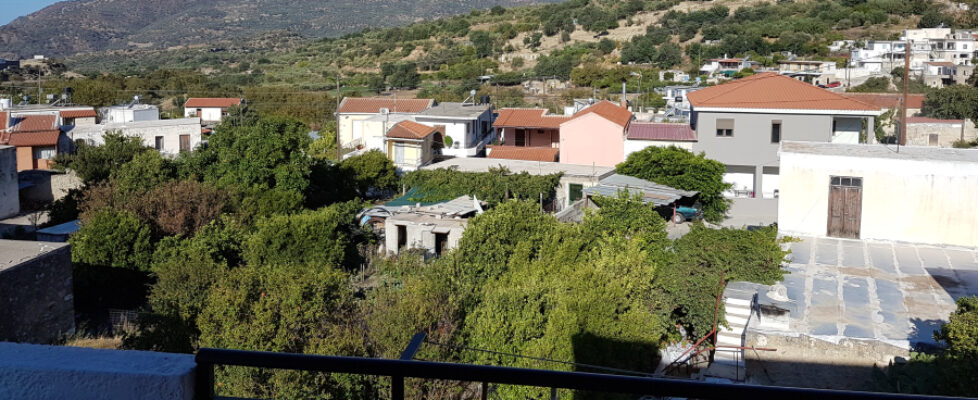
The View from Our Room at Keramos Studios in Zaros
Zaros in Central Crete is a lovely little town. The first time we went we were just passing through and stopped to do a walk in the Rouvas Gorge. We loved the town so much that we said we had to go back and stay sometime – so we did!
Where to Stay in Zaros
Keramos Studios in Zaros
There are a few places to stay in Zaros but we definitely recommend the Keramos Studios and you can read all about our stay there here.
Where to Eat in Zaros
Dining at Vegera in Zaros
You have plenty of choice of eating places but there’s nowhere quite like Vegera, a unique and fun dining experience that we wrote about here.
If you want trout fresh from the lake then the Votomos Taverna is right by a trout farm. It’s about a 20-minute walk or a 5-minute drive from the centre of Zaros.
A Walk From Zaros
We thoroughly enjoyed this circular walk from Zaros to the Rouvas Gorge. It should take 3-4 hours and you can read about it and get directions here. Zaros is on the E4 European Walking Path.
Officially Zaros is only a village but with a population of about 3,000 it’s more like a small town. It certainly has a lively atmosphere and stands out for several reasons.
Zaros Water
One distinctive feature of Zaros is that it has a lake. Lake Votomos is a short walk out of the village to the west, or you can drive there. They farm trout in the lake and you’ll see it on taverna menus. You have to eat trout if you visit Zaros!
The lake is fed by a mountain spring and the spring water is also bottled and well-known locally for its purity. Go into any of the shops in Zaros and ask for a bottle of the local water. You can find out much more about the lake and the area here.
Where is Zaros?
Map (c) Google Maps
As you can see from the map, Zaros is almost slap-bang in the middle of Crete. It’s in the southern foothills of Mount Psiloritis, less than an hour’s drive southwest of Irakleio. The Minoan Palace of Phaistos is a half-hour drive southwest of Zaros, The resorts of Matala and Ayia Galini are also both southwest of Zaros, and a 35-40-minute drive.
What to Do in Zaros
In truth, there’s not a lot to do in Zaros, which is part of its charm. It makes a great base if you’re exploring the area, and in our view is more interesting, more relaxing, and less expensive than nearby resorts like Matala and Ayia Galini.
One attraction is the Vrontisi Monastery, which is about an hour’s walk or a ten-minute drive northwest of town. It’s on the southern slopes of Mt Ida at a height of 550m (1,804ft) and you get wonderful views from there. No-one knows how old it is but there are references to it from the late 15th century – so it’s pretty old!
You can also hike in the area, including the Rouvas Gorge walk we mentioned. Even if you don’t stay at the Keramos Studios, call in and ask about visiting the family farm. They’re set up to do tours and it’s a fascinating insight into rural Cretan life.
Donkey Ride at the Keramos Studios Family Farm
Shopping in Zaros
There are several craft shops in Zaros and we spent an enjoyable half-hour in the weaving shop of Maria Zacharioudakis, admiring the weavings and watching Maria work at her loom.
Zaros is also home to one of the best musical instrument makers on Crete, Antonios Stefanakis. He makes lyra, mandolins, violas, bouzouki, and Cretan bagpipe, and even if you don’t want to buy an instrument he also sells CDs of Cretan music.
This Rouvas Gorge walk starts and ends in Zaros in southern Crete and should take three to four hours with a distance of eight kilometres or five miles.
Map (c) Google Maps
This exhilarating walk from Zaros takes you to a mountain monastery and up a rocky gorge, rich in flora and fauna and with beautiful views of central Crete’s Psilorítis range. If you want to make a full day of it, you can extend the walk to another mountain church. Start early to avoid the worst of the midday heat.
NOTE: These directions were correct at the time of writing but sometimes routes can change so check before setting off.
Zaros
The delightful village of Záros nestles at the southern foot of Mount Ída (Psilorítis). It is famous throughout Crete for its spring water, bottled by a local company on the edge of town. Drive west through town and park on the main road near the post office. (To shorten the walk, you could also drive to the lake).
Lake Votomos
Continue walking along the main road. Just past a modern fountain, you’ll see signs for the Idi Hotel and Lake Votomos. Turn right and follow the narrow road up the hill, past vegetable gardens and an old olive press to the Idi Hotel, about 1 km from town.
The Idi Hotel near the Rouvas Gorge
The road makes a sharp bend to the left. Continue uphill past the trout farm – its fish is a Záros speciality. The road is lined with morning glories, pomegranate and lime trees while the mountains rise up ahead. After 15 minutes you reach the small Lake Votomos, formed by the Záros springs. There’s a good taverna on the south side.
Around the Lake
Both the right- and left-hand paths lead round the shore of the lake and up stone steps. Go through the gate (and close it). Proceed along the dirt path that ascends gently above the olive groves, with views over the valley to the left and the mountain on your right.
Monastery of Áyios Nikólaos
As you round a bend you can see the monastery of Áyios Nikólaos ahead on your left. Although the complex appears modern, its church has frescoes dating from the 14th century. It is home to a small community of monks.
Chapel of Áyios Efthimios
Opposite a little wooden bridge beside the monastery, a set of rock steps on your right leads up to the tiny chapel of Áyios Efthimios, filled with icons.
Into the Rouvas Gorge
Cross the bridge. The path turns sharply to the right and zig-zags up and away from the monastery. Follow the yellow arrows and markings painted on the rocks to guide you through the boulders. You are now entering the Roúvas Gorge, which the locals also call Áyios Nikólaos gorge, after the monastery.
After a short, steep climb you come to a fence. Go right following the arrow as the path curves around the next hill. Take the stone steps up and through a gate. The 1.6 km (1 mile) path through the gorge alternates easy stretches along the herb-covered hillsides with steeper climbs up stone steps. The route is well marked with yellow arrows.
Church of Áyios Ioannis.
The path follows along the steep side of the gorge, then drops down through the ravine and doubles back on the far side. Here it becomes a wide track leading uphill to a signpost. To extend the walk, follow the trail up through the peaks for 2.7 km (1.7 miles) to the mountain church of Áyios Ioannis.
Return to Zaros
To return, follow the sign for Votomos and Áyios Nikólaos. This dirt track is narrow and steep at first, so go slow. There are beautiful views down the gorge to Záros. When you reach some bee hives, walk quickly past and turn left onto a wide dirt road that leads downhill to the monastery. Follow the sign for Votomos that leads round behind it to the wooden bridge, and return to Záros the way you came.
Print the Rouvas Gorge Walk
If you want a copy of this walk to print out then click here.
Keramos Studios in Zaros on Crete is an inexpensive two-star hotel/guesthouse with one of the best breakfasts on the island using food from the family’s farm.
Keramos Studios in Zaros
We’d visited Zaros in Crete several years earlier while researching a guidebook. We didn’t have time to stay there while we did our Rouvas Gorge Walk, but we had time to look around the small village (population about 3,000) and found it a really interesting and charming place. We were determined to return, and eventually got the chance, but this time to stay overnight.
Where is Zaros?
Map (c) Google Maps
Zaros could hardly be more central on Crete. Just look at Google’s map. It’s about an hour’s drive south-west of Irakleio, just under two hours’ drive south-east from Rethymnon, and about half an hour from Matala and Phaistos on the south coast. If you have a car, Zaros would make a great place to be based.
Keramos Studios in Zaros on Crete
Keramos Studios in Zaros
Keramos Studios was easy to find, in the centre of the small village, and there was plenty of parking nearby. Though they call themselves ‘studios’, it’s a combination of guesthouse and 2-star hotel. If you think two stars doesn’t seem much, don’t worry.
Our Room at Keramos Studios in Zaros
While the accommodation is simple, it’s super-clean, has everything you need, the family which runs it are incredibly friendly and helpful, and the room rates are remarkably cheap. We thought it was excellent value for money and would go back like a shot.
Our Room at Keramos Studios
The View from Our Room at Keramos Studios in Zaros
Our room was on one of the upper floors, and there’s a very old-fashioned elevator, which we loved. Our room key was a very old-looking and enormous metal key – yes, a real key! We had a large and comfy double bed, kitchenette (which we didn’t need), an en suite bathroom, a big wooden wardrobe, and a lovely traditional feel to it. We also had a balcony where we could sit and gaze out at the mountains.
Our Room at Keramos Studios in Zaros
Dining at Vegera
Keramos only serves breakfast so we had dinner at the Vegera Restaurant, a one-minute walk away and an inspired choice. See our separate review here: Dining at Vegera.
Breakfast at Keramos Studios
Katerina with the See Greece Team at Keramos Studios in Zaros
By the time breakfast came round, we couldn’t believe it after the feast at Vergera but we were actually hungry again. It was just as well as we’ve never been served such a breakfast spread. It didn’t surprise us when we discovered that the woman who makes the breakfasts fresh every morning is Katerina, the aunt of Vee-Vee who runs Vergera. Cooking and generosity obviously run in the family.
Katerina at Keramos Studios in Zaros
Katerina’s baking is her speciality and she starts very early in the morning in the Keramos kitchen. As well as making bread, she makes about twenty different pies, and between us we managed to sample fifteen of them (I counted)! The waiter just kept on bringing them. He more we praised them, the more he brought.
Our Breakfast Feast at Keramos Studios in Zaros
They included banana pies, several different types of cheese pie, zucchini and mint pies, marmalade pies, raisin pies, milk pies, spinach pies, pumpkin pies with honey and nuts in them, two kinds of chocolate pie, one baked and one fried – eat them with honey, the waiter told us. Chocolate with honey? Yes, it was brilliant.
And as if this wasn’t enough, we were also told to tuck into the buffet of cold meats, cheese, tomatoes, yoghourt, and honey. We admit we did take a small plate, just to keep him happy. Finally, when we assumed we’d finished, he bought us each an omelette. A chip omelette.
The Family Farm
Donkey Ride at the Keramos Studios Family Farm
Katerina’s son, Mikalis, runs the family farm and at Keramos Studios you can book a farm tour, so of course we did one before leaving Zaros. There are three types of tour available, and we did the basic tour as that’s all the time we had.
Cooking Chips for Lunch at the Keramos Studios Farm in Zaros
You can also add a cheese- and bread-making class, or go for the luxury option which adds an outing to gather wild herbs and going back to the farm and making pies with them. You might also join in wine-making, raki-making, or making olive oil, depending on the season.
Bread Fresh from the Oven at the Keramos Studios Farm in Zaros
Our farm tour was wonderful. We were accompanied by Mikalis’s two young daughters, who helped introduce us to all the animals. The chickens had chicks that were a few days old, and one of the goats had a tiny kid with it, which Mikalis picked up and brought over to us. There was a horse, too, and rabbits, pigs with little ones suckling, and donkeys.
Lunch at the Keramos Studios Farm in Zaros
Afterwards we went back to the farmhouse where Katerina was baking bread, then started frying chips and eggs, cutting cheese, and we were treated to a lovely lunch with everything from the farm: tomatoes, cucumbers, olives, peaches, bread, cheese, and of course eggs and chips. Oh, and a little raki. It was delicious and delightful. We highly recommend it, and the Keramos Studios in Zaros. It’s more than just somewhere to stay, it’s a very Greek family experience.
See Greece eats at Vegera in Zaros and finds a cheap but wonderful feast of meat, fish and vegetarian dishes cooked daily with fresh local food.
Dining at Vegera in Zaros
We were staying in Zaros on Crete at the lovely Keramos Studios, where they only serve breakfast, so we walked a minute round the corner and found the Vegera Restaurant. It had been recommended to us by our Cretan guide, Isi from Go Crete, who we knew by now could be relied on to find the best eating places around.
Vegera is run by the vivacious Vee-Vee, who is part of the family that also runs the Keramos Studios. Not only is Vee-Vee quite a character, we were soon to discover that she is also quite a cook.
Vegera Restaurant in Zaros
Dining at Vegera – the Menus
Vee-Vee doesn’t have a regular menu, but three basic menus and you choose from one of these: Full Menu with Fish, Full Menu with Meat, or Full Vegetarian Menu.
Part of the Feast at Vegera
When the restaurant opened way back in 2011 they decided they would only serve food cooked fresh that day. Zaros doesn’t get many visitors so it’s difficult to have a big menu and make everything fresh. They didn’t want to serve people yesterday’s moussaka but instead cook like you would cook at home.
We ordered some red and white wine and told Vee-Vee we would eat anything, so she gave us a mix of all menus. The restaurant was quiet and the food just kept on coming.
The Feast at Vegera
Lentil Soup at Vegera
We started with a dish of lentil soup, which smelled and tasted fantastic. Then some cheese pies arrived, followed by spinach pies, a plate of wild greens, some cabbage leaves stuffed with rice, some stuffed vine leaves, a green salad, stuffed zucchini, stuffed tomatoes, stuffed peppers, several mini moussakas, and finally a main course which was a bigger dish of beef, onion and rice.
Beef Stew at Vegera
We thought that was it, but no. Finally came a whole trout, which the town is noted for as there’s a trout farm here. It’s one of only two places on Crete where they farm trout. To round off the meal, Vee-Vee produced a bottle of raki, and a piece of chocolate cake. When we came to pay I think Vee-Vee simply made up a figure. As it was a remarkably small figure for such a feast, we didn’t worry.
Dining at Vegera
Vee-Vee is very enterprising and also gives cookery courses, organises cooking and wine-tasting holidays, and can arrange for people to eat with the locals. Find out more on the website for the Vegera Restaurant in Zaros.
The best things to do on Crete include the Samaria Gorge, Minoan Palaces at Knossos, Malia and Phaistos, and seeing lovely towns like Hania and Rethymnon.
Samaria Gorge
The best things to do on Crete include hiking the longest gorge in Europe, seeing the remains of vast Minoan Palaces like Knossos, Phaistos and Malia, relaxing in pretty waterfront towns such as Hania, Rethymnon and Sitia, spending a day or more in Iraklion with its marvellous Archaeological Museum, and seeing religious sites like the haunting Arkadi Monastery and the beautiful frescoes in the church of the Panagia Kera. And that’s without even mentioning the beaches!
Best Things to Do on Crete
Here in alphabetical order is our list of the best things to do on Crete:
Agios Nikolaos
Agios Nikolaos
Agios (or Ayios) Nikolaos is one of the prettiest towns on Crete, renowned for its twin harbours. It is therefore very busy too, and the crowds can detract from the enjoyment of it, but it’s well worth seeing. It also has a good Archaeological Museum, and a little Folklore Museum, but its main appeal is the town itself. To learn more see our page all about Agios Nikolaos.
Arkadi Monastery
Arkadi Monastery
It’s an enjoyable drive up a twisty mountain road to get to one of the island’s most significant monasteries. In 1866 hundreds of Cretans were killed here by the occupying Turksh forces, including many Cretan resistance fighters. The monastery has therefore become a symbol of the islanders’ struggle for independence. Don’t miss the ossuary, where the skulls and bones of those who died are preserved and displayed. See our full page about the Arkadi Monastery for further information.
Gortys
Ancient Gortys
Gortys was a Greco-Roman city and the ruins, although small, sprawl pleasantly over fields and olive groves making it a lovely spot to explore. The 6th-century church of Ayios Titos is one of the main ruins, and nearby in what is thought to have been the agora, or market, is a truly unique find. Carved in about 500BC on huge stone blocks is what was the first Code of Law to have been written down in Europe.
Gournia
Gournia
The ruins at Gournia are interesting because they are of an ordinary working Minoan town, not one of the great palaces. The ruins are from about 1500BC and it’s really fascinating to walk among them and discover the houses and workshops. get to the top of the site for a good over-view, and when you do it remember that Gournia was originally four times as big as what you see in front of you. The rest has not yet been uncovered.
Hania
Hania Harbour
Hania, Crete’s second-largest city, is many people’s favourite place on Crete, and we’d find it hard to disagree. It has a really beautiful Venetian harbour, which is the perfect place for a drink or a meal especially in the evening when it bustles with people. The town has good shopping, several excellent museums, and some of the nicest hotels and best restaurants on the island. See our Hania page for more information.
Iraklion
Iraklion Port and Venetian Harbour
Try to spend at least a day in Iraklion, Crete’s capital, or preferably a few days. It’s a lively city with plenty of things to do, including the Archaeological Museum, its Venetian harbour, the Historical Museum, the Icon Museum, several interesting old churches, and plenty of good restaurants too.
Knossos
The Ruins of a Temple at Knossos
The Minoan Palace at Knossos is the biggest attraction on Crete, and well worth at least half a day of your time. There were once over 1,200 rooms here, and some of them have been recreated to give an impression of the scale and grandeur of the palace. The first palace was built here in about 2000BC, but that was destroyed in an earthquake 300 years later. Then an even greater palace was built, but that too was destroyed in 1450BC, possibly by the eruption of the volcano on Santorini causing a huge tidal wave. See our full page on Knossos.
Malia
Malia
Malia Palace is Crete’s third-largest Minoan Palace. It was built in about 1900BC, destroyed in an earthquake then rebuilt in about 1650BC. Its remains with a reddish tinge to the stone make a great place to wander around, and because it’s usually less crowded you have more time to make sense of the ruins.
Panagia Kera
Panagia Kera on Crete
This little Byzantine church is one of the most famous on Crete, known for its 14th- and 15th-century frescoes. They seem to cover every inch of the walls, and make a great impact when you first walk into the church.
Phaistos
Ancient Palace of Phaistos on Crete
The ruins of the Minoan Palace at Faistos are just as enjoyable, if not more so, than the more famous ruins at Knossos. They’re set on a hill overlooking a plain and the site is usually nowhere near as crowded as Knossos. Enjoy the central courtyard, royal apartments, the grand staircase, and the place where the famous Phaistos Disc was uncovered in 1903. This small disc was made in about 1700-1600BC and no-one has ever worked out what it’s spiralling series of pictograms are meant to be. It’s on display in the Irakleio Archaeological Museum. See also our full page all about Phaistos.
Rethymnon
Rethymnon’s Harbour at Night
Crete’s third-largest town has a busy modern side to it but also a great beach and a lovely little port area. It also has a huge Venetian fortress from the 1570s, thought to be the biggest ever built, a good Archaeological Museum, a Historical and Folk Art Museum, and some smart hotels and restaurants. To learn more see our full page all about Rethymnon.
SamariaGorge
Samaria Gorge
Walking the Samaria Gorge, the longest gorge in Europe, is one of the most exhilarating things you can do on Crete. The scenery is spectacular, and while it’s hot and tiring to cover the 11 miles (18kms), it can be done by anyone who’s reasonably fit. In fact it can get over-crowded in the summer, but nothing takes away from the sense of achievement when you reach the Libyan Sea at the southern end, having started from high up in the White Mountains.
Sitia
The Harbour at Sitia
This north-coast town is more visited by Greeks than foreign tourists and so maintains a laid-back and still-Greek feel to it. It has a lovely waterfront area with some very good eating places, and has an Archaeological Museum and a Folk Museum too. The drive to it along the coast from Ayios Nikolaos is one of the most beautiful drives on Crete.
This Amari Valley drive in southern Crete starts and ends in Ayia Galini, takes four to five hours and cover 100 kilometres or 62 miles.
Fishing Boats in Agia Galini
The Amari Valley is one of the most beautiful and fertile regions of Crete. Despite this, and the fact that it is easily reached from popular tourist spots on both the north and south coast, comparatively few visitors venture there. Those that do, enjoy some breath-taking views, see orchards, vineyards and olive groves, and will experience genuine Cretan hospitality in the lovely villages encountered en route.
It is easy to start the drive from Rethymnon, and join this route at Ayía Fotínis (30 km/18.6 miles from Rethymnon), but our route from Ayía Galíni begins with some winding roads with spectacular views.
Amari Valley Drive
Leaving Ayía Galíni
Take the only road out of Ayía Galíni. Ignore the first two roads going off to the left. After 5 km (3.1 miles) take the left turn for Amári and Rethymnon. As you now head north you see the southern slopes of the Psilorítis mountain range ahead of you to the right.
Paraskevi
After 2 km (1.2 miles) a sign in Greek indicates the left turn to Paraskeví, which you take. The road is asphalt but watch out for the pot-holes! There are olive groves on either side, and high in the hills to your left is the mountain village of Mélambes.
In Ayía Paraskeví the church of the Panayía has fine 16th century frescoes, though you will have to park and ask for directions as it is hidden away, off the main road. This road winds up through Ayía Paraskeví and becomes more gravelly with some sharp uphill bends. The high peak on the left on the far side of the valley is Kédhros (1,776 meters/5,827 feet).
To Áno Méros
At the next junction take the left fork towards Rethymnon. This is a wonderful road that snakes down into the valley and up the other side, with many a sharp bend. Passengers may want to look out for eagles and vultures circling overhead.
Some 9 km (5.6 miles) after the junction you reach an unmarked junction. Turn right. 2 km (1.2 miles) beyond is the sleepy hamlet of Khordáki, and a few kilometres beyond that the hill town of Áno Méros, where white houses fill the hillside and there are a few cafés and shops.
Vrises
About 4 km (2.5 miles) beyond Áno Méros is Vríses, where there are more shops and cafés and, on the right of the main road, a large, white war memorial. These Amari Valley villages may look peaceful now, but after the kidnapping of the German General Kreipe during World War II, German troops destroyed the villages by way of reprisal, slaughtering the village men, looting and burning the houses, and even dynamiting schools and cemeteries. The villages you pass through today were rebuilt after the war, although a few old churches survived the destruction.
Yerakári
5 km (3.1 miles) after Vríses is Yerakári, the centre of the cherry-growing area of the valley. If you pull over at one of the shops or tavernas you should be able to buy or sample some cherry brandy or cherry preserve.
Méronas
Continue through Yerakári, and ignore the left turn to Spíli and some minor turns, staying on the main road towards Méronas. In Méronas look for the old church on the right. Park around the next bend where there is a monument to the villagers who have died in various wars from 1717 to 1949.
Walk back to look at the beautiful 14th century Byzantine church of the Panayía. It has lovingly-tended gardens outside, and inside the walls and ceilings are covered with frescoes.
Ayía Fotínis
A few kilometres beyond Méronas is a picnic stop on the right, with fabulous views of the valley. Soon after this is the village of Ayía Fotínis, where you meet a main road: turn right, signposted for the Asomati School. After 1 km (0.6 miles) turn left, for Thrónos.
Thrónos
In Thrónos is the wonderful 11th century church of the Panayía, on the right. Though usually locked, there is part of a lovely mosaic to be seen on the floor outside the church, and beyond it good views of the valley.
To Amari Village
Beyond Thrónos the road forks. Turn right to loop back down and meet the main road again, where you turn left. When you reach the next few houses take the sharp right turn to the village of Amári itself.
In Amári, park in the small square outside the taverna and walk up the nearby narrow street that heads up towards the Venetian Bell Tower. You can climb the tower to enjoy the views but there is no guard rail so take care. Drive back out of the village square the same way you came in, keeping straight on past the Police Station and on through Monastiráki to rejoin the main road.
Fourfourás and Kouroútes
At the main road turn right, signposted Vizári. Drive on through Vizári to Fourfourás. Drive on through Fourfourás and Kouroútes, and as you leave the next village, Níthavris, take the road to Timbáki ignoring the right turn to Ayíos Ioánnis.
Apodoúlou
At Apodoúlou, if time allows, park in the village and look for the signs to the Minoan site which is still being excavated, and to the 14th century church of Ayíos Yiórgios.
Agia Galini
Back to Ayia Galini
Beyond Apodoúlou, ignore the left fork marked Platanías and keep on the main road, to the right but not signposted. Rejoin the main road and turn left towards Timbáki, then at the next junction turn right back to Ayía Galíni.
Amari Valley Drive
If you like, you can print out a PDF copy of this drive by clicking here.
For a Crete olive oil tour See Greece visits Biolea, one of the few olive oil factories on Crete that you can tour.
Biolea Olive Oil Bottles
Biolea is one of the few olive oil manufacturers in Crete that you can visit. So we did, thanks to Isidoros, our tour guide from Go Crete. Outside the factory we are greeted by our guide, Chloe Dimitriadis.
Crete Olive Oil Tour
‘Last week when it rained,’ she says, ‘the trees were happy as it was the first rain for four months.’
It was hard to believe it had rained so recently, as when we arrived in late September it was gloriously hot with temperatures into the low 90s (32-34C). It’s not the kind of weather when you would normally do a factory tour, but this was no normal factory.
Chloe welcomes us and explains that while Biolea may be a factory, they still use a traditional stone press.
‘Crete has one of the biggest concentrations of olive trees in the whole Mediterranean. We make 5% of the olive oil in the world, and Greece is 3rd in the world for olive oil production after Spain and Italy.
‘They’ve been making olive oil here since Neolithic times. The average person in Greece consumes 32 litres of olive oil a year, which is twice as much as in Italy.’
After this explanation of facts and figures, Chloe moves on to what everyone in the small tour group wants to know: How to make sure you get good quality when you buy.
Map (c) Google Maps
Buying Good Quality Olive Oil
‘First look for the word virgin,’ Chloe explains. ‘By EU laws this is 100% pure olive oil. If it doesn’t say virgin, stay away. Extra virgin is the same thing, 100% olive oil, but with lower acidity. Extra virgin isn’t necessarily better than virgin. There are other factors.
‘You must also look for cold-pressed, which means it is done below 27 degrees and hasn’t been burned. If you blast it with heat you get bigger quantities but you lose the health content. Even if you go over 30 degrees you start to lose qualities.’
Chloe knows so much about olive oil because it was her father who started the factory about 25 years ago.
‘He was one of the first to become organic at the time when everyone was going industrial,’ she says. ‘Everyone thought he was crazy!’
Biolea Olive Oil Vats
Chloe explains that they have about 3,000 olive trees in their village, and it takes two months to harvest them. They put nets down on the ground and beat the tree branches with electronic beaters to shake the olives loose. They then get them to the factory as fast as they can, for the ultimate freshness.
She then leads us inside the factory where we see the modern-looking machine that presses the olives, with three large stone presses inside it. The machine works in the traditional way, but eliminates the need to have donkeys trudging around to turn the stones.
One of the hardest things, Chloe tells us, is keeping everything clean.
‘We’re an organic factory so don’t use any chemical cleaners. It’s all done with hot water and pressure – and olive paste is very hard to get off!’
Another tip Chloe passes on to us is to store olive oil either in dark glass or a tin, and to avoid plastic bottles.
Biolea Lemon-Flavoured Olive Oil
Flavoured Olive Oil
As well as producing their natural stone-milled cold-pressed estate olive oil, Biolea also makes two flavoured olive oils, lemonio and nerantzio. These are done by throwing in the peel from lemons or bitter oranges when they mill the olives. At the tasting we do after the tour, both the lemon and the orange olive oil are huge hits. They’re tangy and aromatic, and everyone wants to buy at least one bottle of each.
The company produces about 20,000 litres of olive oil a year, and the production sells out by about March. They could make more but, like many of the food and wine makers we met on Crete, they go for quality over quantity. They use all their own olives, and only buy any in if they have a bad harvest. Even then, they will only buy organic olives from farmers who they are sure know what they’re doing.
Know Your Olives
Chloe then gives us another reason why it’s important to know exactly what you’re buying: ‘80% of Cretan olive oil is exported in bulk in containers to Italy where they blend it with olive oil from Tunisia, Spain and other countries. It’s therefore possible that the Italian olive oil you buy in the supermarket is blended and has Cretan olive oil in it. If it was blended and bottled in Italy then it can be called Italian olive oil, no matter where the olives came from.’
Biolea exports 70-80% of its own production, so if you’re not lucky enough to visit the factory in its idyllic setting surrounded by olive trees and mountains, in Astrikas, west of Hania, where can you buy their organic olive oil?
‘Our biggest market is Japan,’ Chloe tells us, ‘then the USA and Canada, and some European countries too.’
Crete Olive Oil Tour
For details of the free tours of the Biolea olive oil factory, see the Biolea website.
See Greece would like to thank Go Crete for arranging the visit to see olive oil making on Crete.
See Greece reviews the travel memoir An Aegean Odyssey by novelist Kathryn Gauci, an account of a journey to Athens, Chios, Lesvos, Rhodes, Karpathos & Crete.
By Mike Gerrard
What’s most interesting about An Aegean Odyssey for me, a writer, is the fact that the author made her journey through Greece and kept her journals before she had written a single book. She was learning to write as she travelled. She then put the journals away and only returned to them after she felt she had learned to write, as her numerous books and awards testify.
We readers can be thankful for that, as An Aegean Odyssey is an excellent and evocative tale of travels in Greece to very contrasting destinations: Athens, Chios, Lesvos, Rhodes, Karpathos, and Crete.
Gauci had worked in Greece, in Athens, as a carpet designer in the 1970s. About thirty years later, in 2005, she decided, almost on a whim, to put on hold her business as a textile designer in Melbourne and return to Greece in order (she hoped) to become a writer. Her husband, who sounds like a saint, readily supported his wife’s wish to travel halfway round the world and be away from home for two months, in order to try to become a writer… with no indication that she had any writing talent.
Well, her journey did produce a book, but it wasn’t the expected travel diary. It was a novel, which begins in 1822 in one of the places she visited, Chios. The story then moves to Smyrna in Turkey and then to Athens, another stop on the author’s Aegean Odyssey.
An Aegean Odyssey: Athens
An Aegean Odyssey
The first stop on the author’s journey is Athens, where she stays well away from the city centre and the tourist crowds, and reflects on her previous time in Athens, looking for the carpet factory where she works. She makes friends with neighbours and finds out just how much Athens (and she herself) has changed in the thirty years since she lived there. This is not a book where the author visits the familiar sites, and is all the better for it.
To Chios
The author then goes to Chios, a choice influenced by a painting she saw in the Louvre in Paris, Delacroix’s Scenes from the Massacre at Chios. This was painted in 1824, and the author’s first novel begins on Chios in 1822, so you can see how her trip inspired her future fiction writing.
An Aegean Odyssey: The Author
Kathryn Gauci is a British-born award-winning best-selling author who worked in Athens for six years as a carpet designer before settling to live in Melbourne, Australia. Here she ran a textile design studio before turning to writing, her work influencing her first novel, The Embroiderer, set in Greece.
Gauci has subsequently written numerous novels set in both Greece and Turkey, including an acclaimed series set during World War II. She became a USA Today Bestseller and an Amazon Bestseller, and has won several awards for her fiction.
History-Lover
The author is certainly a lover of Greek history – the Chios chapter begins with several pages of it – so if you’re as interested as I am in it, you’ll probably love the book, and the author’s historical novels.
But it’s not all dry factual history. If you’re a lover of good writing, you won’t be disappointed. Take this, for example:
I was surrounded by a palette of diverse, rich colours. Everything was saturated with the Mediterranean sunshine. Glowing purple aubergines contrasted with brilliant red tomatoes and glossy red peppers, bright green peppers, fresh green parsley and baby courgettes. Braids of garlic cascaded everywhere, and the carrots, potatoes, and onions still had a damp smell as if they had just been pulled out of the earth. There were mounds of beans in all shapes and sizes, enormous bunches of spinach, and my favourite of all, the delicate yellow-tipped courgette blossoms. In summer, fragrant fruits added another rush to the senses. Dark, velvety grapes, blush-coloured apricots, and orange-fleshed melons bursting with perfume made one feel glad to be alive.
What a beautiful vivid description – and the book is full of them. The author is clearly very observant, and she draws your attention to aspects of Greek life that you might take for granted, like the sound of church bells or the hand-drawn signs above shop doorways, like this:
The best and most creative signs of all are the milk and cheese shops, vegetable shops, and especially the butchers. They are in the centre of the old market streets, adding extra character to the area. Some of these signs take up the whole of the shop front, covering every centimetre of the wall except for the windows. One butcher has named his shop Eclectic and underneath is written Meats. On each side are stylised images of a leg of lamb and a chop.
I especially liked this comment:
I flop on my bed and watch the news on the BBC, where I am faced with wars, terrorism, and economic doom and gloom, with a little Hollywood gossip thrown in to add spice. I switch it off. Now I know why I left the real world behind me.
I was glad I left the real world behind me in the time I spent reading An Aegean Odyssey. It’s one of the best travel books about Greece that I’ve read in the past few years.
See Greece visits and tours the Manousakis Winery on Crete with a wine-tasting and a chance to buy their tsikoudia, sea salt, olive oil and other goodies.
A twenty-minute drive southwest from Hania brings us to the delightful Manousakis Winery. Their name will be more familiar to you when you know that it’s here they make Nostos Wines, a familiar name on some of the better wine lists in restaurants around Crete.
The winery is very attractive, set out like an old Cretan village, and extremely colourful with flowers growing in old olive oil cans, basil plants in ceramic pots, and a huge rosemary bush growing around the base of a tree.
Flowers in Cans at the Manousakis Winery on Crete
There are tables with bright tablecloths, where people are enjoying meals or snacks, or doing wine-tastings. To one side of the central courtyard, a cookery course is taking place, one of the many events the winery holds, including live music concerts.
Winery Shop
Sea Salt for Sale at the Manousakis Winery on Crete
We explore the winery shop, where we find some of the produce they make here, in addition to the wine. There are pots of sea salt, jars of olive oil, bottles of the Cretan spirit tsikoudia, ceramics made by a local artist, and t-shirts with funny slogans on them. We can’t resist buying the one that says ‘We are what we drink’. In that case, at the moment we’re 50% Cretan wine and 50% raki.
Love Story
Ashfin Molavi, Co-owner of the Manousakis Winery on Crete
Like most vineyards on Crete it’s a family business. The winery is run today by Alexandra Manousakis (whose parents now live in the USA) and her husband Ashfin Molavi. Alexandria had been born in Washington DC and was living in New York when she decided to return to Crete to run the family vineyard.
Ashfin was born in Sweden, trained as a sommelier, and then moved to Athens where he worked in a top restaurant. Here he met Alexandra, who was travelling back and forth from Crete to Athens trying to get the best restaurants there to stock their wines. Before long they were married, and Ashfin was helping run the winery. Ashfin does the blending, and they also have a winemaker and a viticulturalist.
Charity Support
Signs at the Manousakis Winery on Crete
“A percentage of the profits from the first two wines and from our sea salt and olive oil go to a charity for handicapped children,” Ashfin tells us as he gets ready to do a wine-tasting with us. “It goes to a school for children with special needs in Hania. Alexandra had two sisters who were both born early and had problems. We have a saying that ‘many small creeks turn into a river,’ so we do what little we can. Alexandra is on the board of the school as it is something that is very dear to her heart.”
Manousakis Wines
In the Gift Shop at the Manousakis Winery on Crete
“My father-in-law went to the USA at the age of 11 because of poverty, looking for a better life. . He refurbished the house here before the winery existed. He was coming back visiting for 20 years and then in 1993 decided to start the winery. Alexandra took over in 2007, and then I came in 2010. So, let’s try the wines!”
Manousakis Wine Tasting
We started with their 2 Mazi White, which is a blend of two grapes, Roussanne and Vilana, and is made in cooperation with the Lyrarakis vineyard. It’s beautifully fresh and aromatic, with a light citrus aroma, and an easy-drinking white that’s 12% ABV. There’s also a rosé and a red in the same range.
A Wine Tasting at the Manousakis Winery on Crete
“We do 60,000 bottles a year in total,” says Ashfin, “and are a small boutique winery. We plant all our own grapes. We don’t buy in. My father-in-law wanted to make wine that was good enough to be sold in the USA, and not just locally, so he set high standards.”
Next in the tasting is an interesting-sounding wine, a Nostos Muscat of Spinas. Spinas is a village to the west of the vineyard where there are 120-year-old vines of the Muscat grape, originally from Samos. Muscat wine is more associated with Samos, and mainly as a dessert wine. Here at Manousakis they age theirs for 5-6 years and the result is an excellent and very floral regular white wine. It has grassy and citrus notes, as well as the floral sweetness you get from Muscat grapes. It’s also really inexpensive for a wine of this quality, at only 13 euros a bottle at the time of our visit.
A Wine Tasting at the Manousakis Winery on Crete
We then try another white, their Nostos Vidiano 2015. “This is the number one grape variety on the island,” Ashfin explains, “and the number one up-and-coming grape in Greece.” Aged for 6 months in oak barrels, it has that lovely buttery-oaky taste that you get in my favourite chardonnays, and yet this too is only 13 euros.
“You can find our wines in Hania at Salis, which has 500 wine labels on the list. Also at other restaurants, in wine shops and at hotels around Crete. Some go to Athens. We export 30% to Sweden, Denmark, and other European countries, ten countries in all, including the USA.”
We try their Nostos Roussanne 2015, which has the buttery-oaky quality of the Vidiano but with a nuttiness to both the aroma and the taste. Ashfin gives us a taste of the same wine from 2012, and it’s developed a darker colour and an even richer and thicker taste.
A Wine Tasting at the Manousakis Winery on Crete
The Nostos Rosé is pink, very balanced, not too sweet, striking a good balance between light and drinkable, and more complex. The first red we try is the Nostos Grenache 2015. They only plant three red grape varieties, of kinds that you find all around the Mediterranean: Grenache, Syrah, and Mourvèdre. Grenache is originally from Spain, then moved to France, and has been grown on Crete for hundreds of years. It’s a lovely, light and fruity red.
They produce more than three reds, though, as they blend them in different ways. Nostos Alexandra’s is 40% Syrah, 40% Mourvèdre and 20% Grenache Rouge and is a deep ruby red colour with a thick and rich taste of strawberry, cherry, other fruits and spices. It would be wonderful with a good meaty meal.
Vats in the Winery at the Manousakis Winery on Crete
We sip our way through the Cuvée Alexandra (their flagship wine), the Nostos Blend and the Nostos Syrah, whose label shows Alexandra’s grandfather, a carpenter who built the building that became the winery. When you talk about family wineries, this is the kind of thing you mean.
Finally Ashfin kindly treats us to a glass of their Nostos Mourvèdre 2012. They’re the only vineyard on Crete which grows the Mourvèdre grape, and they only have one small plot of it. They only make two barrels a year of this 100% Mourvèdre red wine, which is deliciously rich, fruity, full-bodies, meaty, peppery, floral… the aromas and tastes just go on and on.
Tsikoudia Bottles from the Manousakis Winery on Crete
It’s a perfect end to our Manousakis wine tasting, a rare wine which only they produce on Crete. It’s what wine tourism is all about – meeting with the makers, and trying their unique wines.
Manousakis Wine Tastings
Tours must be booked in advance through their website. It’s not necessary to book tastings in advance although it’s advisable during the busy summer months. https://www.manousakiswinery.com/visit
Our visit to Manousakis was part of a food and wine tour of Crete booked for us by the excellent www.gocrete.net.
See Greece tours the Lyrarakis Winery on Crete, and learns about Crete grape varieties such as plyto, dafni, vidiano, vilana, mandilari and kotsifali.
Touring the Lyrarakis Winery on Crete
The Cretan wine business is booming, a fact that was recognised recently by Wine Enthusiast magazine. It nominated Crete on its shortlist for Wine Region of the Year, along with Champagne, Provence, Sonoma County and the eventual winner, Oregon’s Willamette Valley. Illustrious company indeed.
Touring the Lyrarakis Winery on Crete
Vineyards at the Lyrarakis Winery on Crete
On a tour of one of the island’s biggest wineries, Lyrarakis, we learn one of the reasons why from our guide, Eva Gouvianaki. ‘There are lots of parents who started wineries,’ she says, ‘and now their children are the second generation. They are educated as oenologists, whereas the parents learned simply by doing it. Right now we have specialists, and the wine is better. The parents started and the children took it further. But here we believe in meraki – it means if you’re going to do something you want to do it with passion.’
The Founding of Lyrarakis
Flowers at the Lyrarakis Winery on Crete
Lyrarakis was founded by brothers Manolis and Sotiris Lyrarakis in 1966 and they made an unusual decision which turned out to be farsighted, and another reason for the current success of Cretan wines. They concentrated on growing two local grape varieties, plyto and dafni, which no-one else was using to make wine and which might well now be extinct if not for the Lyrarakis brothers.
Today there are over 50 wineries on Crete, many of them growing familiar imported grape varieties like syrah and merlot, but Lyrarakis and others prefer their native varieties like plyto, dafni, vidiano, vilana, mandilari and kotsifali. They make distinctive wines that are part of the terroir of Crete, the largest and most southerly of the Greek islands.
Karoula Wine Press
Karoula Wine Press at the Lyrarakis Winery on Crete
Before we tour the winery and tastes the wines, Eva drives us out to see another of the Lyrarakis brothers’ legacies, the Karoula wine press. Crete is home to many ancient wine presses, including the oldest known press in the world, some 3500 years old. The Karoula press dates from the 14th century and is carved out of the area’s natural rock.
‘It was a communal press,’ Eva explains, ‘where everyone would bring their grapes to tread them, and the juice would flow down the slope. There was a second pressing nearby. Everyone knew that the press was here, but one of the founding brothers thought it was important to protect it so he reported it to the authorities to help preserve it for future generations. Those are our vines behind the press, the plyto grapes. At one time this whole valley would have been filled with vines.’
Karoula Wine Press at the Lyrarakis Winery on Crete
Cretan wines have a distinguished history. Homer reported that they were known and loved throughout the known world. The Minoans exported wine to Egypt, which is about 400 miles away across the Libyan Sea. In the 15th and 16th centuries, Cretan wines were exported to Venice, where they were rated very highly indeed.
Lyrarakis Today
Snacks Accompanying a Wine Tasting at the Lyrarakis Winery on Crete
Today Lyrarakis, the biggest and oldest winery in the Iraklion region, produces a million litres of wine a year, half of which is exported to the USA, Japan, China and several other countries. In the UK the importers are Berry Brothers and Rudd, who have supplied wine to the royal family since the reign of King George III.
Tasting Room at the Lyrarakis Winery on Crete
Lyrarakis is now run by the second generation, the five children of Manolis and Sotiris Lyrarakis. As we enter the tasting room and impressive restaurant, a young girl enters and skips through the room.
‘And here comes the third generation,’ Eva laughs, as we sit down to taste the wines, and pair them with cheese and other Cretan delicacies. We try the dafni, which has hints of rosemary and lavender – and which you can buy in M&S in the UK. Their Legacy rosé is unusually dark for a rosé, almost a plum colour, while the intensely delicious Malvasia of Crete dessert wine uses a blend of plyto, dafni, vidiano and vilana grapes which are dried in the sun for nine days to concentrate the sugars.
Wines for Sale at the Lyrarakis Winery on Crete
We also try their Symbolo wine, a complex and fruity wine, heavy on the tannin. It’s a flagship wine, only made when the grapes are excellent, and last produced in 2012. The good news is… 2016 was an excellent vintage on Crete, making 2017 the perfect year for wine-lovers to visit.
The Kalimera Archanes renovated stone houses are in the village of Archanes, about 7 miles (11 kms) from the Lyrarakis Winery, and a similar distance from Iraklion Airport. They can be booked through Sunvil Holidays.
See Greece offers a free guide to Crete, aimed at first-time visitors to let them know how to plan and what to expect from a Crete vacation.
Aptera in Crete
Let’s be clear from the start. Our Free Guide to Crete is very much aimed at first time visitors who want to know the basics – what to expect when they arrive, what documents they need, how to get around, that kind of thing.
If you’ve been to Crete before, or elsewhere in Greece, then this guide will probably not offer you anything you don’t know. You can still download it if you like, of course! It’s free, and as a PDF you can save it and pass it on to any friends you think might be interested.
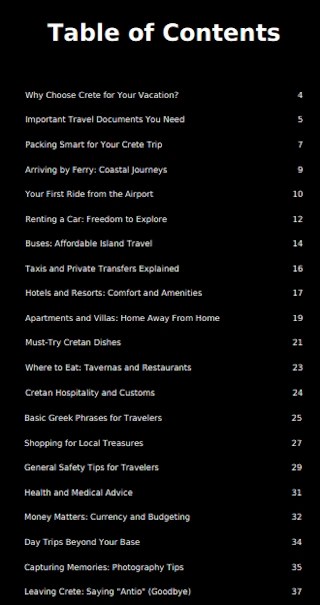
Free Guide to Crete: Table of Contents
As for what’s in the guide, just check out the Table of Contents below. You’ll see that it’s very much an overview of what first-time visitors can expect. As such, we’re happy to offer this 37-page guide free to anyone who might get something from it.
Downloading the Free Guide to Crete
To read or download this Free Guide to Crete, click on this lovely picture of Crete.
See Greece’s guide to Agios Nikolaos on Crete with a brief history and a note of what there is to do and see there, including nearby beaches.
Agios Nikolaos
The port of Agios Nikolaos is one of the prettiest and most popular places on Crete. Justifiably so as it is beautifully located on the Gulf of Mirabello, retains some of its old mansion houses, has a beautiful fishing harbour and another inner harbour which is in fact a lake: Lake Voulismeni.
All these attractions, and many more in and around the town, do turn it into one of the busiest places on Crete in midsummer, yet despite all this it manages to cling onto its own character.
Agios Nikolaos
Agios Nikolaos: A Brief History
Oficially founded in the late 19th century, the town was named after the Byzantine church of Agios Nikolaos (Saint Nicholas) that once stood there. However, the area has ancient roots, with nearby archaeological sites such as the Minoan settlement of Lato dating back to the 8th century BCE.
The modern town grew around a deep, circular lake called Voulismeni, once believed to be bottomless and linked to ancient myths. During the Venetian and Ottoman periods, the region was sparsely populated, but after Crete’s independence in 1898 and union with Greece in 1913, Agios Nikolaos developed into a fishing village.
In the 1960s and 70s, tourism transformed the town into a popular destination, attracting artists, writers, and celebrities. Today, it serves as the capital of the Lasithi regional unit, blending traditional Cretan charm with modern amenities. Its scenic beauty, archaeological sites, and lively waterfront make it a key tourist hub in eastern Crete.
It is also still an important port, and you will find fishermen drying their nets in the harbour, and ferry boats coming in regularly from the Dodecanese, Cyclades and from Piraeus.
The Harbour at Agios Nikolaos
Boats in the Harbour at Agios Nikolaos
The harbour is lined with shops, bars, cafes and tavernas, which make full use of their setting by charging prices that are expensive by Greek standards. If you want better food and a slightly more Cretan atmosphere, forego the setting and wander into the back streets. On the south side of town is a small beach and a marina, also home to some pricey restaurants.
Near the bus station at the western end of the marina is the church of the Panagia Vrefotrofou, which dates back to the 12th century and is yet another Cretan example of the ancient and modern standing side by side.
The Bottomless Lake
Agios Nikolaos
The Lake that acts as the inner harbour, Lake Voulismeni, is known as the Bottomless Lake. It has very steeply sloping sides and is certainly deep for its size, but its depth has been measured at 64m (210ft), which is a long way from bottomless. It links with the outer harbour by a channel that was built between 1867 and 1871.
The Archaeological Museum
Agios Nikolaos also has an excellent Archaeological Museum, slightly out of the centre to the northwest, which is one of the highlights of the town. There are several Minoan sites for the museum to call on, and it has a good display of recovered artifacts.
One notable exhibit is the Goddess of Myrtos in Room II, found at Mochlos just outside Gournia. It is a drinking vessel made of clay and dating back to the early Minoan period. It was obviously used for fertility purposes as it has a neck and head that is clearly phallic but the vessel itself has two breasts shaped onto it.
The most unusual if unsettling exhibit is a skull which is thought to be that of an athlete as it was found intact complete with the golden laurel wreath which was traditionally given for athletics victories, and a silver coin to pay his fare to the ferryman for the journey across the River Styx to the Underworld. The skull was found near the town and can be dated by the coin to the 1st century AD.
Agios Nikolaos
Agios Nikolaos Beaches
The beaches around Agios Nikolaos offer a mix of golden sands, crystal-clear waters, and stunning landscapes, catering to both relaxation and adventure seekers. The most famous is Ammoudi Beach, right in the town center, with soft sand and shallow waters, ideal for families. Nearby, Kitroplatia Beach is another convenient option, featuring tamarisk trees for shade and a lively seaside atmosphere.
Just a 5-minute drive south is Almyros Beach, a long stretch of golden sand backed by freshwater springs, creating a unique mix of cool and warm waters. Along the coast to the north, Ammos Beach in Elounda offers shallow, turquoise waters with views of Spinalonga Island.
For a more secluded experience, Voulisma Beach (Golden Beach) in Istro, about 15 minutes south of Agios Nikolaos, dazzles with its fine white sand and blue waters, often ranked among Crete’s best.
For adventure, Karavostasi Beach, a hidden pebble cove near Plaka, offers tranquility and stunning Spinalonga views, while Ligaria Beach, with its dramatic cliffs, is perfect for diving.
See Greece’s guide to visiting Knossos on Crete with a history of Knossos, what to see and how to get there.
The Ruins of a Temple at Knossos
The Royal Minoan Palace at Knossos was built on a vast scale, with some 1300 rooms, and it remains the prime tourist attraction on Crete. For that reason, give a little prior thought to planning your visit if your time is flexible. The huge crowds that descend here every day throughout the summer, combined with the frequent intense heat, can mar what ought to be a stimulating visit.
When to Visit Knossos
It is far better to try to be at the site, which is easily accessible by bus or by taxi from Iraklion, either at the very start of the day, or in the early evening (in summer the site remains open until sunset.) Mid-day can also be quieter, when the large group tours go off and have lunch. You should also arm yourself with plenty of water and a good map of the site.
The History of Knossos
The Ruins of Knossos on Crete
What you see today are far from being the oldest buildings at Knossos, which was first settled in Neolithic times, about 6000 BC Even the first palace on the site has been dated to 2000 BC, though this was destroyed in an earthquake that took place in about 1700 BC. The present palace is what was rebuilt after that earthquake, and survived until 1380 BC when it too was destroyed, this time by fire. At its height, and when the Minoan civilisation was at its most powerful, it is estimated that there would have been at least 100,000 people living in and around the palace. The site is so vast, covering 75 hectares in all, that only a part of it is open to the public with many more discoveries still to be made.
The Ruins of Knossos
The Knossos Site
It is a confusing site, and you need to be patient and a little imaginative to make the most of a visit. The confusion may well be connected with the fact that the legend of the Minotaur and the Labyrinth came from here, where the wife of King Minos gave birth to the beast that had the head of a bull on the body of a man. Minos confined the Minotaur (which means ‘Bull of Minos’) to a labyrinth from which it could not escape, and he fed it from time to time with human sacrifices. For a long time it was thought that King Minos was just a legend too, until Sir Arthur Evans found the Minoan Palace. In fact the name labyrinth derives from the word labrys, which is a double-headed axe that was a Minoan symbol.
Entering the Site
When you enter the site you pass a bust of Sir Arthur Evans, and behind this are three large pits, probably used for storing grain. As you progress further into the site you will see on the right one of the famous symbols of Knossos, the Horns of Consecration. These have been restored and naturally represent the horns of the sacred bull that would originally have stood at the very top of the palace itself. To the left of the main path almost opposite here are some steps which lead up to the piano nobile or upper floor, where there are the remains of some shrines and good views down over much of the site.
The Throne Room
The Throne Room at Knossos
In this area is the Throne Room, which was in a state of some turmoil when Evans discovered it, leading him to speculate that some significant final event had occurred here, coinciding with the destruction of the palace. In one room is a copy of the original throne, said by Evans to be the oldest known throne in the world, and all around it is a wonderful restored fresco showing several griffins, another sacred symbol to the Minoans. Evans’s reconstruction and restoration work is still the subject of controversy, but it is fascinating to be able to see some of the palace rooms in their probable original state.
Knossos Frescoes
Dolphin Fresco at Knossos on Crete
There are many more frescoes around the site, some restored and some replicas when the original has been removed for safekeeping or display in the Archaeological Museum in Iraklion. One highlight is the Priest-King Fresco, which is just beyond the Horns of Consecration. In the centre of the site is the large, open central courtyard, and beyond this are the main parts of the palace, including the royal apartments. Here the King and Queen lived in some splendour, and the Queen’s Megaron, or Hall, is decorated with a replica of another of Knossos’s highlights, the vivid dolphin fresco.
Ruins of a Temple at Knossos
Visiting Knossos
Getting to Knossos
The site of Knossos is about 5kms (3 miles) south of Iraklion, and you can drive there in about 10-15 minutes. If you’re staying in or near Iraklion you can also easily get there by taxi. You can either arrange to be picked up again later in the day or, if you don’t want to be tied to a time, you can find taxis near the entrance to Knossos as people are always coming and going. You can also get there by bus from Iraklion, and there are numerous organised excursions which include Knossos from most of the main tourist towns on Crete.
Visitor Information
The archaeological site at Knossos is normally open every day in summer from about 8am to 7pm (closes 3pm on Sundays). Winter hours from November to March are usually 8am-3pm daily. However, given the current financial unrest in Greece, these hours can change so always check locally if planning a visit. There is a modest admission fee.
See Greece’s guide to the Cretan Diet, covering what it includes and asking if it really is one of the healthiest diets in the world.
A Healthy Greek Salad
The Cretan Diet is said to be one of the healthiest diets in the world. Several studies have shown this, and fortunately the diet is not just healthy but also very tasty. It blends pulses, olive oil, fresh fruit and vegetables, lots of fresh fish… and the robust but health-giving red wine too.
In addition, the diet incorporates most of the other requisites for healthy eating, including nuts, spices, garlic, bread, cheese and meat. Some people refuse some foods such as meat and cheese, believing them to be unhealthy, but the Cretan Diet shows that a moderate amount of all these items is definitely good for the body.
What Goes into the Cretan Diet?
Vegetables
The Cretan Diet Has Plenty of These
Part of the secret is the quantity of fresh vegetables eaten. Cretans consume three times as many vegetables as other Europeans. These are rich in vitamins and fatty acids, which help fight off heart disease. Most are also organically grown in an ideal climate: mild winters and moderate temperatures in early summer.
Fruit
Plenty of Fruit at Greek Markets
Cretans are also said to eat four times as much fruit as the average southern European (and they eat a lot!), and six times as much as their northern European counterparts. Most notable among the fruits is the orange, which grows in such profusion on the island, even in winter, that sometimes people cannot even give away the crop of oranges on their land.
These provide numerous vitamins in the diet, notably vitamin C. Grapes are eaten as well as turned into wine, grape skins having antioxidant elements which are believed to offer protection against cancer.
Fish
Fish Isn’t Fresher Than This!
Although Crete is a large island, its long, thin shape means that nowhere is so far from the sea that fresh fish isn’t easily available. There are also trout farms in the interior. As well as being full of vitamins, fish oils are known to help protect against heart disease.
Olive Oil
Cretan Olive Oil Bottles
Crete produces especially good-quality olive oil. Olive oil reduces the amount of unhealthy LDL cholesterol in the blood stream, which can lead to clogged arteries, but increases the amount of HDL cholesterol, which helps to break down these fatty deposits.
Next time you have a Greek salad, there is no need to refuse the olive oil in the belief that it is bad for you. Far better to cut down on dairy products, for example eating your bread without butter, as the Cretans do, and only having a modest amount of cheese in the diet.
Wine
Vineyards at the Lyrarakis Winery on Crete
Moderate amounts of wine, especially red wine, are also believed to be generally good for health. Red wine has anti-oxidants which help fight several diseases, and studies have shown that people who drink a moderate amount of wine (roughly one glass per day for women and two for men) live far longer than either tee-totallers or heavy drinkers.
Cretan Diet Research
Research begun in 1956 by the innovative American nutritionist Dr Ancel Keys compared diets, diseases and death rates in seven countries across the world, including Japan, Italy and the USA.
Greek studies were undertaken in Corfu and Crete. Crete had by far the lowest mortality rates for heart diseases and cancer. In Finland, for example, there were 972 such deaths per 100,000 people in 1986, when the studies were still continuing. The figure for Crete was just 38 deaths, the lowest in the world.
Similarly Crete had the lowest rate of deaths from other causes, and lowest incidence of disease. So impressed was Dr Keys by the findings, that he began to follow the Cretan Diet himself… and lived to be 100!
Lyon Study
In a further study of heart patients in Lyon, French doctors divided their patients into two groups. One group was given a conventional low fat/low cholesterol diet, as recommended by the US Society of Cardiology for sufferers from heart disease. The second group was put on the Cretan Diet. The results were astonishing. Mortality rates in the second group were 75% lower than the first group after two years.
The See Greece guide to Rethymnon, third-largest city in Crete with a Venetian fortress, Archaeological Museum, Old Town area and Venetian harbour.
Rethymnon’s Harbour at Night
The third-largest city in Crete with a population of almost 40,000, Rethymnon is in some ways like a scaled-down version of Hania, with its harbour, strong Venetian and Turkish influences and strong traditional culture. Like its neighbour along the coast to the west, Rethymnon also goes by several variations on its name, such as Rethymno and Rethimnon.
The original name of the town was actually Rithymna, and it is known to have been occupied since Minoan times. There are no palatial Minoan remains but there are many from the Greco-Roman period when it was already a busy trading centre and port. During the 16th century Venetian rule it boomed, attaining a reputation for art and scholarship that it retains to this day.
Rethymnon’s Venetian Fortress
Rethymnon’s Venetian Fortress
It was a busy time architecturally too, and the Venetian fortress, which is such a dominant feature of the town, was built in the 1570s to defend against pirate attack and also with one prescient eye on the increasing dominance of the Turks. The strength of the fortress was short-lived, as the Turks conquered it in 1645 after a siege that lasted for 23 days.
The Fortetsa, as it is called, is said to be the biggest Venetian fortress ever built and is still in quite good condition, revealing inside the remains of some administrative buildings, a barracks, cisterns, the church of St Catherine and the Sultan Ibrahim Mosque. It is even big enough to contain a small theatre, used for performances in summer. The views from the huge ramparts over coast and town are worth the visit alone.
Rethymnon
Rethymnon’s Archaeological Museum
Opposite the entrance to the Fortetsa is the former prison, which now houses the Archaeological Museum. The conversion has been well done and the displays are arranged in rooms around a light, central atrium.
Although the city itself is not rich in Minoan remains, the surrounding area certainly is and the museum has an excellent collection of them, including a fascinating and large selection of painted burial chests known as larnakes.
There is also a good range of statuary, especially from the Greco-Roman period when Rethymnon was a prospering outpost. For further details visit the website.
The Old Town
Rethymnon Old Town
To the south of the Archaeological Museum is the old part of the town, with numerous structures of historical interest which seem a long way removed from the jostle of foreign visitors in the harbour tavernas and stretched out along the town beaches. But there is bustle in the old town too, notably around the Rimondi Fountain, which stands at one end of a busy main street surrounded by cafes and shops.
The fountain was built in 1629 by the Venetian governor (allegedly jealous of the Morosini Fountain in Iraklion), with waterspouts in the shape of the lions’ heads that are emblematic of Venice. Close by is an even older building, the 16th century loggia, built by the Venetians as a marketplace.
The Venetian Harbour
Rethymnon Harbour
Near here is the little Venetian harbour, only able to take the smaller boats and the local fishermen, with the bigger inter-island and Piraeus ferries forced to moor outside. It’s in the Venetian harbour that the fishermen can be found mending their nets, and in the mornings selling their catch from the night before.
At the harbour too is another notable Venetian legacy, the 16th century lighthouse. By night here the scene is transformed, as all the world comes here to see and be seen, to eat and drink the night away.
Moni Arkadi
An essential trip out of town is 24km (15 miles) to the southeast where, in a truly spectacular setting at the head of a gorge and surrounded by groves of fruit trees, stands the monastery of Moni Arkadi.
A monastery has stood on this site since the 5th century, with what we see today dating mostly from the 16th century when the Venetians restored the buildings including the audaciously ornate double-naved church which is the site’s most impressive feature. We’ve listed it as one of the best things to see on Crete, and if you want to learn more visit our separate page about Arkadi Monastery.
See Greece’s guide to visiting the Arkadi Monastery on Crete with a brief history, travel tips and a list of the best things to see.
Arkadi Monastery on Crete
Standing proudly at the end of a steep, twisting road on the edge of the Psilorítis Mountains, the Arkadi Monastery contains one of the finest Venetian churches on Crete. But its striking facade is not the only reason to visit. The tragic events that took place here in 1866 made it a national symbol of Crete’s heroic struggle for independence.
History of the Arkadi Monastery
Though Arkadi’s origins date back to the 5th century, the present church was built in 1587, with the surrounding buildings added during the 1600s. By the 19th century it had become one of the most prosperous monasteries on the island and was a centre of resistance against the Turks.
Siege of the Arkadi Monastery
During the 1866 rebellion, nearly 300 guerrilla fighters and some 700 women and children took refuge in the monastery. The Turks laid siege to it, and after three days broke through the gates on 9th November. As they rushed in the abbot ordered the ignition of the gunpowder stores, even though civilians were hiding inside.
Hundreds of people, Cretans and Turks alike, were killed in the massive explosion. The angry Turks slaughtered most of the survivors. But this heroic act of sacrifice galvanised support for Cretan independence both at home and abroad.
Arkadi Monastery on Crete
What to See at the Arkadi Monastery
The Venetian Church
Although the Turks set fire to the Church, its lovely facade of golden stone survived. The two-nave edifice with its graceful bell tower stands in the centre of the courtyard. Inside is a beautifully carved altar screen of cypress wood, executed in 1902. On the right-hand side is a large gilt-framed icon of Christ, part of a scene of the Resurrection from the church’s original altar screen.
Take a close look at the crucifixes high on either side of the church’s altar screen. They both have ladders propped up against the cross and a skull and crossbones at the foot of each one. In the courtyard outside the refectory is an ancient cypress tree with a shell from the Turkish siege still embedded in its trunk. An arrow marks the spot.
The Refectory
To the left of the church is the Refectory, where 36 freedom fighters were massacred. You can still see sword marks on the long wooden table and benches. Above the refectory is a room with portraits of Cretan patriots throughout history.
The Gunpowder Magazine
At the far left side of the courtyard you can step down into the roofless gunpowder magazine – formerly the monk’s wine cellar – where the holocaust took place. A simple shrine commemorates the tragedy.
Fun Fact
The Arkadi Monastery is so important in Greek history that in pre-Euro days it was depicted on the old 100-drachmae note.
Other Features
On the opposite side of the courtyard, the arched stone arcade over the old cloisters is very atmospheric. Above is a small museum which houses historic items from the monastery, including a fragment of the Sacred Banner and the battered old refectory door with visible bullet holes.
The ossuary, housed in a former windmill outside the gate near the parking area, contains the skulls and bones of the people who died in the great explosion.
Arkadi Monastery FAQ
1. Where is Arkadi Monastery located?
Arkadi Monastery is in central Crete, about 23 km southeast of Rethymno. It sits on a scenic plateau at the foot of Mount Ida (Psiloritis).
2. What are the opening hours and entrance fees?
The monastery is typically open daily from 9:00 AM to 7:00 PM in summer (shorter hours in winter). Entry costs around €3–€4, with discounts for students and seniors.
3. Why is Arkadi Monastery historically significant?
It’s a symbol of Cretan resistance against Ottoman rule. In 1866, hundreds of Cretans tragically perished here in a mass suicide explosion rather than surrender during a siege.
4. What should visitors see inside the monastery?
Highlights include the 16th-century Venetian-style church, the historic refectory, the museum (with religious artifacts and revolutionary relics), and the poignant gunpowder storage room.
5. Is there a dress code for visitors?
Yes, modest clothing is required (covered shoulders and knees). Shawls or wraps are sometimes provided at the entrance if needed.
Driving Tip
If driving on towards Elevtherna note that the road is the one which appears to go through the monastery grounds. The signpost is at the far end.
Dining Tip
With nothing else in the area, it’s as well that the monastery has its own restaurant, simple but fine for a meal or snack.
Visitor Information
Phone: 08310-83116 Open: Daily 9am-7pm summer, shorter hours in winter Getting There: There are direct buses from Rethymnon, otherwise you will need a car.
See Greece picks five of the best drives on Crete, including drives from Hania, through the Imbros Gorge, across the Lasithi Plateau and along the south coast.
Road on Crete
Five of the Best Drives on Crete
Crete, Greece’s largest island, is a paradise for road-trippers, offering dramatic landscapes, ancient ruins, charming villages, and breathtaking coastal views. With winding mountain roads, scenic coastal highways, and routes through lush valleys, driving in Crete is an adventure in itself. Here are five of the best drives on the island, each offering a unique experience.
Crete Road Bridge
1. The Road from Hania to Balos Beach & Gramvousa
Distance: ~60 km (one way) | Duration: ~1.5 hours
Why It’s Special:
This route takes you to one of Crete’s most stunning beaches—Balos Lagoon—with its turquoise waters and white sand. The drive itself is an adventure, combining coastal views with rugged terrain.
Route Highlights:
– Start in Hania, a beautiful Venetian harbor town.
– Drive toward Kissamos, then follow signs to Balos.
– The last section is an unpaved road (about 8 km) with steep drops but incredible views.
– Stop at the viewpoint above Balos for a panoramic shot before descending.
– Optionally, take a boat from Kissamos to Balos and the island of Gramvousa, home to a historic fortress.
Best Time to Drive:
Early morning or late afternoon to avoid midday heat and crowds.
Entrance to the Imbros Gorge on Crete
2. The Imbros Gorge Drive (Chania to Hora Sfakion via the South Coast)
Distance: ~75 km | Duration: ~2 hours
Why It’s Special:
This route takes you through the dramatic Imbros Gorge, a less crowded alternative to Samaria Gorge, and ends at the remote southern coast.
Route Highlights:
– From Chania, head southeast toward Vryses, then take the road to Askyfou Plateau, a high-altitude plain surrounded by mountains.
– Continue to Imbros village, where the gorge hike begins (a 3-hour walk downhill).
– Alternatively, drive through the winding mountain roads toward Hora Sfakion, a rugged coastal village.
– Stop at Frangokastello, a seaside Venetian castle with a legendary ghost story.
Best Time to Drive:
Spring or autumn, when temperatures are mild and the landscape is lush.
The Lasithi Plateau on Crete
3. The Lasithi Plateau & Dikteon Cave (Irakleio to Psychro)
Distance: ~50 km (one way) | Duration: ~1.5 hours
Why It’s Special:
This drive takes you through the fertile Lasithi Plateau, dotted with windmills and traditional villages, and leads to the legendary Dikteon Cave, said to be the birthplace of Zeus.
Route Highlights:
– Start in Irakleio, heading east toward Malia and then inland.
– Climb through the Selena Pass, with stunning views of the plateau below.
– Explore Psychro village and hike (or take a donkey) up to Dikteon Cave.
– Visit Tzermiado or Krasi, charming villages with authentic tavernas.
– Return via Neapoli for a different perspective.
Best Time to Drive:
Spring (April-May) when wildflowers bloom, or early summer before the heat peaks.
Chora Sfakion on Crete
4. The South Coast Drive: Loutro to Chora Sfakion & Agia Roumeli
This route explores Crete’s wild south coast, where roads are few, and some villages are only accessible by boat or foot.
Route Highlights:
– From Hora Sfakion, drive east along the coastal road (if you have a sturdy car).
– Stop at Sweetwater Beach, a secluded spot with natural springs.
– Loutro, a car-free fishing village, is reachable only by boat or hiking—park in Hora Sfakion and take a ferry.
– Further east, Agia Roumeli (end of the Samaria Gorge hike) is another remote paradise.
Best Time to Drive:
Late spring to early autumn, when ferry services are running.
Preveli Beach on Crete
5. The Road to Preveli Beach & Kourtaliotiko Gorge (Rethymno to Plakias)
Distance: ~45 km | Duration: ~1.5 hours
Why It’s Special:
This drive combines a stunning gorge, a historic monastery, and one of Crete’s most famous palm beaches.
Route Highlights:
– Start in Rethymno, heading south toward Spili, a village with lion-head fountains.
– Continue to Kourtaliotiko Gorge, where you can stop at a viewpoint or hike down to the waterfall.
– Visit Preveli Monastery, with panoramic sea views.
– End at Preveli Beach, where the Palm Forest meets the Libyan Sea.
Best Time to Drive:
Early morning to avoid crowds at Preveli Beach.
Tips for Driving in Crete
– Rent a sturdy car—some roads are rough or unpaved.
– Drive cautiously—mountain roads can be narrow and winding.
– Fuel up in towns—remote areas may not have gas stations.
– Respect local driving styles—Cretan drivers can be bold!
Each of these drives offers a unique way to experience Crete’s diverse landscapes, from towering gorges to hidden beaches. Whether you seek adventure, history, or relaxation, a road trip in Crete is unforgettable.