See Greece uncovers the best restaurants on Mykonos, choosing those gourmet restaurants known for their fine dining, and some with tasting menus.
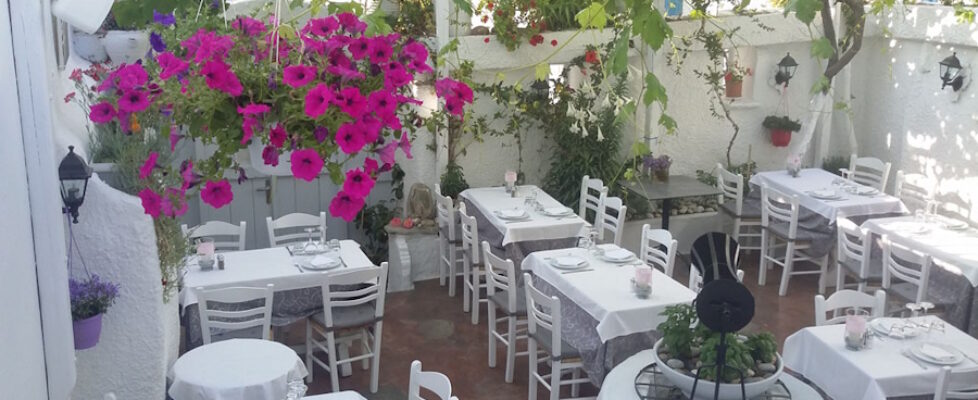
Eva’s Garden Restaurant on Mykonos
Sumptuous dining experiences await visitors to the Greek island of Mykonos in the Cyclades, as it is home to some of the finest and top-quality gourmet restaurants. Food lovers who find themselves on this beautiful island are in for a culinary treat. Today, we’re here to share our list of the best restaurants on Mykonos.
The Chef at the Matsuhisa Restaurant on Mykonos
Best Restaurants on Mykonos
Our first stop is the renowned Matsuhisa Mykonos in the Belvedere Hotel in Mykonos Town. Celebrity chef Nobu Matsuhisa’s restaurant offers an exciting fusion of Japanese cuisine with Peruvian ingredients. Mykonos’ branch continues to uphold the reputation with an exquisite menu and stunning views of the Aegean Sea. Their signature black cod in miso is a must-try.
Next on our list, we have the acclaimed Interni, in Matogianni. This place is a mecca for both Greek food lovers and those seeking an opulent al fresco dining experience. Interni opened ahead of the crowd back in 2000 and features both conventional Greek dishes and modern interpretations, made with the freshest of local ingredients.
Another top-tier establishment is Remezzo, in Polikandrioti. It’s been an iconic destination since 1967 and is perfect for those who love gourmet dining and sophisticated cocktails. With stunning views of the old port, it provides an unforgettable dining experience. How about risotto with asparagus cream, roasted scallops, shrimps and shellfish?
For more fine Italian dining on Mykonos, look no further than Sale&Pepe, in Lakka, . Exceptional Italian cuisine is prepared with a modern twist, ensuring it leaves an unforgettable impression on diners. They have a range of fantastic pizzas, homemade pastas, risottos, and wonderful fresh seafood.
Sample Dish at the Koursaros Restaurant on Mykonos
Our list would be incomplete without mentioning Koursaros, in Meletopoulou. Known for its delicious seafood, its menu encompasses a wide range of Mediterranean seafood dishes, as well as some of the best sushi on the island. The ambiance of its lush garden adds a romantic touch to your night out.
Prepare for an enchanting dining experience at Eva’s Garden, located at Gouma Square in Kalogera. Serving Greek dishes, this place combines tradition and innovation to present flavoursome dishes in a unique rooftop garden setting. Some of the dishes sound simple – dolmades, spinach pie, moussaka – but you won’t find them done better anywhere, and there are more international offerings like penne with smoked salmon or chicken with cashews and soy sauce.
Next on our journey is Buddha-Bar Beach, based at the Santa Marina Resort, Ornos. Perfectly located by the sea, it serves innovative fusion cuisine, and their sushi and cocktails are noted for their flavourful twists. Try their green chicken curry with jasmine rice, or black pepper wok-fried beef.
We wrap up our list with Scorpios, also in Paraga. This well-designed beachfront eating place serves up local cuisine but with an international flair. Their tasting menus offer a variety of stunning dishes, and there’s always something happening here, including music and other events.
While exploring these gourmet eating places, keep in mind that dining in Greece is a leisurely affair. Allow yourself ample time to savour and enjoy the meal.
Don’t worry if you’re not a seafood lover. These fine dining establishments offer a wide selection of meats, poultry, and vegetarian dishes that are equally delicious.
While it’s not necessary to dress up for dinner, some of these establishments encourage smart-casual attire. So, it’s always worth checking before you go.
Don’t forget to make a reservation, especially during peak season. Many of these places are high in demand and might be fully booked.
If possible, plan to dine at sunset. The breathtaking view adds an extra touch of magic.
Consider trying local wines; Mykonos produces excellent wines that wonderfully complement your meal.
If you’re celebrating a special occasion, let the establishment know ahead of time. They often provide added touches to make your evening even more special.
Most of these fine dining places offer both a la carte and set menu options. For a complete culinary delight, consider opting for the tasting menus.
If you have any dietary restrictions or food allergies, let the restaurant staff know in advance. They’re typically very accommodating.
The dining prices in Mykonos may be on the higher side, but the combination of the picturesque views, the exceptional service, and the excellent food all add up to a truly unforgettable dining experience.
Make sure to leave room for desserts. Greek cuisine is famous for its sweet delights, and trust us, it’s worth trying!
In a nutshell, Mykonos is a food lover’s paradise where every diner can find something to satisfy their palate. “Kali Orexi” or as they say in French, “Bon Appétit!”
See Greece picks the ten best budget hotels on Santorini, some with caldera views, some near beaches and some close to the heart of Fira.
Villa Iliovasilema, Santorini
Santorini is famous for its breathtaking sunsets, whitewashed buildings, and stunning caldera views. While it’s often associated with luxury resorts, there are plenty of budget-friendly hotels that offer comfort, charm, and excellent service. Below is a list of the ten best budget hotels on Santorini, each with a brief description, address, and website for easy booking.
We always recommend booking direct with hotels for the best prices, and to make it easier if you need to change or cancel. Some hotel booking websites lead you to believe that they have the best prices, but this isn’t always the case so always check direct with the hotel rather than believing what you read. If the hotel’s prices seem to be higher, then ask if they’ll price-match. Hotels pay a hefty booking fee to these websites, so if they price-match they get all of the money for themselves with no booking fee to pay.
Ten Best Budget Hotels on Santorini
Hotel Keti
Hotel Keti, Santorini
Location: Fira
Description: Hotel Keti is a cozy, family-run hotel just a short walk from Fira’s bustling center. The rooms are simple but clean, with traditional Cycladic architecture and some offering caldera views. The hotel has a lovely terrace where guests can enjoy breakfast with a view. It’s perfect for travelers who want affordability without sacrificing location.
Description: This charming hotel offers stunning caldera views at a fraction of the price of luxury resorts. The rooms are decorated in classic Santorini style, with white walls and blue accents. The highlight is the sunset-view terrace, perfect for relaxing after a day of exploring.
Description: Located near Perissa’s famous black sand beach, Sunny Villas offers affordable studios and apartments with kitchenettes. The property has a pool, garden, and a relaxed vibe, making it great for budget-conscious travelers who want to stay near the beach.
Description: A budget-friendly option in the heart of Fira, Hotel Matina features clean, minimalist rooms with balconies overlooking the town or the sea. The staff is friendly, and the location makes it easy to explore Santorini’s nightlife and attractions.
Description: This small, family-run resort hotel is just a few minutes from Kamari Beach. The rooms are bright and airy, with balconies and some offering sea views. The hotel has a pool and a peaceful garden, ideal for relaxation.
Description: A great budget choice near Perissa Beach, Pension George offers simple but comfortable rooms with private balconies. The hotel has a pool and a welcoming atmosphere, making it a favorite among backpackers and budget travelers.
Description: This charming hotel offers affordable rooms with caldera views, just a short walk from Fira. The traditional architecture and friendly service make it a great budget option for both couples and solo travelers.
Description: A short walk from Kamari Beach, Hotel Antonia offers clean, modern rooms with balconies. The hotel has a pool and a relaxed vibe, perfect for travelers who want a beachside stay without the high price tag.
Formerly known as Hotel Zorzis, this charming budget hotel is now called Spiros & Hiroko Hotel and is adults only. Located in the heart of Fira, it offers simple, clean, and comfortable rooms with private balconies. The friendly staff and excellent location make it a great choice for travelers who want to explore Santorini’s nightlife, restaurants, and attractions without spending too much on accommodation.
Description: These stylish, budget-friendly hotel apartments offer stunning caldera views and a peaceful setting. The rooms are spacious, with kitchenettes, making them ideal for longer stays. The sunset views from the terrace are unforgettable.
Santorini doesn’t have to be expensive—these ten of the best budget hotels prove that you can enjoy the island’s beauty without overspending. Whether you prefer a beachside stay in Kamari or Perissa, or a caldera-view room in Fira or Firostefani, there’s an affordable option for every traveler.
See Greece brings you a choice of the best beaches on Mykonos, from family-friendly to LGBTQ+-friendly and from peaceful to party beaches.
Whether you are young or old, traveling with your family, or seeking a solo adventure, Mykonos has a beach to suit every taste and preference.
Mykonos is renowned for its crystal-clear turquoise waters, golden sandy shores, and picturesque landscapes. The island boasts over 25 stunning beaches, each with its own unique atmosphere and allure. Whether you seek a tranquil hideaway or a lively beachfront party, Mykonos has it all.
For those yearning for tranquility and relaxation, the serene beaches of Agios Sostis and Fokos are perfect choices. Nestled away from the bustling crowds, these unspoiled stretches of sand offer a peaceful escape and breathtaking natural beauty. Feel the soft sand beneath your toes as you bask in the warm Mediterranean sun, enjoying the gentle lapping of the waves.
If you are in search of vibrant beach parties and a buzzing social scene, Mykonos has you covered. Paradise and Super Paradise beaches are legendary for their energetic atmosphere, where international DJs spin the latest tunes and beach clubs host lively events throughout the summer. Join the carefree crowd, sip refreshing cocktails, and dance your heart out on the sun-drenched shores.
Busy Mykonos Beach
Families visiting Mykonos will prefer the family-friendly beaches of Platis Gialos and Ornos. These well-organized beaches offer shallow, calm waters, making them ideal for children to splash around and build sandcastles. Enjoy a variety of water sports, dine at seaside tavernas, or simply relax.
Mykonos also prides itself on being an LGBTQ+ friendly destination, with a vibrant gay scene. The iconic Super Paradise beach, with its welcoming atmosphere and lively beach bars, has long been a favorite gathering spot for the LGBTQ+ community. Embrace the freedom to be yourself and enjoy the open-minded spirit that permeates the island.
Paradise Beach: The Ultimate Party Destination
Welcome to Paradise Beach, the crown jewel of Mykonos and the ultimate party destination.
Known worldwide for its legendary beach parties, Paradise Beach offers an unparalleled experience that will leave you with unforgettable memories. As you step onto the golden sand and feel the warm sun on your skin, the pulsating beats of the music will start to draw you in. Brace yourself for a day filled with non-stop dancing, refreshing cocktails, and an atmosphere charged with energy.
Paradise Beach caters to all tastes and preferences. Whether you’re looking for a tranquil spot to relax or a wild party scene, you’ll find it here. Families can enjoy a designated area with gentle waves and plenty of space for sandcastle building, while singles and groups can venture into the heart of the action. The beach is also known for being gay-friendly, welcoming and celebrating the diversity of the LGBTQ+ community.
Once the sun sets, Paradise Beach transforms into an even more vibrant place. The beach clubs and bars light up, casting a colorful glow across the sand. Join the crowd as DJs from around the world spin their tracks, creating an electric atmosphere that will make you lose track of time. Dance under the stars, sip on delicious cocktails, and immerse yourself in the lively Mykonos nightlife.
If you’re seeking an adrenaline rush, Paradise Beach offers a variety of water sports for thrill-seekers. From jet skiing and parasailing to windsurfing and wakeboarding, there’s something for every water enthusiast. Challenge yourself or simply watch the experts show off their skills while you relax with a refreshing drink.
Paradise Beach truly lives up to its name, providing an idyllic setting for a day of fun and excitement. So pack your beach essentials, put on your dancing shoes, and get ready to experience the ultimate party destination.
Super Paradise Beach: A Haven for LGBTQ+ Travelers
Welcome to Super Paradise Beach, the ultimate destination for LGBTQ+ travelers visiting the stunning island of Mykonos. Known for its vibrant and inclusive atmosphere, Super Paradise Beach offers a unique and unforgettable experience that caters to visitors of all ages, backgrounds, and sexual orientations.
Nestled on the southern coast of Mykonos, Super Paradise Beach boasts crystal-clear turquoise waters, golden sandy shores, and breathtaking views of the Aegean Sea. This iconic beach has become synonymous with the LGBTQ+ community, drawing in a diverse crowd from around the world.
As you step onto the shores of Super Paradise, you’ll immediately feel the energy and acceptance that permeates the air. Whether you’re young or old, traveling with your family, or exploring the island solo, Super Paradise Beach welcomes everyone with open arms.
For LGBTQ+ travelers, Super Paradise Beach is a sanctuary where you can embrace your true self and celebrate love and diversity. This beach has a long-standing reputation as a safe space and a hub for LGBTQ+ individuals to connect, socialize, and create lasting memories.
Throughout the day, you’ll find an array of beach clubs and bars lining the coast, each offering its own unique vibe. From lively beach parties to relaxing lounges, there’s something for everyone. Dance under the sun to the beats of world-renowned DJs, sip on refreshing cocktails, or simply bask in the warm Mediterranean sun.
Super Paradise Beach is also famous for its vibrant nightlife scene. As the sun sets, the beach transforms into a playground for partygoers, with clubs and bars coming alive with music and laughter. The lively atmosphere is contagious, and you’ll find yourself dancing the night away alongside fellow travelers from all walks of life.
While Super Paradise Beach is renowned for its LGBTQ+-friendly environment, it’s important to note that it is a destination for all visitors. The beach’s inclusive atmosphere allows for a wonderful blend of cultures and identities, creating a harmonious and accepting environment for everyone.
So, whether you’re seeking a relaxing day under the sun, a thrilling party experience, or a place to connect with like-minded individuals, Super Paradise Beach is the perfect destination. Come and discover why this beautiful stretch of sand has become a haven for LGBTQ+ travelers and a must-visit spot on your Mykonos travel itinerary.
Psarou Beach: Luxurious Sunbathing and Celeb Spotting
Psarou Beach is a true gem of Mykonos, offering visitors an exquisite blend of luxurious sunbathing and the thrill of celebrity spotting. Whether you are a young adventurer, a family seeking a relaxing retreat, a single traveler in search of excitement, or a member of the LGBTQ+ community looking for a welcoming destination, Psarou Beach has something to offer everyone.
Nestled on the southern coast of Mykonos, Psarou Beach boasts crystal-clear turquoise waters, golden sandy shores, and a vibrant atmosphere that sets it apart from other beaches on the island. If you’re a sun seeker, you’ll be delighted to find plush sunbeds and umbrellas lining the beach, providing the perfect spot to soak up the Mediterranean sun and indulge in pure relaxation.
Psarou Beach is not only a paradise for sun worshippers but also a hotspot for the rich and famous. Known as a celebrity magnet, this beach has attracted the likes of Hollywood stars, international jet-setters, and prominent figures from around the world. Keep your eyes peeled while you sunbathe, as you may just spot a familiar face lounging nearby or sipping a cocktail at one of the fashionable beach clubs.
For those seeking an extra touch of luxury, Psarou Beach is home to some of the most exclusive beach clubs in Mykonos. These establishments offer a lavish beach experience, complete with VIP services, world-class cuisine, and top-notch entertainment. Indulge in delectable Mediterranean dishes, sip on refreshing cocktails, and dance the day away to the pulsating beats spun by renowned DJs.
Psarou Beach is also a haven for water sports enthusiasts. Whether you’re a thrill-seeker or a beginner, you can try your hand at various activities such as jet skiing, paddleboarding, or even diving to explore the vibrant underwater world. The beach is equipped with top-quality rental facilities and experienced instructors who will ensure an unforgettable experience for all.
In addition to its luxurious offerings, Psarou Beach is renowned for its inclusivity. Mykonos has long been celebrated as a gay-friendly destination, and Psarou Beach is no exception. Visitors from the LGBTQ+ community will find a warm and accepting atmosphere, making it an ideal spot for sunbathing, socializing, and connecting with like-minded individuals from around the world.
Psarou Beach truly encapsulates the essence of Mykonos, offering a perfect blend of luxury, natural beauty, and an exciting social scene. Whether you’re looking to bask in the sun, enjoy a celebrity sighting, partake in thrilling water sports, or simply unwind in an inclusive environment, Psarou Beach is a must-visit destination for every traveler to Mykonos.
Ornos Beach: Family-Friendly Relaxation
When it comes to finding the perfect spot for some family-friendly relaxation on the vibrant island of Mykonos, look no further than Ornos Beach. With its calm, crystal-clear waters and sandy shore, Ornos Beach offers a safe and inviting environment for visitors of all ages.
Located just a short distance from Mykonos Town, Ornos Beach is easily accessible and offers a range of amenities that cater to the needs of families. Whether you’re traveling with young children or teenagers, this beach has something for everyone.
For families with little ones, the shallow waters of Ornos Beach provide a safe and enjoyable space for children to splash and play. Parents can relax on sun loungers while keeping a watchful eye on their kids. Snorkeling and swimming are also popular activities for families to enjoy together, creating lasting memories in the clear blue sea.
If you’re in need of some shade or a break from the sun, Ornos Beach offers a variety of beachfront tavernas and restaurants. Here, visitors can indulge in traditional Greek cuisine while taking in the stunning views of the Aegean Sea. From fresh seafood to mouthwatering souvlaki, there’s something to satisfy every palate.
For those seeking a bit of adventure, Ornos Beach also offers a range of water sports activities. From jet skiing to paddleboarding, there’s no shortage of options to keep the whole family entertained. The nearby marina also offers boat trips and excursions, allowing visitors to explore the beautiful coastline of Mykonos.
Ornos Beach is not only family-friendly but also caters to visitors from all walks of life. Whether you’re a solo traveler, part of a couple, or a member of the LGBTQ+ community, Ornos Beach welcomes everyone with open arms. Its diverse and inclusive atmosphere makes it a favorite among locals and tourists alike.
So, whether you’re looking for a relaxing day by the sea or an exciting water sports adventure, Ornos Beach is the ideal destination for a family-friendly getaway on the enchanting island of Mykonos. Dive into the crystal-clear waters, soak up the Mediterranean sun, and create unforgettable memories with your loved ones at this idyllic beach paradise.
Agios Sostis Beach: Tranquility and Natural Beauty
As you explore the enchanting island of Mykonos, there’s one beach that stands out for its tranquil atmosphere and untouched natural beauty – Agios Sostis Beach. Tucked away from the bustling crowds and vibrant nightlife that Mykonos is famous for, this hidden gem offers a peaceful retreat for visitors of all ages and backgrounds.
Located on the northern coast of the island, Agios Sostis Beach is a haven of serenity that remains unspoiled by commercial development. Its untouched sandy shores and crystal-clear turquoise waters create a picturesque setting that will take your breath away. Whether you’re seeking solitude or quality time with loved ones, this beach is the perfect escape.
Agios Sostis Beach is a beloved spot among locals and seasoned travelers who appreciate its natural charm. Unlike the more popular beaches in Mykonos, you won’t find rows of sunbeds or beach bars here. Instead, you’ll have the opportunity to immerse yourself in nature’s embrace, feeling the soft sand between your toes and listening to the soothing sound of waves crashing against the shore.
With its pristine surroundings, Agios Sostis Beach is an ideal spot for sunbathing, swimming, and simply unwinding. The absence of commercial establishments allows you to fully appreciate the unspoiled beauty of the Aegean Sea. If you’re a nature enthusiast, take a leisurely stroll along the beach and explore the rocky coves and hidden crevices. You might even catch a glimpse of the local wildlife, including seabirds and marine life.
While Agios Sostis Beach lacks the amenities offered by other beaches, it compensates with its unpretentious and authentic atmosphere. Visitors are encouraged to bring their own towels, umbrellas, and refreshments to fully enjoy the peaceful ambiance. It’s the perfect setting for a picnic with loved ones or a quiet read under the shade of a tree.
As you plan your trip to Mykonos, don’t miss the opportunity to visit Agios Sostis Beach. Whether you’re a young adventurer, a family seeking quality time, a single traveler in search of tranquility, or a member of the LGBTQ+ community, this serene paradise welcomes everyone. Discover the true essence of Mykonos at Agios Sostis Beach – a place where natural beauty and peace come together to create an unforgettable experience.
Ftelia Beach: Windsurfing and Serenity
Nestled on the northern coast of Mykonos, Ftelia Beach is another hidden gem that offers a unique blend of thrilling watersports and tranquil serenity. This subchapter explores the wonders of Ftelia Beach, captivating both adventure seekers and those in search of a peaceful escape.
For the adventurous souls, Ftelia Beach is a windsurfing paradise. With its steady winds and crystal-clear waters, it attracts windsurfers from all over the world. Whether you’re a seasoned pro or a beginner looking to learn, Ftelia Beach has something for everyone.
The beach is equipped with windsurfing schools and rental shops, making it accessible to all levels of experience. So, grab a board, catch the wind, and embark on an unforgettable windsurfing adventure at Ftelia Beach.
Beyond its thrilling windsurfing opportunities, Ftelia Beach offers a serene escape from the bustling crowds of Mykonos. Surrounded by rugged hills and untouched natural beauty, this beach is a haven for those seeking tranquility. The peaceful atmosphere invites visitors to relax and unwind, basking in the warm Mediterranean sun. Picture yourself lying on the soft golden sand, listening to the gentle lapping of the waves, and feeling the stress melt away. Ftelia Beach is the perfect spot to recharge and rejuvenate your mind, body, and soul.
As part of its appeal to a diverse audience, Ftelia Beach welcomes visitors of all ages and backgrounds. Whether you’re traveling with family, friends, or on your own, this beach offers something for everyone. The wide expanse of sandy shore provides ample space for families to build sandcastles and enjoy quality time together.
Meanwhile, solo travelers and groups of friends can enjoy beach volleyball or simply lounge under the shade of an umbrella, sipping on refreshing cocktails from the beachside bars.
Ftelia Beach also embraces diversity and inclusivity, making it an ideal destination for the LGBTQ+ community. Mykonos has long been celebrated for its vibrant and inclusive atmosphere, and Ftelia Beach is no exception.
In conclusion, Ftelia Beach is a mesmerizing destination that combines the thrill of windsurfing with the tranquility of a secluded paradise. Whether you’re seeking adventure or simply looking to unwind, this beach offers a little slice of heaven for visitors of all ages, backgrounds, and preferences. So, pack your bags, grab your board, and get ready to discover the magic of Ftelia Beach on your journey through Mykonos
The best time to visit Mykonos depends on if you want crowds or quiet, heat or cooler temperatures, all of which affect when is the best time to visit Mykonos.
Mykonos Bougainvillea
The best time to visit Mykonos in the Cyclades will vary from person to person, depending what you want. If you want to visit Mykonos at its busiest, when nightclubs are buzzing, the beaches are packed, and the social life is at its height, then the best time is August. For other people, though, this would be the absolute worst time!
Best Time to Visit Mykonos
Mykonos Shoes for Sale
Mykonos in July and August
If you do visit Mykonos in August then you are guaranteed sunshine and no rain. There is usually no rainfall in either July or August, though in early July you might get a very brief light sprinkling.
The average high temperature in August is about 27C (80F), and just a degree or so cooler in July. Remember that’s the average high for the month, so some days are going to be much hotter than that. It also doesn’t cool down much at night so you’d better have air-conditioning or at least a fan.
Little Venice in Mykonos Town
Mykonos Meltemi
Another factor in deciding the best time to visit Mykonos is the Greek wind called the Meltemi. This blows down through the Aegean from the north in July and August, and can make being on a sandy beach very unpleasant. So if you like beaches and want to go in July and August, choose somewhere on the more sheltered southern coast.
Mykonos Cat
Mykonos Crowds
You will obviously only visit Mykonos in August if you don’t mind crowds. The beaches are busy, the nightlife is busy, and Mykonos Town is busy. The crowds in Mykonos Town are also added to by the cruise ships which arrive and disgorge their passengers daily in season. Some visitors prefer to avoid Mykonos Town then, and return in the early evening when the cruise passengers have gone back to their ships.
The steadily increasing numbers of cruise passengers visiting Mykonos has in fact become something of a problem. Sometimes you can hardly move through the narrow streets of Mykonos Town, and local businesses have complained that cruise passengers spend little money on the island. In 2025 the Greek government introduced a cruise passenger tax, and Mykonos has one of the highest rates in Greece.
Mykonos Pelican
Swimming on Mykonos
If you’re a beach person and like swimming, bear in mind that the later you leave it, the warmer the sea temperature will be, so you might want to consider early September – very similar to August, slightly fewer people around, but everything will still be open.
Mykonos
Is October the Best Time to Visit Mykonos?
Many people say that October is the absolute best time to visit Mykonos. Our view is that you should visit in early October, as later in the month some places start to close down for the season. The peak season is so frantic and busy on Mykonos, that some people decide they need a break and close down earlier than they might do on other less-busy islands.
October Weather on Mykonos
Later in October the weather will start to cool off just a little, though it will certainly remain pleasant and warm. There will be an increasing chance of a few rainy days, though. The average high temperature in October is 24C (75F), which is warm enough for most people. You can still enjoy swimming, hiking or other outdoor activities.
Mykonos
Visiting Mykonos in Winter
The difference between Mykonos in summer and in winter is huge, in all kinds of ways. You have to know what to expect of Mykonos in winter just as much as if thinking of visiting in summer, probably even more so as you can probably guess what August is like!
To begin with, many hotels, restaurants, bars, cafes and shops will have shuttered up their businesses for winter, closing in about late October and not opening again till about April. Some businesses use Greek Easter as a sign of the start of the tourist season.
Mykonos
You should probably still be able to find somewhere to stay, perhaps on Airbnb or somewhere like that, but you won’t find the large resort-style hotels open. There simply aren’t enough visitors to warrant them staying open.
You will also probably be able to find a place to eat, though your choice will be much more limited. It’s also going to be too cold for swimming, unless you’re really hardy. December-March are the coldest months with the average high in January being only 14C (57F). January is also the wettest month and on average there will be 11 days in January on which it rains. That’s not good news if they coincide with your visit.
Another disadvantage is that the archaeological site on the island of Delos is closed over the winter months. Again it’s a matter of economics. You have to take a boat to get there and there aren’t enough visitors to keep the boats in business or to warrant having staff on Delos.
Little Venice on Mykonos
Is the Best Time to Visit Mykonos at Easter?
Greek Easter is a fantastic time to be anywhere in Greece, as we’ve done it several times and have always had unforgettable experiences. It would certainly be a memorable time to visit Mykonos. Our advice would be to book your transport and your accommodation early. People born on Mykonos like to return home for Easter.
Depending on the dates for Greek Orthodox Easter, which aren’t usually the same as the Christian Easter, the weather should be pleasantly warm, though you might get some rain.
Mykonos Sunset
The Best Time to Visit Mykonos
As we said, the best time to visit Mykonos depends what you want to do when you’re there. If you want to party, go clubbing, get the warmest weather, then absolutely July/August is the time to go. If you have broader interests and want to spend some time on the beach but also visit Delos and maybe have a good choice of places to eat out and enjoy warm weather (and OK, risk a day or two of rain) then try June or late September/early October.
The See Greece guide to the best things to do on Mykonos, including nightlife, beaches, churches and visiting the ancient site of Delos.
Little Venice in Mykonos Town
At only 85.5 sq kms (33 sq mi) and with a population of about 10,000, Mykonos is a fairly small island. Yet there are enough things to do on Mykonos to keep people visiting year after year, and making it one of the most popular islands, not only in the Cyclades but in the whole of Greece.
Best Things to Do on Mykonos
Mykonos Beaches
Mykonos may not have the best beaches in Greece but it certainly has some of the busiest. You don’t go to Mykonos for a beach holiday and hope to get away from it all. It does have some good beaches but aesthetics doesn’t come into it if a beach gets a reputation for being ‘the’ place to be one year.
If you want to sample Mykonos’s beaches you need to do some homework first and ask what the various beaches are like. If you’re staying in Mykonos Town – which is the only major settlement on the island – then you can reach a number of beaches by either bus or by boat. Be sure to check what a beach is like, and what facilities are there if you’re thinking of being dropped at a particular beach. Also double-check the return times for buses and boats.
The most famous, or notorious, beach on Mykonos is Paradise Beach. This is on the south coast, about a 20-minute drive from Mykonos Town, so close enough to get a taxi there and back if you’re not renting a car or other transport. It is a lovely big sandy beach, though in summer you can hardly see the sand for the bodies packed on top of it. It is the beach to go to if you want to join in Mykonos’s party scene, with lots of lively beach bars and music.
Not to be out-done, the next beach along has dubbed itself Super Paradise, which is more of the same but has also become known as gay-friendly and, at one end, is also a clothing-optional beach.
Mykonos
Mykonos Churches
Mykonos has a remarkable number of churches, and there’s a reason for that. It used to be a law that if you wanted to build a house on your land you must first build a church on it. Many of these churches survive, some of them tiny, but none of them photographed as much as the Panagia Paraportiani (Church of Our Lady).
Mykonos Church
This strange-looking church is actually a collection of four small chapels that have been amalgamated into one building. It stood next to the entrance to the old castle, or kastro, which used to exist here and which gives its name to the whole district of Kastro.
Mykonos Monasteries
Mykonos also has a couple of monasteries worth seeking out, one in and the other near the island’s second settlement, the village of Ano Mera. Right on the village’s main square is the 16th-century Monastery of Panagia Tourliani, while just to the north of the village is the even older 12th-century Paleokatro Monastery.
It takes about 90 minutes to walk from Mykonos Town to Ano Mera, which is right in the centre of the island and a world away from the beaches and nightlife.
Mykonos Museums
Despite its party reputation, Mykonos does have a lot of culture to take in as well. It has, after all, been inhabited since at least the 11th century BC and since then has been inhabited by the Romans, been part of the Byzantine Empire, been invaded by the Venetians, and then the Turks. Mykonos played an important part in the Greek War of Independence.
All of this history is celebrated in several museums in Mykonos Town. Here you’ll find the Archaeological Museum, with much about Delos of course, and also a Maritime Museum. There’s also a Folklore Museum and finally there’s Lena’s House, a restored 19th-century family home.
Mykonos Nightlife
Mykonos Windmills at Night
It’s impossible to list all the nightlife options on Mykonos, some of which in any case change from year to year. Mykonos Town is the nightlife capital of the Cyclades, and if that’s your thing then you won’t be disappointed. Take plenty of cash and plastic, though, as Mykonos Town is also the most expensive place in the Cyclades.
Visiting Delos from Mykonos
Terrace of the Lions on Delos
If you want to see the unique archaeological site of Delos – unique because the entire island, which has no inhabitants, is an ancient site – then you have to go by boat from Mykonos. Boats start to leave Mykonos in the early morning and keep going through to about 5pm, in season. They allow you to spend a few hours on Delos, till the site closes. This is usually mid-afternoon out of season and by about 8pm in the summer season.
No-one is allowed to stay overnight on Delos. The island only has one small café so be sure to take food and drink with you.
See Greece’s guide to six fun things to do on Santorini, such as listening to Greek bagpipes, enjoying Santorini beers & visiting an old tomato canning factory.
Santorini Tomato Industrial Museum
This list of six fun things to do on Santorini in the Cyclades include visiting an old tomato canning factory, listening to Greek bagpipes, and enjoying some local beers.
Some of Santorini’s attractions are obvious, and you can read our other page on the main things to do on Santorini. However, some things are less obvious so we’ve rounded up a few suggestions for some of the other fun things to do on the island.
Six Fun Things to Do on Santorini
Visit a Fruity Museum
The Santorini Arts Factory
Santorini Tomato Industrial Museum
The Santorini Arts Factory is a cultural centre which took over an old tomato canning works. Part of the centre is a museum telling the surprisingly interesting story of the factory’s history. The arts factory is also an events venue, so check the program on their website for the music, arts exhibitions, and other events being held while you’re on Santorini. There’s also a pretty neat gift shop with some creative ideas for souvenir shopping.
Listen to the Greek Bagpipes
Symposion
One of the world’s leading players of the Greek equivalent of the bagpipes, the tsabouna, lives on Santorini. In the summer Yannis Pantazis gives concerts in Symposion, a place which combines a live music venue, a bagpipe museum, and a workshop where Yannis can be seen making various Greek musical instruments. There’s also a wine café, a botanical garden, and a shop where you can buy Greek music and Greek musical instruments.
Down a Donkey Beer
Santorini Brewing Company
You’ll come across local brews from the Santorini Brewing Company, like White Donkey and Red Donkey, not to mention Lazy Ass, on many bar and restaurant menus. You can also find the whole range at the brewery itself, where you can also buy a neat ‘donkey’ t-shirt. The brewery has an interesting story, too, as it was founded by a Serbian brewer, an American, a Greek winemaker, and an English brewer.
Hike to a Venetian Fortress
Skaros Rock
Santorini’s medieval fortresses are a little-known aspect of the island, and one of the most dramatic is Skaros Rock. Not much remains of the fortress that was built here in the 16th century by the Venetian rulers, but the views are worth hauling yourself up the last 300 steps for.
Find a Quiet(ish) Beach
Vlychada Beach
Very few beaches on Santorini are totally quiet, but while the crowds flock for the novelty value of the Red Beach and the Black Beach (and they are worth seeing), you’ll find fewer people at Vlychada Beach, where the sand is a greyish-white colour and there are dramatic cliffs backing the beach.
Visit a Unique Bookshop
Atlantis Books
The Atlantis Bookshop on Santorini
The vast Atlantis Bookshop is the kind of place you might expect to find in Athens, but not in little Oia. There are books in several languages, and it’s worth buying one to be able to hear the story of how the founders came to Santorini in 2002, fell in love with the island, and as they noticed there wasn’t a bookshop they decided on a whim to settle there and open one.
Some of the best things to do on Santorini, as well as seeing the caldera, include wine tasting, beaches, and visiting the sites of ancient Thira and Akrotiri.
Santorini Sunset
Santorini in the Cyclades is one of the most popular islands in Greece, which is not surprising. Although only small it has a dramatic beauty all its own. You can read more about Santorini including how to get there on our main Santorini page.
Things to Do on Santorini
So apart from admiring its beauty, what are the best things to do on Santorini? Here are some of the top options.
The Caldera
The Caldera on Santorini
You can’t miss seeing the caldera, especially if you arrive by ferry. Then you sail right into it. If you look at a map of the island you’ll see that it resembles a pair of jaws. If the jaws were extended to meet at the little island of Thirasia, you’d have a circular island with a lake in the middle of it (with two little islands in the middle of the lake).
That circle shows you the rim of the volcano whose eruption created the island as it is today, from the much bigger island which was there in antiquity. The lake would be the volcano’s crater. When it erupted, the sea rushed into the crater, covered some of the land, and left only the highest parts standing – Santorini.
It happened in about 1600BC and remains one of the largest volcanic explosions ever experienced on the planet. It caused a tidal wave, or tsunami, which is thought to have swept over Crete and destroyed the Minoan civilisation that existed there.
The best places to get good views and photos of the caldera include the town of Oia, on the northwest tip of Santorini, or by taking the road out to Akrotiri in the southwest.
What’s in a Name?
The original name of the island was Thira, and that’s how you will often see it referred to, and why the archaeological site is known as Ancient Thira, and why the main town is still called Thira (or Thera or Fira). Thira is also a girl’s name and means ‘untamed’, but the Crusaders renamed the island Santorini, after the church dedicated to Saint Irene which stood in the village of Perissa. In the past it has also been called Kalliste (the most beautiful one) and Strongyle (the circular one).
Sunset in Oia
Watching the sunset from the castle remains in the town of Oia has become a Santorini tradition. It does mean that in summer it gets impossibly crowded, and you may or may not get a good view. Of course the sunset looks the same from wherever you watch it, but the castle remains do provide a good vantage point. The people in Thira will tell you you’ll get just as good a view from there. Whether you go for the sunset or not, Oia itself is one of Santorini’s must-see places, a very pretty place with a clifftop walkway and a Naval Museum to visit.
Sunset in Oia
Santorini’s Museums
In the town of Thira there are a couple of excellent museums. The Museum of Prehistoric Thira is an excellent museum, whose collection includes frescoes and other finds from Akrotiri, while the Archaeological Museum also has displays from Ancient Thira. There are several other museums around the island, including in the south the unusual Tomato Industrial Museum, which tells the story of Santorini’s tomato paste industry, housed in a former tomato canning plant.
Santorini’s Beaches
The Red Beach on Santorini
Because of its volcanic nature, Santorini’s beaches come in a variety of colours. If you’re a beach lover then you could plan a holiday around seeing as many of them as you can. The colour of the sand depends on which particular geological level of the volcano it came from, and you’ll find beaches named for their colour: The Red Beach, The Black Beach or The White Beach (yes, there are some of those too).
One of the best beaches, for sunbathing and for photos, is the black sand beach at Kamari. Bear in mind that black sand gets hotter than white sand as it absorbs the heat rather than reflecting it. You’ll find out how hot if you try to walk on it in your bare feet. This is also one of the busiest beaches on Santorini, so be prepared for the crowds.
Another popular beach is at Perissa, in the southeast of the island. With its neighbouring beach of Perivolos, here you have about 7 kms (4.5 miles) of sand. The beaches tend to get quieter the further south you go.
The Red Beach is on the coast southwest from Akrotiri, and is backed by dramatic red and black volcanic rocks. You can walk to it if you’re visiting Akrotiri, or take the bus if you’re staying in Thira. It’s also a popular spot for day trips by boat so don’t expect to have the beach to yourself.
If you want a quieter beach try Monolithos on the east coast, which is a good place for families as the sand only shelves gradually. You’ll need a car to get there, unless you’re staying nearby.
There are also several nudist beaches, if that’s your thing. Be aware that nude sunbathing is technically illegal, but tolerated on certain beaches. One of these is Koloumbo Beach, in the northeast corner of the island, and another is Manganari, on the south coast. Southwest from Perissa, Vlihada is a quieter beach where you can find private areas where nude sunbathing will not draw anyone’s attention. There are also sections of the Red Beach where you will find nude sunbathing spots. In fact it’s been called one of the best nude beaches in Greece.
Wine-Tasting on Santorini
Santorini Wine Museum
Santorini has a long tradition of wine-making, which still thrives today thanks to a renaissance generally in the Greek wine industry. The volcanic nature of the terrain gives Santorini wines a distinctive taste, and as well as trying the wines in restaurants you can visit some of the wineries for wine-tastings.
The Canava Roussos winery in Episkopi is the oldest of the current wineries on Santorini, looked after now by the 4th generation of the same family. There’s a free winery tour but naturally a charge for the wine-tasting.
Volcan Wines is between Messaria and Kamari and in addition to the self-guided tour there are wine-tastings and an underground wine museum. In Megalohori you’ll also find the much smaller but charming Gavalas Winery.
Near Pirgos there are some more wineries to visit, including the Argyros Estate in the village of Mesa Gonia, east of Pirgos. They aren’t open for visitors but will show you around and give you a tasting if you phone them in advance (tel: 22860-31489). The same applies to the Hatzidakis Haridimos Winery which is on the road that leads from Pirgos to the Profitis Ilias Monastery (tel: 22860-32552).
Ancient Thira
Frieze from Santorini at the National Archaeological Museum in Athens
Climb uphill from the beach at Perissa and you reach the site of the ancient city of Thira. This is known to have survived the volcanic eruption thanks to its elevated position in the east of the island. The oldest finds date back to the 9th century BC, with the city being founded in the 8th century BC. Although the archaeological remains aren’t as impressive as other Greek sites, its location certainly is.
Ancient Akrotiri
Ancient Akrotiri on Santorini
When the volcano that created today’s Santorini erupted, it also destroyed the Minoan city of Akrotiri. It was buried in volcanic ash and soil until the late 19th century when parts of an ancient wall appeared during excavations. It wasn’t till the late 20th century, though, that a team led by Greek archaeologist Spiros Marinatos began to uncover the rest of the city.
Unlike in Pompeii, the inhabitants of Akrotiri knew that the volcano was dangerous, and they had time to leave their homes before the final massive eruption. So you’ll find no bodies here, only the houses and items that the people were unable to take with them. A visit here is definitely one of the best things to do on Santorini.
See Greece picks where to eat on Symi, down by the harbour or in the upper town, and whether you like fish, meat, vegetarian, traditional or modern.
The Taverna O Meraklis on Symi
When we first visited, choosing where to eat on Symi was easy. There were just a handful of restaurants by the harbour in the lower town, Yialos, and a few more up in the upper town, Horio. All of them had similar menus of traditional dishes like moussaka or stifado, with the catch of the day being the main fish option.
However, that was a long time ago and the choice today is much more varied thanks to an increased number of visitors and much higher standards in food and wine throughout Greece. More Greeks travel abroad than ever before, including chefs, and they bring back ideas from around the Mediterranean and beyond, to absorb into their own kitchens.
So here are a few suggestions of where to eat on Symi today.
Where to Eat on Symi
Giorgio and Maria
Giorgio and Maria’s Restaurant on Symi
Let’s start with an old – very old – favourite, which was always our first choice if we wanted to dine in the upper town. It used to be known as Giorgio’s, but now it’s Giorgio and Maria’s. Giorgio himself would wander round the restaurant as the ultimate maître d’, and if you were regulars you could rely on him to sit down at your table, help himself to a few chips, and perhaps bring his guitar out and sing a song.
Today there are regular live bands, but the friendly atmosphere that Giorgio created remains the same. As does the menu, so if you want traditional Greek, head here. There’s no website but you’ll find it on the left at the top of the steps that lead from Yialos up to Horio, on the left immediately after a sharp turn to the right.
Taverna Zoe
Zoe’s Taverna on Symi
Also in the upper town but much further on than Giorgio and Maria’s, nearer the castle, is Taverna Zoe. This is definitely one of the best places to eat on Symi, and with views over the water, but it’s pretty small so you might want to get there early or call to book a table (+30 2246 072520). It’s a delightful family-run place where Zoe herself will go over the menu with you while her husband mans the grill.
The cuisine is traditional home-cooked Greek but with twists, like chicken cooked in lemon and orange, or jugged hare. All the food is sourced locally and cooked with love and attention to detail. Zoe’s also has probably the widest choice on Symi for vegans and vegetarians.
You’ll find this on the left on the road from Horio down towards Pedi (or on the right if you’re staying in Pedi). If you’re staying in Yialos it’s a bit of a trek, though a taxi is cheap but you should book a table in advance if you’re planning to go (+30 2246 072153). The food is best described as typically Greek, but with a twist. They do an absolutely delicious dish of feta cheese wrapped in filo pastry and with a mix of fig jam and honey. Try the lamb lemonata, if it’s on the menu. They also cater for vegans and vegetarians, and have live music on Fridays in summer,
If you walk round the harbour, past the clock tower, and keep on going for a couple of minutes, you’ll find Odyssia (tel: +30 2246 071210), which also has apartments to rent. It’s a nice spot, away from the main harbour bustle, but you can still eat right by the water. In fact many people think this is the best waterside restaurant on Symi. You can expect a few surprises (Greek sushi?) but old favourites too, like baked feta and octopus. The Odyssia salad which has walnuts in it is also unusual and tasty. There are vegan and vegetarian options too.
You’ll find this on the harbour close to where the ferries come in, so it’s a great place to be when the ferries are coming or going. It’s open all day so you can stop in for a drink, and it’s a great spot to have breakfast. It’s a family-run place with mum and dad in the kitchen and their daughter waiting tables. The seafood is excellent, most of it bought right off the fishing boats in the harbour. Do try the local Symi shrimps, which are delicious, as is the grilled octopus.
A few doors away from the Haris, the Pantelis is another good place if you want to eat by the harbour in Yialos. Good for people-watching too. It’s a typical Greek menu but they do an excellent seafood risotto and of course the grilled Symi shrimps are very tasty. There’s also an extensive list of Greek wines.
The Meraklis is a block back from the harbour, behind the National Bank of Greece building, and so it doesn’t get quite the traffic that the harbourside restaurants do. But the food is every bit as good and you’re more likely to be dining alongside the locals than tourists. The seafood is a good choice, and if they have their lamb baked in the oven on the menu, don’t miss it!
This walk in Ali Pasha’s Ioannina also takes in the city’s main museums, the citadel, and a ferry ride to the island of Nissi to visit the Ali Pasha Museum.
Ferry on Lake Pamvotis in Ioannina in Epirus
You may be forgiven for thinking in some parts of Ioannina that you have somehow wandered into a Middle Eastern city, or at any rate a Turkish one. Five hundred years of Turkish rule have left a significant legacy. No one had more impact on the city than the evil ruler Ali Pasha, and this walk takes in some of the sites associated with him, beginning with the citadel from where he ruled with an iron fist.
Fethiye Mosque and tomb of Ali Pasha in Ioannina in Epirus
Start at Ioannina’s Citadel
The walk begins at the main entrance to the citadel, which is the second entrance through the thick fortress walls on your right as you walk down Karamanli from Plateia Neomart Yioryiou. A small shrine is in the wall beside the entrance. Go through the entrance and turn immediately left along Ioustinianou. You will pass on your right the Old Synagogue, which isn’t open to the public. This was built in 1790. At one time Ioannina had a big Jewish community which dated back to the 13th century, but only a few dozen Jewish people survived World War II.
Red Scooter in a Back Street in Ioannina in Epirus
Aslan Pasha Tzami Mosque
Continue along Ioustinianou till the end, where it bends to the right and leads you towards the Aslan Pasha Tzami mosque. This contains the Municipal Ethnographic Museum of Ioannina. The other rooms around the courtyard are not open to the public, and it was in these that one of the worst episodes of Ali’s tyrannical rule took place. He raped the mistress of his eldest son, then threw her and seventeen other women into the lake in weighted sacks so that they could not reveal his dreadful crime.
Aslan Pasha Mosque in Ioannina in Epirus
Ioannina’s Byzantine Museum
On leaving the mosque by the way you came in, turn left to resume the walk. Keep to the left, just inside the citadel walls, and ignore the sign that directs you to the lake through a gateway. Instead, carry on ahead and through the entrance gates into the inner citadel. On the left is a cafe and the building ahead of you is the Byzantine Museum, with the Fethiye Tzani (not open to the public) to its left, in front of which is the probable tomb of Ali Pasha. The museum’s Silverwork Hall annex is over to your right, housed in what was Ali Pasha’s Treasury building.
Lake Pamvotis in Ioannina in Epirus
Ferry to the Island
Return to the gate that gives access to the lake and take the steps down to the lakeside, turning left until you reach the departure point for the ferries to the island of Nissi (whose name simply means ‘island’). The little ferryboats sail back and forth every 30 minutes in summer, and every hour in winter, from 8am-11pm, though always check in case timetables have changed. Take the ferry across to the island. No doubt you’ll be in the company of a few other visitors, but for the most part with islanders returning from their errands.
Lake Pamvotis in Ioannina in Epirus
Ioannina Walk: Around Nissi
On reaching the island, turn left to walk through a small network of streets, following the signs that direct you to the Ali Pasha Museum. It has an interesting collection of Ali Pasha’s artifacts, and you can see the holes left by the bullets that killed him. You can read the details on our Ioannina page.
From the museum you can continue on and take the path that goes all the way round the island, which is surrounded by reed beds and has abundant wildlife, especially birds. There are lovely views across to the Pindus Mountains, and back across the lake to Ioannina, although in places you will be unaware of the busy city’s existence. Carry on along the path, where you might see fishermen mending their nets, until you return to the ferry quay for the boast back to Ioannina… or perhaps first enjoy a meal at one of the excellent fish tavernas on Nissi.
Ioannina is the capital of Epirus in North-West Greece, located by Lake Pamvotis and noted for museums and galleries, a castle, and a tradition for silversmiths.
Ioannina in Epirus
The slim minarets of Ali Pasha’s citadel poking above the lakeside trees are a distinctive feature of this beautiful regional capital, the largest city in Epirus. Idyllically situated on the shores of Lake Pamvotis, with the Pindus Mountains on the far side beyond the delightful lake island of Nisi (the name simply means ‘the island’). Ioannina is a lovely place to spend a few days or even more.
Ioannina and Ali Pasha
It’s wise not to make any complimentary remarks around here about Ali Pasha, the murderous tyrant who dominated the city from 1788 until his death on the island of Nissi in 1822 (see below), for even after all these years local feeling still runs high.
Ioannina was under the Turkish yoke for almost 500 years, the longest and blackest spell in Greek history, and Turkish influence has survived here more strongly than in many other places. Yet the name of Ali Pasha is inextricably entwined in the city’s history, whether the present citizens like it or not.
Under the Ottomans, Ioannina flourished as a center for arts and crafts, most notably for silversmiths. Even today, silver from Ioannina is considered to be among the finest in Greece, and you can still find a few craftsmen working in cramped workshops in the back streets, producing exquisite and intricate creations.
Samples of some of the best silversmithing can be seen in the annex to the city’s Byzantine Museum, which is inside the citadel and contains excellent and well-explained collections of Byzantine art. Next to the Byzantine Museum is the Fethiye Tzami, or Victory Mosque, which isn’t open to the public. In front of this stands the unmarked and untended grave of Ali Pasha.
Aerial View of Ioannina in Epirus
Ioannina Archaeological Museum
The Archaeological Museum of Ioannina in Epirus, Greece, offers a fascinating journey through the region’s history, with over 3,000 artifacts spanning a vast period from the Lower Paleolithic (around 250,000 years ago) to the late Roman times (3rd century AD).
Paleolithic Era to Roman Times: The collection starts with some incredibly ancient relics, including 120,000-year-old fossilized rhinoceros teeth and stone tools from the earliest human settlements in the region (from sites like Kokkinopilos, Asprochaliko, and Kastritsa). It then moves through the Neolithic, Bronze Age, Geometric, Archaic, Classical, Hellenistic, and Roman periods.
Highlights from Dodoni: A significant portion of the museum is dedicated to findings from the archaeological site of Dodoni, one of the most important sanctuaries and oracles of the ancient Greek world. This includes:
Lead tablets from the oracle: These are particularly intriguing, as they bear the actual questions posed by pilgrims to Zeus and his consort Dione.
Architectural elements and inscriptions from the sanctuary.
Daily Life and Culture: The displays offer insights into the daily life, religious practices, and artistic traditions of the inhabitants of ancient Epirus. You’ll see:
Pottery and ceramics (including beautifully crafted vases).
Exquisite marble sculptures and fragments of ancient Greek and Roman sculptures.
Intricate jewelry.
Intricate mosaics
Tombs and funerary artifacts, providing a glimpse into burial customs.
The Byzantine Museum in Ioannina in Epirus
Ioannina’s Other Museums and Galleries
The Silversmithing Museum (Piraeus Bank Group Cultural Foundation)
Focus: This is the most popular art museum in Ioannina, given its historical significance to the city. Ioannina has been renowned for centuries for its silversmithing tradition.
Displays: The museum showcases the technology and artistry of silversmithing from the Post-Byzantine era onwards. You’ll see a stunning collection of finely crafted objects, including ornate jewelry, weapons, household silverware, and religious artifacts.
Experience: It’s housed within the Citadel of Ioannina (specifically in the Its Kale fortress), in a beautifully restored stone chamber that once housed the castle kitchens. It uses interactive presentations, audiovisual materials, and even simulated sounds to bring the craft to life.
Municipal Art Gallery of Ioannina
Focus: This museum is dedicated to modern Greek art.
Displays: It houses a permanent collection of over 500 works by Greek artists, including paintings, prints, and sculptures. The collection spans from the academic style of the Munich School through Impressionism and Humanism to more contemporary Greek art. Notable artists include Nikolaos Gyzis, Georgios Jakobides, Yannis Tsarouchis, and others.
Setting: It’s housed in the Pyrsinella Mansion, a beautiful neoclassical building dating to around 1890, which adds to the aesthetic experience.
Activities: The gallery frequently hosts temporary exhibitions and cultural events.
Folklore Museum “Kostas Frontzos” (Society for Epirotic Studies)
Focus: This museum is dedicated to Epirotic folk culture and traditional art.
Displays: You’ll find a rich collection of rare items representing the traditional life and customs of Epirus. This includes beautifully ornamented traditional costumes (especially elaborate female costumes worn by Ioannina noblewomen), exquisite jewelry (made with famous Ioannina techniques like hammering and filigree), traditional textiles and embroideries, household items, tools, furniture, and even weapons.
Setting: It’s located in a charming 19th-century Ottoman manor house, which provides an authentic backdrop for the exhibits.
Historical Context: The museum also has memorabilia related to the liberation of Ioannina from Ottoman rule, including flags and the sword of Essad Pasha.
Lake Pamvotis in Ioannina in Epirus
Lake Pamvotis
The other essential visit when you’re in Ioannina is to Nissi, the charming island on the far side of Lake Pamvotis. Nissi (or Nisi) is simply the Greek word for island. It’s reached by a regular ferry service that runs all day long, and into the evening, and leaves from the lakeshore under the citadel walls. There’s one small, straggling village on the island where people make a living from fishing or tourism.
It’s a wonderful experience to sail across and have lunch or dinner in one of the excellent lakeside fish tavernas. If going for dinner, check the time of the last boat back. Note that most of the fish served in the restaurants comes not from the lake but from fish farms in the mountains. It doesn’t mean it isn’t top quality, but the lake could never provide enough fish to satisfy the demand. What does come from the lake and surrounding area is a dish you don’t find on many Greek restaurant menus: frogs’ legs. Frogs are so abundant locally that they are even exported to France.
Lake Pamvotis in Ioannina in Epirus
A trail goes all the way round the island, which makes for an enjoyable short walk. Because Nissi isn’t developed, it’s still a good place for wildlife. Walk around the island and you might see and hear nightingales, reed buntings, kestrels, a variety of water fowl… and frogs, of course!
Look for signs to the island’s only cultural attraction, the Ali Pasha Museum, inside the Monastery of Pantaleimon. The monastery was built in the 16th century but the present building is a modern reconstruction, the original having been demolished by a falling tree. It was in here that Ali Pasha was assassinated but not, as you might suppose, by local Greeks. He was killed by Turks from Istanbul. Ali’s own rulers had become concerned at the power and wealth he had accumulated, and his ambition to create an independent state.
Ferry on Lake Pamvotis in Ioannina in Epirus
Ali was besieged in the citadel in Ioannina but somehow managed to escape to the island in the lake, taking refuge in the monastery. Unsympathetic locals gave away his hiding place, and with Ali hiding upstairs the Turks shot up through the floorboards from downstairs to kill him. The bullet holes can still be seen. Ali was then beheaded and his head sent to the Sultan in Istanbul to prove that the mission had been accomplished. It is a violent past, in stark contrast to the peaceful nature of the lake and the island today.
The National Archaeological Museum is one of the best things to see in Athens, and the best museum in the world for seeing Greece’s ancient treasures.
The National Archaeological Museum in Athens
This collection of the best treasures from Greek civilisations down the centuries forms the core of one of the world’s great museums. If you do only two things in Athens you should visit the Acropolis and also visit this remarkable collection of artifacts.
Outdoor Sculpture at the National Archaeological Museum in Athens
Guided Tours of the National Archaeological Museum
To see everything properly you would probably need to visit the museum at least twice, as there is too much to take in on one long visit when museum-fatigue might set in. If your time is limited then take a guided tour which will show you the unmissable highlights, and these tours are available in several languages. Ask in the ticket office. You should at the very least buy a museum guide, or take an audio tour, also available in different languages.
Mycenean Collection
Gold Cup from Mycenae at the National Archaeological Museum in Athens
If you’re visiting by yourself then head first for the Mycenean collection, one of the jewels in the crown whether you have plans to visit Mycenae or not. These treasures from the royal tombs at Mycenae date from 1500 BC. They include gleaming gold masks, cups, dishes, and jewellery discovered by archaeologist Heinrich Schliemann in 1874.
Don’t miss the exquisite golden burial mask which Schliemann believed (partly because he wanted to) to be the face of King Agamemnon. Later dating, however, showed that it predated King Agamemnon (if he even existed) and the Trojan Wars by 200-300 years. Other finds include a silver wine vase (a rhyton) in the form of a bull’s head with horns of pure gold.
Cycladic Figurines
Cycladic Bowl at the National Archaeological Museum in Athens
You will also find a stunning collection of Cycladic figurines found, naturally, in the Cycladic islands. Despite dating from about 2000 BC they are uncannily modern-looking.
Sculptures at the National Archaeological Museum
Sculptures at the National Archaeological Museum in Athens
The museum’s sculptures are equally impressive. Seek out the rudely exuberant statue depicting the gods Pan and Aphrodite, dating from the 1st century AD. He clearly has lascivious designs on the naked goddess, while she preserves her modesty with one hand and wields a show in defence in the other. Also lovely are the remnants of a colossal cult statue of Zeus, found in 1916, and some delicate plaques of dancing girls from the Theatre of Dionysos below the Acropolis.
Bronzes at the National Archaeological Museum
Statue of Poseidon (or Zeus) at the National Archaeological Museum in Athens
The bronzes, which include some of the museum’s largest works, possess an overpowering majesty, none more so than the huge figure of the sea god Poseidon. Arm stretched back in muscular grace, he is about to throw a trident, though some believe the figure is actually Zeus preparing to throw a thunderbolt. Experts have been able to use his facial expression to date the statue to about 460-450 BC.
The Little Jockey Sculpture at the National Archaeological Museum in Athens
The more delicate Jockey Boy (or Little Jockey) is one of the museum’s most famous bronzes. The powerful horse and its tiny rider may or may not have been intended as one work – it was found in pieces – but the result is dramatic and full of movement. The figures were discovered, like Poseidon, in the sea off Cape Artemision, off the coast near Evia, and date from the 2nd century BC.
Another brilliant piece is ‘The Youth of Antikythira’, a 6.5-feet (2m) high bronze statue of a nude young man that combines delicacy and power. Some believe it’s the work of the famous sculptor and painter, Euphranor of Corinth. The youth once held a spherical object in his right hand, perhaps an apple, which would make him Paris, the son of King Priam and Queen Hecuba of Troy. The statue gets its name because it was found in the waters off the small island of Antikythera in 1900 and dates from the Hellenistic period (323-31 BC).
Egyptian Art at the National Archaeological Museum
Miniature Egyptian Boat at the National Archaeological Museum in Athens
The collection of Egyptian art reminds us of the way the ancient Greeks had close trading relationships with the Egyptians. Among the works to admire are an alabaster statue of a pharaoh dating from 2575-2155 BC, a granite statuette of Ramses II dating from 1290-1244 BC, and a stone stela from 664-525 BC with hieratic text, the ancient Egyptian writing system.
The Gift Shop at the National Archaeological Museum in Athens
Private Collections
The museum also boasts two private collections: the Eleni Stathatou Jewellery Collection and the Karpanos Collection. The latter includes many artifacts from the ancient site of Dodoni, near Ioannina in Epirus, including lead tablets containing questions for the oracle at Dodoni.
The jewellery collection includes beautiful works in turquoise, silver, bronze, and glass, ranging in time from the Bronze Age to the Byzantine era.
Jewellery at the National Archaeological Museum in Athens
Temporary Exhibits
Also worth checking out are the museum’s temporary exhibits, as there have been some really impressive shows put on there over the years.
Numismatic Museum
Coins from the Numismatic Museum in Athens
Coin enthusiasts will definitely want to see the Numismatic Museum, which has one of the greatest collections of coins in the world. It contains over 600,000 items and coins range from the ancient Greeks through the Roman and Byzantine period right through to the present day.
It’s also interesting for the building in which it is housed, the 1878 mansion which was once the home of archaeologist Heinrich Schliemann and known as the House of troy. It’s a 20-minute walk from the National Archaeological Museum, a few minutes from Syntagma Square, but it is part of the main museum collection.
Greek Coins
The old Greek currency, the drachma, had been in existence since at least 1100 BC before it was replaced by the euro in January 2002. It wasn’t a universally popular move, partly because of the drachma’s longevity and partly because there were price rises caused by ’rounding up’ amounts due to the new exchange rates. The drachma lived on, though, on the new 1 euro coins which cleverly depict on one side an old 4 drachmae coin from the 5th century BC. The 2 euro coin also has an ingenious design from Greek mythology showing Zeus as a bull abducting Europa, after whom Europe and ultimately the euro were named. Other coins depict Greek ships, from old triremes to a modern tanker, and famous Greek politicians including Venizelos and Kapodistrias.
Frieze from Santorini at the National Archaeological Museum in Athens
The Athens Acropolis has the city’s most iconic building, the Parthenon, along with other historic buildings and is where the Elgin Marbles were taken from.
The Parthenon on the Acropolis in Athens
Akro poli means ‘upper city’, and many Greek towns have an acropolis, such as Lindos on Rhodes. Athens has the most famous, capped as it is by the Parthenon. Whether you see it in daylight when approaching from the airport, at night from your hotel balcony, or up close when you visit, the Parthenon dominates the Athens skyline, a constant reminder of the Golden Age of ancient Greece.
Sometimes people get confused with the names. The Acropolis is the whole area of the upper city, and the rock on which all the buildings at the top stand. The Parthenon is the name of the main temple, the one that you can see from everywhere.
Getting to the Athens Acropolis
This Way to the Acropolis!
You can reach the entrance to the Acropolis by walking up one of the two approaches to the western end. The more atmospheric of the two is through the Plaka district where you will spot occasional hand-written signs directing you up through the steep and winding streets. Local shopkeepers are also used to being asked directions, as the route is not always obvious. The approach from the pedestrianised Dionysiou Areopagitou street is perfectly straightforward.
On the Athens Acropolis
The Parthenon in Athens
Evidence of a settlement on the southern slopes of the Acropolis dates the first habitation in Athens to about 3000 BC. The buildings that remain date mainly from the 5th century BC, when ancient Athens reached its pinnacle during the period that is referred to as the Golden Age of Pericles.
Pericles hired the finest workers of the day, including the master sculptor Pheidias. He was the main artistic director of the Parthenon, the temple and the first building to be raised on the site. The great architect Iktinos was probably responsible for its overall design and construction.
It’s now one of the well-known facts about the Parthenon that it has no straight lines in its construction, the apparent symmetry being created by gently tapering columns and steps. The building is designed using repeated ratios of 9:4, for such aspects as the gap between columns in relation to the width of a single column, or the width of the building in relation to its height.
Originally, the focus of the building was a 40-foot-high (12 m) golden statue of the goddess Athena, after whom the city is named. A model of the Parthenon as it would have looked then can be seen in the National Archaeological Museum.
Building the Athens Acropolis
The Athens Acropolis
The building took nine years to construct, was finished in 438 BC, and is made from marble quarried locally. Flecks of iron in the chosen marble give the building its wonderfully warm golden glow in the evening light.
Several other buildings on top of the Acropolis are worth a closer look. To the right, soon after you enter, is the small temple of Athena Nike, added in 427-424 BC to celebrate victories by the Athenians in their wars with the Persians. Athena Nike means Athene of Victory. The Parthenon was dedicated to a different aspect of the goddess, Athena Promachos, Athena the Champion. In 1686 the temple was destroyed by the Turks who were then occupying Greece. It has been reconstructed twice since then, most recently in 1936-1940.
The Turks wreaked havoc on the Acropolis, including building a mosque inside the Parthenon, which was left to fall into ruin before parts of it were sold off to Lord Elgin (see box below on the Elgin Marbles). The Turks also used the building as a weaponry store, which resulted in further damage when the arsenal exploded after being fired upon. This happened in 1687 and removed the roof of the Parthenon.
First Olive Tree in Athens
The Erechtheion at the Athens Acropolis
Over to your left as you approach the Parthenon from the entrance is the Erechtheion, added between 421 and 395 BC and partially reconstructed in 1827. It is said that the first olive tree in Athens sprouted on this spot when the goddess Athena touched the ground with her spear. An olive tree has been kept growing here since 1917 as a symbol of this legend.
The building includes the Porch of the Caryatids, where the supporting columns have been sculpted in the shapes of six maidens. Those you see today on the site are copies. Five of the originals are in the Acropolis Museum. The sixth was carried off by Lord Elgin.
The Elgin Marbles
The Elgin Marbles in the British Museum
In 1801 Thomas Bruce, the Earl of Elgin, was the British Ambassador to the Porte, which was the name of the Turkish government that was then in control in Athens. The Turks were using antiquities from the crumbling Acropolis as building materials.
Lord Elgin was allowed to save some stones and sculptures, which he ended up selling to the British government, who handed them to the British Museum in 1816. The most famous of these, the friezes from the Parthenon, became known as the Elgin Marbles, although the Greeks refer to them more appropriately as the Parthenon Marbles.
The Greeks have wanted the friezes back virtually ever since they gained their independence in 1832. Pressure was increased in the 1980s by the Greek Minister of Culture, Melina Mercouri, and the campaign continues.
When the new Acropolis Museum opened in 2009, it had a special viewing area giving terrific views of the Acropolis and the Parthenon, and showing how wonderful the building would look if the friezes were returned. T
he British Museum had always argued that the friezes could not be returned because there was no suitable place in Athens where they could be safely displayed. That argument is no longer valid, but the friezes remain in London.
World Heritage Site
The Athens Acropolis is a UNESCO World Heritage Site. Learn more here.
This walk around the Kolonaki neighbourhood of Athens starts and ends in Syntagma Square and takes you to several museums, Kolonaki Square and Mount Lykabettos.
Kolonaki
Start/end point: Syntagma Square
Distance: 3 kms (1.9 miles)
Time: 90 minutes without stops, 2–3 hours with stops, or all day if you also visit any of the museums.
Walk Around Kolonaki: Directions
From Syntagma Square walk up Vasilissis Sofias, the main road to the left of the imposing National Parliament building. At the fifth junction on your left, on the corner with Koumbari, stands the Benaki Museum. The museum houses the art collection of a wealthy Greek merchant, Antoine Benaki. See our full page about the Benaki Museum.
Kolonaki: Shopping & Fashion Hub
Home to designer stores (e.g., Louis Vuitton, Gucci) and local Greek fashion boutiques.
Voukourestiou Street is famous for its jewelry shops and luxury brands.
The weekly Kolonaki Flea Market (on Xenokratous Street) offers antiques, books, and vintage items.
To Kolonaki Square
Turn left by the museum, up Koumbari to Kolonáki Square. Kolonáki is one of the most fashionable districts of Athens, the kind of place where well-to-do Greek ladies walk their dogs. Kolonáki Square is surrounded by designer stores, cafés, and smart gift shops.
The area has a mix of bouzoukia clubs and upscale cocktail lounges.
To Mount Lykabettos
Cross the square and leave it at the far right corner along the main road, Patriarchou Ioakim. Cross two junctions; at the third, at the first set of traffic lights, turn left up Plutarchou.
Mount Lykabettos
This steep street leads towards Mount Lykabettos, visible at the top.
At the end of Plutarchou you may appreciate taking the funicular to the top of Mount Lykabettos. Enjoy the views over Athens: on a clear day you can see as far as the island of Aegina.
The Lycabettus Theater hosts concerts and performances with panoramic views.
To the Byzantine and Christian Museum
Take the zigzag path to the left, going down again through the lightly wooded slopes of the hill. If you ignore minor paths to left and right, you emerge on Aristippou, about 100m down from the funicular station. Head straight down Loukianou, another steep stepped Kolonáki Street, back down to Vasilissis Sofias, to emerge almost opposite the Byzantine and Christian Museum.
Kolonaki houses several foreign embassies and diplomatic residences, adding to its cosmopolitan feel.
Back to Syntagma Square
Turning left here would take you to the War Museum and, a little further on, the National Gallery. If you have had enough walking for one day, turn right to go back down Vasilissis Sofias and return to Syntagma Square.
The See Greece guide to Epidavros in the Peloponnese, one of the top archaeological sites in Greece and famous for its ancient theatre.
Ancient Theatre at Epidavros in the Peloponnese
To see Epidavros (or Epidaurus) empty is impressive enough, and if you are lucky enough to attend one of the summer performances here, the effect is truly magical. The theatre is used to put on performances during the Athens and Epidavros Festival every summer.
Because much of Epidavros appears overgrown, many visitors do not take the trouble to explore it, leaving after a look at its most famous feature, the theatre. Look for the signs that direct you to the various remains, and if you can arm yourself with a map, and go first to the museum and not straight to the theatre, you’ll have a much more rewarding visit.
Epidavros Theatre
Ancient Theatre at Epidavros in the Peloponnese
The theatre was built in the 4th century BC, and has 55 rows of seats, capable of holding 14,000 people. The stage is 65 feet (20m) in diameter. It’s hard to believe that such a huge structure lay buried and undiscovered until excavations began in the late 19th century.
It was finally restored in 1954 and it’s worth noting that the first 34 rows of the auditorium are all original. Imagine these very same seats being used by people living almost 2,500 years ago. The audience, especially those higher up, look out across the stage and the site of Epidavros to the mountains beyond. It’s a spectacular setting.
The God of Healing
Ancient Theatre at Epidavros in the Peloponnese
There is much more to Epidavros than the theatre, which wasn’t built purely for aesthetic reasons or to show drama. The site was dedicated to the God of Healing, Asklepios, the son of Apollo. He learned his healing skills from the centaur, Charon, and he was so gifted at healing that he is said to have had the power to bring people back from the dead. However, he was himself killed by a thunderbolt from Zeus, the King of the Gods, as he feared that Asklepios was becoming too powerful.
There was a temple dedicated to Asklepios at Epidavros and it contained a statue of the God made from gold and ivory. Little of the temple is visible today but there are ongoing excavations here and Epidavros may be revealed as a much more important site than we already know it to be.
Ancient Site of Epidavros in the Peloponnese
Epidavros Museum
People brought their health problems to Epidavros, where medical practitioners were based, and the museum on the site contains examples of the kinds of medical instruments used. Drama played a part as a kind of catharsis or purging in some of the healing processes recommended in those days.
The museum also contains records of cures alleged to have taken place here, as well as more conventional vases and statuary recovered during the excavation work.
Ancient Theatre at Epidavros in the Peloponnese
Around the Site of Epidavros
Spread around the site of Epidavros are also the remains of the guesthouses where visitors stayed, a bath-house, and a gymnasium, showing that physical exercise was as important in some cures back then as it is today. The Greeks were firm believers in having a healthy mind in a healthy body. This small nation gave the word not only the greatest philosophers and dramatists but also the Olympic Games and the father of medicine, Hippocrates, who was from the island of Kos.
Ancient Site of Epidavros in the Peloponnese
The Tholos
Another important building is the circular tholos, which was designed by the same architect who built the theatre, Polykleitos. Its purpose isn’t known for sure, though it might have been home to the sacred serpents which were used in some rites, or it may have been where the rites were carried out.
One theory is that it might have worked as a shock therapy for people who had mental illness. Patients were made to crawl through the concentric passages inside until they reached the central area and were in pitch blackness surrounded by snakes. It sounds guaranteed to produce a shock, if not a cure. It also sounds like a scene from Indiana Jones.
Ancient Theatre at Epidavros in the Peloponnese
The Stadium
Near the tholos and about 400 yards (365m) northwest of the theatre are the remains of the 5th-century BC stadium. Some of the seating and the starting and finishing lines for races can still be seen. It would have been used during the major festival in honour of Asklepios, which was held every four years.
Some Epidavros Fun Facts
The theatre’s main stage, or orchestra, had an altar at its centre.
The back row of seating is about 74 feet (23m) above the ground.
There are 36 sets of steps leading up from the ground to the back row of seats.
Behind the stage there was a reception hall, called a skene, which provided an additional performing space for the actors.
The See Greece guide to Mycenae in the Peloponnese, one of Greece’s top archaeological sites, famous for its royal tombs and Lion Gate.
Beehive Tomb at Mycenae in the Peloponnese
Without doubt, Mycenae (or Mykinai) is the most important historical site on the Peloponnese. The great palace of Mycenae was known as the House of Atreus after the ruler of that name. He was the son of Pelops, who gave his name to the Peloponnese (Peloponissos in Greek).
The ruined complex lies just over a mile (2km) outside the modern village of Mycenae, which straddles the main road between Athens and Nafplion, and the ancient site is clearly signposted.
The first thing you see as you approach, on your left, is the Treasury of Atreus. This beehive tomb is a really impressive structure, especially considering that it was built without a scrap of mortar. You then pass down a long corridor into the main tomb, where the acoustics are startling. Say something out loud to experience this for yourself. Take a look, too, at the hefty lintel over the entrance door, which is 26 feet (8m) long and weighs almost 120 tons.
The Lion Gate
The Curse on the House of Atreus
Greek dramatists tell the grisly story of the curse on the House of Atreus. Atreus’s wife, Aerope, was seduced by his brother, Thyestes. In revenge, Atreus murdered two of Thyestes’s sons, boiled them, and then served them to their father at a banquet. He then showed Thyestes the severed heads of his sons, to let him know what he had just eaten. From then on, Atreus and his descendants – who included Agamemnon, Menelaus, and Orestes – were cursed by the gods.
The Tomb of Agamemnon?
Golden mask of Agamemnon (allegedly) on display at the National Archaeological Museum in Athens and found at Mycenae in the Peloponnese
The Treasury at Mycenae is often referred to as the Tomb of Agamemnon, and although it was indeed a royal burial tomb, there is no evidence to support it being the tomb of Agamemnon. The spot that archaeologist Heinrich Schliemann believed to be the tomb of Agamemnon is at the main site, father along the road. The Treasury dates from the 14th century BC and so would have been used before the time of Agamemnon.
The Lion Gate
Treasury of Atreus at Mycenae in the Peloponnese
The first thing to strike visitors arriving at the main site is the famous Lion Gate, the carved lintel which straddles the entrance. Built in the 13th century BC, it is 12.5 feet (3.75m) wide at the base and almost 11 feet (3.5m) high. Note the grooves in the floor, which were made by chariots, and the holes for bolts at the side to keep the doorway firmly shut, when required.
The Royal Tombs
Gold finds from Mycenae on display at the National Archaeological Museum in Athens
When you pass through the gate, to your right are the circular remains of the royal tombs. In Grave Circle A, as it is known, six graves were discovered, containing a total of 19 bodies. This is where Schliemann found the spectacular golden burial mask which he believed was buried with King Agamemnon. In all, 30 pounds (14kg) of gold in the form of masks, jewelry, crowns, and other items were discovered here, and this treasure haul is one of the major attractions in the National Archaeological Museum in Athens.
The Rest of Mycenae
Mycenae in the Peloponnese
You need to use a certain amount of imagination, and have a map of the site, to make the most of a visit to the rest of Mycenae. There are plenty of foundations to see, and the picture which emerges is of a large royal palace, with huge walls, and an extensive community living just outside the walls and serving the royal court.
The walls themselves were up to 46 feet (14m) thick and were called the Cyclopean Walls, as people later could not understand how they had been built, if not by the one-eyed giants known as the Cyclops.
Destroyed by Fire
The royal palace was destroyed by fire in 1200 BC and the burn marks can still be seen on the foundations that remain. A century later, the site was abandoned and left to decay until its rediscovery by Heinrich Schliemann in 1874. As you wander around today, you can see the remnants of bedchambers, royal apartments, baths, a grand reception hall, and a throne room.
Cyclops
The huge, one-eyed Cyclopes are often maligned, especially due to Odysseus’s encounter with the hungry Polyphemus in The Odyssey, but they do have a presence in classical mythology. They play a pivotal role in Homer’s The Odyssey, and also appear in Hesiod’s Theogony. In the latter, the Cyclopes, banished to Tartarus, are said to have fashioned Zeus’s thunderbolts, Artemis’s bow, and Poseidon’s trident. They also made Perseus’s helmet of darkness.
It’s quite the resumé, but you have to ask how the idea of a race of one-eyed giants made it into the collective imagination. In 1914, palaeontologist Othenio Abel posited that the skulls of prehistoric elephants might have had something to do with it, as they appear to have only one eye socket, which is actually the nasal cavity.
Whether there’s any truth in that or not, the myth of the Cyclopes lives on, their name even being used to describe a medical condition: cyclopia is a congenital defect found in one out of every 16,000 live births, causing the unfortunate child to have only one eye.
See Greece’s guide to Agios Nikolaos on Crete with a brief history and a note of what there is to do and see there, including nearby beaches.
Agios Nikolaos
The port of Agios Nikolaos is one of the prettiest and most popular places on Crete. Justifiably so as it is beautifully located on the Gulf of Mirabello, retains some of its old mansion houses, has a beautiful fishing harbour and another inner harbour which is in fact a lake: Lake Voulismeni.
All these attractions, and many more in and around the town, do turn it into one of the busiest places on Crete in midsummer, yet despite all this it manages to cling onto its own character.
Agios Nikolaos
Agios Nikolaos: A Brief History
Oficially founded in the late 19th century, the town was named after the Byzantine church of Agios Nikolaos (Saint Nicholas) that once stood there. However, the area has ancient roots, with nearby archaeological sites such as the Minoan settlement of Lato dating back to the 8th century BCE.
The modern town grew around a deep, circular lake called Voulismeni, once believed to be bottomless and linked to ancient myths. During the Venetian and Ottoman periods, the region was sparsely populated, but after Crete’s independence in 1898 and union with Greece in 1913, Agios Nikolaos developed into a fishing village.
In the 1960s and 70s, tourism transformed the town into a popular destination, attracting artists, writers, and celebrities. Today, it serves as the capital of the Lasithi regional unit, blending traditional Cretan charm with modern amenities. Its scenic beauty, archaeological sites, and lively waterfront make it a key tourist hub in eastern Crete.
It is also still an important port, and you will find fishermen drying their nets in the harbour, and ferry boats coming in regularly from the Dodecanese, Cyclades and from Piraeus.
The Harbour at Agios Nikolaos
Boats in the Harbour at Agios Nikolaos
The harbour is lined with shops, bars, cafes and tavernas, which make full use of their setting by charging prices that are expensive by Greek standards. If you want better food and a slightly more Cretan atmosphere, forego the setting and wander into the back streets. On the south side of town is a small beach and a marina, also home to some pricey restaurants.
Near the bus station at the western end of the marina is the church of the Panagia Vrefotrofou, which dates back to the 12th century and is yet another Cretan example of the ancient and modern standing side by side.
The Bottomless Lake
Agios Nikolaos
The Lake that acts as the inner harbour, Lake Voulismeni, is known as the Bottomless Lake. It has very steeply sloping sides and is certainly deep for its size, but its depth has been measured at 64m (210ft), which is a long way from bottomless. It links with the outer harbour by a channel that was built between 1867 and 1871.
The Archaeological Museum
Agios Nikolaos also has an excellent Archaeological Museum, slightly out of the centre to the northwest, which is one of the highlights of the town. There are several Minoan sites for the museum to call on, and it has a good display of recovered artifacts.
One notable exhibit is the Goddess of Myrtos in Room II, found at Mochlos just outside Gournia. It is a drinking vessel made of clay and dating back to the early Minoan period. It was obviously used for fertility purposes as it has a neck and head that is clearly phallic but the vessel itself has two breasts shaped onto it.
The most unusual if unsettling exhibit is a skull which is thought to be that of an athlete as it was found intact complete with the golden laurel wreath which was traditionally given for athletics victories, and a silver coin to pay his fare to the ferryman for the journey across the River Styx to the Underworld. The skull was found near the town and can be dated by the coin to the 1st century AD.
Agios Nikolaos
Agios Nikolaos Beaches
The beaches around Agios Nikolaos offer a mix of golden sands, crystal-clear waters, and stunning landscapes, catering to both relaxation and adventure seekers. The most famous is Ammoudi Beach, right in the town center, with soft sand and shallow waters, ideal for families. Nearby, Kitroplatia Beach is another convenient option, featuring tamarisk trees for shade and a lively seaside atmosphere.
Just a 5-minute drive south is Almyros Beach, a long stretch of golden sand backed by freshwater springs, creating a unique mix of cool and warm waters. Along the coast to the north, Ammos Beach in Elounda offers shallow, turquoise waters with views of Spinalonga Island.
For a more secluded experience, Voulisma Beach (Golden Beach) in Istro, about 15 minutes south of Agios Nikolaos, dazzles with its fine white sand and blue waters, often ranked among Crete’s best.
For adventure, Karavostasi Beach, a hidden pebble cove near Plaka, offers tranquility and stunning Spinalonga views, while Ligaria Beach, with its dramatic cliffs, is perfect for diving.
See Greece’s guide to visiting Knossos on Crete with a history of Knossos, what to see and how to get there.
The Ruins of a Temple at Knossos
The Royal Minoan Palace at Knossos was built on a vast scale, with some 1300 rooms, and it remains the prime tourist attraction on Crete. For that reason, give a little prior thought to planning your visit if your time is flexible. The huge crowds that descend here every day throughout the summer, combined with the frequent intense heat, can mar what ought to be a stimulating visit.
When to Visit Knossos
It is far better to try to be at the site, which is easily accessible by bus or by taxi from Iraklion, either at the very start of the day, or in the early evening (in summer the site remains open until sunset.) Mid-day can also be quieter, when the large group tours go off and have lunch. You should also arm yourself with plenty of water and a good map of the site.
The History of Knossos
The Ruins of Knossos on Crete
What you see today are far from being the oldest buildings at Knossos, which was first settled in Neolithic times, about 6000 BC Even the first palace on the site has been dated to 2000 BC, though this was destroyed in an earthquake that took place in about 1700 BC. The present palace is what was rebuilt after that earthquake, and survived until 1380 BC when it too was destroyed, this time by fire. At its height, and when the Minoan civilisation was at its most powerful, it is estimated that there would have been at least 100,000 people living in and around the palace. The site is so vast, covering 75 hectares in all, that only a part of it is open to the public with many more discoveries still to be made.
The Ruins of Knossos
The Knossos Site
It is a confusing site, and you need to be patient and a little imaginative to make the most of a visit. The confusion may well be connected with the fact that the legend of the Minotaur and the Labyrinth came from here, where the wife of King Minos gave birth to the beast that had the head of a bull on the body of a man. Minos confined the Minotaur (which means ‘Bull of Minos’) to a labyrinth from which it could not escape, and he fed it from time to time with human sacrifices. For a long time it was thought that King Minos was just a legend too, until Sir Arthur Evans found the Minoan Palace. In fact the name labyrinth derives from the word labrys, which is a double-headed axe that was a Minoan symbol.
Entering the Site
When you enter the site you pass a bust of Sir Arthur Evans, and behind this are three large pits, probably used for storing grain. As you progress further into the site you will see on the right one of the famous symbols of Knossos, the Horns of Consecration. These have been restored and naturally represent the horns of the sacred bull that would originally have stood at the very top of the palace itself. To the left of the main path almost opposite here are some steps which lead up to the piano nobile or upper floor, where there are the remains of some shrines and good views down over much of the site.
The Throne Room
The Throne Room at Knossos
In this area is the Throne Room, which was in a state of some turmoil when Evans discovered it, leading him to speculate that some significant final event had occurred here, coinciding with the destruction of the palace. In one room is a copy of the original throne, said by Evans to be the oldest known throne in the world, and all around it is a wonderful restored fresco showing several griffins, another sacred symbol to the Minoans. Evans’s reconstruction and restoration work is still the subject of controversy, but it is fascinating to be able to see some of the palace rooms in their probable original state.
Knossos Frescoes
Dolphin Fresco at Knossos on Crete
There are many more frescoes around the site, some restored and some replicas when the original has been removed for safekeeping or display in the Archaeological Museum in Iraklion. One highlight is the Priest-King Fresco, which is just beyond the Horns of Consecration. In the centre of the site is the large, open central courtyard, and beyond this are the main parts of the palace, including the royal apartments. Here the King and Queen lived in some splendour, and the Queen’s Megaron, or Hall, is decorated with a replica of another of Knossos’s highlights, the vivid dolphin fresco.
Ruins of a Temple at Knossos
Visiting Knossos
Getting to Knossos
The site of Knossos is about 5kms (3 miles) south of Iraklion, and you can drive there in about 10-15 minutes. If you’re staying in or near Iraklion you can also easily get there by taxi. You can either arrange to be picked up again later in the day or, if you don’t want to be tied to a time, you can find taxis near the entrance to Knossos as people are always coming and going. You can also get there by bus from Iraklion, and there are numerous organised excursions which include Knossos from most of the main tourist towns on Crete.
Visitor Information
The archaeological site at Knossos is normally open every day in summer from about 8am to 7pm (closes 3pm on Sundays). Winter hours from November to March are usually 8am-3pm daily. However, given the current financial unrest in Greece, these hours can change so always check locally if planning a visit. There is a modest admission fee.
See Greece’s guide to the Cretan Diet, covering what it includes and asking if it really is one of the healthiest diets in the world.
A Healthy Greek Salad
The Cretan Diet is said to be one of the healthiest diets in the world. Several studies have shown this, and fortunately the diet is not just healthy but also very tasty. It blends pulses, olive oil, fresh fruit and vegetables, lots of fresh fish… and the robust but health-giving red wine too.
In addition, the diet incorporates most of the other requisites for healthy eating, including nuts, spices, garlic, bread, cheese and meat. Some people refuse some foods such as meat and cheese, believing them to be unhealthy, but the Cretan Diet shows that a moderate amount of all these items is definitely good for the body.
What Goes into the Cretan Diet?
Vegetables
The Cretan Diet Has Plenty of These
Part of the secret is the quantity of fresh vegetables eaten. Cretans consume three times as many vegetables as other Europeans. These are rich in vitamins and fatty acids, which help fight off heart disease. Most are also organically grown in an ideal climate: mild winters and moderate temperatures in early summer.
Fruit
Plenty of Fruit at Greek Markets
Cretans are also said to eat four times as much fruit as the average southern European (and they eat a lot!), and six times as much as their northern European counterparts. Most notable among the fruits is the orange, which grows in such profusion on the island, even in winter, that sometimes people cannot even give away the crop of oranges on their land.
These provide numerous vitamins in the diet, notably vitamin C. Grapes are eaten as well as turned into wine, grape skins having antioxidant elements which are believed to offer protection against cancer.
Fish
Fish Isn’t Fresher Than This!
Although Crete is a large island, its long, thin shape means that nowhere is so far from the sea that fresh fish isn’t easily available. There are also trout farms in the interior. As well as being full of vitamins, fish oils are known to help protect against heart disease.
Olive Oil
Cretan Olive Oil Bottles
Crete produces especially good-quality olive oil. Olive oil reduces the amount of unhealthy LDL cholesterol in the blood stream, which can lead to clogged arteries, but increases the amount of HDL cholesterol, which helps to break down these fatty deposits.
Next time you have a Greek salad, there is no need to refuse the olive oil in the belief that it is bad for you. Far better to cut down on dairy products, for example eating your bread without butter, as the Cretans do, and only having a modest amount of cheese in the diet.
Wine
Vineyards at the Lyrarakis Winery on Crete
Moderate amounts of wine, especially red wine, are also believed to be generally good for health. Red wine has anti-oxidants which help fight several diseases, and studies have shown that people who drink a moderate amount of wine (roughly one glass per day for women and two for men) live far longer than either tee-totallers or heavy drinkers.
Cretan Diet Research
Research begun in 1956 by the innovative American nutritionist Dr Ancel Keys compared diets, diseases and death rates in seven countries across the world, including Japan, Italy and the USA.
Greek studies were undertaken in Corfu and Crete. Crete had by far the lowest mortality rates for heart diseases and cancer. In Finland, for example, there were 972 such deaths per 100,000 people in 1986, when the studies were still continuing. The figure for Crete was just 38 deaths, the lowest in the world.
Similarly Crete had the lowest rate of deaths from other causes, and lowest incidence of disease. So impressed was Dr Keys by the findings, that he began to follow the Cretan Diet himself… and lived to be 100!
Lyon Study
In a further study of heart patients in Lyon, French doctors divided their patients into two groups. One group was given a conventional low fat/low cholesterol diet, as recommended by the US Society of Cardiology for sufferers from heart disease. The second group was put on the Cretan Diet. The results were astonishing. Mortality rates in the second group were 75% lower than the first group after two years.
The See Greece guide to Rethymnon, third-largest city in Crete with a Venetian fortress, Archaeological Museum, Old Town area and Venetian harbour.
Rethymnon’s Harbour at Night
The third-largest city in Crete with a population of almost 40,000, Rethymnon is in some ways like a scaled-down version of Hania, with its harbour, strong Venetian and Turkish influences and strong traditional culture. Like its neighbour along the coast to the west, Rethymnon also goes by several variations on its name, such as Rethymno and Rethimnon.
The original name of the town was actually Rithymna, and it is known to have been occupied since Minoan times. There are no palatial Minoan remains but there are many from the Greco-Roman period when it was already a busy trading centre and port. During the 16th century Venetian rule it boomed, attaining a reputation for art and scholarship that it retains to this day.
Rethymnon’s Venetian Fortress
Rethymnon’s Venetian Fortress
It was a busy time architecturally too, and the Venetian fortress, which is such a dominant feature of the town, was built in the 1570s to defend against pirate attack and also with one prescient eye on the increasing dominance of the Turks. The strength of the fortress was short-lived, as the Turks conquered it in 1645 after a siege that lasted for 23 days.
The Fortetsa, as it is called, is said to be the biggest Venetian fortress ever built and is still in quite good condition, revealing inside the remains of some administrative buildings, a barracks, cisterns, the church of St Catherine and the Sultan Ibrahim Mosque. It is even big enough to contain a small theatre, used for performances in summer. The views from the huge ramparts over coast and town are worth the visit alone.
Rethymnon
Rethymnon’s Archaeological Museum
Opposite the entrance to the Fortetsa is the former prison, which now houses the Archaeological Museum. The conversion has been well done and the displays are arranged in rooms around a light, central atrium.
Although the city itself is not rich in Minoan remains, the surrounding area certainly is and the museum has an excellent collection of them, including a fascinating and large selection of painted burial chests known as larnakes.
There is also a good range of statuary, especially from the Greco-Roman period when Rethymnon was a prospering outpost. For further details visit the website.
The Old Town
Rethymnon Old Town
To the south of the Archaeological Museum is the old part of the town, with numerous structures of historical interest which seem a long way removed from the jostle of foreign visitors in the harbour tavernas and stretched out along the town beaches. But there is bustle in the old town too, notably around the Rimondi Fountain, which stands at one end of a busy main street surrounded by cafes and shops.
The fountain was built in 1629 by the Venetian governor (allegedly jealous of the Morosini Fountain in Iraklion), with waterspouts in the shape of the lions’ heads that are emblematic of Venice. Close by is an even older building, the 16th century loggia, built by the Venetians as a marketplace.
The Venetian Harbour
Rethymnon Harbour
Near here is the little Venetian harbour, only able to take the smaller boats and the local fishermen, with the bigger inter-island and Piraeus ferries forced to moor outside. It’s in the Venetian harbour that the fishermen can be found mending their nets, and in the mornings selling their catch from the night before.
At the harbour too is another notable Venetian legacy, the 16th century lighthouse. By night here the scene is transformed, as all the world comes here to see and be seen, to eat and drink the night away.
Moni Arkadi
An essential trip out of town is 24km (15 miles) to the southeast where, in a truly spectacular setting at the head of a gorge and surrounded by groves of fruit trees, stands the monastery of Moni Arkadi.
A monastery has stood on this site since the 5th century, with what we see today dating mostly from the 16th century when the Venetians restored the buildings including the audaciously ornate double-naved church which is the site’s most impressive feature. We’ve listed it as one of the best things to see on Crete, and if you want to learn more visit our separate page about Arkadi Monastery.
See Greece’s guide to visiting the Arkadi Monastery on Crete with a brief history, travel tips and a list of the best things to see.
Arkadi Monastery on Crete
Standing proudly at the end of a steep, twisting road on the edge of the Psilorítis Mountains, the Arkadi Monastery contains one of the finest Venetian churches on Crete. But its striking facade is not the only reason to visit. The tragic events that took place here in 1866 made it a national symbol of Crete’s heroic struggle for independence.
History of the Arkadi Monastery
Though Arkadi’s origins date back to the 5th century, the present church was built in 1587, with the surrounding buildings added during the 1600s. By the 19th century it had become one of the most prosperous monasteries on the island and was a centre of resistance against the Turks.
Siege of the Arkadi Monastery
During the 1866 rebellion, nearly 300 guerrilla fighters and some 700 women and children took refuge in the monastery. The Turks laid siege to it, and after three days broke through the gates on 9th November. As they rushed in the abbot ordered the ignition of the gunpowder stores, even though civilians were hiding inside.
Hundreds of people, Cretans and Turks alike, were killed in the massive explosion. The angry Turks slaughtered most of the survivors. But this heroic act of sacrifice galvanised support for Cretan independence both at home and abroad.
Arkadi Monastery on Crete
What to See at the Arkadi Monastery
The Venetian Church
Although the Turks set fire to the Church, its lovely facade of golden stone survived. The two-nave edifice with its graceful bell tower stands in the centre of the courtyard. Inside is a beautifully carved altar screen of cypress wood, executed in 1902. On the right-hand side is a large gilt-framed icon of Christ, part of a scene of the Resurrection from the church’s original altar screen.
Take a close look at the crucifixes high on either side of the church’s altar screen. They both have ladders propped up against the cross and a skull and crossbones at the foot of each one. In the courtyard outside the refectory is an ancient cypress tree with a shell from the Turkish siege still embedded in its trunk. An arrow marks the spot.
The Refectory
To the left of the church is the Refectory, where 36 freedom fighters were massacred. You can still see sword marks on the long wooden table and benches. Above the refectory is a room with portraits of Cretan patriots throughout history.
The Gunpowder Magazine
At the far left side of the courtyard you can step down into the roofless gunpowder magazine – formerly the monk’s wine cellar – where the holocaust took place. A simple shrine commemorates the tragedy.
Fun Fact
The Arkadi Monastery is so important in Greek history that in pre-Euro days it was depicted on the old 100-drachmae note.
Other Features
On the opposite side of the courtyard, the arched stone arcade over the old cloisters is very atmospheric. Above is a small museum which houses historic items from the monastery, including a fragment of the Sacred Banner and the battered old refectory door with visible bullet holes.
The ossuary, housed in a former windmill outside the gate near the parking area, contains the skulls and bones of the people who died in the great explosion.
Arkadi Monastery FAQ
1. Where is Arkadi Monastery located?
Arkadi Monastery is in central Crete, about 23 km southeast of Rethymno. It sits on a scenic plateau at the foot of Mount Ida (Psiloritis).
2. What are the opening hours and entrance fees?
The monastery is typically open daily from 9:00 AM to 7:00 PM in summer (shorter hours in winter). Entry costs around €3–€4, with discounts for students and seniors.
3. Why is Arkadi Monastery historically significant?
It’s a symbol of Cretan resistance against Ottoman rule. In 1866, hundreds of Cretans tragically perished here in a mass suicide explosion rather than surrender during a siege.
4. What should visitors see inside the monastery?
Highlights include the 16th-century Venetian-style church, the historic refectory, the museum (with religious artifacts and revolutionary relics), and the poignant gunpowder storage room.
5. Is there a dress code for visitors?
Yes, modest clothing is required (covered shoulders and knees). Shawls or wraps are sometimes provided at the entrance if needed.
Driving Tip
If driving on towards Elevtherna note that the road is the one which appears to go through the monastery grounds. The signpost is at the far end.
Dining Tip
With nothing else in the area, it’s as well that the monastery has its own restaurant, simple but fine for a meal or snack.
Visitor Information
Phone: 08310-83116 Open: Daily 9am-7pm summer, shorter hours in winter Getting There: There are direct buses from Rethymnon, otherwise you will need a car.