Greek feta cheese is the most popular cheese in Greece, usually made from sheep’s milk, with a soft texture and salty taste and used to top off a Greek salad.
Greek Feta Cheese
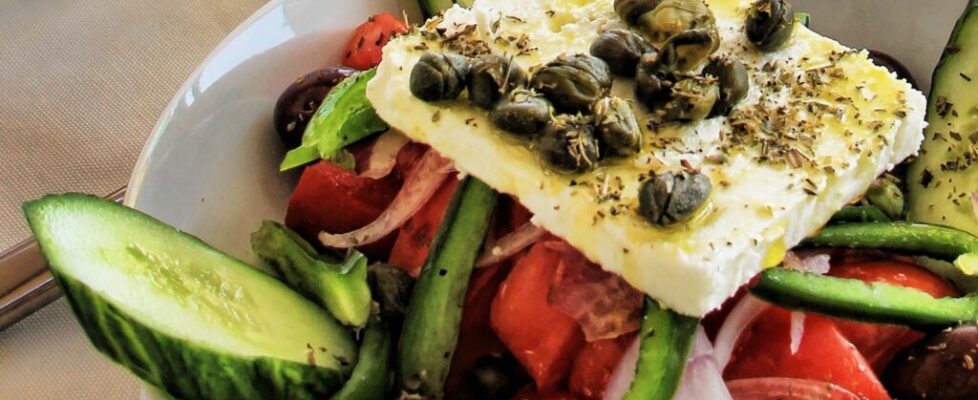
It’s impossible to miss Greek feta cheese when visiting Greece. If you order a Greek salad it will almost certainly come with a slab of white feta cheese on top of it. It’s a delicious cheese that is both creamy and salty at the same time, and the perfect accompaniment to the salad and its flavor-filled mix of tomatoes, peppers, cucumber, olives, greens, and onions.
How is Greek Feta Cheese Served?
Feta is so popular in Greece that it is served in a variety of ways, not just with a Greek salad. You can order it as a dish on its own as part of a meze, and if you order saganaki, or fried cheese, chances are in most places it will be feta, although several other cheeses can also be used. And if you’ve never tried saganaki, order it the next time you get the chance. It’s unusual and really tasty.
Greek Feta Cheese
You will also find feta in tyropita (cheese pies) and in spanakopita (spinach pies), which have some cheese included as well. These are two of the most popular street foods in Greece, and we eat them all the time. It’s basically fast food, so some are better than others, but if you find a good one you will keep going back, guaranteed. An omelette with cheese in it? Yes, that will almost certainly be feta too.
How is Greek Feta Cheese Made?
In Greece, feta cheese is usually made with sheep’s milk, though it can also be made with a mix of sheep’s milk and goat’s milk. To be legally described as Greek feta cheese there should be no more than 30% goat’s milk. The milk is usually (but doesn’t have to be) pasteurized.
Feta Cheese on a Greek Salad
The milk is heated then cooled, when rennet is added. Once it’s solidified, the cheese is put in a cloth bag for the whey to drain away. The cheese is then cut up and salt added, and left to mature for several days. After this, the cheese is then put into brine and matured for several weeks at room temperature, and then for two months in a refrigerated but high-humidity place, though these things can vary from maker to maker. You then have feta cheese!
Where is Greek Feta Cheese Made?
Feta cheese can be made anywhere in the world, and is made from Armenia to Vietnam. That’s because it is a fairly straightforward cheese to make, using simple and available ingredients, and it goes well with a wide variety of food. However, some historians say it probably originated in Greece.
Within the EU (European Union) Greek feta has a Protected Designation of Origin (PDO). In other words, you can’t make the cheese outside Greece and call it Greek feta cheese, even if made in the Greek style. In Greece it’s made across much of the mainland, and in some of the islands, the most notable being Lesvos, which is especially renowned for its feta as well as its wonderful ouzo.
Walking on Paxos is the best way to discover this tiny island south of Corfu in the Ionian Islands, with its wooded hills and terraces of olive trees.
Paxos
Vassili was in his boat on the edge of the harbour in Loggos, on Paxos, filleting a huge fish. It looked like a tuna, its body as big and as round as a dinner plate, and as we watched him slice it into juicy steaks we knew where we would be eating that night.
In any case, a travel writer friend of mine who goes to Paxos regularly had already told me that Vasilli’s serves the best food on Paxos, the small island just south of Corfu in the Ionian group. It’s been in business in the same family since 1957 so is clearly doing something right. Fresh fish in a waterfront taverna, after a good day’s walking, is one of the reasons we keep going back to the Greek islands year after year.
Near Gaios on Paxos
Walking on Paxos
Paxos is a tiny island, so small in fact that you could walk from one end to the other in a few hours, if you wanted to. Or you can do what sensible walkers do – spend a week or two meandering the many paths through its olive groves, even walking along its handful of quiet main roads, discovering new beaches, getting lost, but usually ending up somewhere beautiful to have a swim and a meal before meandering back again.
Loggos
Walking on Paxos from Loggos to Dendiatika Map (c) Google Maps
Loggos (also written as Longos in English) is one of the island’s three small main towns, all down the more sheltered east coast. It’s little more than a clutch of houses and shops, and villas to rent, around a harbour with a decent little beach about five minutes’ walk away.
For our first short walk, to start to get our bearings around Loggos, we chose to go to the village of Dendiatika, which stands in the wooded hills above Loggos. A self-guided walk leaflet that we’d found guided us past an abandoned olive oil factory and up through the terraces of olive trees that are such an important part of the island’s economy.
Paxos Olive Oil
Vassilis Taverna on Paxos
Paxos is said to produce some of the best olive oil in Greece, and groves of trees cover the island. Terraces made from dry-stone walling are everywhere, and ancient tracks through the trees from village to village are a delightful way of getting about, frequently shaded from the fierce Greek sun.
Beneath the trees we see the black olive nets curled up like cats, while olive warblers and blackcaps flit from branch to branch. In winter, when the summer visitors have gone, the Paxiots will spread their nets on the ground to catch the olives. Unlike in the rest of Greece, where the branches will be hit with sticks when the olives are thought to be ready, here in the Ionian Islands they prefer to let nature take its course.
When we reach Dendiatika the few streets are quiet, the church is closed, and the white houses are mostly shut against the intense summer heat. Only Englishmen, but thankfully no mad dogs, seem to be out in the middle of the day in midsummer.
Walking on Paxos from Loggos to Lakka
Walking on Paxos from Loggos to Lakka Map (c) Google Maps
For our next walk from Loggos to Lakka we turned to a delightful hand-drawn walking map of Paxos we found in one of the local shops. It’s full of detailed landmarks like ‘villa with red/brown shutters’, which we hope hasn’t recently been repainted. The same goes for the ‘hut with blue door’ and ‘hut with green door’.
We get lost, as we often do, and scramble up along unmarked tracks through olive groves, thankful that the Greeks are very tolerant of walkers. According to the map, we should come out near the Villa Ina (‘they play classical music a lot’), but with no sounds or signs to guide us we improvise, which proves to be an important part of walking on Paxos.
Although there are a surprising number of guides and maps for such a small island, indicating its popularity, none of them seem to agree with each other. It’s the perfect way to approach walking in the Greek islands. You may set off with a particular destination in mind, but be prepared to change your plans and just enjoy whatever comes along.
Deprived of the pleasure of a coastal walk, we did a big loop inland, walked along the quiet main road that runs north-south down the spine of Paxos, and veered off again down a new bulldozed track to Monodendri Beach. The reward was a terrific little tavern right on the sand, with a wood-fired oven making the tastiest pizzas and a charcoal grill for the tuna steaks.
Paxos Walking: Loggos to Magazia
Walking on Paxos from Loggos to Magazia Map (c) Google Maps
We had no trouble filling a week with our wanderings, walking up to hill villages like Magazia, then on across to the rugged west coast with its high cliffs and squawking seabirds. We walked back in the late afternoon, as the sky grew dark and were reminded that there is a reason why the Ionian Islands are so green and fertile: it rains!
Yes, even in the first few days of September the rain came bucketing down, soaking our t-shirts and shorts. Who would think to take a waterproof jacket with them when setting off for a walk in the 26-degree heat (79F) of the morning?
Never mind. Greece teaches you to be philosophical. It is, after all, the land where the bus may or may not come, today or tomorrow, and the country whose slogan ought to be ‘No problem!’
Sample Dish at Vassilis Taverna on Paxos
There comes a point when you know you can’t possibly get any wetter, so we splashed our way back to our cottage, showered, changed, and when the rain at last eased we made our way down to Loggos harbour for an early evening ouzo and a walk past Vasilli’s taverna to try to see – or smell – what was cooking.
This Symi Town Walk from See Greece links the two great stone staircases of Chorio and visits Symi’s two museums and several churches.
View of Symi Town from Symi Castle
Distance 2.5 km (1.6 miles)
Time 3 hours allowing for visits to museum and churches
From Skala Square climb the broad steps of the Kali Strata. Follow prominent signs (blue arrows) to the town’s two museums, through a series of alleyways. You’ll eventually find your way to the Archaeological Museum and the Symi Folklore Museum, which are side by side.
The museum contains an excellent collection of Byzantine and medieval artefacts. Right by the Archaeological Museum is the handsome restored 18th-century Chatziagapitos Mansion. Check whether it’s open for visitors to look round, as it has been closed for repair work.
Walk straight ahead from the Archaeological Museum doorway past a telegraph pole. Go beneath an arch, then climb steps by a sign for ‘Castle’. Follow a narrow alley.
The Church of Ágios Athanosios
At a junction keep right, go down two steps to an open square in front of the handsome Church of Ágios Athanosios. Like all of Symi’s churches, St Athanosios is brightly painted and immaculate.
Go down curved steps on the far side of the square, then turn left. Keep straight ahead at the telegraph pole, then at a T-junction go left. At the next junction go right to reach another immaculate church.
Symi’s Castle
Go up the steps to the left of the church, then turn right, then left. Keep ahead to where a sharp turn right leads up some steps. Go up left to reach the castle (Kastro).
The site of the old castle is dominated by the Church of Megali Panagia, a replacement of a previous church destroyed during World War II. One of the church bells is the nose-cone of a bomb.
Retrace your steps from the church, then go down left to reach another church with a tall bell tower. Turn right down more steps, then go left. Follow a road round the hillside to reach another church, from where steps lead down to the top of the Katarraktis, Chorió’s second great stone stairway that leads back down to Gialos.
Mandraki Harbour is the main harbour of Rhodes Town for travellers and from here you can catch ferries to Piraeus, Symi, Kos, Kalymnos, Patmos, and to Turkey.
Entrance to Mandraki Harbour in Rhodes Town
The attractive Mandraki Harbour is the most northerly of Rhodes Town’s three harbours and by far the most interesting. This was the ancient ‘sheep pen’, the name in Greek being mandri, a name often used for small, encircling harbours. To the east is the Commercial Harbour, and beyond that is the Marina.
Mandraki was one of the five ports of ancient Rhodes. It was the naval port and was known as the ‘small harbour’ as opposed to the ‘great harbour’, the present Commercial Harbour. The entrance to ancient Mandraki could be sealed with chains.
History of Mandraki Harbour
Ancient Origins: Mandraki Harbour, located on the northern tip of Rhodes Town, has served as a vital port since antiquity. It was one of three main harbours of Rhodes, acting as the “front door” to the island.
Medieval Period: During the Middle Ages, the Knights of St. John fortified the harbour. Landmarks such as St. Nicholas Fortress and the three medieval windmills were built to protect and support maritime trade
Ottoman & Italian Influence: The harbour area evolved under Ottoman rule and later during Italian occupation in the early 20th century. The Italians constructed notable buildings like the Evangelismos Church (1920s) and the Nea Agora Market, blending Gothic and modern styles
Modern Role: Today, Mandraki serves as a marina for yachts and cruise departures to nearby islands like Symi. It remains a hub of tourism, lined with promenades, statues of deer (symbols of Rhodes), and vibrant markets
Mandraki Harbour is not only a functional port but also a cultural and historical showcase, reflecting Rhodes’ strategic importance in the Mediterranean across centuries.
The Colossus of Rhodes
The Colossus of Rhodes
Construction: The Colossus was built around 280 BCE by the sculptor Chares of Lindos to celebrate Rhodes’ victory over Demetrius I of Macedon. It was funded using weapons and siege equipment left behind by the defeated army.
Appearance: Standing about 33 metres (108 feet) tall, the statue depicted Helios, the sun god, crafted from bronze plates over an iron framework. It was one of the Seven Wonders of the Ancient World, the tallest statue of its time.
Location Myth: While legend suggests the statue straddled Mandraki Harbour’s entrance, modern research indicates it likely stood beside the harbour, not across it.
Destruction: In 226 BCE, an earthquake toppled the Colossus. Its remains lay scattered for centuries before being sold off as scrap metal in the 7th century CE
Legacy: Though long gone, the Colossus remains a symbol of Rhodes’ resilience and ambition. Today, statues of a stag and doe mark the spots where the giant’s feet are believed to have stood.
Mandraki Harbour in Rhodes Town
Mandraki Harbour Boat Tours
Mandraki Harbour is the place to head to if you want to do any boat tours from Rhodes Town. Several boats offer island tours so ask around to find out exactly where they’ll take you and when you’ll come back.
There are also different options if you want to visit the nearby island of Symi. Some are for day trips only, and you won’t be allowed to take anything more than a backpack with you. If you want to take luggage and are going to Symi to stay overnight or for a few days, you must find the regular ferry boats, in another part of the harbour.
Travel Tip
If you do plan to take the regular ferry to Symi to stay there, take the one which arrives in the evening. Sailing into the beautiful Symi harbour by night is a magical experience.
You can also go to several other Greek islands from Mandraki Harbour, including Kos, Tilos, Kalymnos, and Patmos, and also to Turkey. There are regular ferries to and from Piraeus, as well.
Cathedral of St John the Evangelist
On the quayside stands the Ekklisía Evangelismoú, the Cathedral of St John the Evangelist. This was built in 1925 as a Catholic church while the Italians occupied Rhodes, and as originally called the church of San Giovanni dei Cavalieri. It uses the distinctively-coloured local sandstone.
Mandraki Harbour Restored Windmills
Windmills at Mandraki Harbour in Rhodes Town
A row of restored medieval windmills, symbols of the days when corn was ground at the harbourside, stands along the outer quay.
At the seaward end of the quay is the fortress of St Nicholas, built in the 1460s and now the site of a lighthouse. On its landward side the harbour is bordered by the busy Eleftherías Street, at the end of which is Plateía Vasileos Georgiou I. Here the Italians left a collection of interesting monumental buildings in a mix of Venetian, Gothic and Ottoman architectural styles.
The best things to do in Athens include top archaeological sites like the Acropolis and must-see attractions such as the National Archaeological Museum.
Statue of Zeus at the National Archaeological Museum in Athens
What are the best things to do in Athens? What are the top must-see sites and attractions, which you shouldn’t miss? If you only have one or two days in the Greek capital, what places and museums should be top of your list? Well, here’s our list of what we think are the best things to do.
The first two are essential, and then we list the rest of the museums and markets, the archaeological sites and places like the Plaka in rough order of importance. Everyone’s different though, so there can never be a definitive list.
We’ve limited ourselves to a Top Ten, as if we didn’t then we’d go on to list 20-30 things you must see and do. But here are our top recommendations.
The Two Best Things to Do in Athens
The Acropolis
The Erechtheion at the Athens Acropolis
The Greek word Acropolis is usually translated as ‘upper town’ or ‘high city’, and it was on this rock that Athens began its life. The Parthenon and several other buildings were constructed here in the 5th century BC, a Golden Age in the development of Athens. The sight of the ancient Parthenon still rising above the modern city is inspiring, and a visit here is definitely the top thing to do in Athens. See our full page about the Athens Acropolis.
The National Archaeological Museum
The Little Jockey Sculpture at the National Archaeological Museum in Athens
Many national museums around the world are filled with wonderful riches, but usually they are items from all around the globe – including many from Ancient Greece. The museum in Athens is exceptional in that it only has Greek items, and despite the many that have been plundered and ended up in the world’s other great museums, here is still the largest collection of ancient Greek artifacts in the world. See our full page all about the National Archaeological Museum.
The Rest of the Best Things to Do in Athens
There are many more things to do and see in Athens, including more fine museums. You could easily compile a list of the top ten museums, and every one would be a gem. However, if you have to prioritise how you spend your time, here are our suggestions for what should be top of your list.
Acropolis Museum
The Acropolis Museum
The Acropolis Museum opened in 2009 and is one of the most exciting museums in the city. It’s below the Parthenon and shows finds from the Acropolis site, as well as fascinating explanations on how that remarkable building was constructed.
Glass floors reveal what was found below, when the museum itself was being excavated, while on the upper floors the museum has been designed to give fabulous views of the Parthenon and other buildings of the Acropolis. It shows what the Parthenon would look like if the controversial Elgin Marbles, now held in London’s British Museum, were returned to their original home.
Museum of Cycladic Art
Museum of Cycladic Art in Athens
This is one museum we always try to visit when we’re in Athens, as the displays are timeless and never cease to delight us. They cover many centuries of ancient Greek art and include vases, glassware and other items, but the main attractions are the beautiful objects from the Cycladic civilisation of 3000–2000BC. Some of the small statues seem to float in their display cabinets, as subtle lighting brings out their shape and texture. Little wonder their graceful shapes inspired many modern artists, and it will be hard to resist taking home one of the beautiful copies from the museum shop. See our full page about the Athens Museum of Cycladic Art.
The Benaki Museum
The Benaki Museum, established in 1930, is housed in the beautiful neoclassical Benakis family mansion and is considered one of Greece’s foremost cultural institutions. Its main building is known as the Museum of Greek Culture and offers a unique journey through Greek history, showcasing over 100,000 artifacts from the prehistoric era all the way to modern times, including Byzantine icons, historic costumes, and Ancient Greek masterpieces. See our page all about the Benaki Museum.
The Ancient Agora of Athens
The Athens Agora
The old market of Athens, below the Acropolis, is an atmospheric place that first became a market in the 6th century BC. It’s easy to imagine it populated by people buying and selling goods from shops and stalls, and talking politics, or about sport or the day’s gossip. For more information visit our full page all about the Athens Agora.
The Central Market
Plenty of Fruit at the Athens Food Market
As well as seeing the Ancient Market, you should try and see the modern Central market, just south of Omonia Square. It’s a real slice of modern Greek life, with butchers, fishmongers, fruit and vegetable stalls, people selling olives, nuts, and all kinds of other produce. If you feel hungry then a meal at one of the market restaurants will be an experience like no other meal in the city – and one of the cheapest eats you’ll have. For a suggestion see our page on Where to Eat in Athens and Piraeus.
Mount Lycabettus
Mount Lycabettus
Mount Lycabettus is the other large hill you can see in the centre of Athens, after the Acropolis. There is one main reason for either walking or taking the funicular up to the top, and that is the view you get over the city – and especially across to the Acropolis. On a clear day you will even be able to see down to the port of Piraeus, and the Aegean Sea beyond. It’s a great place for an evening meal with a view.
The Plaka
The Plaka
Many people deride the Plaka district, on the north side of the Acropolis, because it is undeniably touristy. But if you are on a short visit you should still see it, especially in the evening when the restaurants are in full swing. Be careful where you eat as there are plenty of tourist traps, but there are plenty of decent eating places too. The streets are also filled with souvenir shops, with some good arts and crafts alongside the trinkets, and some interesting food and drink shops as well.
Monastiraki Flea Market
The Monastiraki Market in Athens
Like a visit to the Central Market, a visit to the flea market near Monastiraki Square on a Sunday morning is an authentic Athenian experience. You can explore the streets around here any day of the week and find a fascinating mix of souvenir and junk shops, but on Sunday morning the place is really packed as people go looking for bargains before enjoying a Sunday lunch in their favourite taverna..
Syntagma Square
The Changing of the Guard in Syntagma Square
Athens’ main square has always been a meeting and rallying point, as well as a hub for the city. It stands in front of the Parliament Building, where the Sunday morning Changing of the Guard is a big attraction, and here too is one of the main Metro stations, cafes and bars, and some of the city’s best hotels like the King George and the Hotel Grande Bretagne.
Mike Gerrard of See Greece wasn’t sure what to expect from a holiday on Symi, but what he found was lots of local feasting, dancing & music.
The Taverna O Meraklis on Symi
How Did Symi Get Its Name?
The Greek island of Symi in the Dodecanese gets its name from the Italian word for a monkey: scimmia. Allegedly, on this small island off Rhodes, Prometheus attempted to model a man out of clay and Zeus, worried about demarcation, promptly turned the man into a monkey.
Alternatively, Symi was the daughter of King Ialysos, abducted by the god Glaukos and brought to the island, which thereafter adopted her name. Then again, Symi was the mother of King Chthonios (try spelling that after a couple of ouzos) and he named the island in her honour.
Symi Harbour
Day Trip to Panormitis… Or Not?
No matter. Greece is the home of the dispute, and when two Greeks are talking you’ll have three different opinions. In the main town I studied the boards outside one travel agent’s office, describing various boat trips you could take. I opted to go to the monastery at Panormitis on Tuesday and went inside to book a ticket.
‘No trip to Panormitis on Tuesday. Panormitis is Thursday.’
I pointed out that it said Panormitis on Tuesday on the board outside, on the SS Triton. Within a few minutes there were four Greek men arguing in the street outside about who went where on what day. I crept away unnoticed and went round the corner to another travel agent where I booked to go to Panormitis on Tuesday on the SS Triton.
Symi Town
Panormitis on Symi
Panormitis is Symi’s second town, named after the island’s saint, the Archangel Michael Panormitis, who also gives his name to the monastery there which is open to visitors. That is, it is open to the quick and the dead.
The dead are already there, it’s the visitors who have to be quick. When the boat comes in, the doors of the church are opened, and ten minutes later they’re closed again as visitors are ushered into the museum.
Anyone deciding that their first need after an hour’s boat trip to get from Symi Town to Panormitis is a sit-down and a drink rather than visit the church will have to sit down and have a second drink and wait till another boat arrives and the church is opened again. You’ll still only have ten minutes, but the wait shouldn’t take long as Panormitis is a popular stop on the day-trips that come from Rhodes all day long.
The Harbour at Symi in the Dodecanese
Sotiros Name Day
Anyone day-tripping from Rhodes on August 6th might have wondered why the boat missed the main harbour at Symi Town and instead went steaming into the bay next door to dock briefly before doling a U-turn out again and finally docking in the main harbour, where it should have done.
The explanation is simple. August 6th is a name-day, when all the men named after St Sotiros get together and celebrate the fact that they are called Sotiros. In the morning there’s a church service in Nimborio, a tiny place just along the coast from Symi Town, so the boat needs to take all the Sotiroses from Rhodes to Nimborio, to save them walking there. Who knows, maybe the captain is called Sotiros.
After the service, a flotilla of tiny boats leaves Nimborio and then into the harbour steams the Lindos 1, a boat so big that it should no more be able to tie up in Nimborio than an elephant should be able to bathe in an eye-bath. But Greek captains know their job and tie up it does, and more Sotiroses disembark. The Lindos I hoots its respects to the church, the old lady in charge of the church bells rings back a greeting, and the ferry leaves again and takes the few hundred bemused day-trippers, who have no idea what’s going on, to their rightful destination in Symi Town.
The Feast of St Sotiros
That evening, everyone was welcome to the feast, where most heads would turn if anyone yelled ‘Sotiros!’ One small notice that I’d spotted in town invited locals and visitors alike to the feast, but only about ten of us mingled with maybe a hundred Greeks and ate and drank and listened to bouzouki music and watched the dancing.
If you’ve ever been to a Greek night and seen a man lift a table up in his mouth, and thought that this was something put on for tourists, let me assure you that this is what happens when Greeks get together for themselves. And the man twirled the table around and didn’t spill a drop from the several glasses and bottled that were on there.
It says little for the foreign visitors that in the week when the young people of Symi got together and organised several nights of entertainment in the basketball ground, with music and dancing and a cookery contest, that few non-Greeks bothered to join the hundreds of locals to have a really good time.
Perhaps the posters, which were only in Greek, were organised by the tourist office which was housed in the base of the clock tower. The padlock over the door doesn’t quite have rust on it yet, but it shows precious few signs of ever being used.
Beyond them the boatyards hint at the island’s earlier industry, and further on is the 40-minute dirt rack to Nimborio, pitted with holes and rocks and proudly described on the local map that I bought as being a ‘road of motorway standard’.
Those with the agility of a goat can climb down to hidden coves and strip off in seclusion, or alternatively hire a boat across to the island of Nimos.
Map (c) Google Maps
Symi’s Beaches
Symi is not really an island for sunbathers, though. Its beaches are mainly stony and mostly inaccessible. It is an island for those who like their Greeks to be Greek, with a dash of daftness. The island that only has about four roads also boasts a bus service. In the wonderful book Bus Stop Symi (if you can find a copy these days), William Travis described how the bus stops on Symi were put up. Just the stops, as there was no bus.
Now that there is a bus, it naturally ignores the stops and pulls up elsewhere. For a few cents, the bus takes you from the harbour area, Yialos, up through the narrow streets of the old town of Chorio, and down the road to the next bay along, Pedi, where the Pedi Beach Hotel dominates the little beach.
The bus, a blue transit van with ‘The Symi Bus’ painted in white on the sides, goes every 30 minutes and is governed by the laws of bus-boarding that prevail everywhere in Greece. One visitor complained that although he was at the front of the queue when the bus arrived, there were three locals on board before he’d even moved.
Giorgio’s
Eating is good on Symi, as the island is rich in herbs, and the Symiotes use them generously. At Giorgio’s Taverna, up in the old town and packed by 8.30 every night, the chef does a lamb special where a good cut of meat is placed on a slice of potato, swamped with garlic, oregano, cumin and other herbs and spices, topped with tomatoes and a slice of feta, foil-wrapped and cooked for five hours. Those who climb the 500 steps from Yialos to Chorio find it tastes like the food of the gods.
The best things to do on Symi include visiting the several museums, climbing to Symi Castle for the view and taking an excursion to the Monastery of Panormitis.
Symi in the Dodecanese
Best Things to Do on Symi
Symi Town
Symi Town is made up of its lower harbour area, known as Gialos, and the upper, older town known as Chorio. Gialos is, understandably, the busiest part of the town. The harbour is broad and long, framed by rising land to either side and overlooked by tiers of pastel-coloured houses with elegant pediments.
Ferries and excursion boats mostly dock at the west quay which is lined with cafes, tavernas, shops, and workshops. The harbourside road leads on from here past hotels and houses to the settlement of Harani, where small boatyards maintain the tradition of Symi boatbuilding.
The Harbour at Symi in the Dodecanese
Chorio
The older district of Chorio rises dramatically from the east side of the harbour to where a line of old windmills punctuates the skyline and the ruined castle of the Knights of St John, occupied by the Church of Megali Panagia, crowns the highest point.
The best way to approach Chorio is to climb the magnificent stone staircase, the Kali Strata, where the atmospheric 19th-century mansions line the lower stairs, some abandoned, some now being restored.
From higher up the Kali Strata you enter a fascinating world where tempting alleyways lead off to either side into a maze of occupied and unoccupied houses linked by stairways and narrow passages, the whole punctuated with open terraces and squares.
Map (c) Google Maps
Nautical Museum
This museum is down in Gialos and occupies a handsome neoclassical building. It’s not a huge collection but does tell you a lot about Symi’s grand nautical history, with both shipbuilding and sponge-fishing being big parts of the island’s past. There are model ships, old maps, diving suits, paintings, and other items on display.
Archaeological and Folklore Museums
These two museums are side by side in Chorio and overlap a little in their contents. Still, for a tiny island it’s impressive to have these historical and cultural displays to see, showing the rich history of the place. At one time Symi had a bigger population than neighbouring Rhodes, which is hard to believe as today
Symi Castle
The View from Symi Castle
There isn’t a lot that remains of Symi Castle but it’s an enjoyable walk to get up there, through the upper town, and you do get the perfect view of Symi harbour far below. Inside the castle remains is the Church of Megali Panagia.
Pedio
The small village of Pedio (or just Pedi) lies on the south side of the high promontory that flanks Symi Town. It still retains its engaging character as a fishing village from where small boats work the inshore waters. There is a narrow shingly beach on the waterfront, and it takes half an hour to walk along the path across the rocky hillside from the south end of the village to the pleasant sandy beach of Agios Nikolaos.
A 20-minute walk along a path from the north end of the village leads to the shingle beach of Agios Marina. Both beaches become very busy in summer, as crowded water-taxis arrive from Symi Town.
The Harbour at Symi in the Dodecanese
Monastery of Panormitis
The Monastery of Panormitis (Moni Taxiarchas Michael Panormitis) lies at the far southern tip of Symi and is an extremely popular destination for excursion boats. It can be reached by road from Symi Town, but this involves a hard six-hour walk or by taxi. The most convenient – and dramatic – approach is from the sea into the horseshoe-shaped bay that lies in front of Panormitis below pine-covered hills.
The 18th-century monastery is a huge building, almost Venetian in style. Its tall, baroque bell tower dominates the long white facade of the main building. The inner courtyard contains the free-standing church, which has a superb carved wooden altar screen and numerous gold and silver lamps, as well as a silver-leafed representation of the Archangel Michael, patron saint of Symi and protector of sailors. Here you can visit a small Byzantine Museum and there is also a museum of folklore.
The See Greece guide to Kavala in Macedonia, a historical port with several museums, nearby archaeological sites and ferries to Thassos.
Kavala in Macedonia
Kavala is a vibrant coastal city in Macedonia, known for its rich history, stunning architecture, and lively port that connects visitors to the island of Thassos. It combines the charm of a seaside town with the depth of centuries-old culture, making it one of the most fascinating destinations in Eastern Macedonia and Thrace.
Kavala’s Location
Map (c) Google Maps
Geography: Kavala lies on the northern Aegean coast, in the region of Eastern Macedonia and Thrace. It is built amphitheatrically on the slopes of Mount Symvolo, giving the city its distinctive layered look with houses and buildings cascading down toward the sea.
Location: Kavala is placed strategically between Thessaloniki to the west and Alexandroupoli to the east.
Port: The city’s port is central to its identity, serving as a hub for fishing, commerce, and ferry connections to nearby islands.
Kavala in Macedonia
History of Kavala
Kavala’s history stretches back thousands of years, and its cultural layers are visible throughout the city.
Ancient Origins: The area was originally known as Neapolis, founded in the 7th century BCE by settlers from Thassos. It became an important port for trade and military campaigns.
Roman Era: Kavala was a key stop along the Via Egnatia, the Roman road that connected Byzantium (modern-day Istanbul) with Rome. This made it a vital link between East and West.
Byzantine Period: The city flourished under Byzantine rule, with fortifications and churches built to protect and serve its growing population.
Ottoman Influence: Kavala was under Ottoman control for centuries, and many of its landmarks, such as the aqueduct (Kamares) and the Imaret, reflect this period. The aqueduct, built in the 16th century, remains one of the city’s most iconic structures.
Modern Era: In the 19th and early 20th centuries, Kavala became a major center for tobacco production and trade. The wealth generated from tobacco is still visible in the grand neoclassical buildings that line its streets.
Old Town Mansion in Kavala
Things to See and Do in Kavala
Kavala offers a mix of cultural exploration, seaside relaxation, and culinary delights.
Kavala Fortress (Castle): Perched on the hilltop, the fortress offers panoramic views of the city and the Aegean Sea. Its Byzantine and Ottoman architecture tells the story of Kavala’s strategic importance.
Kamares Aqueduct: This 16th-century aqueduct is one of Kavala’s most photographed landmarks. Its arches dominate the skyline and symbolize the city’s Ottoman heritage.
Imaret: Built in the early 19th century by Muhammad Ali Pasha, the Imaret is a stunning example of Ottoman architecture. Today, it functions as a luxury hotel but retains its historical charm.
Tobacco Museum: A unique museum dedicated to Kavala’s tobacco industry, showcasing the city’s economic and cultural history in the 19th and 20th centuries.
Archaeological Museum: Exhibits from Neapolis and Philippi (a nearby UNESCO World Heritage Site) highlight Kavala’s ancient past.
Philippi: A half-hour drive north from Kavala, Philippi is an ancient city founded by Philip II of Macedon. It is famous as the site where the Apostle Paul established one of the first Christian communities in Europe.
Beaches: Kavala boasts beautiful beaches such as Rapsani, Perigiali, and Kalamitsa, perfect for swimming and sunbathing.
Kavala in Macedonia in Greece
Food and Culture
Cuisine: Kavala is known for fresh seafood, traditional Greek dishes, and its famous sweet treat, Kourabiedes (almond cookies dusted with powdered sugar).
Festivals: The city hosts cultural events throughout the year, including music festivals, religious celebrations, and art exhibitions.
Ferries to Thassos
Thassos
One of Kavala’s biggest draws is its ferry connection to the island of Thassos.
Routes: Ferries from Kavala travel to the port of Skala Prinos on Thassos. There are multiple daily crossings, especially in summer.
Duration: The journey takes between 25 minutes and 1 hour 45 minutes, depending on the vessel.
Operators: Companies such as Aneth Ferries, Thassos Ferries, and Thassos Link operate the route.
Alternative Route: Ferries also depart from Keramoti (a smaller port closer to Thassos), arriving at Limenas (Thassos Town). This route is shorter, but Kavala’s connection to Prinos is ideal for those already in the city.
Why Visit Thassos: Known as the “Emerald Island,” Thassos offers lush forests, crystal-clear waters, and archaeological sites. Many visitors combine a stay in Kavala with a trip to Thassos for the perfect blend of city and island experiences. See our full page all about Thassos.
Kavala in Five Days
If you’re planning a trip:
Day 1: Explore Kavala’s old town, fortress, and aqueduct.
Day 2: Visit Philippi and the Archaeological Museum.
Day 3: Relax on Kavala’s beaches and enjoy local cuisine.
Day 4: Take the ferry to Thassos for a day trip or overnight stay.
Day 5: Return to Kavala and explore its modern city center and tobacco heritage.
Kavala
Why Visit Kavala?
Kavala is more than just a port city—it’s a living museum of Greek, Roman, Byzantine, and Ottoman history. Its location on the Aegean coast, its rich cultural heritage, and its easy ferry access to Thassos make it a destination that blends history, leisure, and adventure. Whether you’re wandering through its cobbled streets, gazing at the aqueduct, or setting sail for Thassos, Kavala offers a truly memorable experience.
Kastoria is a lakeside town in Macedonia which prospered with the fur trade and today has some handsome mansions, museums and many Byzantine churches to visit.
Kastoria
Visitors to the Greek islands and the mainland holiday resorts may feel they are seeing the most beautiful parts of the country, but the more adventurous travellers who find themselves in towns such as Kastoria in Macedonia may disagree.
It has a magnificent location around a headland that juts into the lake of the same name, though in typical Greek fashion this also has an alternative name: Lake Orestiada. There are cobbled streets and hidden alleyways, and the geography of the town, with water surrounding it and almost turning it into an island, means that it is very easy to get lost or disorientated.
Kastoria is about 700 m (2,300 ft) above sea level and has a population of around 33,000.
Kastoria’s Byzantine Churches
Getting lost is no bad things as some of the town’s best features are hidden away, like its numerous Byzantine churches. There are 54 of these, some of them over 1000 years old, such as the 9th century church of Taxiarkhes tís Mitropoleos, which is the oldest in the town. It has some good frescoes, added over the centuries, while in the 10th century church of Agios Stefanos there is an unusual women’s gallery.
Church in Kastoria
Most of the churches are normally locked and to see inside them you will either have to be lucky and be there when there is a service or they are being cleaned, or track down the keys normally held at the Byzantine Museum.
Kastoria’s Museums
The Byzantine or Archaeological Museum
The Byzantine Museum is only small but is worth seeing as it has some beautifully detailed and coloured examples of icons from Kastoria’s churches. The museum is situated at the top of the town just off the main Platia Dexamenis, but if asking the way bear in mind that many local people refer to it as the Archaeological Museum.
The Folklore Museum
The town also has a Folklore Museum that merits a longer visit, not least for the building that houses it, the Aïvazi Mansion. This is a 17th-century mansion which was lived in until 1972 when it was converted into this fine museum containing household items, costumes, agricultural implements and a restored kitchen and wine cellar. There are also good displays on the fur trade to which Kastoria owed its former wealth.
Other Museums
Kastoria also has a couple of smaller, specialist museums, worth seeking out if you have a little more time. There is Costume Museum and a Monuments Museum.
Winter Sky in Kastoria
Aquarium of Kastoria
The Aquarium of Kastoria is the largest freshwater aquarium in the Balkans, dedicated to showcasing the rich aquatic life of Greece’s lakes and rivers. It has 49 tanks housing 56 fish species including endemic and native varieties. It also has a fascinating replica of Lake Orestiada.
Kastoria Fur Trade
The very name of the town comes from the Greek word for beavers, kastoria, and it was their fine fur which made Kastoria the centre of the Greek fur trade from the 17th century onwards. Even though these had sadly been hunted to extinction by the 19th century, the furriers continued to import fur, and still do so today. Scraps and offcuts come in from various countries and are turned into coats, gloves, hats and other items which you will see for sale in some of the shops, although a lot of the material is immediately re-exported.
Kastoria in Macedonia
Handsome Mansions
The wealth that was created over the centuries resulted in some very handsome mansions being built, and in addition to seeing inside the one that is now the Folklore Museum, there are other impressive examples around the town, which can be viewed from outside.
Several of these are located in the streets within the vicinity of the Folklore Museum. Look for the Skoutari, Natzi, Basara and Immanouil mansions. They are typically built of stone on the ground floor but with more elaborate upper floors with wooden balconies, sgraffito plasterwork and occasionally stained glass in the windows. The living quarters are on these upper floors, the ground floor being used for storage, as you will see in the Folklore Museum.
Lakeside Walk
If you take a stroll along the lakeshore, which is a very pleasant walk especially in the spring or autumn when the many plane and beech trees are at their best, you will see the unusually-shaped local boats tied up at the water’s edge.
The lake’s waters are rather polluted, but nevertheless still harbour some wildlife, such as frogs and terrapins. It’s also home to around 200 bird species. A walk all the way round the headland would take you past another of the town’s attractions, the Monastery of Mavriotíssa, in its forested setting. It is no longer a working monastery, only two churches remaining, but these date back to the 11th and the 14th centuries and have well-preserved frescoes that are worth seeking out.
Sunset at Lake Kastoria
Why Visit Kastoria?
Kastoria is a lakeside jewel of Western Macedonia, blending Byzantine history, fur trade heritage, and serene natural landscapes. With its churches, mansions, museums, lake promenade and lively traditions, it offers a unique glimpse into Greece’s cultural and natural diversity.
The See Greece guide to visiting the monasteries of Meteora, with information about each monastery and the best way to visit, by car, on foot or by guided tour.
Sunset over the Rousanou Monastery at Meteora
Meteora is one of the world’s most extraordinary spiritual and cultural landscapes, a place where nature and faith meet in breath-taking harmony. Six active monasteries perch on the top or the sides of towering sandstone pillars, each with its own history, treasures, and atmosphere.
Visiting them requires some planning, but whether by car, on foot, or with a guided tour, the journey is unforgettable. Kalambaka, the town at the foot of Meteora, is the ideal base for exploring this UNESCO World Heritage site. Another option is the city of Trikala, about a half-hour or so away from Meteora.
Meteora, Greece
Introduction to Meteora
Meteora, meaning “suspended in the air,” is located in Thessaly. The rock formations rise dramatically from the plain, shaped over millions of years by geological forces. From the 11th century onward, hermit monks sought refuge here, eventually building monasteries on the cliffs in the 14th and 15th centuries.
At its peak, Meteora had more than twenty monasteries, with up to 400 monks living there. Today, six monasteries remain active and open to visitors with a mix of about fifty monks and nuns.
Meteora Monastery
Visiting Meteora is not only about admiring architecture but also experiencing the serenity of a place where human devotion blends with natural grandeur. The monasteries are accessible by road and footpaths, and guided tours, either booked locally or from Athens, offer historical context and logistical ease.
It’s a four-hour drive from Athens, so be prepared for a long but rewarding day. It’s true to say that there is nowhere else on earth like Meteora.
The Six Monasteries of Meteora
The Monastery of Great Meteoron
The Great Meteoron Monastery is the largest and oldest of Meteora’s monasteries, founded in the 14th century by Saint Athanasios the Meteorite. Built atop the highest rock, it dominates the landscape.
Inside, visitors find a remarkable katholikon (main church) dedicated to the Transfiguration of Christ, adorned with 16th-century frescoes that exemplify post-Byzantine art. The monastery also houses a museum with manuscripts, icons, and relics, offering insight into monastic life and scholarship.
Visiting Great Meteoron requires climbing a series of stone steps carved into the rock. It is moderately accessible, though those with mobility issues may find it challenging.
The Monastery of Varlaam
Founded in the mid-16th century, Varlaam Monastery is the second largest at Meteora. It was established by two brothers, Theophanes and Nektarios Apsarades, who carried materials up the cliffs using ropes and pulleys. The katholikon is dedicated to All Saints and features frescoes by the renowned painter Frangos Katelanos. Varlaam’s museum displays manuscripts, vestments, and religious artifacts.
Varlaam sits close to Great Meteoron, making it convenient to visit both in succession, provided they are both open as the monasteries rotate their opening hours. Access involves climbing steps, but the ascent is less demanding than Great Meteoron. Visitors often combine Varlaam with Rousanou in a single day. Walking between Varlaam and Great Meteoron is feasible for those who enjoy hiking.
Rousanou Monastery At Meteora
The Monastery of Rousanou (St. Barbara)
Rousanou Monastery, dedicated to St. Barbara, is perched on a slender rock and appears precariously balanced. It was founded in the 16th century and later restored in the 20th century. Today, it is inhabited by nuns, who maintain the monastery with devotion. The katholikon is decorated with frescoes depicting scenes of martyrdom and resurrection, reflecting the resilience of faith.
Rousanou is one of the most accessible monasteries, with a relatively short climb compared to others. It is popular among visitors who prefer a less strenuous ascent. Guided tours often highlight Rousanou’s unique position and its role as a convent. Walking paths connect Rousanou to Varlaam and St. Nicholas Anapausas, making it ideal for those exploring on foot.
The Monastery of St. Nicholas Anapausas
The Monastery of St. Nicholas Anapausas is the smallest of the six, built in the early 16th century. Despite its size, it is renowned for its frescoes by Theophanes the Cretan, one of the most important icon painters of the era. The frescoes depict vivid biblical scenes, including the Last Judgment, with striking detail and emotional intensity. The monastery’s compact design reflects the limited space on top of its narrow rock.
Access to St. Nicholas Anapausas involves a steep climb, but the effort is rewarded with intimate surroundings and exceptional art. It is often the first monastery encountered when entering Meteora from Kalambaka.
The Monastery of Holy Trinity
The Holy Trinity Monastery is one of the most dramatic, perched on a solitary pillar with panoramic views of the valley. Founded in the 15th century, it is famous for its appearance in the James Bond film For Your Eyes Only. The katholikon is dedicated to the Holy Trinity and contains frescoes from the 18th century. The monastery also preserves manuscripts and relics.
Reaching Holy Trinity requires a demanding climb, including a footpath and stairway carved into the rock. It is less accessible than other monasteries, but its views are unparalleled. Visitors who enjoy hiking will find the journey rewarding. Guided tours often include Holy Trinity for its cinematic fame, but independent travellers should be prepared for a strenuous ascent.
The Monastery of St. Stephen
St. Stephen’s Monastery is the most accessible of Meteora’s monasteries, connected by a small bridge rather than steep steps. Founded in the 14th century, it was rebuilt in later centuries and is now inhabited by nuns. The katholikon is dedicated to St. Charalambos, whose relics are preserved here. St. Stephen’s also houses a museum with icons and ecclesiastical artefacts.
Because of its easy access, St. Stephen’s is ideal for visitors with mobility challenges or those seeking a less strenuous visit. Cars and buses can reach the entrance directly. Guided tours often conclude here, as it provides a gentle finale to the Meteora experience.
Meteora Monastery
Best Ways to Visit the Monasteries
By Car: Offers flexibility and convenience, especially for those wishing to visit multiple monasteries in one day. Parking is available near most sites.
On Foot: Hiking trails connect the monasteries, allowing visitors to experience Meteora’s natural beauty. This option requires stamina but rewards with spectacular views.
Guided Tours: Provide historical context, logistical ease, and efficient scheduling. Ideal for first-time visitors or those with limited time.
Kalambaka: The Perfect Base
Kalambaka, Gateway to Meteora
At the foot of Meteora lies Kalambaka, a lively town that serves as the gateway to the monasteries. It offers a range of accommodation, from simple guesthouses to comfortable hotels, catering to different budgets. Dining options are plentiful, with tavernas and restaurants serving traditional Greek cuisine.
Kalambaka’s location makes it the best base for exploring Meteora. The town provides transport connections, guided tour services, and amenities for travellers. Its atmosphere blends modern convenience with proximity to one of Greece’s most awe-inspiring landscapes.
Meteora Monasteries
Conclusion
Meteora is more than a destination; it is an encounter with history, faith, and nature. Each monastery—Great Meteoron, Varlaam, Rousanou, St. Nicholas Anapausas, Holy Trinity, and St. Stephen—offers unique treasures and perspectives. Whether approached by car, on foot, or with a guide, the journey through Meteora is unforgettable. With Kalambaka as your base, you can immerse yourself fully in this extraordinary world “suspended in the air.”
Arachova is a mountain town in the Parnassus Mountains of Greece and a good base for visiting the ancient archaeological site of Delphi, a 15-minute drive away.
Arachova Village near Delphi in Central Greece
Despite being just 7 miles (12 km) from Delphi, this delightful mountain town in Central Greece is little affected by tourism, other than the coaches and cars which sometimes stop off here to shop in the souvenir shops lining the main road. In winter, though, it’s become such a popular spot with Athenians because of the nearby ski resort that it’s sometimes referred to as the Winter Mykonos, with nightlife to match (personally we think that’s stretching it a bit.).
Flokatis
Roadside stores are lined with shops selling flokatis, which are colourful woolen rugs/blankets, excellent for keeping out the cold mountain air during winter, when temperatures can drop below freezing. Arachova is at an altitude of about 950m (3,117ft). These flokatis used to be home-made but many of them now are imported and machine-made, and if you want to learn more about the town’s weaving tradition visit the Ethnographic Museum.
Arachova in Central Greece
Arachova’s Volta
Beyond the main street, however, the traditional life of Arachova goes on, as you will see if you spend a night or two here, which we highly recommend. Once the coaches and cars have disappeared, locals reclaim the main street for their evening volta, as they walk around and socialise before dinner.
Away from the main road you find narrow streets of traditional houses, and tavernas serving hearty mountain food. The region is known for its cheeses and robust wines.
Arachova’s Cheese
The cheese local to Arachova is called formaela, and you should definitely try this. It’s made either from sheep’s milk or goat’s milk, and is a hard and slightly yellow cheese. It’s usually served roasted, fried, or grilled, and with a few drops of lemon juice squeezed over it. Other local produce to try and/or buy includes honey, figs, tsipouro, and many other treats.
Arachova Village near Delphi in Central Greece
Things to Do in Arachova
There aren’t a lot of things to do in Arachova itself, but it’s a good place to hang out, go hiking, go skiing in winter, and visit Delphi.
In the town itself be sure to walk up the 264 steps to see the main church of St George, but also wander the town as there are a number of Byzantine churches too, with ancient and well-preserved frescoes. There’s also the Ethnographic Museum where you can learn all about local history, arts and crafts.
Hiking Around Arachova
If you’re based in Arachova, it’s easy to get out and hike around the lower slopes of the Parnassus Mountains. You can either arm yourself with a good map or hire a local guide and discover places you might not find on your own. If you do go out by yourself, check the weather forecast first as it can change quickly in the mountains. Also let someone at your accommodation know where you’re going, and when you hope to be back.
Feast of St George
One of the best times to visit Arachova (though you’d better book well ahead, or have friends in the town) is for the Festival of Ayios Yiorgios, St George, to whom the main church is dedicated. This takes place on April 23, or on the Monday after Easter Monday if April 23rd falls during Lent, though the fun spreads over a few days. The church is the main hub for activities, and you’ll experience lots of traditional dancing and music, people wearing traditional clothes, processions, as well as plenty of eating and drinking.
Arachova Village near Delphi in Central Greece
Arachova in Winter
Arachova gets busy on winter weekends as it’s only a 15-minute drive from here to the Parnassus Ski Centre, Greece’s largest ski resort with 23 slopes. As there’s no accommodation at the resort itself, Arachova is the place to be, as you can’t get to the centre from Delphi without passing through Arachova.
Visiting Delphi from Arachova
If you have your own car then Arachova is the perfect base for visiting Delphi, a 15-minute drive away. Of course you can always stay in the town of Delphi itself, and walk to the ancient site and to the museum, but we find Arachova more authentically Greek and less expensive. You can get to the site when it opens, or linger later in the day, after the tour buses have left for their 2-3 hour journey back to Athens.
If you don’t have your own transport then you can take a taxi each way: there are taxi ranks in both Delphi and Arachova. There’s also a local bus service a few times a day, and every couple of hours the bus from Athens to Delphi will stop off in Arachova. If using the bus, double-check the times and be prepared for the Athens bus to be full. We recommend making life easy and taking a taxi: they’re not expensive.
If you’re feeling ambitious, and fit, then you can hike from Arachova to the Corycian Cave, which is dedicated to the god Pan and the nymph Corycia. This is an uphill hike of about 3.5 km (2.2 miles). The European-wide E4 hiking trail also goes close to the cave, and you can take this slightly longer hike down to Delphi. After that, and exploring the ancient ruins, you might be ready to take a taxi back to Arachova.
Where to Stay in Arachova
For a small place of only about 3,000 people, there’s a surprisingly good range of accommodation. They include 4-star mountain resorts and hotels, rooms in traditional houses, and there’s also a wide range of accommodations, from studios to entire houses, on Airbnb.
The See Greece guide to the East Macedonia and Thrace National Park, one of the biggest and most varied wetlands in Greece.
Flamingos at sunset at Lake Vistonida in East Macedonia and Thrace National Park
The East Macedonia and Thrace National Park is one of Greece’s largest and most ecologically rich wetland parks, covering about 930 km² and including the Nestos Delta, Lake Vistonida, and Lake Ismarida. Note that the park is often also referred to as the Nestos National Park and, as the name tells you, is on the border between Thrace and Macedonia.
Key Facts
Establishment: Created in 1996 by ministerial decision, making it a relatively young protected area. Size: Covers 93,000 hectares (930 km²) of land and water. Habitats: Includes wetlands, rivers, lakes, lagoons, forests, and coastal zones, offering diverse ecosystems.
Major Features:
Nestos Delta – a river delta with rich biodiversity. Lake Vistonida – a large brackish lake connected to the sea. Lake Ismarida – a freshwater lake important for birdlife.
East Macedonia and Thrace National Park Biodiversity
The park is a birdwatching paradise, hosting over 300 bird species, including pelicans, herons, flamingos, and rare raptors.
It also shelters otters, wild boar, jackals, and amphibians, making it a hotspot for wildlife.
Its wetlands are part of the Ramsar Convention, meaning they are internationally recognized for ecological importance.
Visitor Experience
Information Centers:
Lake Vistonida Center (Porto Lagos)
Nestos Delta Center (Keramoti)
These provide maps, guided tours, and suggested routes by car, bike, or foot.
Activities: Hiking, cycling, birdwatching, and eco-tourism are popular. The Nestos River area is especially scenic for cycling and kayaking.
Attractions:
Nestos River cycling routes with spectacular views.
Wetland trails around Porto Lagos.
Forested areas in the Rhodope Mountains.
Kayaks and Flamingos on the Nestos River in East Macedonia and Thrace National Park
Top Five Must-See Spots
Nestos River Delta
A mosaic of lagoons, sand dunes, and riparian forests.
Famous for its meandering river bends and rich birdlife.
Cycling and kayaking routes along the riverbanks make this one of the most scenic areas.
Lake Vistonida
A vast brackish lake connected to the Aegean Sea.
Home to flamingos, pelicans, and herons.
The Porto Lagos Information Center nearby offers guided tours and panoramic views.
Lake Ismarida
The only freshwater lake in the park.
Surrounded by reed beds and forests, it’s a haven for otters and rare amphibians.
Ideal for birdwatching in quieter, less‑visited surroundings.
Nestos Forest (Kotza Orman)
A remnant of the once vast riparian forest along the Nestos River.
Known as the “Great Forest,” it shelters jackals, wild boar, and raptors.
Walking trails here feel like stepping into a primeval landscape.
Flamingos in front of the Monastery at Porto Lagos in East Macedonia and Thrace National Park
Porto Lagos Monastery & Wetlands
A striking monastery built on small islets in Lake Vistonida.
Surrounded by wetlands teeming with wildlife.
Combines cultural heritage with natural beauty, making it a unique stop.
Tip for visitors: The park is best explored with a mix of guided tours (for deep ecological insight) and self‑led cycling or hiking routes (for immersion in the landscapes). The two visitor centers — at Porto Lagos and Keramoti — are excellent starting points.
East Macedonia and Thrace National Park in Two Days
Here’s a sample 2‑day itinerary for exploring the East Macedonia and Thrace National Park — balancing wildlife, culture, and scenic routes so you get the full flavor of the region:
Day 1 – Wetlands & Culture
Morning
Start at the Porto Lagos Information Center (Lake Vistonida).
Pick up maps and get an overview of the park’s ecosystems.
Walk the boardwalks around the wetlands for flamingos, pelicans, and herons.
Visit the Porto Lagos Monastery (St. Nicholas), built on tiny islets in Lake Vistonida — a striking blend of spirituality and nature.
Afternoon
Drive or cycle along the Lake Vistonida shoreline.
Stop at birdwatching towers for panoramic views.
Enjoy a local seafood lunch in Porto Lagos village (fresh fish and mussels are specialties).
Evening
Head to Lake Ismarida for a quieter, freshwater setting.
Sunset here is magical, with reed beds glowing and otters sometimes visible.
Overnight in Xanthi, a charming town nearby with Ottoman‑era architecture and lively tavernas.
Day 2 – River & Forest Adventure
Morning
Begin at the Nestos Delta Visitor Center (Keramoti).
Rent a bike or join a guided kayaking tour along the Nestos River meanders.
The river’s curves and sand dunes are spectacular from the water.
Afternoon
Explore the Nestos Forest (Kotza Orman).
Walk shaded trails through one of Greece’s last great riparian forests.
Look out for jackals, wild boar, and raptors overhead.
Picnic lunch in the forest or riverside.
Evening
Return to Keramoti or Xanthi for dinner.
Try Thracian specialties like kavourmas (slow‑cooked meat) or bougatsa (sweet pastry).
The Traditional Thracian Dish of Kavourmas
Kavourmas is a traditional Greek preserved meat dish, typically made from pork, slow-cooked with spices and stored in its own fat. It’s a rustic delicacy rooted in northern Greek regions like Thrace and Macedonia, known for its rich flavor and long shelf life. It is often served with gigantes (giant beans) in a tomato sauce and sometimes topped off with a fried egg.
Travel Notes
Best season: Spring and autumn — mild weather, migratory birds in abundance.
Transport: Car is most flexible, but cycling routes are well‑marked.
Style: Mix of guided tours (for ecological insight) and self‑led exploration (for immersion).
Importance of the East Macedonia and Thrace National Park
The park is a critical ecological corridor between Macedonia and Thrace.
It preserves rare habitats and supports sustainable tourism.
It’s considered one of Greece’s most valuable natural reserves, balancing conservation with visitor access.
In short
The East Macedonia and Thrace National Park is a vast wetland and forest reserve in northern Greece, famous for its birdlife, lakes, and the Nestos River delta. It’s both a conservation area and a great Greek destination for eco-tourism.
If you’re wondering where to eat in Athens or Piraeus See Greece has a few suggestions including favourites around the Acropolis, Omonia Square and Syntagma.
Dourabeis Restaurant in Piraeus
We’ve also included some highly-acclaimed places in both Athens and Piraeus, ranging from Michelin-starred restaurants that we aspire to eat in one day, to cheap tavernas that we go to every time we visit Athens and which simply ooze atmosphere.
This neo-classical mansion has contemporary art works on the walls and has been voted the best restaurant not just in Athens but in the whole of Greece several years in a row. Pyrronos 5, Varnava Square, tel: 210 752 4021, spondi.gr
To Kouti €€
One of the few reliable places on this busy Plaka street, most of the others catering for the fast tourist trade. Here the service is more leisurely, the menu’s unusual and the setting with its Acropolis views will give you a romantic night to remember. Adrianou 23, tel: 210 321 3229, no website.
Bakalarakia €
The Bakalarakia Restaurant in Athens
One of the Plaka’s basic basement tavernas, much older and more reliable than many of the smart places on the street. This is named after its speciality, a cod dish served with a garlic sauce. Kidathineon 41, tel: 210 322 5084, mpakaliarakia.gr
O Platanos €
The O Platanos Restaurant in Athens
It sometimes seems like The Plane Tree has been here for as long as the Acropolis, so well-established is it in its leafy square. Visitors love it but locals hang out here too, and though the food is nothing fancy, it is wonderfully cooked. Great atmosphere too, whether outside or inside. Diogenous 4, tel: 210 322 0666, eleinitsa.wixsite.com/platanos
Around Omonia Square
Athinaikon €
The Athinaikon Restaurant in Athens
Wonderful venerable old place with its wooden interior still intact, and some of the waiters dating from the same era. They have one of the best meze menus in town, dozens of dishes made fresh every day so it’s a chance to try lots of different things like grilled octopus or deep-fried whitebait. Themistokleous 2, tel: 210 383 8485, athinaikon.gr
Diporto €
Diporto: Plain and Simple
If you want a real Athens eating experience then head for this old place in a basement beneath the Central Market, where the market traders go for good, honest, fresh, hearty food, though you’ll find local business people there too. If you’re on a budget, it’s ideal. Corner of Theatrou and Sokratous, There’s no phone or website but you can read more about it here: https://culinarybackstreets.com/cities-category/athens/2015/diporto/
Around Syntagma Square
Aigli Café and Restaurant €€€
Aigli Restaurant in Athens
Fabulous setting in the National Gardens by the Zappeion, but don’t assume it’s just another café as the bistro-style menu is very inventive, as is the more extensive (and expensive) French-influenced evening menu. Zappeion, tel: 210 336 9363, aeglizappiou.gr
Balthazar€€€
Sample Plates at the Balthazar
This has long been one of the most stylish places to eat and greet in Athens, housed in a wonderful 19th-century mansion on the north-east edge of Kolonaki.Vournazou/Tsocha 27, tel: 210 644 1215, balthazar.gr
Ratka €€-€€€
International menu ranges from sushi to pasta in this chic place which has been a fashionable meeting and eating spot in Kolonaki for decades. Haritos 32, tel: 210 729 0746, no website.
Ouzadiko €€
This contemporary take on a traditional Greek ouzerie shows off the new Greek-style cooking at its best with a long list of meze, the Greek version of tapas, to choose from, and the chance to find out that not all ouzos taste the same. Karneadou 25-29 (in the shopping mall), tel: 210 729 5484, no website.
Benaki Museum Café €
Dine at the Benaki
Great place for a spot of lunch on this attractive second-floor terrace, with a very popular buffet on their Thursday late-night opening, for which you would be advised to book. Koumbari 1/Vasilissis Sofias, tel: 210 367 1000, benaki.gr.
Dexameni €
Well-loved and long-established café-restaurant, with mainly light meals but a great people-watching place in a lovely little Kolonaki square. Platia Dexameni, tel: 210 723 2834, no website but you can read more here: https://culinarybackstreets.com/cities-category/athens/2013/dexameni/
Piraeus
Alli Skala €€€
Alli Skala Restaurant in Piraeus
This distinguished restaurant has a wonderful courtyard and isn’t over-priced by Piraeus standards. It has a wider menu than just seafood and more seafood, with meats, vegetarian dishes, and good old-fashioned Greek dishes like Greek sausages. Serifou 57, tel: 210 482 7722, allhskala.gr
Jimmy’s Fish€€-€€€
Jimmy’s Fish
Ask an Athenian to recommend one Piraeus fish restaurant and chances are it would be this one, not just for the fresh fish and its speciality seafood pasta dishes but also its lovely setting on the harbour at Mikrolimano. Don’t expect to turn up late on a sunny Sunday lunchtime and expect to find an empty seat. Akti Koumoundourou 46, tel: 210 412 4417, jimmysfish.gr
Dourabeis €€
Dourabeis Restaurant in Piraeus
If a seafood restaurant has been in business for over sixty years then it must be doing something right, and the secret here is: keep it simple. The freshest of fish, the lightest of grillings and dinner is perfect. Not cheap but then fish never is. Akti Dilaveri 27-29, tel: 210 412 2092, facebook.com
For a Crete olive oil tour See Greece visits Biolea, one of the few olive oil factories on Crete that you can tour.
Biolea Olive Oil Bottles
Biolea is one of the few olive oil manufacturers in Crete that you can visit. So we did, thanks to Isidoros, our tour guide from Go Crete. Outside the factory we are greeted by our guide, Chloe Dimitriadis.
Crete Olive Oil Tour
‘Last week when it rained,’ she says, ‘the trees were happy as it was the first rain for four months.’
It was hard to believe it had rained so recently, as when we arrived in late September it was gloriously hot with temperatures into the low 90s (32-34C). It’s not the kind of weather when you would normally do a factory tour, but this was no normal factory.
Chloe welcomes us and explains that while Biolea may be a factory, they still use a traditional stone press.
‘Crete has one of the biggest concentrations of olive trees in the whole Mediterranean. We make 5% of the olive oil in the world, and Greece is 3rd in the world for olive oil production after Spain and Italy.
‘They’ve been making olive oil here since Neolithic times. The average person in Greece consumes 32 litres of olive oil a year, which is twice as much as in Italy.’
After this explanation of facts and figures, Chloe moves on to what everyone in the small tour group wants to know: How to make sure you get good quality when you buy.
Map (c) Google Maps
Buying Good Quality Olive Oil
‘First look for the word virgin,’ Chloe explains. ‘By EU laws this is 100% pure olive oil. If it doesn’t say virgin, stay away. Extra virgin is the same thing, 100% olive oil, but with lower acidity. Extra virgin isn’t necessarily better than virgin. There are other factors.
‘You must also look for cold-pressed, which means it is done below 27 degrees and hasn’t been burned. If you blast it with heat you get bigger quantities but you lose the health content. Even if you go over 30 degrees you start to lose qualities.’
Chloe knows so much about olive oil because it was her father who started the factory about 25 years ago.
‘He was one of the first to become organic at the time when everyone was going industrial,’ she says. ‘Everyone thought he was crazy!’
Biolea Olive Oil Vats
Chloe explains that they have about 3,000 olive trees in their village, and it takes two months to harvest them. They put nets down on the ground and beat the tree branches with electronic beaters to shake the olives loose. They then get them to the factory as fast as they can, for the ultimate freshness.
She then leads us inside the factory where we see the modern-looking machine that presses the olives, with three large stone presses inside it. The machine works in the traditional way, but eliminates the need to have donkeys trudging around to turn the stones.
One of the hardest things, Chloe tells us, is keeping everything clean.
‘We’re an organic factory so don’t use any chemical cleaners. It’s all done with hot water and pressure – and olive paste is very hard to get off!’
Another tip Chloe passes on to us is to store olive oil either in dark glass or a tin, and to avoid plastic bottles.
Biolea Lemon-Flavoured Olive Oil
Flavoured Olive Oil
As well as producing their natural stone-milled cold-pressed estate olive oil, Biolea also makes two flavoured olive oils, lemonio and nerantzio. These are done by throwing in the peel from lemons or bitter oranges when they mill the olives. At the tasting we do after the tour, both the lemon and the orange olive oil are huge hits. They’re tangy and aromatic, and everyone wants to buy at least one bottle of each.
The company produces about 20,000 litres of olive oil a year, and the production sells out by about March. They could make more but, like many of the food and wine makers we met on Crete, they go for quality over quantity. They use all their own olives, and only buy any in if they have a bad harvest. Even then, they will only buy organic olives from farmers who they are sure know what they’re doing.
Know Your Olives
Chloe then gives us another reason why it’s important to know exactly what you’re buying: ‘80% of Cretan olive oil is exported in bulk in containers to Italy where they blend it with olive oil from Tunisia, Spain and other countries. It’s therefore possible that the Italian olive oil you buy in the supermarket is blended and has Cretan olive oil in it. If it was blended and bottled in Italy then it can be called Italian olive oil, no matter where the olives came from.’
Biolea exports 70-80% of its own production, so if you’re not lucky enough to visit the factory in its idyllic setting surrounded by olive trees and mountains, in Astrikas, west of Hania, where can you buy their organic olive oil?
‘Our biggest market is Japan,’ Chloe tells us, ‘then the USA and Canada, and some European countries too.’
Crete Olive Oil Tour
For details of the free tours of the Biolea olive oil factory, see the Biolea website.
See Greece would like to thank Go Crete for arranging the visit to see olive oil making on Crete.
Visiting the ancient site of Delphi and its archaeological museum in the Parnassos Mountains of Central Greece.
Site of the Oracle at Delphi in Central Greece
From Athens there are several buses a day to the centre of the universe. That is how the ancient Greeks regarded Delphi in Central Greece, where the famous oracle who could predict the future and also offer advice on people’s problems was to be found.
Delphi in Central Greece
Getting to Delphi
In addition to the regular public bus service you can also easily drive the 111m/178km on good roads that skirt the edge of the Parnassus Mountains, on the slopes of which the site of ancient Delphi stands. It’s an exhilarating drive, which should take about 2-3 hours. Or you can do it the easy way and book one of the coach excursions which you can arrange in any travel agent or through most hotels.
If booking a trip, try to find one which also visits the stunning monastery at Ossios Loukas on the way to Delphi, or allows time in the nearby mountain village of Arachova, which is also recommended if you plan an overnight stay, though there are also plenty of accommodation and eating options in the modern town of Delphi too, which is much closer to the ancient site.
The Tholos at Delphi in Central Greece
Delphi
At Delphi you find the modern town, which is a pleasant-enough mountain village though these days mostly devoted to tourism. The ancient site of Delphi, on the edge of the town, is quite rightly a magnet for tourists and cruise-ship passengers, and on summer days both the site and the town can be crammed with visitors.
Try to avoid peak periods if you can. Staying overnight in Delphi and getting to the site late in the day, or as soon as it opens next morning, is one way to beat the crowds and is easily done from Athens. If you have a car, basing yourself at nearby Arahova is more of a Greek mountain village experience.
Delphi in Central Greece
Ancient Delphi
The site, known overall as the Sanctuary of Apollo, is quite large and sprawling, with some tucked-away corners, and it could take two hours and more if you want to see everything. You enter the site along the Sacred Way, which at one time led all the way from Athens to Delphi. On either side you will see the ruined remains of numerous memorials and treasury buildings, where pilgrims would leave their offerings, or which would be erected afterwards as thanks to the oracle.
The Sacred Way zig-zags its way up towards the Temple of Apollo, where the Oracle’s mouthpiece, a priest, would deliver the Oracle’s predictions and pronouncements. The six columns that can be seen standing today were in fact repositioned to give an impression of the Temple’s look and scale, as only the foundations remained when it was first uncovered.
Ruins of Apollo Temple at Delphi in Central Greece
Beyond here are the remains of a theatre, and further on still, and easily missed, the impressive remains of an athletic stadium. The theatre dates from the 4th century BC and in its prime would have held 5000 people, while the stadium was even larger with stone seating for 7,000 spectators. It is up here at the back of the site, where few of the organised groups have time to venture, that you might get some peace on busy days.
Behind you are the Parnassos Mountains, where eagles and hawks fly, and you may have some idea of why this was regarded as the centre of the universe in ancient times. It received pilgrims from the 12th century BC right through to the 4th century AD.
Along the main road on the left, and separate from the main precinct, is the Castalian Spring, where visitors to the site had to purify themselves first. Further on still, on the other side of the road, is the Sanctuary of Athena (with free admission), Athena being worshipped as the Guardian of the Temple.
Delphi Archaeological Museum
West of the ancient site is the excellent museum, probably the best in the country outside Athens. It isn’t huge but the finds that have been made here and are on display are truly fabulous. The most famous of all is a 5th century BC bronze called The Charioteer, which is both life-size and very lifelike, its eyes of onyx giving an eerily human feel to its gaze. Nearby is a huge marble carving of three dancing women – not to be missed.
Archaeological Museum Shop
The shop at the Archaeological Museum is very well-stocked with cards and reproductions of some of its exhibits. It’s worth saving some time to spend there, if on an organised tour where your departure time is fixed.
Further Details
For more information and to check opening times see the Greek Ministry of Culture websites for the Archaeological Site of Delphi and the Delphi Archaeological Museum. Note that the Ministry of Culture website isn’t always totally up-to-date for every single site and museum, so it helps to double-check.
During Easter on Rhodes the See Greece publisher Mike Gerrard travels from Lindos to Kattavia to visit a monastery and spend Easter with a Greek family.
Easter in Greece
We left Lindos at midnight on Saturday as the church bell was ringing, the fireworks exploding and the villagers were taking their Easter candles home and bidding each other Christos Anesti, Christ is Risen. For Ianni this was to be a rare chance to see his family in the south of Rhodes, as for 180 days of the summer season he would be working in a bar he co-owned in Lindos, catering to the mass of visitors, seven days a week for at least ten hours a day.
As I’d already helped him get his bar profits off to a good start for the year, he invited me to spend Easter Sunday with his family in the village of Kattavia, where he returns in the winter. By 1am we were there, and after Ianni woke his parents up to tell them he was home, we went to light a candle in the village church, where people were singing and praying their way through till Sunday morning, the air thick with incense and chanting.
For such a small village, the church is enormous, at least twenty times the size of the tiny Byzantine one in Lindos. Kattavia is home to about 2,000 people, Ianni tells me, though only 350 or so live there permanently, the rest away working for ten or twenty years in America or Australia while their homes stand empty awaiting their return. Meanwhile, the life of the village centres on its church, two shops, three cafés and a solitary garage.
As we left the church, Ianni said he would take me to the hilltop monastery at Skiadi, a few miles away, to show me how the boys from his village spend Easter Saturday night. The monastery means a great deal to his family, as one son from each generation has always gone into the church, with Ianni’s grandfather rising to the rank of Bishop of Skiadi.
The monastery dates from the 14th century, and has housed a holy icon since the 15th, when a heretic stabbed a painting of the Madonna and Child which promptly spurted blood from the wound in the Madonna’s cheek.
We didn’t see the icon that night as the services were over by the time we arrived. Ianni woke up the caretaker who, like the other Greeks I saw, didn’t seem to mind being disturbed in the middle of the night. Well, not on this night, anyway. The caretaker said that the boys from Kattavia had set off home at 11pm, though there were still over 100 men there who had come from every part of Rhodes to spend Easter at the monastery.
We groped our way back in absolute darkness, feeling our way along the monastery walls to the Ford pick-up that Ianni had borrowed, then bumped and pitched back to the village down a road that was like a bomb site. ‘You know what we call this road?’ Ianni asked me. ‘We call it The Road that Kills People. A pity there is no moon as you cannot see over the side and down to the beach. Is beautiful.’
It was around 3am when we arrived back in Kattavia and found half a dozen of Ianni’s friends sitting round drinking Scotch and beer, in one of Greece’s typical ‘sell everything’ shops, and watching what seemed to be interference on an enormous TV. It turned out that we were the interference as we’d interrupted their blue video session. They asked if I’d be offended if they put the film back on.
The French frolics weren’t quite the Greek Easter experience I was expecting, but as Ianni explained, there wasn’t a lot to do in Kattavia. One of the men was poised with his finger on the remote control and switched off at every passing noise from the street, from where the TV was clearly visible. The Gallic gropings and gruntings were ended for good when one of the men saw his parents pull up and park outside, and the flickering figures had hardly faded from the screen when his mother came in carrying a more traditional Greek offering: a pot of Easter soup.
This was our cue to return to Ianni’s parents for a 4am meal of Greek salad, slabs of cheese the size of house bricks, dark local bread, and a bowl of Magaritsa, an egg and lemon soup with rice and heavy with the offal from the lambs whose meat would be roasted for Easter Sunday.
‘OK,’ Ianni said, ‘now we have four hours sleep. Breakfast at eight o’clock. You are sleeping in my grandmother’s house.’ He took me fifty yards or so to the house and marched in, switching on the light to reveal grandmother and a family aunt sleeping head-to-toe in a single bed, leaving the other one free for their unexpected guest.
Although grandma had been told about my overnight visit, she had forgotten by the time she woke up and was more than a little confused on Easter Sunday morning to find a bearded figure sleeping across the room from her.
Breakfast was three fresh fried eggs and the inevitable salad, after which Ianni drove me around to see some of the local beaches. They were easily the most beautiful I’d seen on the island, the more so for being empty of the visitors who were already, in the opening weeks of the season, crowding the two main centres of Rhodes Town and Lindos.
On the three long sweeping beaches we visited we saw no-one but a single Greek family, picnicking and dancing by the side of their battered green van. This was on the beach at Prasonisi, the southernmost tip of Rhodes, the site of a Greek village in pre-Christian times, where Ianni showed me a beautiful floor mosaic he’d found in the scrub behind the beach.
Driving back to Kattavia we passed two roadside shrines side by side, an unusual sight. Ianni told me the story. Two lovers from the village had fallen foul of the Greek law forbidding a man to marry his sister-in-law, and they chose to live together in death at Prasonisi.
In Kattavia a service was in progress outside Ianni’s parents’ house in the village square, and the priest had brought the holy icon down from the monastery. The villagers, mostly in black, formed a half-moon round the priest and the painting, against a backdrop of blue sky and green hills. On the cheek of the Madonna you could see the cut from the heretic’s knife, with brown stains where the blood was said to have flowed. At the end of the service everyone queued to kiss the silvery painting and Ianni paid the priest to have the icon stay overnight in his parents’ house: a blessing and an Easter gift for his mother.
Lunch was barbecued lamb and the sweet red local wine. My plate was piled with large hunks of meat and anything that needed finishing, but my stomach’s relief when the table was finally cleared was short-lived.
‘Now,’ said Ianni, ‘we go to my grandmother’s house. My aunt has cooked a different kind of lamb… come, we must eat there too.’
Must we, I thought, though I somehow expanded to fit in my fourth meal in less than twelve hours – and a bottle of retsina, a milk-sweet pastry and the Greek coffee that had been so hard to find in the more commercial Lindos.
Still, it was back to Lindos we went, stopping only to buy a tub of honey and passing, outside Kattavia, the Turkish community of half-a-dozen houses, of fields, donkeys, children and olive groves.
‘Do you get on with the Turkish people?’ I asked Ianni, as the Greeks and the Turks haven’t always been the easiest of neighbours.
‘Of course, why should we not? They are poor people, like we are. My best friend in Kattavia is the fisherman, Mustapha.’
And we drove on to Lindos where, by five o’clock, Ianni was back behind the bar. There were only 170 more days to go until October and the end of the season, when he could return to Kattavia and tend his father’s olive groves all day, and in the evening talk with his friend Mustapha.
See Greece recommends what to do on Rhodes including visiting Rhodes Old Town, Lindos, Kameiros, and a day trip to Symi.
Back Street in Rhodes Old Town
What to do on Rhodes? You’re spoiled for choice as it’s a big island with attractions raging from the UNESCO site of Rhodes Old Town to classic Greek beaches and beautiful villages such as Lindos. Here’s our Top Ten.
What to Do on Rhodes
Rhodes Old Town
Rhodes Old Town
The UNESCO-listed Rhodes Old Town is one of Europe’s best-preserved medieval cities. Walking through its cobbled streets feels like stepping back into the era of the Knights Hospitaller, who fortified the city against Ottoman sieges. Highlights include the Palace of the Grand Master, the Street of the Knights, and the Archaeological Museum housed in the former Knights’ hospital.
Rhodes Old Town
Cafés and shops tucked into stone archways add charm, while the imposing walls and gates remind visitors of its strategic importance. Exploring at dusk is magical, as lanterns light up the alleys and the atmosphere becomes even more enchanting. This is the cultural heart of Rhodes and a must-see for history lovers.
Lindos and the Acropolis
Lindos Acropolis
The whitewashed village of Lindosis postcard-perfect, perched on a hillside overlooking a turquoise bay. Its narrow streets are filled with boutiques, tavernas, and rooftop restaurants offering stunning views.
Above the village rises the Acropolis of Lindos, an ancient citadel blending Greek, Roman, and Byzantine ruins. The climb is steep but rewarding, with panoramic vistas across the Aegean. Lindos Beach below is ideal for swimming, making this destination a perfect mix of culture and relaxation.
Ancient Kameiros
Often called the “Pompeii of Greece,” Kameiros was one of Rhodes’ three ancient cities. Unlike Lindos, it was never rebuilt after its decline, leaving behind evocative ruins that showcase daily life in antiquity. Visitors can see remnants of houses, temples, cisterns, and streets laid out in a grid pattern.
The city thrived during the Classical period, and its water system was remarkably advanced for its time. Standing among the ruins, with the sea shimmering in the distance, offers a sense of connection to Rhodes’ ancient past. Kameiros is quieter than other sites, making it a contemplative stop for history enthusiasts.
Day Trip to Symi
The Harbour at Symi
A short ferry ride from Rhodes brings you to Symi, a jewel of the Dodecanese. Its harbor is lined with pastel-colored neoclassical mansions, creating one of the most picturesque arrivals in Greece. Visitors can stroll along the waterfront, climb to the upper town for wonderful views, or visit the Panormitis Monastery, dedicated to Archangel Michael.
Symi is also known for its sponge-diving heritage and fresh seafood. The island’s slower pace contrasts with Rhodes, offering a perfect day of exploration and relaxation. Swimming in Symi’s crystal-clear bays is unforgettable, making this excursion a highlight of any Rhodes itinerary. To make the visit more magical, think about spending a night on the island before returning to Rhodes.
The Valley of the Butterflies
Jersey Tiger Moth in the Valley of the Butterflies
In summer, the Valley of the Butterflies becomes a magical sanctuary where thousands of Jersey Tiger moths gather. Shaded paths wind through lush greenery, streams, and wooden bridges, creating a tranquil escape from Rhodes’ bustling towns. The sight of butterflies clustering on tree trunks is mesmerizing, and the cool microclimate makes it a refreshing retreat.
A small museum at the entrance explains the valley’s ecology. Visiting early in the morning or late afternoon avoids crowds and enhances the serenity. This natural wonder is unique to Rhodes and appeals to families, nature lovers, and anyone seeking a peaceful walk.
Tsambika Beach
For pure relaxation, Tsambika Beach is one of Rhodes’ finest stretches of sand. Nestled beneath a hill crowned by a monastery, the beach boasts golden sand and shallow waters perfect for swimming. Sunbeds, tavernas, and water sports facilities make it ideal for both families and adventure seekers. It’s on the east coast roughly halfway between Rhodes Town and Lindos.
The climb to the Monastery of Tsambika above offers panoramic views and a touch of spirituality, as it is associated with fertility blessings. Spending a day here combines leisure with a sense of local tradition. The beach’s size ensures space even in peak season, making it a favourite among visitors.
Monolithos Castle
On Rhodes’ west coast, Monolithos Castle sits dramatically on top of a rocky hill, overlooking the sea. Built by the Knights of St. John in the 15th century, the castle was never conquered, and its ruins still exude strength. Inside, a small chapel dedicated to St. Panteleimon adds charm. The views from the castle are breathtaking, stretching across the Aegean to nearby islands.
The surrounding area offers quiet beaches and traditional tavernas, making it a rewarding detour
Prasonisi Peninsula
At Rhodes’ southern tip lies Prasonisi, a unique double beach where the Aegean and Mediterranean seas meet. Depending on the season, the sandy strip connecting the mainland to the islet may be submerged or exposed. Prasonisi is famous for windsurfing and kitesurfing, thanks to strong winds and ideal conditions.
Even if you’re not into water sports, the landscape is striking, with waves crashing on one side and calm waters on the other. It’s a place of raw natural beauty, perfect for adventurous travelers. Watching the sunset here is unforgettable, as the skies and seas merge in dramatic colours.
Seven Springs (Epta Piges)
Hidden in a forested valley, Seven Springs offers a cool, shaded retreat. Streams converge into a small lake, and visitors can walk through a narrow tunnel to reach it—a fun adventure for children and adults alike. The area is rich in flora and fauna, and peacocks often roam freely. A traditional taverna nearby serves local dishes, making it a pleasant spot for lunch.
The springs are said to have healing properties, and the setting feels almost mystical. Seven Springs combines nature, relaxation, and a touch of folklore, making it a charming stop on a Rhodes road trip. You’ll find them on the east coast, a ten-minute inland from Tsambika Beach.
Mandraki Harbor
Windmills at Mandraki Harbour in Rhodes Town
Mandraki Harbor is Rhodes Town’s modern waterfront, blending history with contemporary life. Legend says the Colossus of Rhodes once stood here, though today two statues of deer mark the entrance. The harbour is lined with yachts, fishing boats, and excursion vessels, creating a lively atmosphere. See our full page about Mandraki Harbour.
The Colossus of Rhodes
Nearby, Italian-era buildings, the Evangelismos Church, and the windmills add architectural interest. Mandraki is also the starting point for boat trips, including the ferry to Symi. Strolling along the promenade at sunset, with the sea breeze and views of the medieval walls, is a quintessential Rhodes experience.
See Greece recommends where to stay in Rhodes Town, including boutique and historic hotels in the Old Town and modern hotels in the New Town.
S. Nikolis Hotel in Rhodes Old Town
If you want to know where to stay in Rhodes Town, the capital of Rhodes, then you have two main choices. Do you want to stay in the Old Town, close to all the main historic attractions, or do you want to stay in the New Town, and be closer to shopping, bars and other modern amenities?
Accommodation in the Old Town is usually more atmospheric and characterful, but it may mean stairs to climb with luggage because there are no lifts, and quirky arrangements. The New Town is where you tend to find the more comfortable and more modern hotels, with a short walk to the Old Town.
Here’s our choice of some good places we can recommend in both parts of Rhodes Town.
Where to Stay in Rhodes Town
Best Western Plaza Hotel
Best Western Plaza Hotel in Rhodes New Town
This 4-star hotel has 136 comfortable rooms with luxury fittings, and the breakfast buffet is outstanding. It has an outdoor pool, a sauna, a cocktail bar, and a restaurant. It’s in the New Town but only about a 10-minute walk from the Old Town.
A pleasant, family-run hotel with character, and the owners speak English, Italian, French, and Greek. The Anastasia is located in a leafy garden area off one of the main streets, a 10-minute walk from the Old Town. The rooms are simple but are bright and sunny and have high ceilings. They also have fridges and air-conditioning, and are all non-smoking. There’s an outside breakfast area beneath a lovely hibiscus canopy.
Note that the hotel is at number 46 on 28 Oktovriou Street. The Greek practice is to put the street name first and then the number of the house.
This 500-year-old former Turkish sultan’s house has been turned into a delightful and remarkably inexpensive little hotel in a quiet residential street in the Old Town. It’s worth booking well ahead as the old atmosphere has been retained and there are only 11 rooms. There’s a roof terrace with views of the medieval walls and across the Aegean to Turkey.
For the ultimate Old Town experience, this splendid 15th-century building in the old Turkish quarter is the place for style and flair, with surviving Ottoman features adding to the ambience. The hotel has a 3-star rating and has an acclaimed restaurant too, as well as a peaceful garden.
A big roof terrace with superb views over the Old Town is a bonus at this reasonably-priced option in a quiet area inside the medieval city walls. This is open from May to October and is where they serve breakfast, drinks, snacks, and light meals.
Tucked away in a quiet square, and with lots of cosy charm, this small, friendly pension has pleasant rooms round a small courtyard. No website. Phone: +30 2241 022469.
Timikida 9, Old Town
S. Nikolis
S. Nikolis Hotel in Rhodes Old Town
This boutique hotel is in a handsome Old Town building in a hidden corner, and we love it. The house was built around 1300 AD, and became a hotel in 1980. Its wonderful ambience includes an inner courtyard with a resident tortoise. A selection of very different types of room is available, and most of them have great character. Excellent facilities, too, and the roof garden offers guests breakfast with a view.
There’s a friendly atmosphere at this small hotel that is in a handy, but quiet location on a narrow cobbled street at the heart of Rhodes Old Town. Don’t be misled by its official 1-star rating as it’s a perfectly comfortable hotel with an old-fashioned feel to it. A buffet breakfast is included.
Lindos is one of the main attractions on the Greek island of Rhodes, with its Acropolis, other ancient sites, beaches and historic captain’s houses.
Lindos on Rhodes
Lindos on Rhodes in the Dodecanese is an impossibly picturesque village; a labyrinth of white-painted Dodecanesian-style houses climbing the slopes to the dramatic Acropolis and Knights’ Castle. The village is, of course, a hugely popular visitor attraction, and from Easter onwards it is crowded by day and fairly lively at night. It’s an hour’s drive south of Rhodes Town, about half-way down the island’s east coast.
The Acropolis is the main attraction, but Lindos has much more to offer than this splendid monument. Its narrow streets are empty of traffic and locals carry everything in motorbike trailers with which they negotiate some alarming challenges in the steeper streets.
In some ways Lindos is robbed of its inherent character by the sheer pressure of visitors and by the multi-lingual guided tours. It’s a popular excursion from the cruise ships which dock in Rhodes Town. Yet the village is still captivating, especially if you allow time to wander and seek out less well-known ancient ruins, the tiny churches, and the quieter corners.
Acropolis of Lindos on Rhodes
Ancient Lindos
Ancient Lindos was the most prestigious of the three great city-states of Rhodes, the others being Kameiros and Ialyssos. When the three cities combined to found the unified city of Rhodes, Lindos continued to prosper and its sanctuary of Lindian Athena remained a place of pilgrimage until Roman times.
The Knights of St John kept a strong presence here, and during the Turkish era, Lindos was a prosperous seagoing community. Modern Lindos still reflects this history of commerce and culture.
Acropolis at Lindos on Rhodes
Ancient Sites Around Lindos
The prime site of the Acropolis apart, there are a number of other ancient sites scattered throughout the Lindos area. Within the village itself is the well-preserved 4th-century BC amphitheatre. It’s located on the south-western side of the Acropolis just below the Stavri Square car park. Nearby are the remains of a large building, thought to have been a temple of the 3rd or 2nd century BC. Later Christian churches were built over the site.
Directly opposite the Acropolis, on the side of Krana Hill and above the highest houses of the village, is the ruin of a monumental necropolis, the tomb of a wealthy Hellenistic family. On Cape Agios Emilianos, across the main bay from the Acropolis, is the so-called ‘Tomb of Kleoboulos’, a large circular mausoleum composed of stone slabs. It can be reached by a path from the main beach. There is no convincing evidence that this actually is the tomb of Kleoboulos, a famous ruler of Lindos.
Lindos Town, Beach and Acropolis
Beaches Around Lindos
On the north side of the village is a substantial bay in the shelter of the Acropolis hill. Directly below the Acropolis lies a small harbour where fishing boats moor. Further round the bay is Lindos’s very busy main beach. There are several tavernas and bars, beach furniture can be hired, and water sports are available.
There is another beach further round the bay, and bathing places beyond the headland of Cape Agios Emilianos. To the south of the Acropolis lies the remarkable natural harbour of St Paul, where the evangelist is said to have landed on his mission to spread Christianity.
Street in Lindos on Rhodes
Houses of the Captains
An earthquake of 1610 devastated Lindos but the settlement was rebuilt in traditional style, and today’s houses, a mix of simple vernacular buildings and handsome Gothic mansions, enhanced with subtle Byzantine and Moorish features, stand behind their high walls and inner courtyards where there is much use made of the exquisite pebble flooring called hokhlaki.
The Lindian doorways, called pyliones, often have fine carvings around them. Wealth from seagoing enriched Lindos, and many of the finer houses were built by sea captains. Several of these restored captains’ houses are open for public viewing, although they are often tied in with restaurants or gift shops. You can get details from the tourist office.
Panagia (Church of the Assumption of Our Lady)
Panagia is the main church of Lindos and stands at the heart of the village. It dates from medieval times but has been lovingly cared for and refurbished over the years. The characteristic exterior is rather engulfed by its close-knit surroundings but the interior is overwhelming, a superb example of Orthodox decoration.
Late 19th-century frescoes, restored in the 1920s, cover the walls and depict vivid biblical scenes. There are numerous fine icons, and the wooden altar screen and Bishop’s throne are beautifully carved. The pebble mosaic floor is outstanding. There is a strict requirement for visitors to dress soberly, and photography is not allowed.
See Greece picks the best time to visit Rhodes, with a monthly summary of the weather, plus hotel prices and special events to help plan a visit.
Lindos Town and Acropolis on Rhodes
Rhodes, the largest of Greece’s Dodecanese islands, is a jewel in the Mediterranean with year-round mild weather. Historical sites, stunning beaches, vibrant nightlife, and charming villages, it’s no surprise that this island is a beloved destination for travellers worldwide.
But when is the absolute best time to visit Rhodes? Let’s explore the island’s climate month by month, including weather, special events, and hotel prices!
City Walls in Rhodes Old Town
Best Time to Visit Rhodes Month-by-Month
Starting with January, Rhodes, like the rest of Greece, is in its winter season. The average temperature is around 56°F (13°C) with an average rainfall of 5.9 inches (150 millimeters). They don’t usually experience snowfall. Hotel prices generally are at their lowest, appealing to budget-conscious travelers. For history enthusiasts, a winter visit can be more comfortable exploring ancient sites like the Acropolis of Lindos without large crowds or intense heat.
In February, temperatures slightly increase to an average of 57°F (14°C). The rainfall is around 4.7 inches (120 millimeters). February is similar to January in terms of pricing and low tourist numbers, with the added benefit of experiencing the Apokries, an engaging pre-lent carnival with traditional music and dancing adding color to the island’s streets.
March sees the arrival of spring, with temperatures hovering at an average of 60°F (16°C), and rainfall decreases to 3.5 inches (90 millimeters). The Independence Day celebrations on March 25th offer an impressive parade showcasing historical Greek costumes and military units. Hotel prices remain quite affordable.
Street in Lindos on Rhodes
April brings more warmth, having an average temperature of 66°F (19°C), and rainfall drops further to 1.6 inches (40 millimeters). Easter celebrations in Rhodes are quite a spectacle, with processions, traditional meals, and fireworks. Hotels start increasing their prices, anticipating the summer tourists.
In May, the temperature averages 73°F (23°C) with only 0.7 inches (18 millimeters) average rainfall, marking the start of the dry season. The Medieval Rose Festival during this month is worth attending, bringing back the medieval times with knight tournaments and street theatre. It’s a great time to be staying in the Old Town of Rhodes. Prices for hotels start to rise, though, due to the increase in visitor numbers.
June ushers in summer with an average temperature of 81°F (27°C) and average rainfall of 0.4 inches (10 millimeters). The Island Rhodes Marathon in mid-June attracts athletes and sports enthusiasts from all corners of the world, creating a unique atmosphere. Hotel prices further increase, marking the start of the high tourist season.
Rhodes Old Town
July is peak summer with daytime temperatures soaring to around 86°F (30°C). It’s virtually rain-free, with an average rainfall of 0.2 inches (5 millimeters). There are various beachside festivities during this month, with hotel prices being the highest. It’s recommended to book well in advance if you’re planning your trip during this time.
August continues the heat trend with an average temperature of 86°F (30°C) and minimal rainfall at 0.2 inches (5 millimeters). In early August, locals celebrate Dekapentavgoustos, The Assumption of the Virgin Mary, with religious processions and feasts. Accommodation costs remain high due to popular demand.
September welcomes the onset of autumn. The temperature drops slightly to 81°F (27°C), and the rainfall starts increasing, reaching up to 0.6 inches (16 millimeters). The International Street Theater Festival is a treat to experience with artistic performances from around the world. The hotel rates start declining after the summer rush.
Windmills at Mandraki Harbour on Rhodes
In October, temperatures cool down to 74°F (23°C) on average, and rainfall increases to 2.7 inches (70 millimeters). The festival of Panormitis, dedicated to the island’s patron Saint Michael, takes place in late October on neighbouring Symi, a short ferry ride away. Hotel prices continue to reduce, proving to be an attractive time for budget travellers.
November sees a further drop in temperature to an average of 65°F (18°C), and the rainfall is at its peak with 5.3 inches (135 millimeters). This is a quieter month with fewer events, but the serene landscapes and reduced hotel prices can attract those who enjoy off-peak travel.
December marks the beginning of winter, the temperatures decreasing to an average of 59°F (15°C) and a rainfall of 4.5 inches (115 millimeters). The festive mood is unforgettable, with Christmas and New Year celebrations. Hotel prices remain at their low end, making it a considerable time to enjoy a Mediterranean winter.
Rhodes Sunset
Best Time to Visit Rhodes Summary
In conclusion, the best time to visit Rhodes in Greece ultimately depends on your personal preferences. If you long for the warm sunshine and lively beach scene, then the summer months are a perfect choice.
However, if you’re looking to explore the rich history and culture at a more leisurely pace and lower budget, the shoulder seasons (spring and autumn), or even winter may be your best bet.