The Dadia Forest Reserve in Thrace is famous for its wildlife, especially raptors, with accommodation and information available at the Dadia Ecotourism Centre.
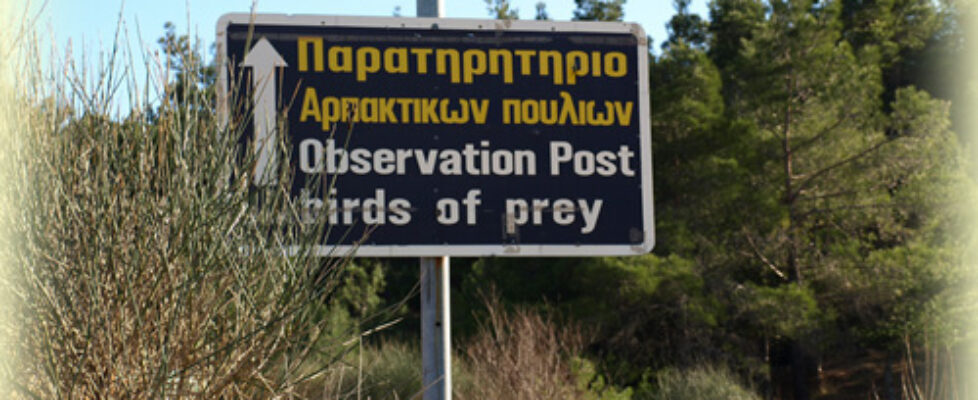
Sign at the Dadia Forest Reserve
Head north-east from the Evros Delta and you will reach the small town of Féres, which would make a good base for exploring the area to the north of here, the 32,500-hectare Dadia Forest Reserve. Set in the Evros Valley and overshadowed by the Evros Mountains, this is another scenically splendid area of Greece and mostly visited by those with an interest in its wide range of wildlife. It’s especially noted for the fact that 36 of Europe’s 38 species of predatory birds can be found here.
Dadia Forest Reserve Information Centre
There is an information centre in the forest, at the Dadia Ecotourism Centre, reached from near the village of Likófi. At the centre you will naturally find a lot of information about the flora and the fauna of the Reserve, which is especially noted for its rare birds of prey. At the centre you can also get advice on exploring the Reserve, which can be done by way of an organised tour van, which goes into the areas where cars are banned, or on foot.
There are two main footpaths to be followed, and these are well-marked. One leads to the highest point in the Reserve, at 520 meters (1706ft), and the other to a hide which looks out over the Mavrorema Canyon, giving chance for visitors to see some of the raptors as they soar on the thermals that rise out of the canyon.
Golden Eagle
In addition to the eagles and vultures, other species seen here include the lanner falcon, black kite, goshawk, Levant sparrowhawk, honey buzzard and the increasingly rare black stork, although there are only a few of these in the forest.
Crested Goshawk
Accommodation in the Dadia Forest
It is quite possible to stay in the Reserve, as there are 20 rooms available at the Dadia Ecotourism Centre, which also has a restaurant and café. You would need to book ahead as it gets full at busy periods such as migration times in spring and autumn. There is a café nearby, and more eating options and shops in the village of Dadiá, about 1km (1/2 mile) away.
See Greece visits and tours the Manousakis Winery on Crete with a wine-tasting and a chance to buy their tsikoudia, sea salt, olive oil and other goodies.
A twenty-minute drive southwest from Hania brings us to the delightful Manousakis Winery. Their name will be more familiar to you when you know that it’s here they make Nostos Wines, a familiar name on some of the better wine lists in restaurants around Crete.
The winery is very attractive, set out like an old Cretan village, and extremely colourful with flowers growing in old olive oil cans, basil plants in ceramic pots, and a huge rosemary bush growing around the base of a tree.
Flowers in Cans at the Manousakis Winery on Crete
There are tables with bright tablecloths, where people are enjoying meals or snacks, or doing wine-tastings. To one side of the central courtyard, a cookery course is taking place, one of the many events the winery holds, including live music concerts.
Winery Shop
Sea Salt for Sale at the Manousakis Winery on Crete
We explore the winery shop, where we find some of the produce they make here, in addition to the wine. There are pots of sea salt, jars of olive oil, bottles of the Cretan spirit tsikoudia, ceramics made by a local artist, and t-shirts with funny slogans on them. We can’t resist buying the one that says ‘We are what we drink’. In that case, at the moment we’re 50% Cretan wine and 50% raki.
Love Story
Ashfin Molavi, Co-owner of the Manousakis Winery on Crete
Like most vineyards on Crete it’s a family business. The winery is run today by Alexandra Manousakis (whose parents now live in the USA) and her husband Ashfin Molavi. Alexandria had been born in Washington DC and was living in New York when she decided to return to Crete to run the family vineyard.
Ashfin was born in Sweden, trained as a sommelier, and then moved to Athens where he worked in a top restaurant. Here he met Alexandra, who was travelling back and forth from Crete to Athens trying to get the best restaurants there to stock their wines. Before long they were married, and Ashfin was helping run the winery. Ashfin does the blending, and they also have a winemaker and a viticulturalist.
Charity Support
Signs at the Manousakis Winery on Crete
“A percentage of the profits from the first two wines and from our sea salt and olive oil go to a charity for handicapped children,” Ashfin tells us as he gets ready to do a wine-tasting with us. “It goes to a school for children with special needs in Hania. Alexandra had two sisters who were both born early and had problems. We have a saying that ‘many small creeks turn into a river,’ so we do what little we can. Alexandra is on the board of the school as it is something that is very dear to her heart.”
Manousakis Wines
In the Gift Shop at the Manousakis Winery on Crete
“My father-in-law went to the USA at the age of 11 because of poverty, looking for a better life. . He refurbished the house here before the winery existed. He was coming back visiting for 20 years and then in 1993 decided to start the winery. Alexandra took over in 2007, and then I came in 2010. So, let’s try the wines!”
Manousakis Wine Tasting
We started with their 2 Mazi White, which is a blend of two grapes, Roussanne and Vilana, and is made in cooperation with the Lyrarakis vineyard. It’s beautifully fresh and aromatic, with a light citrus aroma, and an easy-drinking white that’s 12% ABV. There’s also a rosé and a red in the same range.
A Wine Tasting at the Manousakis Winery on Crete
“We do 60,000 bottles a year in total,” says Ashfin, “and are a small boutique winery. We plant all our own grapes. We don’t buy in. My father-in-law wanted to make wine that was good enough to be sold in the USA, and not just locally, so he set high standards.”
Next in the tasting is an interesting-sounding wine, a Nostos Muscat of Spinas. Spinas is a village to the west of the vineyard where there are 120-year-old vines of the Muscat grape, originally from Samos. Muscat wine is more associated with Samos, and mainly as a dessert wine. Here at Manousakis they age theirs for 5-6 years and the result is an excellent and very floral regular white wine. It has grassy and citrus notes, as well as the floral sweetness you get from Muscat grapes. It’s also really inexpensive for a wine of this quality, at only 13 euros a bottle at the time of our visit.
A Wine Tasting at the Manousakis Winery on Crete
We then try another white, their Nostos Vidiano 2015. “This is the number one grape variety on the island,” Ashfin explains, “and the number one up-and-coming grape in Greece.” Aged for 6 months in oak barrels, it has that lovely buttery-oaky taste that you get in my favourite chardonnays, and yet this too is only 13 euros.
“You can find our wines in Hania at Salis, which has 500 wine labels on the list. Also at other restaurants, in wine shops and at hotels around Crete. Some go to Athens. We export 30% to Sweden, Denmark, and other European countries, ten countries in all, including the USA.”
We try their Nostos Roussanne 2015, which has the buttery-oaky quality of the Vidiano but with a nuttiness to both the aroma and the taste. Ashfin gives us a taste of the same wine from 2012, and it’s developed a darker colour and an even richer and thicker taste.
A Wine Tasting at the Manousakis Winery on Crete
The Nostos Rosé is pink, very balanced, not too sweet, striking a good balance between light and drinkable, and more complex. The first red we try is the Nostos Grenache 2015. They only plant three red grape varieties, of kinds that you find all around the Mediterranean: Grenache, Syrah, and Mourvèdre. Grenache is originally from Spain, then moved to France, and has been grown on Crete for hundreds of years. It’s a lovely, light and fruity red.
They produce more than three reds, though, as they blend them in different ways. Nostos Alexandra’s is 40% Syrah, 40% Mourvèdre and 20% Grenache Rouge and is a deep ruby red colour with a thick and rich taste of strawberry, cherry, other fruits and spices. It would be wonderful with a good meaty meal.
Vats in the Winery at the Manousakis Winery on Crete
We sip our way through the Cuvée Alexandra (their flagship wine), the Nostos Blend and the Nostos Syrah, whose label shows Alexandra’s grandfather, a carpenter who built the building that became the winery. When you talk about family wineries, this is the kind of thing you mean.
Finally Ashfin kindly treats us to a glass of their Nostos Mourvèdre 2012. They’re the only vineyard on Crete which grows the Mourvèdre grape, and they only have one small plot of it. They only make two barrels a year of this 100% Mourvèdre red wine, which is deliciously rich, fruity, full-bodies, meaty, peppery, floral… the aromas and tastes just go on and on.
Tsikoudia Bottles from the Manousakis Winery on Crete
It’s a perfect end to our Manousakis wine tasting, a rare wine which only they produce on Crete. It’s what wine tourism is all about – meeting with the makers, and trying their unique wines.
Manousakis Wine Tastings
Tours must be booked in advance through their website. It’s not necessary to book tastings in advance although it’s advisable during the busy summer months. https://www.manousakiswinery.com/visit
Our visit to Manousakis was part of a food and wine tour of Crete booked for us by the excellent www.gocrete.net.
See Greece tours the Lyrarakis Winery on Crete, and learns about Crete grape varieties such as plyto, dafni, vidiano, vilana, mandilari and kotsifali.
Touring the Lyrarakis Winery on Crete
The Cretan wine business is booming, a fact that was recognised recently by Wine Enthusiast magazine. It nominated Crete on its shortlist for Wine Region of the Year, along with Champagne, Provence, Sonoma County and the eventual winner, Oregon’s Willamette Valley. Illustrious company indeed.
Touring the Lyrarakis Winery on Crete
Vineyards at the Lyrarakis Winery on Crete
On a tour of one of the island’s biggest wineries, Lyrarakis, we learn one of the reasons why from our guide, Eva Gouvianaki. ‘There are lots of parents who started wineries,’ she says, ‘and now their children are the second generation. They are educated as oenologists, whereas the parents learned simply by doing it. Right now we have specialists, and the wine is better. The parents started and the children took it further. But here we believe in meraki – it means if you’re going to do something you want to do it with passion.’
The Founding of Lyrarakis
Flowers at the Lyrarakis Winery on Crete
Lyrarakis was founded by brothers Manolis and Sotiris Lyrarakis in 1966 and they made an unusual decision which turned out to be farsighted, and another reason for the current success of Cretan wines. They concentrated on growing two local grape varieties, plyto and dafni, which no-one else was using to make wine and which might well now be extinct if not for the Lyrarakis brothers.
Today there are over 50 wineries on Crete, many of them growing familiar imported grape varieties like syrah and merlot, but Lyrarakis and others prefer their native varieties like plyto, dafni, vidiano, vilana, mandilari and kotsifali. They make distinctive wines that are part of the terroir of Crete, the largest and most southerly of the Greek islands.
Karoula Wine Press
Karoula Wine Press at the Lyrarakis Winery on Crete
Before we tour the winery and tastes the wines, Eva drives us out to see another of the Lyrarakis brothers’ legacies, the Karoula wine press. Crete is home to many ancient wine presses, including the oldest known press in the world, some 3500 years old. The Karoula press dates from the 14th century and is carved out of the area’s natural rock.
‘It was a communal press,’ Eva explains, ‘where everyone would bring their grapes to tread them, and the juice would flow down the slope. There was a second pressing nearby. Everyone knew that the press was here, but one of the founding brothers thought it was important to protect it so he reported it to the authorities to help preserve it for future generations. Those are our vines behind the press, the plyto grapes. At one time this whole valley would have been filled with vines.’
Karoula Wine Press at the Lyrarakis Winery on Crete
Cretan wines have a distinguished history. Homer reported that they were known and loved throughout the known world. The Minoans exported wine to Egypt, which is about 400 miles away across the Libyan Sea. In the 15th and 16th centuries, Cretan wines were exported to Venice, where they were rated very highly indeed.
Lyrarakis Today
Snacks Accompanying a Wine Tasting at the Lyrarakis Winery on Crete
Today Lyrarakis, the biggest and oldest winery in the Iraklion region, produces a million litres of wine a year, half of which is exported to the USA, Japan, China and several other countries. In the UK the importers are Berry Brothers and Rudd, who have supplied wine to the royal family since the reign of King George III.
Tasting Room at the Lyrarakis Winery on Crete
Lyrarakis is now run by the second generation, the five children of Manolis and Sotiris Lyrarakis. As we enter the tasting room and impressive restaurant, a young girl enters and skips through the room.
‘And here comes the third generation,’ Eva laughs, as we sit down to taste the wines, and pair them with cheese and other Cretan delicacies. We try the dafni, which has hints of rosemary and lavender – and which you can buy in M&S in the UK. Their Legacy rosé is unusually dark for a rosé, almost a plum colour, while the intensely delicious Malvasia of Crete dessert wine uses a blend of plyto, dafni, vidiano and vilana grapes which are dried in the sun for nine days to concentrate the sugars.
Wines for Sale at the Lyrarakis Winery on Crete
We also try their Symbolo wine, a complex and fruity wine, heavy on the tannin. It’s a flagship wine, only made when the grapes are excellent, and last produced in 2012. The good news is… 2016 was an excellent vintage on Crete, making 2017 the perfect year for wine-lovers to visit.
The Kalimera Archanes renovated stone houses are in the village of Archanes, about 7 miles (11 kms) from the Lyrarakis Winery, and a similar distance from Iraklion Airport. They can be booked through Sunvil Holidays.
The best things to do on Skiathos include seeing Skiathos Town, enjoying its beautiful beaches, hiking in the forests, and visiting ancient monasteries.
Skiathos Town
Best Things to do on Skiathos
Skiathos Town
If you’re not staying in Skiathos Town then it is well worth a day trip. It’s a pleasant place to wander round, do some shopping, visit the art galleries, and have lunch or a drink in one of the places lining the waterfront.
Papadiamantis Museum
You can also visit the Papadiamantis Museum. Alexandros Papadiamantis was an acclaimed writer of both fiction and poetry, born on Skiathos in 1851 in the house that was previously on this site. His father built the present house in 1860 and it is now a museum devoted to the author.
It’s worth seeing even if you haven’t read any of his books, several of which have been translated into English and are still available. He has been called the Dostoyevsky of Greece, and Skiathos features prominently in his work, though in his day it was a very different place, of course, and very poor.
Skiathos Town
Cathedral
Another place to see is the town’s cathedral, Trion Ierarhon, or the Church of the Three Bishops. It was built in 1846 and has some excellent icons, including the one which inspired the building of the Monastery of Panagia Kounistra (see below).
If you are in Skiathos Town, a great day out is to take a boat trip around the island. There are lots of options that stop off at different beaches on the way – and there are plenty of beaches on Skiathos to choose from!
Beaches
Skiathos
With dozens of beaches, Skiathos will keep beach bums happy for weeks. There are two dozen along the south coast alone, all easily reached in the summer by a regular bus service that stops at all of them. It does mean they get crowded, though.
One of the quieter ones is Mandraki Beach as it takes a bit of a walk from the bus stop to get to, and that reduces its appeal to some people, though others appreciate the walk through lovely woods. It’s about a 30-minute drive from Skiathos Town, has nice golden sand, and a taverna in summer.
There’s another bunch of beaches on the northeast coast, one of the best being Lalaria Beach. You can only reach it on a boat trip from Skiathos Town, and take provisions with you as there are no facilities. There’s also no shade. It’s the only beach on Skiathos that is made up of small pebbles rather than sand.
One word of warning: in the northeast you can get strong winds, so always ask about wind conditions before booking. If the wind is too strong the boats will take you to different beaches, and you won’t get your money back if they can’t get into Lalaria.
Skiathos is terrific if you like hiking, as 70% of the island is forested so there’s lots of shade. Bird life is abundant, as birds appreciate the shade too. In all there are 26 recognised hiking routes, and of course many more informal one. You can get lots of information on the Hiking Skiathos website, which is highly recommended.
Monasteries
Skiathos has several old monasteries that can be visited. The most notable is the Monastery of Evangelistria (the Annunciation), which is a 10-minute drive or an hour’s walk north of Skiathos Town. The monastery was founded in 1794 by monks who came from Mount Athos, and it is revered because it was used as a base for freedom fighters during the Greek War of Independence.
In 1807 they designed a new Greek flag, a precursor of today’s flag, which was made here at the monastery. You can still see the loom on which it was made, and this was the first place in Greece where the national flag was raised.
Panagia Kounistra
The Monastery of Panagia Kounistra is a 25-minute drive or a 2-hour hike to the west of Skiathos Town in a lovely location in the middle of a pine forest. Its name translates as The Swinging Virgin (!), as the story goes that in 1650 a monk found an icon of the Virgin Mary swinging from the branch of a pine tree, and it inspired him to build the church here. It’s noted for its fine frescoes and its wooden iconostasis. You can see the icon in the cathedral in Skiathos Town.
Skiathos easily has the best beaches in the Sporades, and some of the best in the Greek islands, ranging from busy and crowded to quiet and remote beaches.
Skiathos Beach
The excellent beaches are just one reason that holidaymakers flock to Skiathos, more so than the other Sporades islands. In fact it’s one of the busiest islands in Greece. This does mean that its beaches get very crowded, especially in the summer months, and that’s what a lot of people want. A crowded and busy beach means more facilities like watersports, beach bars, and tavernas.
The bus which goes around the island stops at the main resorts and main beaches, which is why some of them get so busy. Others are easily reached by car, so if you want a bit of privacy and quiet you should aim for the beaches that are hardest to get to, or have no easy road access.
Apart from hiking to them, you could also hire a boat as some beaches can only be reached by sea. Alternatively you could hire someone with a boat to take you there and call back for you later on. This can be a bit nerve-wracking, as the Greeks don’t exactly have a good reputation for punctuality, and you might begin to worry you’ll be stranded… but most are happy for you to pay them at the end, so you can be confident they will return for you.
Skiathos
Meltemi Wind
One problem the beaches on the north side of the island have is that this is the direction that the summer meltemi wind comes from. As well as being uncomfortable, they can prevent boats from sailing. If you book in advance on a boat to take you to Lalaria Beach, for example, because you want to see the best beach on Skiathos, and the meltemi blows up on the day you’re booked to travel, the boat may have to take you to another beach that is sheltered from the meltemi.
The meltemi wind mainly blows up in the afternoon, so even if there’s no wind in the morning, the boat owner will have checked the weather forecast in the afternoon, and if a strong wind is coming he can’t take the chance of leaving you stranded so he will have to make alternative arrangements. You can use a weather app yourself, or an app like Windfinder, to help you plan your beach visit.
Skiathos is said to have over 60 beaches in all, so that does mean that there are also quieter beaches in more remote parts of the island, so there should be a beach on Skiathos to suit everyone. Here are some to choose from, in alphabetical order.
Skiathos
Best Beaches on Skiathos
Aselinos Beach
Aselinos Beach is actually two beaches, Megalos (Big) and Mikro (Small), and they’re about a 25-minute drive from Skiathos Town around on the north-west coast. They’re both sandy beaches, and the bigger one has a bar and taverna, with the smaller beach being much quieter. Bear in mind that because of the hilly terrain, you can’t easily walk between the two beaches so pick your spot. If you want the quieter beach, take your supplies with you.
Kastro Beach
Kastro Beach is a small beach in the north of the island, a mix of sand and rocks, and with coves to explore. It’s just to the west of Lalaria Beach and some boats from Skiathos Town offer you the chance to make a visit to Kastro Beach before going on to Lalaria Beach. You might want to take this option as there’s a bar at Kastro Beach, and there’s also the ruins of an old town up the hill behind the beach.
Lalaria Beach
Lalaria Beach is at almost the northern tip of the island and is drop-dead gorgeous. With its rocky backdrop it’s often used in posters to help attract visitors to Skiathos for its beaches. The backdrop, though, means that there is no way to get down to the beach on foot so you’ll have to take a boat. Water-taxis take people there and back twice daily from Skiathos Town, though, so that’s not a problem. The trip takes about 40 minutes.
Lalaria Beach is made up of white sandy pebbles, which is very pretty but make sure you have something comfortable to lie on. You will also need to take all your provisions with you, as there’s nothing there. There’s no shade either, so take an umbrella, although in the afternoon the rocks start to shade the beach.
Maratha Beach
Maratha Beach is on Skiathos’s south-west coast and is about a 20-minute drive from Skiathos Town, or you could take the bus. It’s a 25-minute walk from Troulos (see below), so if you don’t want to take food and water with you it’s easy enough to get to Troulos to eat and drink. Maratha Beach does have a beach bar and sunbeds to hire.
Megas Gialos Beach
Despite the fact that it’s only a 10-minute drive from Skiathos Town, this remains a fairly quiet beach. You can also walk there in under an hour. There are no facilities so you’ll have to take everything with you, and it’s not far from the airport so does get some noise. It’s a mix of sand and pebbles and is also popular with nudists. It’s also popular with divers and snorkelers.
Troulos Beach
Troulos Beach is in the village of Troulos and is one of the most popular on the island. It’s a 15-minute drive west from Skiathos Town, or you can get there by bus. It’s also walkable, though it will take you two hours. It’s a sandy beach with umbrellas, loungers, watersports, and eating options.
Tsougrias Beach
Tsougrias Beach is an attractive beach on Tsougrias Island, which is just over 2 miles (3.5 kms) south of Skiathos Town, where you can get a boat to take you there and back. It has some small beach bars and sun beds and umbrellas you can rent.
Vromolimnos Beach
Vromolimnos Beach is on the south coast, which where most of the busiest and best Skiathos beaches are. This one is a 15-minute drive south-west from Skiathos Town, and is also on the local bus route. It has a taverna, sun beds to rent, and you can also rent surfboards, paddle boards, and water skis etc.
These are a good cross-section of some of the best beaches on Skiathos, but remember that there are several dozen more to discover!
The resort of Parga, in Epirus in the west of Greece, is one of the most popular along the Ioanian coast, with several beaches and waterfront seafood tavernas.
Parga in Epirus
There are several good beaches both in and close to the town, a choice of numerous excellent waterfront fish restaurants, and easy access to Dodoni (a 75-minute drive), Ioannina (90 minutes, passing Dodoni on the way), and even the Zagorian villages and the Vikos Gorge (about an hour north of Ioannina). You’ll need your own transportation to get to all these places.
Red House in Parga in Epirus
Parga as a Base
Parga makes a good base as there are also ferried from here to the lovely little island of Paxos, from where you can then take a ferry to Corfu. It’s also only an hour from the airport at Preveza, for international charter flights. You can also get to Athens from Ioannina National Airport.
You can also of course spend an enjoyable week or two at Parga without visiting anywhere else, if you enjoy a lazy beach holiday and relaxing in the evening in different tavernas. Everything considered, and given how attractive it is as well, it’s not surprising that Parga is so popular. If you plan to visit in the middle of summer, you should definitely book ahead.
Parga
Parga History
For all its appearance as a simple beach resort town, Parga has had a fascinating history. At one end of the harbour, that’s lined with restaurants and shops, is an imposing Venetian fortress, built in 1624, as a date over one of the gates indicates. You can see the symbol of Venice, the Lion of St Mark, carved into one of the walls in the keep.
The town was conquered by the Turks but then taken by the Venetians at a time when the Turkish Empire dominated most of modern Greece. The British then captured it from the Venetians, and in 1819 sold it back to the Turks, where it came under the control of Ali Pasha in Ioannina. Under his despotic rule, many of the Parga natives went into exile on Corfu, the families only returning when Parga became Greek again in 1913.
Parga
Parga Town Beach
Beyond the headland where the fortress stands is one of the town’s best beaches, a long sandy stretch, and there are several more to both the east and west of the town centre.
Parga in Epirus
Parga Town
In the town itself, look for a mix of dazzling whitewashed houses, and brightly-coloured ones. The whitewashed houses have dabs of vivid colour from numerous bougainvillea, hibiscus and morning glory plants that cascade down from walls and balconies. Here too are the small hotels, more restaurants, and the souvenir shops that all mark it out as a tourist resort.
Outside the high season from about June to early September, these back streets are pretty enough to retain their Greek picture-postcard charm.
See Greece offers a free guide to Crete, aimed at first-time visitors to let them know how to plan and what to expect from a Crete vacation.
Aptera in Crete
Let’s be clear from the start. Our Free Guide to Crete is very much aimed at first time visitors who want to know the basics – what to expect when they arrive, what documents they need, how to get around, that kind of thing.
If you’ve been to Crete before, or elsewhere in Greece, then this guide will probably not offer you anything you don’t know. You can still download it if you like, of course! It’s free, and as a PDF you can save it and pass it on to any friends you think might be interested.
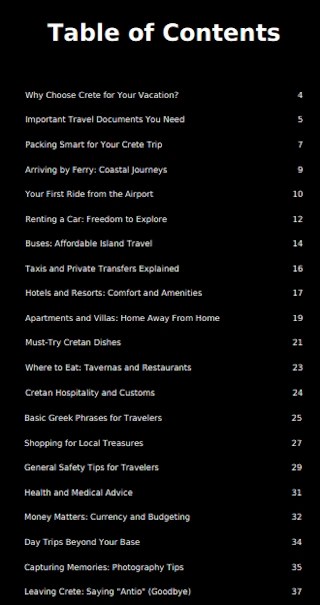
Free Guide to Crete: Table of Contents
As for what’s in the guide, just check out the Table of Contents below. You’ll see that it’s very much an overview of what first-time visitors can expect. As such, we’re happy to offer this 37-page guide free to anyone who might get something from it.
Downloading the Free Guide to Crete
To read or download this Free Guide to Crete, click on this lovely picture of Crete.
The Zagorian Villages and Vikos Gorge in the Pindus Mountains of northern Greece are popular for hiking, and for their scenic beauty and historical traditions.
Vikos Gorge
A 45-minute drive north of Ioannina in Epirus, as you head towards the Albanian border, you come to Zagori (or Zagoria) and the Vikos Gorge, one of the most intriguing regions of northern and western Greece. Forty-six Zagorian villages, with their own distinctive architecture and culture, are linked together by a network of centuries-old paths that make for ideal walking through the superb scenery of the lower Pindus Mountains.
Vikos Gorge
The Vikos Gorge in the Pindus Mountains of Greece
One of the great natural features of the area is the Vikos Gorge, which runs for 7 miles (12 km) and is only 2 miles (3 km) shorter than the Samaria Gorge on Crete. In places its walls rise 3,117 feet (950 m) sheer from the ground, while elsewhere the gorge opens out to flower-filled meadows, with the opportunity to swim in the Voidhomatis River at the right times of the year.
If you are reasonably fit and have arranged transport and accommodations, it is possible to walk the gorge in one day. Walkers need to be extra careful as the gorge is nowhere near as busy as the Samaria Gorge and is relatively free of other walkers. Travelling at the best times, in early and late summer, you may see only a handful of other people so a twisted ankle or dehydration could become a serious problem.
Winter in the Vikos Gorge
The Vikos Gorge at Sunset
In winter the gorge may not be passable, and the same applies in April and May when the mountain snows melt and turn the trickling rivers into thundering torrents which fill the base of the gorge in places. Always take local advice on conditions, and let people know where you are planning to walk.
The Zagorian Villages
Icon Workshop in Monodendri in Zagoria in Epirus
It would take at least a week just to begin to explore this region. The Zagorian villages are fascinating, and the history and the landscape are richly intertwined. Today’s cultural wealth is partly a result of the region’s past poverty. The harsh landscape made it hard for people to scrape a living here, and many were forced to seek work abroad and send money to their families left behind.
The Turks who ruled from Ioannina, about 30 miles (48 km) to the south, granted Zagori autonomy so that the steadily-growing wealth from abroad was largely retained, and used in the 18th and 19th centuries to build houses known as archontika. These are modest in size for mansions, but certainly grand in comparison to the average mountain home. Some are derelict and romantically crumbling, some are still lived in, while others have been restored for use as museums or guesthouses.
This corner of the Pindus Mountains is not thickly wooded, so the mansions are mostly built from the local limestone, with slate roofs. Often there is space for livestock on the ground floor, and a walled yard. They give a very distinctive look to these small villages: fewer than 4,000 people live permanently in Zagori, one of the most sparsely-populated parts of Greece.
Some of the villages are now deserted and some have just a handful of families supporting themselves by agriculture, but others prosper from the increasing tourism in the area. They are popular with hikers, mountaineers, and the more curious and adventurous travellers. The best bases for exploring are the main villages of Monodendri, Tsepelovo, and the twin villages of Megalo Papingo and Mikro Papingo. They all have guesthouses, restaurants, and small shops, and you can usually find a walking guide to hire, if you wish. If you don’t have a car, you can reach these villages on the local bus from Ioannina.
Hiking the Zagorian Paths
The pathways that connect the various Zagorian villages are best enjoyed in the spring when the paths, which are usually no more than a thin covering of gravel, become carpeted with wildflowers.
Zagorian Bridges
Stone Bridge in Zagoria in Epirus
Be warned that the trails are narrow, and the bridges along the way are equipped with bells which alert those about to cross them of any extremely high winds. The bridges are hump-backed with no sides, so can leave hikers exposed to high winds. The bridges are ancient, built by traders who had to cross the region during the spring melt when flooding was common. Some of these precarious stacks of stone don’t look like they could survive a gust of wind, much less the erosion of the centuries. One of the best-preserved – and most-photographed – is the Kalogeriko Bridge near Kipi.
The best time of year to hike the trails is from about April to October. In late summer the Alpine flowers are still blooming but there are autumnal charms too, with cool breezes and mellow colours.
Stone Bridge in Zagoria in Epirus
The paths are somewhat rough. Boots, or at the very least good walking shoes, are a must. There are many different routes but it is best to hire a local guide. The paths are poorly marked, and some are not marked at all.
For the most part, accommodations in the villages are usually limited to small inns or bed-and-breakfasts, but you can find a good choice from cheap to expensive on places including Airbnb. Each of the main villages has several family-owned tavernas and restaurants
The town of Metsovo stands at Greece’s highest mountain pass, between Ioannina and the plains of Thessaly, and has historic mansions and a distinctive cuisine.
Mountains near Metsovo in Epirus, Greece
To travel from the plains of Thessaly into the region of Epirus involves a drive over the highest road pass in the country, which is 5,599 feet (1,707 m) high and often closed in winter.
Nearby is the lovely mountain town of Metsovo, full of character and atmosphere, reflecting the independent spirit of these tough people who live high in these hills. Some are settled Vlach nomads, although a few hill dwellers still retain the old nomadic lifestyle.
Metsovo is very much on the tourist trail as it’s a ski resort in the winter and popular with hikers in the summer, though it has still lost none of its charm. It has a permanent population of only about 3,000 people, and the drive here, in whichever direction, is one of the best drives in Greece though you can also get here by bus from Ioannina, Kalambaka (near Meteora), or Trikala.
View from Metsovo in Epirus, Greece
Metsovo History
Metsovo has a rich history dating back to at least 1380 AD, when it was first mentioned as a small settlement of shepherds. Its strategic location on the main passes between northern and southern Greece became crucial to its development.
Under Ottoman rule, from the mid-15th century until 1912, Metsovo often held special privileges, particularly after 1430 and again in 1659. These privileges were granted in exchange for guarding mountain passes and allowed the town a degree of political and economic autonomy, effectively creating an autonomous “federation” with nearby villages. This led to significant prosperity, especially from the 18th century onward. The Vlach (Aromanian) speaking population became known as successful merchants and traders, establishing commerce networks across the Balkans and Europe.
View of Metsovo in Epirus, Greece
This wealth funded the establishment of schools, churches, and public works, and Metsovo became the birthplace of influential National Benefactors like Georgios Averoff and Michael Tositsas, whose philanthropy greatly supported the Greek state. Despite suffering destruction during an uprising in 1854, the town’s economy boomed in the mid-19th century. Metsovo was finally liberated by the Greek army during the First Balkan War on October 31, 1912.
In the modern era, the legacy of the benefactors, particularly the establishment of the Baron Michael Tositsas Foundation in 1948, has been key to preserving its cultural heritage and developing its economy, focusing on local traditions like woodcarving, cheesemaking, and winemaking.
Metsovo Cuisine
Breakfast at the Katogi Averoff Winery in Metsovo
The cuisine of Metsovo is rich, hearty, and deeply connected to its pastoral, Vlach heritage and mountainous setting. It is most famous for two exceptional products: cheese and wine.
The town is the birthplace of the renowned Metsovone, a Protected Designation of Origin (PDO) smoked semi-hard cheese, traditionally made from cow’s milk with a small percentage of sheep’s or goat’s milk. Other local cheeses to try include Metsovela and a local graviera.
Meat features heavily, often roasted over a spit, with local specialties like savory kontosouvli (large pieces of seasoned pork) and unique local sausages, sometimes flavored with wine or Metsovone cheese. Another staple is the wide variety of pies (pites), which are central to Epirot cuisine, often filled with wild greens, cheese, or meat.
Metsovo Wine
Katogi Averoff Winery Vineyards near Metsovo
Metsovo is also home to the Katogi Averoff Winery, famous for cultivating Greek and international varieties like Cabernet Sauvignon in its high-altitude vineyards, making its local wine a perfect pairing for the robust mountain fare. Dishes often feature local ingredients like wild mushrooms, butter (as olive oil is less common in this climate), and the traditional pasta, trachana. They also have accommodation.
The Metsovo Folk Art Museum offers a fascinating glimpse into the culture and wealthy history of the mountain town of Metsovo, Greece. Housed in the rebuilt 17th-century Tositsa Mansion, it was one of the first projects of the Baron Michael Tositsa Foundation, opening in 1955.
The museum is designed as an “open museum,” showcasing rich collections in their natural setting within the manor’s rooms, stables, and parlours, allowing visitors to experience the organization and function of a traditional Metsovo archontiko (mansion).
Key exhibits include:
Traditional wood-carved furniture, textiles, and gold-embroidered costumes.
Silverware, decorative items, and everyday household utensils.
A significant collection of 15th to early 20th-century icons and Byzantine metal items.
Weapons and swords from the Greek War of Independence in 1821.
The third floor is dedicated to the life and political career of Evangelos Averoff-Tossizza, a major benefactor who oversaw the mansion’s reconstruction and the foundation’s work in revitalising Metsovo. The museum provides a vivid, experiential history lesson about life in this prosperous Epirus region.
The Averoff Museum of Neohellenic Art (Averoff Gallery) is one of the most significant museums for modern Greek art in the country.
Overview and History
The museum was founded by Evangelos Averoff-Tossizza (a prominent politician, writer, and descendant of the town’s great benefactors) to fulfill his wish of establishing a high-quality art institution in his hometown. Inaugurated in 1988, the three-story building and its initial collection of 200 works were donated to the Evangelos Averoff-Tossizza Foundation. An expansion in 1994 significantly augmented the exhibition spaces and collection.
Collection and Focus
The permanent exhibition primarily showcases representative works by major Greek painters and sculptors of the 19th and 20th centuries. The collection includes over 700 paintings, sculptures, drawings, and prints and is considered one of the most complete and important collections of this period in Greece.
Visitors can admire masterpieces by renowned artists such as Nikolaos Gyzis, Nikephoros Lytras, Konstantinos Volanakis, and Yannis Moralis. The museum frequently organizes temporary exhibitions and holds a prominent place in the cultural life of the Epirus region.
The See Greece guide to the ancient archaeological site of Tiryns, near Mycenae, in the Peloponnese of Greece, a UNESCO World Heritage Site.
Where is Tiryns?
From Athens to Tiryns Map (c) Google Maps
Tiryns is about 20 kms (12 miles) south of Mycenae, and 5 kms (3.1 miles) north of Nafplion in the Peloponnese of Greece. If you’re based in Nafplion it’s easy to combine visits to the two sites in one day, or if you’re driving from Athens to Nafplion and make an early start you can also visit both sites on your journey.
Tiryns is about a 90-minute drive from Athens, or about two hours from Athens International Airport. There is some accommodation near Tiryns but our advice would be to stay in Nafplion and make the 5-minute drive to Tiryns.
Ancient Tiryns on the Peloponnese in Greece
Why Is Tiryns Famous?
The site is mainly famous for its impressive fortifications, which date back to the Bronze Age, and for being one of the main centers of the Mycenaean civilisation.
How Old is Tiryns?
The earliest evidence of settlement in Tiryns dates back to the Neolithic period, around 4000 BC. However, it was during the Bronze Age that the site became an important center of Mycenaean culture, which flourished in Greece between 1600 and 1100 BC.
Mycenean Civilisation
The Mycenaean civilisation is known for its monumental architecture, including large palaces, tombs, and fortifications. Tiryns is particularly famous for its fortifications, which were built in several phases between the 15th and the 13th centuries BC. The walls of Tiryns are among the most impressive and well-preserved examples of Mycenaean military architecture.
Tiryns Fortifications
The first fortifications at Tiryns were built around 1500 BC, during the Middle Helladic period. These walls were made of stone and mud-brick, and they encircled the hill on which the palace and other buildings were located. However, these walls were not very strong and were replaced by new, more massive walls around 1400 BC.
Ancient Tiryns on the Peloponnese in Greece
The Walls of Tiryns
The new walls were built of huge limestone blocks, some of which weigh over 10 tons. These blocks were carefully fitted together without mortar, using a technique called “Cyclopean masonry,” which is named after the mythical race of giants who were said to have built the walls. The walls were up to 7 meters (23 feet) thick and over 10 meters (33 feet) high, with towers and bastions at strategic points.
The construction of such massive walls required a large workforce and a high degree of organization. It’s believed that the Mycenaean rulers of Tiryns controlled a large territory and had access to a substantial labor force, including slaves and prisoners of war.
The Palace of Tiryns
The Palace of Tiryns was located within the walls and was the residence of the Mycenaean rulers. The palace was a complex of buildings, including a central hall, private rooms, and storage areas. The central hall was the most impressive part of the palace and was used for public ceremonies, feasts, and other important events. The hall had a large hearth in the center and was decorated with frescoes and other artworks.
Tiryns was an important center of Mycenaean culture and played a role in the wider Mediterranean world. The Mycenaeans were skilled traders and sailors and maintained contacts with other civilisations, such as the Minoans on the island of Crete and the Egyptians.
Tiryns and the Trojan War
Tiryns was also involved in the Trojan War, which is described in Homer’s Iliad. According to the legend, the Mycenaean king Agamemnon gathered a large army at Tiryns and sailed to Troy to recover his wife, who had been kidnapped by the Trojan prince Paris.
Rediscovery of Tiryns
In the centuries that followed, Tiryns declined in importance and was eventually abandoned. The site was rediscovered in the 19th century by German archaeologist Heinrich Schliemann, who also excavated the nearby site of Mycenae. It’s now a UNESCO World Heritage Site.
Corinth has four aspects to it, which are the Corinth canal, the modern town of Corinth, nearby Ancient Corinth, and above that Akrokorinthos or Upper Corinth.
Ancient Corinth in the Peloponnese
The Corinth Canal
The Corinth (Korinthos) Canal is one of the great sights of Greece. With luck, you might be there when a ship is being steered between the narrow, sheer walls which stretch away in the distance to link the Gulf of Corinth with the Aegean Sea. The only way to see it – apart from taking a boat through it – is to take the main road from Athens onto the Peloponnese, which crosses over the canal. You can park and get out to have a lovely view down the canal, an engineering marvel which effectively turned the Peloponnese into a giant island.
The Corinth Canal in the Peloponnese
Roman Emperor Nero (37-68 AD) first mooted the idea of cutting a canal through the isthmus so that ships could sail from Italy into the Aegean without going all the way round the Peloponnese. He performed the first symbolic excavation in person, using a silver shovel, but the task was never completed. Ships continued to sail up the Gulf of Corinth, unload their cargoes, , and have them carried the 3.5 miles (6 km) to a ship waiting on the far side rather than risk losing the cargo on the sometimes stormy circuit around the Peloponnese.
It wasn’t until 1893, after a total of 12 years work, that the 75-foot (23-metre) Corinth Canal was finally cut through, enabling boats to sail directly to Piraeus. The canal is still used, though less so these days as it isn’t large enough to take the latest super-tankers.
Modern Corinth
A few miles beyond the canal (if coming from Athens) is the modern town of Corinth, which detains few visitors except maybe as a refueling stop. It’s mainly an agricultural service town, and it’s interesting to know that it’s the centre of the Greek currant industry: the word ‘currant’ actually derives from the name Corinth. There are hotels and restaurants if you need to spend the night, but the charms of Nafplion are little more than an hour’s drive away, so head there for the evening.
Ancient Corinth
Ancient Corinth in the Peloponnese
Beyond the modern town, the site of Ancient Corinth is to the south of the main road. Regular buses from modern Corinth also take visitors to and from the site. The site really comes to life as you walk around the well-preserved remains which are dominated by a Temple of Apollo from the 5th century BC. With its massive Doric columns, this is one of the buildings that the Romans left when they redeveloped the city as their provincial capital in 44BC.
The city was once home to 300,000 citizens and 460,000 more who were slaves – a total population bigger than modern-day Denver, Boston, or Washington DC. The smallest buildings are the ones that speak of the history: the remnants of shops, houses, and administrative buildings. The Peirine Fountain was a gift from Herodes Atticus, the wealthy Athenian, patron and friend of the Romans, and the spring beneath it still provides the water supply for the modern town of Corinth.
Ancient Corinth in the Peloponnese
The Archaeological Museum on the site has a good display of remains found there. Some lovely mosaics, mostly dating from the second-century AD Roman period, are a good indication of the city’s wealth at that time. Domestic vases, pottery, and jewelry all give the collection a more human scale.
Upper Corinth
Overlooking the lower city from the hilltop 2.5 miles (4 km) away was Akrokorinthos, or Upper Corinth. To get here you’ll need a car or take a taxi from Corinth, and though it’s a bit steep you can hike it or bike it too. Akrokorinthos’s walls and spectacular views are the chief reasons to visit.
When you see the position the city commands, you realise its strategic importance and why it was refortified by every subsequent wave of invaders, including the Venetians, the Franks, and the Turks. The walls run for 1.25 miles (2 km) around the 60-acre (24-hectare) site, where you can find the remains of chapels, mosques, houses, fortifications, and the still-working Turkish Fountain of Hatzi Mustafa.
This walk in Old Corfu Town, or Campiello, takes you from the Liston through the narrow back streets and alleyways and should take about one to two hours.
The Rooftops of Corfu’s Old Town
One of the highlights of a visit to Corfu Town, the capital of Corfu, is a walk through the atmospheric streets of the old town, known as the Campiello, with its narrow alleyways, tall shuttered buildings, ornate balconies and steep stairways.
A Walk in Old Corfu Town
Start at The Liston
The Liston in Corfu Town at Night
To begin this walk in Old Corfu Town start at the southern end of the Liston and walk west down Voulgareos Street. If it’s hot or wet, walk beneath the shopping arcades – they were built for protection from the weather. Silversmiths have traded along this street since Venetian times, and there are many jewellery stores.
Town Hall Square
Take the first left, just before the flags which mark the entrance to the Town Hall. This leads into Town Hall Square, also known as Plateía Demarchíou or M Theotoki Square. On the left is the Catholic cathedral. Paved terraces adorned with gardens and a fountain rise up the steps to the former archbishop’s palace, which now houses the Bank of Greece.
Iroon Square
Leave the square on the other side of the Town Hall, cross over Voulgareos Street, and continue straight ahead on M Theotoki Street. Pass little Pinia Square with its replica Venetian well, and turn right on N Theotoki Street which leads to Iroon Square. The yellow church on the east side of the square is the Faneromenis Church, built in 1689. Its ornate interior is decorated with gilded wood and icons by Cretan painters.
Paper Money Museum
Opposite is the Ionian Bank, home of the Paper Money Museum. On the square’s south side is St John the Baptist church, Corfu’s former cathedral built in 1520. In the middle of the square is a statue of the politician G. Theotoki. You will have gathered by now that the Theotoki family was an important Corfu dynasty, with numerous streets named after different members.
Church of St Spyridon
Tower of the Church of St Spyridon
Exit the square along the narrow street behind the statue to the left, and go up the steps and into the church of St Spyridon. Leave through the opposite door and turn left down Spyridon Street. At the end, turn left on Filarmonikis Street.
Evangelistrias Square
Cross N Theotoki and take the narrow street between the cigarette and grocery shops. Bear left and return to Pinia square. Turn right at the far end down Vrahlioti Street. It leads to tiny Evangelistrias Square, overlooked by a crumbling bell tower, all that remains of the 16th-century church of Evangelistrias.
Palaiologou Street
Cross over the square and continue down Voulgareos again. Take the first right on Palaiologou Street, signposted to Spilia and the Jewish Community. Bear left after the flower bed, beside the little bakery, Rosy’s. This narrow street is lined with interesting shops and small cafés.
Walking Tip
It is almost inevitable that you will get lost in the confusing warren of streets in the Old Town. Accept it as part of the experience. A compass would really help, as you are not always walking in the direction you might think you are. If confused, simply stop and ask a shopkeeper.
Solomou Street
Just before the end, turn left on Solomou Street. On your right along here is a small square covered in café tables. At the far end is a moving monument to the 2000 Jews of Corfu who perished in Nazi concentration camps in 1944. Solomou Street continues uphill past a pink church to the entrance to the New Fortress.
To the Cathedral
Walk back down Solomou to the end, where you turn left and immediately right down a tiny alley, Prosalendiou. Take the first right onto Alipiou, and bear right past the palm tree, walking uphill. Take the second left, at the top, onto Ag. Theodoras (unmarked), which leads to the top of the Cathedral steps.
The Venetian Well
Sign for the Venetian Well in Corfu’s Old Town
Continue on Ag. Theodoras, past the front of the cathedral and swerving around the cafe tables of a small square. The second left, Komninon Street, takes you under a huge arch and up a flight of steps to Kremasti Square. Here you’ll find the delightful Venetian Well, and the restaurant named after it.
Back to the Liston
Beyond the well, take the first right turn back down to Ag. Theodoras, cross over and continue down Ag. Nikolaou. Ahead you can just see the top of the spire for St. Spyridon’s. When you reach a small square, turn right and immediately left down towards Dousmani. When you reach the shops at the T-junction, turn right and go down the steps. At the bottom bear right down the shopping street and take the first left into Spyridon Street. This leads you back to Kapodistriou Street, where you turn right to return to the start of the walk.
See Greece suggests the ten best things to do on Poros, from museums and monasteries to beaches and cookery classes.
Poros
Nestled between the Peloponnese and the Aegean Sea, Poros is a small but fascinating island that offers a rich array of experiences. Whether you’re a history buff, beach lover, foodie, or adventurer, Poros has something to offer.
The Best Things to Do on Poros
🏛 Explore Poros Town (Chora)
Poros Town
Poros Town is the beating heart of the island. Built amphitheatrically on a hillside, it’s a maze of narrow alleys, whitewashed houses with terracotta roofs, and vibrant bougainvillea. The waterfront promenade is lined with cafés, tavernas, and shops, perfect for people-watching or sipping ouzo as yachts bob in the harbor.
Don’t miss the Clock Tower, perched on the highest point of town. It offers panoramic views of the sea and the Peloponnese coast.
Wander through the backstreets to discover artisan shops and hidden tavernas.
🏖 Swim at Love Bay
Love Bay is one of Poros’s most iconic beaches. Surrounded by pine trees that nearly touch the turquoise water, it’s a romantic and serene spot ideal for swimming and sunbathing.
The beach is small but organized, with sunbeds and a beach bar.
The pine-scented air and calm waters make it a favorite for couples and families alike.
Visit the Temple of Poseidon
High on a hill in the northern part of the island lie the ruins of the Temple of Poseidon, dating back to the 6th century BC. Though only fragments remain, the site is steeped in myth and history.
Ancient Greeks believed Poseidon ruled the seas from here.
The location offers sweeping views and a peaceful atmosphere for reflection.
Map (c) Google Maps
🏺 Discover the Archaeological Museum of Poros
Located in Poros Town, this museum houses artifacts from the Temple of Poseidon and nearby regions like Troezen and Methana.
Exhibits span from the Mycenaean to Roman periods.
Highlights include votive offerings, pottery, and a clay figurine of a horseman from 1300 BC.
🌲 Walk Through the Lemon Forest (Lemonodasos)
Just across the narrow strait in Galatas lies the Lemonodasos, or Lemon Forest—a lush grove of lemon trees interspersed with streams and old watermills.
A short boat ride or drive gets you there.
Ideal for a tranquil walk, especially in spring when the blossoms perfume the air.
Poros Lighthouse
🏄 Try Water Sports at Askeli Beach
Askeli is the longest beach on Poros and a hub for water sports. Whether you’re into kayaking, paddleboarding, or wakeboarding, this is the place to get your adrenaline fix.
The beach is well-organized with restaurants and bars.
The nearby hills offer hiking trails with stunning views.
🕍 Visit the Monastery of Zoodochos Pigi
Founded in 1720, this monastery sits on a pine-covered slope east of Askeli Beach. Legend has it that its spring cured the Metropolitan of Athens of kidney stones.
The church features 17th- and 18th-century religious art.
It’s a peaceful retreat with spiritual and historical significance.
🍽 Eat Fresh Seafood at a Waterfront Taverna
Fresh Fish at the Taverna Apagio on Poros
Poros is a paradise for seafood lovers. Local fishermen supply daily catches to tavernas that serve grilled octopus, fried calamari, and fresh fish.
Try Taverna Apagio, a family-run spot near the new port known for its authentic dishes.
Pair your meal with local wine and enjoy the sunset over the harbor.
⛵ Take a Day Cruise Around the Saronic Islands
Poros is perfectly positioned for island-hopping. Join a day cruise to nearby islands like Hydra and Aegina, each with its own character and charm.
Cruises often include swimming stops and onboard meals.
It’s a great way to see more of the Saronic Gulf without packing your bags.
Join a Traditional Greek Cooking Class
Greek Cooking Course on Poros
Located near Askeli Beach, this hands-on workshop lets you prepare traditional dishes like kleftiko, gyros, and souvlaki meze in a relaxed, friendly setting. After cooking, you’ll enjoy your creations at Odyssey’s Corner Bistro, surrounded by herbs, flowers, and Greek music under the stars
Sirene Blue Hotel on Poros
🌅 Bonus Tips for Visiting Poros
Best Time to Visit: Late spring and early autumn offer pleasant weather and fewer crowds.
Getting There: Poros is just an hour from Athens by fast ferry from Piraeus, making it one of the most accessible Greek islands.
Stay Options: From cliffside resorts like Sirene Blue to charming town hotels like Anemone, there’s accommodation for every taste.
See Greece picks the best time to visit Hydra with a month-by-month breakdown of the weather, hotel prices & any special events to add to the holiday fun.
Hydra at Night
Hydra, one of the Saronic Gulf Islands, is a timeless destination that blends natural beauty, rich history, and a charming car-free atmosphere. Whether you’re a solo traveler seeking serenity, a couple chasing romance, or a family looking for a cultural escape, Hydra offers something for everyone.
But when is the best time to visit? That depends on your priorities—weather, crowds, hotel prices, and events all play a role. So let’s dive into Hydra’s climate and then explore each month in detail to help you plan the perfect trip.
Hydra, with the Peloponnese in the Background
🌤Hydra’s Climate: Mediterranean Magic
Hydra enjoys a classic Mediterranean climate:
Hot, dry summers with long sunny days
Mild, wetter winters with occasional chilly nights
Low annual rainfall (~14.8 inches / 375 mm)
Rare snowfall, usually in January or February
The island’s weather is ideal for outdoor activities from spring through autumn, while winter offers a quieter, more introspective experience.
Events: New Year’s celebrations are low-key; many businesses are closed
Hotel Prices: Lowest of the year; ideal for budget travelers
January is Hydra at its quietest. With high humidity and frequent rain, it’s not beach weather—but it’s perfect for peaceful walks, cosy tavernas, and introspection.
Events: Greek Independence Day (March 25) with parades and celebrations
Hotel Prices: Still affordable, but rising slightly
March is a transitional month. The weather improves, and the island begins to stir from its winter slumber. Independence Day celebrations add a festive touch.
Events: Orthodox Easter (date varies); a deeply cultural and spiritual experience
Hotel Prices: Moderate; book early for Easter
April is a wonderful time to visit. The island blooms, and Easter brings candlelit processions and feasts. It’s a great mix of mild weather and cultural immersion.
Events: Hydra’s Miaoulia Festival preparations begin
Hotel Prices: Rising with demand; still reasonable
May is arguably one of the best months to visit Hydra. Warm days, blooming landscapes, and fewer crowds make it ideal for hiking, swimming, and sightseeing.
Events: Miaoulia Festival (late June) with fireworks, concerts, and naval reenactments
Hotel Prices: High during the festival; book early
June is peak season kickoff. The Miaoulia Festival honours local hero Admiral Miaoulis and is a highlight of the year. Expect warm seas, lively nights, and packed hotels.
Events: Feast of the Dormition (August 15); religious and cultural events
Hotel Prices: Peak season; most expensive month
August is Hydra’s busiest month. The weather is scorching, the sea is warm, and the island is alive with visitors. Book well in advance and prepare for crowds.
Hotel Prices: Moderate; many businesses begin to close
October is Hydra’s autumnal retreat. The weather is still pleasant, and the island takes on a quieter charm. Great for cultural travelers and photographers.
November is cool and damp, but peaceful. Ideal for writers, artists, and anyone seeking solitude. Many hotels and restaurants are closed, so plan ahead.
Events: Christmas and New Year’s Eve; quiet celebrations
Hotel Prices: Lowest of the year
December is Hydra’s hibernation mode. While not festive in a commercial sense, it offers a tranquil escape for those who enjoy winter walks and quiet evenings.
Hydra Graffiti
Final Tips for Travelers
Book early for June–August, especially during festivals
Pack layers in spring and autumn; winters are damp
Check ferry schedules, especially in off-season
Explore beyond Hydra Town—hiking trails and hidden beaches await
Hydra is a destination that rewards thoughtful timing. Whether you crave sun-soaked beaches, cultural immersion, or peaceful solitude, there’s a perfect month waiting for you.
The See Greece guide on what to do on Hydra with kids, including the best beaches, where to stay and kid-friendly dining.
Public Transport on Hydra
Hydra with Kids: Family-Friendly Activities & Tips for a Memorable Island Escape
Hydra, one of the Saronic Gulf Islands of Greece, is a car-free haven that offers a peaceful yet adventurous escape for families. With its charming harbor, gentle beaches, and walkable cobblestone streets, Hydra is a dream destination for parents seeking a blend of relaxation and exploration with their children.
Hydra is 65-140 minutes by ferry from Athens Map (c) Google Maps
Whether you’re traveling with toddlers or teens, this guide will help you uncover the best family-friendly activities and practical tips to make your Hydra holiday unforgettable.
🚶 Why Hydra Is Perfect for Families
Public Transport on Hydra
One of Hydra’s most unique features is its absence of cars. Transportation is limited to donkeys, water taxis, and your own two feet. This makes the island exceptionally safe for children to roam without the usual traffic worries. The laid-back pace, friendly locals, and compact size of the island mean less stress and more quality time together.
🏖 Best Beaches for Kids
Hydra’s beaches are mostly pebbled, but they’re clean, calm, and ideal for family fun. Here are the top picks:
Vlychos Beach
Just a 20-minute walk or short water taxi ride from Hydra Town.
Shallow waters and gentle waves make it perfect for younger kids.
A beachfront taverna offers snacks and shade.
Kamini Beach
Located in the quiet fishing village of Kamini.
Small, peaceful, and great for a picnic.
Ideal for toddlers thanks to its calm waters and easy access.
Mandraki Beach
One of the few sandy beaches on Hydra.
Offers sunbeds, umbrellas, and water sports for older kids.
Easily accessible by water taxi.
Tip: Bring water shoes for the kids—most beaches are pebbly and can be tough on little feet.
🐴 Donkey Rides & Local Transport
Kids Can Take a Donkey Ride on Hydra
Donkeys are a beloved symbol of Hydra and a fun way for kids to experience local culture. While they’re traditionally used for transporting goods, short rides around town are available and safe for children.
Donkey stations are located near the harbor.
Always check with the handler for age and weight limits.
A short ride through Hydra’s alleys can be a highlight for younger kids.
For longer distances, water taxis are a scenic and exciting alternative. Kids love the boat ride, and it’s a quick way to reach beaches or nearby villages.
Hydra Harbour
🏛 Cultural Activities for Curious Minds
Hydra isn’t just about beaches—it’s steeped in history and art, which can be surprisingly engaging for children.
Historical Archives Museum of Hydra
Offers interactive exhibits and maritime history.
Great for older kids interested in Greek independence and naval heritage.
Kountouriotis Mansion
A preserved 18th-century home with period furniture and artifacts.
Gives kids a glimpse into Hydra’s aristocratic past.
Art Galleries
Hydra has a thriving art scene, with galleries like the DESTE Foundation hosting contemporary exhibitions.
Some galleries offer family-friendly events or workshops during summer.
Hydra at Night
🍽 Kid-Friendly Dining
Greek cuisine is naturally kid-friendly—think grilled meats, fresh bread, and lots of cheese. Hydra’s tavernas are welcoming to families and often offer high chairs and children’s portions.
Recommended Spots:
Techne Restaurant & Social – Stylish yet relaxed, with a kids’ menu and sea views.
Taverna Gitoniko – Traditional Greek dishes in a cosy courtyard.
To Pefkaki – Near Vlychos Beach, perfect for a post-swim meal.
Tip: Try local specialties like souvlaki, spanakopita, and loukoumades (Greek doughnuts)—they’re usually a hit with kids.
🛏 Where to Stay with Kids on Hydra
Hydra offers a range of accommodations, from boutique hotels to family-run guesthouses. Look for places with:
Spacious rooms or suites
Kitchenettes for easy meal prep
Proximity to the harbor or beaches
Family-Friendly Options:
Hotel Angelica – Centrally located with family rooms and a garden.
Hydra Icons – Stylish apartments with kitchen facilities.
Four Seasons Hydra – Located near Plakes Beach, ideal for families seeking tranquility.
Hydra
🎨 Fun & Creative Activities
Hydra’s artistic vibe can inspire creativity in kids. Here are a few ideas to keep them engaged:
Sketch the harbor: Provide a small sketchbook and let them draw the boats and donkeys.
Shell collecting: While Hydra’s beaches aren’t sandy, kids can still find interesting pebbles and shells.
Photo scavenger hunt: Create a list of things to spot—like a blue door, a cat, or a church bell.
Practical Tips for Parents
To make your Hydra trip smooth and stress-free, keep these tips in mind:
Pack light but smart: Strollers can be tricky on cobblestones—opt for a baby carrier or lightweight travel stroller.
Hydration is key: The island gets hot in summer, so carry reusable water bottles.
Sun protection: Hats, sunscreen, and UV-protective swimwear are essential.
Cash is handy: While most places accept cards, small shops and donkey rides may prefer cash.
Book early: Hydra is popular in summer—secure your accommodation and ferry tickets in advance.
🌅 Making Memories That Last
Hydra’s charm lies in its simplicity. Without cars, theme parks, or loud nightlife, families can reconnect over slow walks, shared meals, and quiet beach days. Whether it’s watching the sunset from the harbor or laughing over a donkey ride, Hydra offers the kind of moments that stick with you long after the holiday ends.
📌 Final Thoughts on Hydra for Kids
Hydra may not have the flashy attractions of larger Greek islands, but that’s exactly what makes it perfect for families. It’s safe, scenic, and packed with opportunities for meaningful experiences. From beach days to cultural discoveries, Hydra invites you to slow down and savor the joy of traveling with your kids.
Wild Abandon by Jennifer Barclay and published by Bradt Guides is A Journey to Deserted Places of the Dodecanese islands in Greece, including Rhodes and Kos.
Wild Abandon by Jennifer Barclay
Bradt Guides publishes excellent guidebooks. However, they also publish some entertaining and usually very different travel narrative books, and Wild Abandon by Jennifer Barclay is one of those.
Jennifer Barclay
Jennifer Barclay is the perfect author for a book like this, as she has made her home on Tilos in the Dodecanese, has lived in Athens, and has travelled widely throughout the Greek islands. She’s also an adventurous traveller and a lover of deserted places, and has written several other books about Greece including Taverna by the Sea, Falling in Honey and An Octopus in my Ouzo.
Jennifer Barclay and her dog Lisa
In Wild Abandon she decides to focus not on the main sites in the Dodecanese, like the Old Town of Rhodes, but visits places few visitors are likely to discover for themselves. Some require some energetic trekking and camping out, and for most of the trips she’s accompanied only by her faithful dog, Lisa. On others, where Lisa has to be left behind for one reason or another, the author travels with an un-named friend.
The Dodecanese
Astypalea
In all she visits eleven of the islands in the group, and as I’ve visited seven of them myself it was a fascinating read… making me now want to visit the four I’ve not been to so far. She includes the main islands, known for their busy tourist areas, like Rhodes and Kos, but you’ll see sides of these islands you probably didn’t know existed. Each island gets a chapter to itself, and the others are: Tilos, Nisyros, Kalymnos, Astypalea, Kastellorizo, Karpathos, Kasos, Chalki, and Arki.
Tilos
Abandoned village on the Greek Island of Tilos
The book starts and ends on Tilos, where the author lives and which naturally she knows intimately. Here, among many places, she talks about the Harkadio Cave, which she can see across the valley from her office desk and is ‘where the last elephants in Europe died four thousand years ago.’ Elephants in Europe only four thousand years ago? This is the kind of entertaining and unexpected fact the author loves to dig out and entertain the reader with.
Nisyros
Nisyros
On Nisyros she uncovers the Pantelidis Baths, a grand therapeutic spa built in 1910, once visited by thousands coming in shiploads but now lying in ruins. Who knew this was on Nisyros? Certainly not me. The Nisyros chapter is typical of the author’s detailed and descriptive writing.
‘As I stand outside the taverna to get a signal on my phone, I watch a little black cat sitting in a hole in the wall. Lisa sees it and growls, and it jumps away. Yiannis, appearing from the kitchen, points to the hole. “Put your hand inside.” I feel warm steam. It’s a geothermal apiria, or blowhole of the volcano.’
Kos
Kos
I realise as I read through Wild Abandon that I could quote from every chapter to give a feel for the book, for the contents and the author’s style. Here, from the chapter on Kos, called ‘Faith in Water’, she discovers the village of Pyli, where not all the houses are inhabited:
‘Others are obviously long abandoned, broken glass in the windows and rubbish in the garden. I tread carefully through tall grass to peek through an open window. There are black-and-white photographs on the mildewed wall. An old black travelling trunk sits open with a New York address painted by hand on the side.’
Don’t you immediately want to know about the trunk, the photographs and the New York address?
Kalymnos
‘Even in August, it felt excitingly wild and empty. The land was dramatic, fearsome even, with craggy grey cliffs, rust-streaked, dropping down steep inclines almost five hundred metres to the sea. Waves surged relentlessly from the northwest into the narrow inlet where aquamarine water almost glowed. I saw a diver in a wetsuit swimming close to the black rocks, then I watched it moving and realised it was a seal.’
Every chapter has gems of lovely, lyrical writing in it, along with detailed descriptions that make you feel you’re standing there alongside the author seeing what she’s seeing.
Kalymnos
Advice
One piece of advice – if you’re reading the book then have this website open alongside you:
The author has put it together to enhance the book, and it’s full of her colour photographs of the islands covered. You can see some of them on this page. Unfortunately I only looked it up after finishing the book and it’s clear that lots of the photos are of places referred to in the text. It will bring the book even more to life if you can see the photos at the same time.
If you’re planning a trip to any of the islands covered in the book, buy a copy of Wild Abandon to sit alongside a conventional guidebook. If you like reading good travel books about Greece, or about anywhere for that matter, then put Wild Abandon on the shopping list or in your Amazon basket. It’s excellent. Or, as Victoria Hislop said: “A vivid and intoxicating account of these beautiful islands”.
A Thing of Beauty by Peter Fiennes describes ‘Travels in Mythical and Modern Greece’ and places the Greek Gods in the context of modern-day Greece.
A Thing of Beauty by Peter Fiennes
Here at See Greece we’re suckers, of course, for travel books about Greece. Our shelves are sagging with them. They include classics like Patrick Leigh Fermor, Lawrence Durrell, and Henry Miller, to more recent must-read titles like Eurydice Street and Wild Abandon. To this list can be added A Thing of Beauty by Peter Fiennes, an evocative and informative book whose sub-title sums it up: Travels in Mythical and Modern Greece.
You would therefore expect his new book about Greece to shine when it comes to the nature writing, and it certainly does, though that is only one part of its multi-faceted appeal. It’s for anyone interested in the Greek Gods and their myths, the Greek countryside and wildlife, Greek politics and history, climate change and sustainable living, whether there’s any hope in the world today… and how many Greek salads can one man eat? If you’re interested in more than one of those topics, it’s definitely the book for you.
Travels in Greece
It’s the theme of the Greek myths which holds the book together, though, as the author travels around the country visiting the places where some of the more famous myths are said to have occurred.
Beginning in Athens and ending in Epirus, via a drive around the Peloponnese, the author retells those myths as well as talking to present-day Greeks – some in pre-arranged meetings and others by chance – and asking everyone the question he’s most curious about: is there hope? It’s a serious question although the book itself is far from sombre, as the author has a light touch and is very funny in places.
Lord Byron
In fact the book begins not in Athens but in Nottinghamshire in England. At Newstead Abbey, to be exact, the ancestral home of George Gordon Byron, 6th Baron Byron, better-known to the world as Lord Byron, poet and Grecophile. The author’s travel plans were scuppered, or at least delayed, by the outbreak of Covid, so he takes the chance to go and see Lord Byron’s home.
And it’s thanks to this that we get a hugely entertaining chapter about Byron and his family, filled with salacious details, leading up to his love affair with Greece. Well, he’d had every other kind of love affair, why not with an entire country?
And while Covid is initially an impediment, it turns out to add what was probably an unexpected dimension to the book. After all, it’s not in the least bit far-fetched to look upon the pandemic as a curse brought down on mankind by the Gods above, Greek or otherwise. This is another theme the author skilfully weaves into the tapestry of his story.
On the Road in Greece
Renting a car, and leaving his wife and son behind after a few family days, the author drives around Greece visiting such places as Eleusis, Corinth, Mycenae, Epidavros, Olympia, Delphi (where he encounters an online Oracle), Messolonghi (where Byron, or at least a bit of him, is buried), and ultimately to the wilds of Epirus, a majestic landscape threatened by voracious oil developers and by fracking.
Lost and Found
While dealing with the immortal (well, some of them) and almighty Gods, the author proves himself to be all-too-human, and very self-deprecating with it. He manages to get lost while hiking, stumbling across German nudists on a beach, and when he has treated himself to a decent hotel for the all-important visit to Delphi, he ends up in the worst room in the building, with the smell of tobacco and the sound of conversation – which is seldom whispered in Greece – both wafting in from a ventilation shaft of some kind.
Epirus
For me the book builds to the best part, towards the end, where the author visits Epirus. Here he meets up with an ornithologist contact, Julian Hoffman, who lives in Prespa, and we’re treated to sightings that show just how rich parts of Greece are in birds and other flora and fauna. Even the ornithologist is impressed by what they see in the Ambracian Gulf, a stone’s throw, literally, from the airport at Preveza which brings holidaymakers in by the charter-flight planeload throughout a normal summer.
In this section I learned where I’m definitely going to eat if I ever find myself in Mitikas, just outside Preveza: the Doctor of Hunger steakhouse, it has to be. It’s also in Epirus, at the Monastery of Rodia, that the author and his ornithologist companion meet an eccentric elderly Greek man named Costas, who for some reason seems to be gathering cyclamen. As they’re about to leave, Costas hands them a bunch of cyclamen and tells them with great feeling: ‘Remember what men are here for. It is to share stories about the things that matter.’
It’s a wonderful summing-up of what’s important in life, and Peter Fiennes should be proud of himself that in his book he has done just that. He’s shared stories about things that matter.
A Rope of Vines by Brenda Chamberlain is an evocative memoir of the author’s time living on the Greek island of Hydra in the early 1960s.
A Rope of Vines by Brenda Chamberlain
A Rope of Vines begins with the kind of opening sentence that compels you to read on:
I have returned to the good mothers of Efpraxia while my friend Leonidas serves sentence for manslaughter of an English tourist in the port of Ydra.
Ydra is an alternative spelling for Hydra, of course, and Efpraxia is a convent on the island, where the author stays for a part of the time during the six years that she lives on Hydra. She returns to the story of Leonidas later in the memoir, naturally, and we learn what exactly happened down in the port.
A Rope of Vines: The Author
Brenda Chamberlain (1912-71) was a Welsh writer and artist who moved to Hydra in the Saronic Gulf Islands, not far from Athens, in 1961, having previously lived on the Welsh island of Bardsey for 15 years, an experience she also wrote about. She returned to Wales in 1967 and died in Bangor, where she had been born, only four years later. She wrote fiction, prose and poetry, and her paintings are on display in several collections in Wales, and in London.
A Rope of Vines: The Book
A Rope of Vines by Brenda Chamberlain
A Rope of Vines was first published in 1965, when the author was still living on Hydra, and republished in 2009 by the Library of Wales, which holds her papers. It’s a fairly short book of less than 150 pages, which also include many of the author’s line drawings of Hydra, mostly of buildings but a few including people too.
It may be a short book but it is also very intense. There are vibrant scenes of people, incidents, wildlife, scenery, and especially the weather, and its intense heat. Hydra is a bare and rocky island, where cacti grow, and it’s ironic that its name is the Greek word for ‘water’, yet it has to bring in most of its water by boat.
Life on Hydra
A Rope of Vines gives you very much a behind-the-scenes look at life on Hydra. The author lives in a house high up above and away from the port, which even then bustles with life and visitors. She dislikes the port and all its transient activity, and the Hydra described in these pages is the Hydra of ordinary people. They’re the people who live simple lives, with hand-to-mouth existences, some with emotional and physical problems. It’s a day-to-day existence which is captured, warts and all, in the pages of A Rope of Vines.
The title, incidentally, comes from the way fishermen used to tie their boats up with a rope made from twisted vines, before proper ropes and metal ties became widely available. It’s the way she sees herself tied to the island.
Leonard Cohen on Hydra
Don’t turn to this book, as I did, if you expect to read at least a little something about one of Hydra’s most famous residents in the early 1960s, Leonard Cohen. His life on the island overlaps with that of Brenda Chamberlain, though the bohemian art scene of which he was a part gets no mention in the book. It’s not that his life there was secretive. While living there he published his poetry collection Flowers for Hitler (1964), as well as his novels The Favourite Game (1963) and Beautiful Losers (1966).
Indeed, TripAdvisor has a long thread about how to find Leonard Cohen’s house on Hydra. As both were writers and artists, and foreigners on Hydra, it’s unlikely they wouldn’t at least have known of each other’s existence. But Chamberlain’s writing is more inward-looking. As artist Shani Rhys-James points out in her introduction to the Library of Wales edition, she makes a hike and camps out overnight on a pilgrimage with an English family, yet we learn nothing at all about the family, though the descriptions of the hike, the landscape, the wildlife and the experience are brought vividly to life.
It has to be said that this won’t be a book for everyone. The style can be florid and very intensely personal, and sometimes the stories can be vague and mysterious. We never do find out, for example, the nature of her relationship with Leonidas. Were they friends or lovers? The reader will never know.
Buying A Rope of Vines
The book is well worth buying, for anyone who wants to learn a little more about Greek family life, and what goes on away from the tourist zones.
If you have any interest in Hydra, you’ll want to read it as the author does visit a lot of the island, going on hikes and describing the flora and fauna beautifully. Her artist’s eye and her poet’s use of language make this an exceptional and unusual book about Greece.
Greek retsina is a dry white wine made and drunk all over Greece with a distinctive pine and resin flavour that people usually either love or hate.
Retsina Bottles
For us, when we visit Greece, our first meal is very often kalamari (squid) and a bottle of retsina, perhaps preceded by an ouzo. It’s the very taste of Greece on a plate and in a glass. It tells us we’re back in our beloved Greece at last. If retsina is an acquired taste, then we acquired it long ago.
What is Greek Retsina?
Retsina is a dry white wine that has been in contact with pine resin to give it its unique flavour. The flavour of retsina is hard to describe, though once you taste it you never forget it. People who don’t like it compare it to turpentine, which we obviously think is unfair. Perhaps they’ve just had some bad retsinas, for as with any wine the quality varies.
Greek Retsina
It’s crisp, a little lemony, and even though it’s dry there can be a touch of sweetness to it. The overpowering taste is of course the pine resin, however. Imagine walking through a pine forest on a hot summer day and being able to capture that aroma in a bottle. To us, that is the essence of retsina.
Which Greek Retsina to Choose?
Of course there is more than one type of retsina and flavors vary, depending on the process. One name you see throughout the country is Kourtaki, though there are other best-selling brands including Malamatina and Ampelicious.
Kourtaki Greek Retsina
Many of the bigger and better winemakers like Gai’a started including a retsina in their line-ups, after a surge in its popularity a few years ago. If you find a bottle of Ritinitis Nobilis from Gai’a on offer anywhere, do try it. These quality retsinas tend to be lighter than the more commercial brands, concentrating more on the wine, and on the citrus taste rather than on being too resiny.
What we like to do is ask if the taverna or restaurant has any local retsinas, so we can try some we’re unlikely to find anywhere else. You don’t usually get draft retsina in the way you get house wines, made by the taverna-owner, as unless you know what you’re doing it’s easy to ruin a good wine by adding too much resin flavour to it.
Cheap Greek Retsina
Retsina traditionally comes in a 50cl bottle with a screwtop cap on it, though some of the more upscale brands use a conventional 70cl bottle with a cork or plastic stopper. It’s one of the cheapest bottled Greek wines that there is, so it’s very popular with students and those on a budget. Some people like to mix it with soft drinks to make a kind of retsina spritzer, and to make the retsina last longer. You can also mix it with colas, if you like, though we prefer our retsinas straight.
Greek Retsina Wine Bottle
For a long time it was seen as the poor man’s drink, which is one reason it’d had such a poor reputation in the past, but with the 21st-century renaissance in Greek winemaking, people have come to realise that retsina can be made well.
Retsina Rosé
The vast majority of the retsina made in Greece is white, but there are a few rosé retsinas around. They’re not common so you should definitely snap one up if you see it.
Which Grape is Retsina Made From?
Most retsina is made from the savatiano grape, which is the country’s most widely-planted grape. It is drought-resistant, which helps see it through the hot Greek summers, and it makes pretty reliable if not very exciting wine – though it can make good wine, if the winemaker is prepared to put more work in.
Retsina Bottle
Two other Greek grape varieties, the assyrtiko and the rhoditis, are often blended with savatiano, or sometimes used on their own, to produce yet another retsina variation. On the island of Rhodes, the most common grape is the athiri, so you’ll get a slightly different retsina flavour yet again.
On Lemnos, the only white grape grown is the muscat of Alexandria, so it’s used for retsina as well as regular wine. As the grape is normally used for dessert wines because of its aromatic nature, you’ll find retsinas from Lemnos to be more aromatic too.
What to Eat with Greek Retsina?
Glasses of Greek Retsina
Retsina goes well with a large number of dishes. Fresh seafood is an obvious choice, though it will also pair well with meats such as roast chicken and roast lamb, because of the way Greeks like to use a lot of herbs and garlic to add flavour to their roast meat dishes. It goes well with dolmades (stuffed vine leaves) and other Greek starters, like fried sardines and anchovies, or even saganaki (fried cheese)
The History of Greek Retsina
So why do the Greeks like wine with a resin taste to it? The tradition goes back over 2,000 years when Greeks stored wine in clay vessels called amphorae, which you can see in almost every archaeological museum in the country. In order to keep them air-tight and keep the wine fresh for longer, Aleppo pine resin plugs were used as they were found to be very effective at keeping the air out.
A Simple Way of Enjoying Greek Retsina
The resin flavour penetrated the wine on sea voyages, and the Greek sailors found they developed a liking for the taste. It’s thought that the first resinated wines were made in about the 2nd century BC. Even when, probably in the first century AD, the Romans invented the wooden barrel with a wooden bung that proved ideal for storing and transporting wine, the Greeks continued using the resin to flavour their wine because by then they liked it so much.
Today the resin is added during the fermentation period of the grapes. And just as barrels have been around since the Romans, so too has retsina – and we’ll drink to that. Yia Mas!
UNESCO made Thessaloniki a City of Gastronomy, under its Creative Cities network, the only city in Greece to be acknowledged for its unique food and drink.
Modiano Market Thessaloniki
Thessaloniki is the second-largest city in Greece and the capital of Macedonia. In November 2021 it also became the first city in Greece to be declared a City of Gastronomy by UNESCO.
Creative Cities
As well as designating certain significant places as World Heritage Sites, UNESCO (The United Nations Educational, Scientific and Cultural Organization) also has a series of Creative Cities. These are cities which are considered exceptional in one of seven creative fields, such as music, literature, crafts and folk art, film… and gastronomy.
At the time of writing there are only thirteen Cities of Gastronomy in the world, including Parma in Italy, Tucson and San Antonio in the USA, Rouen in France… and now Thessaloniki in Greece. Thessaloniki also has fifteen UNESCO World Heritage Sites, and was already referred to as Greece’s unofficial culinary capital.
Thessaloniki: City of Gastronomy
So why has UNESCO made Thessaloniki the first City of Gastronomy in Greece? One reason is that Thessaloniki has long been at a crossroads of cultures. It was, for example, the second most important city of both the Byzantine and Ottoman vast empires. It also offered a safe haven to Sephardic Jews fleeing the Spanish Inquisition, which led to Thessaloniki at one time having Europe’s biggest Jewish community.
Thessaloniki is 500 km (311 miles) from Athens, but only 600 km (373 miles) from Istanbul, 300 km (186 miles) from Sofia in Bulgaria, and 240 km (149 miles) from Skopje in the Republic of North Macedonia. Its food and drink combines elements of native Greek cooking, Middle Eastern cuisine, and influences from various southern European nations.
Thessaloniki Market
Thessaloniki Street Food
Like all gastronomical centers, it isn’t only because of haute cuisine. Good food cities are also noted for good street food. In Thessaloniki this would include local specialities like koulouri (similar to bagels and topped with sesame seeds), or trigonaPanoramatos. These are decadent cream-filled pastries with various possible toppings and are hyper-local, as they come specifically from the Thessaloniki suburb of Panorama.
Or try bougatsa for breakfast, which can be savoury or sweet depending on your taste or mood – it’s basically a filo pastry pie that can be filled with feta or some other cheese, or with a sweet custard cream. Another local specialty is soutzoukakia. These are meatballs but more Middle Eastern than Italian, with spices like cumin and cinnamon adding a spiciness to the mix.
Thessaloniki Cuisine
Thessaloniki may not have the several Michelin-starred restaurants that Athens has, including the acclaimed two-star Spondi, but it can more than hold its own when it comes to classy, contemporary, gourmet cuisine. Likewise, its cocktail scene is a thriving one, and there has been a renaissance in the Ladadika quarter, where down-at-heel shops have been converted into restaurants and bars, both smart and casual.
The city’s historic Modiano Market is also getting a makeover, and while it won’t lose its traditional butchers and fishmongers, it’s being modernised and will add live music, food festivals and other events to bring it bouncing into the 21st century. This is where you’ll find all the best produce from the whole of Macedonia, one of Greece’s main food-producing regions. Look for deliciously sweet Florina red peppers, juicy Naoussa peaches, and olives from Halkidiki, showing that Kalamata isn’t the only place you can grow the best olives.
Thessaloniki Wine
In the last few years Greece has emerged as a leading wine destination, after previously being known for cheap table wines and the Greek speciality, retsina, which we love but not everyone develops a taste for. If you head southwest from Thessaloniki towards Athens, you’ll pass by some of the best wine-growing areas on the mainland.
Don’t let the fact that many Greek grape varieties are not known outside Greece and have strange names like malagousia and assyrtiko. Any decent wine waiter will be able to tell you which one tastes like a chardonnay or which like a cabernet sauvignon, so that you have a reference point. Don’t miss the unique opportunity to try good Greek wines that you won’t find elsewhere, some not even outside of Thessaloniki.