The churches of Thessaloniki are remarkable and include UNESCO World Heritage Monuments, Byzantine masterpieces, and a church dating from the 5th century.
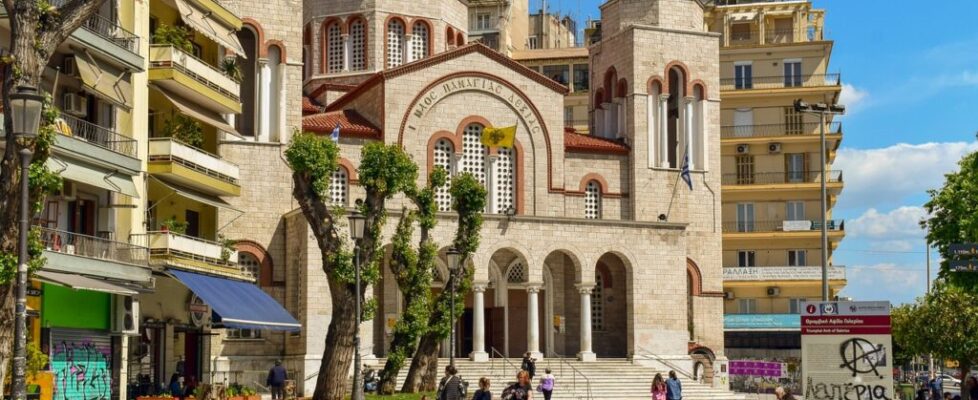
Church of Panagia Dexia in Thessaloniki
It would be possible to spend an entire day visiting the churches of Thessaloniki and still not see them all. There are churches large and small, churches old and churches comparatively new, and seeing them is to take a walk through the history of Thessaloniki.
The churches in Thessaloniki are so remarkable that UNESCO declared its Byzantine churches to be World Heritage Monuments in 1988.
So here is a list of the most notable churches in Thessaloniki, in alphabetical order, and a little about each of them.
St Catherine’s Church is near the junction of Olympiados with Lampousiadou in Ano Poli, or the Upper City. It dates from the 14th century and has some original murals. These were covered in plaster when the Turks turned it into a mosque but were uncovered again during the 1947-51 restoration of the church.
Agia Sophia was built in the middle of the 7th century and was a copy of Agia Sofia in Istanbul. It’s considered one of the most important churches in the Greek Orthodox religion, and parts of it date from a previous church that was built here in the 5th-6th centuries. It also has remarkable murals which date from the 8th-11th centuries. It was turned into a mosque in 1523 but returned to Christian worship in 1912.
Agios Dimitrios
Church of Agios Dimitrios in Thessaloniki
This huge edifice is the most famous Byzantine church in the city. St Dimitrios is Thessaloniki’s patron saint and his church was built in the 7th century on the ruins of a 5th-century basilica. It was destroyed by a fire in 1917 but restored and re-opened in 1948. Some mosaics survive from the 5th and 6th centuries, and don’t miss a visit to the crypt, which was where St Dimitrios was martyred in the early 4th century.
Agios Gregorios Palamas
The Holy Metropolitan Church of Agios Gregorios Palamas, which is near the Museum for the Macedonian Struggle, was built in 1914 in Byzantine style. The original 8th-century church on this site was destroyed in a fire in 1890.
Agios Minas
Located at Ionos Dragoumi 10, just off Tsimiski, the original church on this site was built in the 8th century, though the present building dates from 1890. It was one of the few churches in Thessaloniki which was not turned into a mosque by the Turks but remained a place of Christian worship.
You’ll find this church on Apostolou Pavlou, near the junction with Koronis. It was built in the early 14th century and many fine original murals can still be seen. It’s considered one of the best-preserved churches in Thessaloniki, and is also worth visiting for the lovely grounds.
This church is on the eastern side of Iasonidou, north of the junction with Egnatia. It is thought to date from the late 13th or early 14th centuries, and some of its original murals can still be seen.
At the western end of Olympou stands one of the oldest churches in the city. It was built in 1310-14 and was originally part of a monastery, of which very little survives. During Turkish rule it was converted into a mosque, a minaret was added, and some of the original murals and mosaics were covered in plaster.
At Agias Sofias 56, north of its junction with Egnatia, this imposing building is on the site of what were the Roman public baths, and the first church was founded here in the 5th century AD. There are mosaics which date back to the 5th century as well as some 13th-century murals.
Osios David
Mosaic of an Unshaven Christ at the Church of Osios David in Thessaloniki
It is worth making the climb to the upper part of the city just to see this church. It is tiny but wonderfully atmospheric, and dates from the 5th or 6th century. Some original mosaics remain along with others from the 12th-14th centuries, including a rare depiction of Christ without a beard. You also get good city views from here.
Close to Hosios David is the only active Byzantine monastery in Thessaloniki. It was built in the 14th century and some of those original murals remain. Good city views, too.
The Church of Panagia Chalkeon is on Chalkeon at its junction with Egnatia and is impossible to miss with a small park in front of it. It was built in 1128 on a site where a temple had previously been in the chalkos or coppersmiths’ district. In 1430 during the Turkish occupation it was turned into a mosque.
Profitis Ilias
The church of the Prophet Elijah was built from the late 13th to the mid-14th centuries. It’s on Olympiados in the Upper City, near the junction with Varvaki and is an impressive sight with its many arches and domes. Some of the original murals can still be seen.
See Greece picks the best time to visit Thessaloniki, with a monthly summary of the weather, plus hotel prices and special events to help plan a visit.
Statue of Alexander the Great on the Thessaloniki Waterfront
When you first consider the idea of jetting off to Greece, you may think of islands like Mykonos or Santorini. However Greece’s second city, Thessaloniki, with its vibrant city life, wonderful food and drink, rich history, and stunning seaside scenic views, is a destination that shouldn’t be overlooked.
When planning your trip, it’s crucial to consider the Thessaloniki weather and Thessaloniki climate as they play a significant role, alongside events and hotel pricing, in shaping the experience. What then, is the best time to visit Thessaloniki?
Person on a Bike in Thessaloniki
Best Time to Visit Thessaloniki: Month-by-Month
January, as the first month of the year, has weather that is undeniably crisp. With average high temperatures sinking to 50°F (10°C), and lows dropping below 32°F (0°C), it’s the coldest month. Rainfall is at its peak, averaging around 1.7 inches (44 mm), but snow is rare. It’s a quiet time for the city, with fewer tourists. As a result, hotel prices are likely to be at their lowest.
As winter eases into February, the temperatures begin to rise slightly to an average of 52°F (11°C). Rainfall decreases slightly but hovers around 1.5 inches (40mm). If you appreciate quieter trips and avoiding crowds, now is a good time to visit, since hotels prices remain reduced due to the off-peak season.
The first whispers of spring are heard in March, with average highs reaching 57°F (14°C). Rainfall remains steady at around 1.3 inches (34mm). The International Documentary Festival, one of Europe’s major documentary festivals, usually takes place this month, which can be of interest to film buffs. Hotel prices are typically still more affordable.
Thessaloniki Waterfront
As we move into April, the Thessaloniki weather becomes more enjoyable with highs of 67°F (19°C). Rainfall continues to decrease, with averages of just 1 inch (26mm). Around mid-April, the blossoming flowers create a gorgeous landscape during Easter, a major event that’s celebrated with processions and feasts. Accommodation becomes slightly more expensive towards the end of April, but still reasonable.
In May, summer is on the horizon with average highs soaring to 77°F (25°C). Rainfall keeps reducing, reaching approximately 0.8 inches (20mm). The Thessaloniki State Symphony Orchestra hosts an open-air concert during this month. Hotel prices begin to rise as the city gears up for the high tourism season.
June marks the start of summer with temperatures reaching up to 86°F (30°C). Rainfall is minimal at around 0.5 inches (13mm), a favorable Thessaloniki climate for beach lovers. With the Street Mode Festival creating a lively atmosphere, hotel prices steadily increase, reflecting high season rates.
Thessaloniki Waterfront at Sunset
July is the heart of summer with clear sunny weather and averages hitting 91°F (33°C). Rain is nearly non-existent at just 0.4 inches (11mm). It’s an ideal time for outdoor activities and with the Dimitria Festival, a celebration of culture and arts, it justifies the peak season hotel costs.
August maintains the hot and dry climate with temperatures averaging 91°F (33°C). Rainfall is the lowest across the year, at about 0.3 inches (8mm). Visitor numbers increase significantly and this peak season brings hotel prices to their highest.
September brings slightly cooler weather, still warm at 82°F (28°C) on average, and minimal rainfall of 0.5 inches (12mm). It’s the perfect time for the Reworks International Music Festival and Thessaloniki’s Urban Picnic, two events with music, food, and fun. The city also continues to buzz with Thessaloniki’s International Fair. Hotel prices gradually start to lower as the high season comes to a close.
Reflections in the water at night in Thessaloniki
In October, autumn takes hold with temperatures dropping to a pleasant 70°F (21°C). Rainfall begins to increase, at 1.4 inches (36mm). Notably, the Thessaloniki International Film Festival takes place either this month or in November, attracting film enthusiasts globally. Hotel rates are more affordable, making it one of the best times to visit Thessaloniki.
November sees a further dip in temperature, averaging 59°F (15°C), and an increase in rainfall to 1.7 inches (43mm). It’s a quiet month with reduced tourist activity. Hotel prices are notably low during this period.
December rounds off the year with temperatures at an average high of 52°F (11°C) and low around 37°F (3°C). Rainfall is relatively high at 1.9 inches (49mm). Although snow is rare, Christmas markets light up the city, making for a festive mood. Lower hotel prices are an added advantage for those who don’t mind the colder weather.
Panoramic View of Thessaloniki
Best Time to Visit Thessaloniki: Summary
In conclusion, the best time to visit Thessaloniki depends on what you value most. Sun lovers will adore the summer months with their lively festivals, albeit at higher hotel prices.
If you prefer cooler weather and fewer crowds with affordable accommodation, late autumn and winter are perfect.
But for those seeking a pleasant combination of temperature, events, and pricing, May, June, and October provide the best balance. Happy travels and enjoy your time exploring the beautiful city of Thessaloniki!
The best day trips from Thessaloniki include visits to Mount Athos and Mount Olympus, and to archaeological sites such as Dion, Pella, and Vergina.
Monastery of St. Panteleimon on Mount Athos in Greece
This is our alphabetical list of the best day trips from Thessaloniki, including the distance from the city and the best ways to get there.
Best Day Trips from Thessaloniki
Dion
Dion Thermal Baths
The site of Ancient Dion and the modern town of Dion are just over an hour’s drive southwest from Thessaloniki, along the A1/E75 road towards Athens. You should allow a full day for this as the site is fascinating and there’s also an archaeological museum in the town, a two-minute drive or five-minute walk away. As well as beautiful mosaics, statues and other remains the lush site is a haven for wildlife. See our full page about Dion for more information.
Halkidiki
Halkidiki
The three-pronged peninsula of Halkidiki, or Chalkidiki, is about an hour’s drive southeast from Thessaloniki, depending of course on where you’re going as it covers an area of 2,918 sq km (1,127 sq mi) in total. Take the road out towards the airport and basically you keep going. The two western-most peninsulas, Kassandra and Sithonia, are filled with holiday resorts and are great places to escape to if you want to chill out on the beach. See our separate Halkidiki page for more information. The third peninsula is Mount Athos, the so-called Monks’ Republic. See below.
Lake Volvi
Drive an hour due east of Thessaloniki and you reach Lake Volvi, one of several lakes that are easily accessible from the city. The quickest route is to first drive north out of the city on the E02 road which then swings west towards Kavala. You’ll first pass the Limni Koronia (Lake Koronia) before reaching Lake Volvi.
We recommend this as it’s the second-largest lake in Greece at 12 miles (19 km) long and 6-8 miles (9.7-12.9 km) wide. It’s a wetlands area that is good for birdwatching, or you can also enjoy watersports here. Head to the village of Volvi on the northern shore to wander round and have lunch overlooking the lake for a full day out.
Mount Athos
Simonopetra Monastery on Mount Athos
Mount Athos is the eastern-most of the three peninsulas making up the southern part of Halkidiki, and you cannot visit this without prior permission. Women are not allowed to visit at all. However, there are some very enjoyable boat trips that take you around Mount Athos and enable you to see some of the twenty inhabited monasteries that look spectacular. See our Mount Athos page, and the page all about Mount Athos boat trips.
Mount Olympus
Mount Olympus in Macedonia
To see Mount Olympus, legendary home of the Greek Gods and the highest mountain in Greece (2,917m/9,570ft), take the A1 towards Athens and you’ll reach the little town of Litochoro, the main base for visiting the mountain, in just over an hour. This is where you can find out about hiking options, which obviously depend on how much time you have and how fit you are. Getting to the top is a two-day effort with one night in a mountain hut, so is not for the inexperienced. See our full page on Mount Olympus.
Pella
Archaeological Site of Pella in Macedonia
Ancient Pella is a 40-minute drive northwest of the city, along the main E02 road that goes to Edessa. It was a hugely important city that was made capital of the Macedonian state in the late 5th century BC. It was the birthplace of Alexander the Great. There’s one main archaeological site to the south of the modern town, with other remains around the town, and an archaeological museum in the town. Allow the best part of a day, including travel time. To learn more, see our full page all about Pella.
Petralona Cave
The Petralona Cave is an hour’s drive southeast from Thessaloniki in the northern part of the Halkidiki (or Chalkidiki) peninsula. Follow the signs for the Makedonia Airport but then continue on the main road past the airport. The cave was discovered by accident in 1959 and extends for about 1,500m (4,921ft), of which you can see about 400m (1,312ft).
In 1960 the most significant find of the cave was made, the Petralona skull. This has been dated to 150,000-200,000 years old, though it could be a great deal older. Whichever it is, the cave is still one of the oldest archaeological sites in the whole of Europe. For more information visit the Petralona Cave website.
Pikrolimni
Pikrolimni is a lake that’s a 45-minute drive northwest of Thessaloniki, leaving the city along Monastiriou and after about 15-20 minutes look for the sign marking a right turn towards Kilkis. The lake covers an area of 450 hectares (1,112 acres) and is filled with salts that are believed to have healing and cosmetic properties with a concentration three times that of the Dead Sea in Isarel/Jordan.
As a result, there is a Mud Therapy Centre here, though the therapies are only available in the summer. There’s also a hotel, a bar, and a restaurant. It’s not a day out for everyone, but certainly is if you love your spa therapies.
Vergina
Royal Tombs at Vergina
The ancient site and royal tombs of Vergina are about an hour’s drive west of Athens initially on the A1 road towards Athens then turning off onto the A2/E90 exit towards Kozani and Veria. Just before Veria you exit onto the road for Kouloura which takes you to Vergina. We recommend using satnav as last time we drove there it was not clearly signposted.
Vergina is a comparatively new site, only discovered in 1977. But what a discovery it was, by the archaeologist Professor Manolis Andronikos. What he found was the royal tomb of King Philip II of Macedon, father of Alexander the Great. The tomb contained the king’s intact skeleton. There are other tombs here too, and the site has been turned into a marvellous museum.
Veroia
Veroia is about a 15-minute drive from Vergina, retracing your steps back to the A2 road and continuing on it. It’s a historic town and worth a visit if you have the time. It’s an easy lunch stop before or after seeing the tombs, and has some 50 Byzantine churches to seek out.
Messolonghi (or Missolonghi) is a town in Western Greece which played a big role in the Greek War of Independence and is where the British poet Lord Byron died.
Messolonghi
Where is Messolonghi?
Messolonghi is on the northern shores of the Gulf of Patras and about a 45-minute drive from the city of Patras. It’s a 3-hour drive west from Athens, along the shores of the Gulf of Patras, and a 2-hour drive from Delphi. It’s also about two hours south of the airport at Preveza.
Map Showing Location of Missolonghi in Western Greece Map (c) Google Maps
What to Do and See in Messolonghi
There isn’t a great deal to see and do in Messolonghi, as it’s not really a tourist town, though if you’re passing through then you could easily spend a night and a day here, to see the handful of sights. It also has a lovely setting, by the water and surrounded by lagoons.
This grandly-titled museum is in a mansion dating from 1931 and contains many artifacts from the Greek War of Independence along with paintings, coins, guns, and medals. There’s also a collection of items that belonged to Lord Byron, as well as some of his manuscripts.
This is Messolonghi’s Cultural and Arts Centre, and is much more comprehensive and modern than the history and art museum. It has traditional costumes, archaeological finds, icons and religious relics, a good collection of paintings and sculptures, and an unusual but interesting collection of salt shakers.
Modern Art Gallery
The Christos and Sophia Mosxandreou Gallery of Modern Art is in an 1835 Neo-classical building opposite the church of Agios Spuridonas. Its traditional exterior is in stark contrast to some of the ultra-modern art works inside.
Garden of Heroes
Next to the cemetery is where you’ll find the Garden of Heroes, dedicated to the men and women who fought in the Greek War of Independence. This is where you will find a statue of Lord Byron, beneath which his heart is buried.
Messolonghi
The Greek War of Independence
In May, 1821, Messolonghi became the first place in Western Greece to join in with support for the Greek War of Independence. There were many Turkish families living in the town and they quickly made their escape to the safety of the town of Vrachori, where there was a strong Turkish military presence. Vrachori is now known as Agrinio and is about a 40-minute drive due north of Messolonghi.
In October, 1822, about 7-8,000 Turkish forces laid siege to Messolonghi, in an attempt to retake control. There were only about 500 Greek soldiers inside the town, but they held out until the Turkish troops gave up on 31 December, 1822. Another attack was launched in September, 1823, but this was abandoned within two months.
A third siege began in April, 1825, and it showed the strategic importance of Messolonghi as this time it involved 30,000 Turkish soldiers, later joined by another 10,000 troops from Egypt. The 10,500 inhabitants held out for 12 months, but this time the Turkish and Egyptian troops did not abandon the siege. Instead, they slaughtered the population as the people tried to escape. Messolonghi was later given the name of Hiera Polis (Sacred City) by Greeks recognizing their heroism and sacrifice in the Greek cause. Greece won its independence in 1829.
Messolonghi Sunset
Lord Byron and Messolonghi
The British poet Lord Byron had been a regular visitor to Greece and loved the country so much that he signed up to support their fight for independence. He was in Messolonghi in 1824, planning to join in an attack on the Turkish-held fortress of Lepanto. Before that could happen, he fell ill and contracted a fever, which led to his death on 19 April, 1824. His heart is buried in the town in a cenotaph, and there is also a statue of him there. All over Greece you will find streets named in his honour.
See Greece explains the long history of the Greek dish of dolmades, or stuffed vine leaves, which goes back to ancient Greece, and provides a recipe.
Dolmades
Dolmades, a popular Greek dish, have a surprisingly rich history that dates back to ancient times. These stuffed grape leaves, known as “dolmades” in Greek, are part of a broader family of dishes referred to as “dolma” or “dolmeh” in various Middle Eastern and Mediterranean cuisines. Here’s a brief history of dolmades.
Dolmades with Beans
History of Dolmades
Ancient Roots: The concept of stuffing grape leaves and other vegetables can be traced back to the ancient Middle East, particularly in regions like Persia and the Levant. The technique of using vine leaves as wrappers became popular due to their abundance.
Greek Influence: Dolmades are a significant part of Greek cuisine. The Greek version of dolmades often features a filling of rice, herbs, and sometimes ground meat, although vegetarian versions are common. These delicious morsels have been enjoyed for centuries in Greece.
Ottoman Influence: During the Ottoman Empire’s rule over Greece, culinary exchanges occurred, leading to the incorporation of ingredients like rice and various spices into the dish. This Ottoman influence can be seen in many Greek dishes, including dolmades.
Variations: While the basic idea of dolmades involves grape leaves stuffed with a flavorful filling, there are numerous regional and personal variations. Some may use minced meat, while others prefer a vegetarian filling. The filling can include rice, herbs, onions, and spices, resulting in a delightful mix of flavors.
Grape Leaves to Make Dolmades
Recipe for Greek Dolmades:
Here’s a classic recipe for Greek Dolmades:
Ingredients:
50-60 grape leaves, blanched and stems removed
1 cup of rice
1/2 cup of olive oil
1 onion, finely chopped
1/4 cup of fresh dill, chopped
1/4 cup of fresh mint, chopped
Juice of 2 lemons
Salt and pepper to taste
Instructions:
In a pot, heat half of the olive oil and sauté the chopped onion until translucent.
Add the rice and continue to cook for a few minutes, stirring.
Add the dill, mint, lemon juice, salt, and pepper. Mix well and let it cool.
Place a grape leaf flat on a work surface, shiny side down. Add a spoonful of the filling at the bottom of the leaf and fold the sides in, then roll it tightly into a small parcel.
Arrange the dolmades in a wide pan, seam side down. Drizzle with the remaining olive oil and add enough water to cover them.
Place a heavy plate or lid on top of the dolmades to prevent them from unraveling during cooking.
Simmer over low heat for about 45 minutes or until the rice is tender and the grape leaves are soft.
Let them cool, then serve with a squeeze of lemon juice.
Argos is one of the top archaeological sites in the Peloponnese, one of the oldest cities in Europe, and with museums and a theatre bigger than Epidavros.
Panoramic View of Argos from the Castle of Larissa
Argos’s claim to fame is that it is the oldest continuously-inhabited city in the whole of Europe, and one of the oldest in the world, with a history going back over 7,000 years. It has a lovely setting at the foot of Mount Chaon, and although it’s not really a major name on the tourist trail it has plenty to see and reward a day or two’s visit.
The History of Argos
During the Late Bronze Age (c. 1700–1100 BCE), Argos flourished as a Mycenaean settlement, though it was overshadowed by nearby Mycenae and Tiryns. The city was built around the hills of Aspis and Larissa, and archaeological finds—including tholos tombs—attest to its significance in this era.
In mythology, Argos was ruled by legendary figures such as Diomedes and was closely associated with Hera, who had a major sanctuary nearby. Homer’s Iliad celebrates Argive warriors among the Greek forces at Troy.
The Heraion Plain around Argos
Following the collapse of the Mycenaean civilization, Argos remained inhabited through the Greek Dark Ages and re-emerged as a dominant city-state in the Archaic period. Under King Pheidon in the 7th century BCE, Argos reached its zenith, pioneering military innovations and defeating Sparta at Hysiae in 669 BCE.
However, Sparta eventually eclipsed Argos, defeating it in 550 and 494 BCE. Argos allied with Athens during the Peloponnesian War but later shifted allegiances, joining Corinth and Thebes in various conflicts.
In the Hellenistic period, Argos became part of the Achaean League and remained influential until Roman times. The city prospered under Roman rule, with notable constructions like its grand theatre and baths.
Despite invasions and decline, Argos endured through Byzantine, Ottoman, and modern eras. Today, it stands as a vibrant town, rich in archaeological heritage and historical legacy, a living testament to Greece’s enduring past.
Argos Archaeological Sites
Ancient Theater at Argos in the Peloponnese
There is no one single archaeological site, but the various archaeological remains are spread throughout the modern city. This makes it unusual, seeing the different layers of life in different places as you move around town. Most archaeological sites in Greece are slightly away from the modern cities which grew up nearby, and everything is in the one place.
Other Argos Sites
Argos has some Roman baths, and a theater that is actually bigger than the more famous one at Epidavros, which is about a 40-minute drive to the east. It could seat up to 20,000 people. Looking at the ruins now it’s hard to imagine just what these theatres would have been like when operating. The orchestra stalls here could be flooded to enable naval battles to be acted out in front of the stage, with action going on behind. Quite a spectacle.
There’s also an acropolis, an ancient agora, and the very unusual Pyramid of Hellinikon. There are several of these in Greece, and although no-one knows for sure what they were used for, it’s thought they may have been inspired by the pyramids in Egypt.
Argos Museums
Argos Archaeological Museum
The Archaeological Museum of Argos is a treasure trove of ancient Greek history, housed in a unique architectural blend of neoclassical and modern styles. Located at the intersection of Vasilissis Olgas and Kallergis streets in Argos, the museum occupies the historic 1830 residence of General Dimitrios Kallergis, alongside a modern wing added in 1961 with support from the French Archaeological School.
Its collection spans from the Mid-Helladic period (c. 2000 BCE) to Late Antiquity (c. 600 CE), showcasing finds from major excavations at Aspida, Deirada, the ancient agora, the Roman theatre, and Lerna.
Highlights include:
A bronze cuirass and helmet from the 8th century BCE, discovered in the “Tomb of the Warrior”
A Proto-Argive crater depicting Odysseus blinding Polyphemus (670–650 BCE)
Minoan-style pottery and geometric-era ceramics, including pomegranate models symbolizing Hera
Roman mosaics in the courtyard, illustrating the twelve months and seasonal festivities
A Farnese-style statue of Heracles, a Roman copy of Lysippus’s original work
The museum also features the “Lerna Room,” dedicated to prehistoric finds from the nearby site of Lerna, including one of Europe’s oldest sculptural representations of the human form.
Argos Epigraphic Museum
The Epigraphic Museum in Argos on the Peloponnese
This new museum, opened in 2023, is a 2-minute walk east of the Archaeological Museum, and housed in the Kapodistrias Barracks, an impressive building worth seeing in itself. At first it might sound a little specialised, containing only tablets and stone inscriptions, but it reveals ancient life in and around Argos in fascinating detail. Some of the bronze tablets go back to the 4th century BC and are considered to be of international historic significance.
The See Greece guide to the top archaeological sites in the Peloponnese including Epidavros, Olympia, Mycenae, Mystras, Tiryns, and Argos.
Beehive Tomb at Mycenae in the Peloponnese
The Peloponnese has some of the best archaeological sites in Greece, so many that you would need to spend a few weeks there in order to visit them all. Mystras alone could easily take up a day of your time, so sprawling is the site and with a lot of climbing up and down.
Top Archaeological Sites in the Peloponnese
Argos
Ancient Theater at Argos in the Peloponnese
Argos’s claim to fame is that it is the oldest continuously-inhabited city in the whole of Europe, and one of the oldest in the world. It has a lovely setting at the foot of Mount Chaon, and although it’s not really a major name on the tourist trail it has plenty to see and reward a day or two’s visit.
There is no one single archaeological site, but the various archaeological remains are spread throughout the modern city. This makes it unusual, seeing the different layers of life in the same place. Most archaeological sites in Greece are slightly away from the modern cities which grew up nearby.
Argos has some Roman baths, and a theater that is actually bigger than the more famous one at Epidavros, which is about a 40-minute drive to the east. There’s also an acropolis, an ancient agora, and the very unusual Pyramid of Hellinikon. There are several of these in Greece, and although no-one knows for sure what they were used for, it’s thought they may have been inspired by the pyramids in Egypt. See our full page on Argos.
Bassae
The Temple of Apollo Epikourios at Bassae on the Peloponnese in Greece
Bassae is a remote site, set up high, just south of the lovely mountain village of Andritsaina, Andritsaina is well worth a stop, either for lunch or overnight, to get to Bassae early in the morning. The site is remarkable for the stunning 5th-century Temple of Apollo Epicurius (‘Apollo the helper’), which is so precious it has to be covered with a protective tent.
In 1986 Bassae was the first archaeological site in Greece to be placed on UNESCO’s World Heritage List. It was noted for the Bassae Frieze, which is now on display in the British Museum in London, and its remote location means that it has been spared the damage and destruction received by other monuments in major towns and cities. See our page on the Temple of Bassae.
Corinth
Ancient Corinth in the Peloponnese
There are actually two archaeological sites to see at Corinth. If you’re visiting the Peloponnese from Athens, Ancient Corinth might well be your first stop, once you’re over the Corinth Canal, and it has various parts to it which are in and around the modern town. These include a Roman amphitheatre and a cemetery, and it’s worth visiting the archaeological museum as at one time Ancient Corinth was one of the most important cities in Greece, with an estimated population of about 90,000 in 400 BC.
A 5-minute drive away in a spectacular hilltop location overlooking the modern town is the site of Acrocorinth (‘Upper Corinth’). This sprawls across the hilltop and with its own water supply this was an impressive fortress until the 19th century, though no-one knows for certain when it was founded. It goes back to Mycenean times at least. See our main Corinth page.
Epidavros
Ancient Theatre at Epidavros in the Peloponnese
Ancient Epidavros (or Epidaurus) is definitely a must-see archaeological site in the Peloponnese. It’s most famous for its remarkable theatre, which was built in the 4th century BC and the 14,000-seater is still in use today for the annual Athens and Epidavros Festival. However, there is much more to the site than this. It was used as a healing centre, as the whole site was dedicated to Asclepius, the God of Medicine.
The Sanctuary of Asclepius was founded in the 6th century BC and had many shrines and several hospitals. It’s about a 30-minute drive east of Nafplion, which makes a good base for seeing several of the top archaeological sites in the Peloponnese, including Argos, Mycenae and Tiryns, as well as Epidavros. See our Epidavros page for more details.
Isthmia
A 15-minute drive from Corinth, modern Isthmia straddles the Corinth Canal but archaeological remains including the Temple of Poseidon are in the Peloponnese on the western side of the canal. The temple, also known as the Temple of Isthmia, is thought to date from about the 7th century BC. Isthmia also has a bath house with well-preserved mosaic floors, and was the site of the Isthmian Games, and you can see the remains of several stadiums.
Messene
Ancient Messene, to give it its full name, is a 40-minute drive north of Kalamata in the southern Peloponnese. The site was only excavated in the 1980s and it is one of the most comprehensive archaeological sites in the Peloponnese, if not the whole of Greece. Here you can see temples, a stadium, a gymnasium, and a theatre that held 10,000 people, amongst other remains.
Mycenae
Mycenae in the Peloponnese
Mycenae is about a 30-minute drive north of Nafplion, and is probably the top archaeological site in the Peloponnese. It was so important that it gave its name to a whole period of Greek history. There’s evidence that this particular site was first occupied as early as 5000 BC, but by the 2nd millennium BC it was known as the City of Golf and housed the royal palace of the Trojan War hero, King Agamemnon.
Much of the site was excavated by the German archaeologist Howard Schliemann, and though he made some mistakes in his over-enthusiasm for what he was finding, we owe him a debt of gratitude for what he uncovered. See our separate Mycenae page for more details.
Mystras
Mystras in the Peloponnese
Mystras is one of the most remarkable places in Greece. It isn’t a conventional archaeological site but the remains of an entire town built on a hill, and which was inhabited till the 1830s. It is another of the must-see sites in the Peloponnese. A few nuns still live in one of the town’s convents, and in addition you can see churches, the remains of palaces, and the remains of the huge hilltop fortress. See more on our Mystras page.
Nemea
The Nemean Games
The site of Ancient Nemea is about a 30-minute drive southwest from Corinth, a 20-minute drive north of Mycenae, and just to the east of the modern town of Nemea. It makes this northeast corner of the Peloponnese rich in archaeological sites, with Tiryns, Argos and Epidavros all being fairly close by. The area around here has been inhabited since at least 6,000 BC, and by 573 BC this was the site of the Nemean Games. These were held every two years until 271 BC, after which they were moved to Argos, 25 km (16 miles) due south.
Olympia
Ancient Olympia on the Peloponnese in Greece
The archaeological site of Ancient Olympia, original home of the Olympic Games, is something not to be missed when visiting the Peloponnese. The games were first held here in 776 BC and continued to run every four years for over 1,000 years. It’s quite a thrill to walk out onto the original running track, and you can also see the archaeological equivalent of the Olympic Village. The nearby modern town of Olympia also has an archaeological museum and a museum devoted to the Olympic Games.
Sparta
Sanctuary of Menelaus at Sparta on the Peloponnese in Greece
Few places see their names enter the language, but the former city-state of Sparta is where we get the word ‘spartan’ from. They were a formidable military power, mainly responsible for Greece’s victory in the Greco-Persian Wars, and even defeated their rivals Athens in the Peloponnesian Wars. The site is just to the north of the modern city limits, with the ruins of a theatre, a temple, and other remains. See our full page on Sparta.
Tiryns
Ancient Tiryns on the Peloponnese in Greece
A 5-minute drive north from Nafplion, going towards Mycenae, brings you to another Peloponnesian archaeological site worth seeing. Tiryns was a hilltop fortress and has been inhabited for several thousand years before becoming a significant Mycenean city, to rival Mycenae itself. Today’s ruins can’t rival those at Mycenae, which is a 20-minute drive north, but they’re still worth seeing and became a UNESCO World Heritage Site in 1999. See our Tiryns page for more information.
See Greece picks the best time to visit Kos, with a monthly summary of the weather, plus hotel prices and special events to help plan a visit.
Kamari Bay on Kos in the Dodecanese
When considering the best time to visit Kos, you’ll want to take into account a variety of factors. Kos, one of Greece’s most popular Dodecanese islands, boasts a charming Mediterranean climate characterized by hot, dry summers and mild, wet winters.
The diversity of Kos’s climate ensures something for everyone across the year, whether you prefer sun-soaked beach vacations or cooler explorations of historical sites. But let’s delve into the specifics to provide you with the best suggestions.
Best Time to Visit Kos: Month-by-Month
January in Kos is a mild winter, often sunny but with the expected chill in the air. Average temperatures hover around 56°F (13°C) during the day, dropping to 47°F (8.5°C) at night. The rainfall is significant, around 5.6 inches (143 millimetres). Kos rarely gets snow. January is considered low season with fewer tourists, thus resulting in lower hotel prices.
When we move into February, the weather remains fairly similar to January. Average day temperatures sit comfortably at 57°F (14°C) and fall to 47°F (8.5°C) at night. Rainfall sees a slight decrease to around 4.3 inches (110 millimetres). Again, February is ideal for enjoying off-peak hotel pricing, as there are typically no major events happening.
March begins to show a few signs of the impending spring. Daytime average temperatures increase to around 61°F (16°C) and fall to 49°F (9.5°C) after sunset. Rainfall continues to drop as we see averages around 3.2 inches (80 millimetres). The island begins to come to life with the local Almond Blossom Festival, bringing an authentic Greek experience with lower hotel rates.
Kos Town in the Dodecanese
April truly welcomes the spring, with averages up to 66°F (19°C) during the day and 54°F (12°C) at night. Kos gets much drier in April, with only 1.6 inches (41 millimetres) of rain. Easter celebrations usually fall in April and dominate the island, with moderate hotel prices.
May starts the beginning of the peak season. Expect to find warmer average temperatures of around 76°F (24°C) in the day, cooling to 63°F (17°C) at night. The rainfall drops to a mere 0.8 inches (20 millimetres), and hotel prices start to climb. Many visitors time their holidays with the Kos Island Horse Races.
June delivers the full glory of the Mediterranean summer with highs of about 84°F (29°C), dipping to around 70°F (21°C) at night. There’s a minimal 0.2 inches (5 millimetres) rainfall. The Kos summer events start taking place, with hotel prices at their peak.
Kastri near Kos in the Dodecanese
Those unfazed by the heat may find July to be the best time to visit Kos. With temperatures hitting an average high of 88°F (31°C) and nights at 73°F (23°C), this is prime beach weather. Rain is virtually non-existent in July. Remember that hotel prices remain at the height of their range.
August keeps the July’s weather pattern stable, with hot days averaging about 88°F (31°C) and nights at 73°F (23°C). You can expect no significant rainfall in August. Kos’s annual Wine Festival attracts oenophiles this month. Keep in mind that hotel prices remain high.
September starts to mellow out the summer heat with daily averages down slightly to 82°F (28°C) and night temperatures around 68°F (20°C). Rainfall remains low at 0.3 inches (8 millimetres). Hotel prices start to reduce as the tourist crowd thins, making this a great time to experience the Olive Oil Festival celebrated in the local villages.
Kos Fisherman
October brings in the autumn weather. However, it’s still pretty warm, with average daily temperatures about 73°F (23°C) and nights cooling to 61°F (16°C). There’s a slight increase in rainfall to 1.9 inches (48 millimetres). Hotel prices continue to fall, making it an economical choice.
November experiences a further drop in temperatures with 66°F (19°C) during the day and 54°F (12°C) at night. Rainfall levels increase to 3.5 inches (90 millimetres). There are fewer crowds around this time, leading to even lower hotel prices. This is a quiet month, with no notable events.
December carries the tranquillity of November into the holiday season. Temperatures range from an average of 59°F (15°C) during the day to 50°F (10°C) at night. Rainfall peaks at around 5.9 inches (150 millimetres). Hotels offer competitive prices to make for a delightful and affordable holiday escape.
Best Time to Visit Kos
From our month-by-month breakdown, it’s clear that the best time to visit Kos is subjective and depends on what kind of holiday you’re after. For those who fancy the beach, consider the warm months of June through August.
However, if you prefer a cultural experience full of authentic Greek events, then visit during spring (March to May) or autumn (September to November). And, for the best deals at hotels, travelling during the winter months might be worth braving the colder Kos weather and heavier rainfall.
There’s no ‘one size fits all’ when it comes to identifying the best time to visit Kos. The island’s vibrant festivals, historical highlights, and stunning coastlines have something to offer to all sorts of travellers year-round.
The capital of Evia is Chalkida, or Chalkis, the industrial port which you drive into if crossing from the Greek the mainland over the Evripos Channel.
Chalkida on Evia
The channel between Evia and the mainland is renowned for having inexplicable currents, and it is still not known how they can sometimes change direction over a dozen times a day, and sometimes only once. A legend says that Aristotle was so frustrated at his inability to understand the phenomenon that he threw himself into the waters and died. He did actually die in Chalkida, but whether in this fashion is another matter.
Bridge to the Mainland
Chalkida Bridge to Evia
The channel has been bridged since 411BC (the present one only dates from the 1960s), and initially the town was one of the independent Greek city-states until it was conquered by Athens in 506BC. Like the rest of the island it was later subject to rule by a range of peoples: Macedonian, Turkish, Franks, Venetian.
The name of the town is thought to derive from the Greek word for copper, chalkos, as this mineral was one of the island’s early major sources of wealth. An indication of the power that the town once had is that it controlled and gave its name to the Halkidiki peninsula (also spelt Chalkidiki in Greek) and it had several Italian colonies too.
For many years the town of Chalkida vied with Eretria for control of the island and especially the fertile Lelantine Plain which feeds much of the island, but it was not until the 7th century B.C. that Chalkida finally proved its superiority and developed as Evia’s capital.
The Chalkida Waterfront
Today, although at first sight not immediately attractive to the visitor, Chalkida is worth a day or two of your time, for its museums, old town and waterfront areas. The main waterfront area is to the left as you cross the bridge, where you will find restaurants, cafes, ouzeries and hotels. It makes a good place to sit over a coffee or a full meal, gazing out over the channel back to the mainland.
The fish restaurants are so highly-rated that it is said Athenians will drive out for the evening in order to eat here, a distance of 88km (55 miles). Here too is the market, where you can see the island produce brought in by the farmers. It is busy most days but on Saturday in particular, and Saturday morning is the worst time of the week to consider driving through Chalkida or across the bridge with the mainland.
Kastro
If you head for the quarter known as Kastro, heading inland and to the right, away from the bridge, you will find much quieter streets and many old houses that testify to the Turkish and Venetian legacy of the town. An unusual element in this is a community of Muslims from Thrace, much further east, bringing a touch of the Orient, added to by a lovely 15th-century mosque, a Turkish aqueduct and the remains of the 17th-century fortress itself. The aqueduct used to bring water to Chalkida from springs on Mt Dirfys some 25km (16 miles) to the northeast.
Agia Paraskevi
The Christian element is in the form of the rather bizarre and imposing church of Agia Paraskevi. This vast building was built in the 13th century, but in the 14th century the exterior was converted by the Crusaders into a Gothic cathedral, while inside it is a mixture of all of the island’s historical influences. Note the ornate wooden pulpit and the wooden ceiling.
Museums
A two-minute walk from Agia Paraskevi is the Cultural Museum, which has the usual collection of folk costumes and rural artifacts, but better is the town’s Archaeological Museum. This is back in the modern part of Chalkida and has some of the excellent finds from Ancient Eretria, as well as from some of the island’s lesser-known sites, like Karystos. Neither museum is among the best in the country, but they are worth visiting if you plan to have more than just a brief visit to Evia.
See Greece picks the best time to visit Athens with a month-by-month account of the weather, hotel prices and any special events that are happening.
It Does Rain in Athens!
Athens is a riveting mix of history and contemporary culture, with a climate that often surprises the uninitiated. Before we dive into our month-by-month guide to the best time to visit Athens, let’s talk a little bit about what you can expect weather-wise in this incredible city.
Athens has, not surprisingly, a Mediterranean climate, with hot, dry summers and mild, wet winters. But remember, it also has its fair share of microclimates due to the surrounding mountains and the sea, leading to some refreshing variations you’ll appreciate. Let’s dive into what each month of the year brings.
Plenty of Fruit at the Athens Food Market
Best Time to Visit Athens Month-by-Month
January has average temperatures of around 55°F (13°C), and it is one of the city’s wettest months with an average rainfall of an estimated 2.24” (56.9mm). Snowfall is quite rare, but if you’re lucky, you might witness the majestic Acropolis dressed in white. On the hotel front, you’ll find some much-needed respite from inflated prices, making it quite an affordable time to visit.
February is similar to January, with temperatures around 57°F (14°C), and average rainfall hitting about 1.84” (46.7mm). No major tourist events occur this month, resulting in lower hotel rates. This time of year offers a quiet, unhurried experience of the city, so it’s perfect for anyone who likes to avoid the crowds.
A mild month, March serves up an average temperature of 62°F (17°C), with rainfall decreasing to 1.6” (40.6mm). It also hosts the Athens Half Marathon, an event attracting a good mix of locals and travelers. Hotel prices begin to nudge upwards but are still comparatively affordable.
The Parthenon is Beautiful All Year Round
A balmy 70°F (21°C) is the norm in April, although it still comes with 1.2” (30.5mm) of rainfall on average. The Easter celebrations in Athens are quite a spectacle, with the city coming alive in religious fervor and cultural fun. Expect hotel prices to rise during the Easter period though.
The Athens weather in May steps up the heat, bringing average temperatures of 79°F (26°C), but still with moderate rainfall of about 0.9” (22.9mm). Towards the end of the month, you can enjoy the Athens Technopolis Jazz Festival, and while hotel prices go up a tad, it’s a good time to visit.
June marks the start of the hot Athens summer. With average temperatures nudging 88°F (31°C) and the raindrops more or less disappearing, suntan lotion is a must. Consider attending the Release Athens Music Festival, which typically occurs in the summer months. Hotel rates are at their peak during this season, so book in advance!
The Changing of the Guard in Athens
July is the hottest month, averaging 91°F (33°C), with virtually no rainfall. It marks the start of the outdoor cinema season, which is an essential part of Athens’ summer culture. Hotel prices stay high, so early booking is key to securing a good deal.
August continues the scorching Athens climate trend with averages still at 91°F (33°C), but remember that these are averages and it often gets much hotter. We know from experience! With locals often out of town and other tourists avoiding the heat, Athens becomes a quieter version of itself. Despite the Athens Epidavros Festival, hotel prices usually decrease slightly due to the mass exodus.
September, often considered one of the best time to visit Athens, delivers an average temperature of 84°F (29°C), and rainfall is still minimal. Local tourism picks up again, along with hotel rates but it’s typically less crowded and more enjoyable.
Athens and the Acropolis
October brings temperatures down to a more comfortable 74°F (23°C), coupled with slightly increased rainfall around 2.05” (52.1mm). Hotel rates start to dip post summer.
November carries you into the start of winter with an average temperature of 64°F (18°C) and rainfall increasing to around 2.3” (58.4mm). Besides the Athens Authentic Marathon, there aren’t many major tourist events in November, and hotel prices continue a slight decline.
The Athens weather in December brings on the cold, presenting an average temperature of 59°F (15°C), coupled with a rainfall of 2.7” (69.1mm). While a rare snowfall could be in the offing, Athens really shines in the holiday season, with festive decorations and fun-filled events. Hotel prices are at their lowest, making it one of the most cost-effective times to visit.
The Plaka District of Athens
Hopefully this guide helps you pick the best time to visit Athens, and remember that Athens’ temperate climate ensures an enjoyable trip no matter when you decide to go.
The best views in Athens include views from the Acropolis and of the Acropolis from the top of some of the city’s several hills and from hotels and restaurants.
View from the Acropolis
Best Views in Athens: From the Acropolis
Although the view of the Parthenon on top of the Acropolis is the single most recognisable view of Athens, the views from the Acropolis are also something special.
On one side you can look north across the city centre to see Lykabettos Hill, and in the distance the range of hills that surround Athens. To the south the view is towards Piraeus and the sea.
Best Views in Athens: Of the Acropolis
Many hotels and restaurants boast of their bars and terraces with views of the Acropolis, which are particularly impressive at night. They’re not all expensive, either. The inexpensive Attalos Hotel, for example, which is a personal favourite, has great Acropolis views from its roof.
We’ve also enjoyed the views – and the superb food! – in the Tudor Hall Restaurant at the top of the King George Hotel on Syntagma Square.
The Acropolis Museum Rooftop
The Acropolis Museum
This offers a modern and luxurious viewing experience. The museum’s rooftop restaurant and café provide a direct, eye-level view of the Acropolis right next door. Enjoy a coffee or dinner with the Parthenon as your backdrop—a perfect blend of ancient wonder and contemporary design.
Aeropagus
Just to the northwest of the Acropolis is Aeropagus, a rocky outcrop that stands 115 meters (377 feet) high and gives you views both of the Acropolis and of the city. The Athenian governing council used to meet up here, and it is where St Paul delivered his sermon known as the Aeropagus Sermon.
Filopappos Hill
Filopappos Hill is southwest of the Acropolis and is 147 meters (482 feet) in height. It was once known as the Hill of the Muses, as it was believed that those inspirational goddesses known as the Muses were buried here.
Lykabettos Hill
Lykabettos Hill
Lykabettos is the highest point in the city centre at 277 meters (908 feet), so naturally provides the best views. Don’t forget your camera as it’s from here you will want to try to get your perfect shot of the Acropolis. If it’s a clear day, you will be able to see down to the port of Piraeus, where the Aegean glistens in the far distance, hinting at the beckoning Greek islands beyond.
For the best experience, book a table at the Orizontes Restaurant, at the top of Lykabettos. From there you can enjoy the views while having a good meal and a drink. We’ve eaten there and it’s a magical experience.
The Pnyx
The Athenian Assembly used to meet in the amphitheatre on the side of the Pnyx hill, and it gave them an impressive view of the Parthenon on top of the nearby Acropolis. Fewer visitors make it here, which is a shame as from the Pnyx you get an excellent view of the front of the Parthenon, which makes for some good photos. Professional photographers often shoot the building from here with a telephoto lens, to get the best results.
Strefi Hill
A quieter, more local spot located in the Exarcheia neighborhood, Strefi Hill offers a different perspective. It’s a great place to escape the tourist crowds and get a view of the Acropolis and Mount Lycabettus from a distance.
Stavros Niarchos Foundation Cultural Center (SNFCC)
For a more modern view of Athens, head to the SNFCC. The expansive rooftop park offers a unique panoramic view of the city and the sea. It’s an excellent place to see how Athens’ urban landscape connects with the coast.
The National Observatory of Athens
Located on the Hill of the Nymphs, the National Observatory provides a fantastic viewpoint for seeing the Acropolis and the ancient ruins below. They also offer nighttime astronomy sessions, making it a great place to see the floodlit Parthenon.
Panathanaikos Stadium
Panathanaikos Stadium in Athens
The historic Panathanaikos Stadium, home of the first modern Olympic Games in 1896, offers a unique viewpoint. From the top row of seats, you can get a panoramic view of the stadium and see a wide expanse of the city, including the Acropolis.
The Temple of Olympian Zeus
From the ground level within the archaeological site of the Temple of Olympian Zeus, you are treated to a powerful view. The towering columns of the temple frame the Acropolis perfectly in the distance, creating a stunning photographic composition of two ancient giants.
Anafiotika
This charming neighborhood, tucked away under the Acropolis, is a hidden gem. Its narrow streets and traditional Cycladic architecture give it the feel of a Greek island village. As you wander through its paths, you’ll get picturesque, close-up views of the Acropolis from a different angle.
Pro Tip
For the best experience, visit the hilltop views (Lycabettus, Philopappos, Areopagus) just before sunset to see the city in the golden hour and then watch it transform into a sea of twinkling lights.
Sunset at Cape Sounion
Temple of Poseidon at Cape Sounion near Athens
OK, so this one isn’t in Athens itself but it isn’t far and apart from its historical interest, the Temple of Poseidon out at Cape Sounion also adds drama to one of the most stunning views around the city of Athens. Many people from Athens make their way out here for the sunset, and when the conditions are right the rewards are tremendous.
You can see across the bay and out to sea, with several islands visible in the near and far distance. It immediately makes you want to be on a boat, out on the Aegean and sailing out towards those romantic-looking dots of land in the distance.
This, then, is our choice of some of the best views in Athens.
The Athens Agora or ancient market is a must-see site and one of the best things to do in Athens with its restored arcade building, the Stoa, and its museum.
The Athens Agora
After the Acropolis and National Archaeological Museum, the market place of ancient Athens, or Athens Agora, is another ‘must see’. It features some good remains and a fine, small museum.
The Ancient Agora of Athens: Heart of a Civilization
Location and Origins
Nestled beneath the northwest slope of the Acropolis, the Ancient Agora of Athens was the beating heart of Athenian life. The word agora in ancient Greek means “gathering place” or “assembly,” and that’s precisely what it was—a vibrant hub where politics, commerce, philosophy, and daily life converged. Established in the 6th century BCE, the Agora evolved from a simple open space into a complex urban center that reflected the dynamism of Athenian society.
The Ancient Agora in Athens
Architectural Grandeur and Layout
The Agora wasn’t just a dusty square—it was a sprawling complex of stoas (covered walkways), temples, altars, law courts, and public buildings. The layout was centered around the Panathenaic Way, a sacred road that cut through the Agora and led to the Dipylon Gate, the main entrance to the city. This road was used during the Panathenaic Festival, a grand celebration held every four years in honor of Athena, the city’s patron goddess.
Among the most iconic structures were:
Temple of Hephaestus: One of the best-preserved ancient Greek temples, dedicated to the god of metalworking and craftsmanship.
Stoa of Attalos: A reconstructed colonnaded building that now houses the Museum of the Ancient Agora.
Altar of the Twelve Gods: A central religious site and a reference point for measuring distances in Athens.
Royal Stoa (Stoa Basileios): Where the king archon conducted official duties and religious ceremonies.
Bema: A speaker’s platform used for public addresses and legal proceedings.
Political Powerhouse
The Agora was the epicenter of Athenian democracy. Citizens gathered here to discuss laws, vote on issues, and hold trials. It was home to the Bouletarion, where the Council of 500 met to prepare legislation for the Assembly. The law courts, often held in open-air spaces, allowed ordinary citizens to serve as jurors—a radical idea that laid the foundation for modern democratic systems.
The Stoa in the Athens Agora
The Stoa of Zeus, another key structure, wasn’t just a religious site—it was also a place where Socrates and other philosophers debated ideas, questioned norms, and shaped the intellectual legacy of the Western world.
Commercial and Social Life
Beyond politics, the Agora was a bustling marketplace. Merchants sold everything from olive oil and pottery to textiles and food. Artisans worked in nearby workshops, and citizens mingled in the stoas, exchanging gossip, news, and philosophical musings. It was a place where rich and poor, young and old, citizens and foreigners crossed paths.
The Mint, located in the Agora, produced bronze coinage, though not the famed Athenian silver coins. This economic activity was vital to Athens’ prosperity and its role as a Mediterranean powerhouse.
The Athens Agora
Intellectual and Philosophical Legacy
Few places in history have hosted such a concentration of intellectual energy. The Agora was the stomping ground of Socrates, Plato, and Aristotle. Socrates, in particular, is said to have spent much of his time here, engaging passersby in dialogue and challenging them to think critically. His method—asking probing questions to reveal contradictions—was born in the Agora’s open spaces.
This tradition of inquiry and debate helped shape the Western philosophical canon, making the Agora not just a physical space but a symbol of free thought and civic engagement.
The Athens Agora
Turbulent Times and Resilience
The Agora’s history wasn’t all sunshine and symposiums. It was destroyed multiple times, including by the Persians in 480 BCE, the Romans, and the Herulians, a Scandinavian tribe, in 267 CE. Each time, it was rebuilt, reflecting the resilience of Athenian society.
Under Roman rule, the Agora saw new additions, including the Library of Pantainos, which served not just as a repository of books but also as a multifunctional civic space. The Romans also added basilicas, nymphaea, and other structures that blended Greek and Roman architectural styles.
Religious Significance
Religion permeated every corner of the Agora. Temples dedicated to Zeus, Apollo, Athena, and Ares dotted the landscape. The Panathenaic Way itself was a sacred route, and the Temple of Hephaestus remains one of the most revered religious sites from antiquity.
The Agora wasn’t just a place for worship—it was a sacred space where civic and spiritual life intertwined. Rituals, sacrifices, and festivals were common, reinforcing the idea that public life in Athens was deeply rooted in divine order.
In the Athens Agora
The Athens Agora Today
Today, the Ancient Agora of Athens is a stunning archaeological site that offers a window into the past. Visitors can walk the same paths as Socrates, stand where jurors once deliberated, and marvel at the enduring beauty of classical architecture.
The Agora Museum, housed in the reconstructed Stoa of Attalos, provides context and artifacts that bring the site to life. From pottery shards to inscriptions, the museum paints a vivid picture of daily life in ancient Athens.
Accessible via the Monastiraki and Thiseio metro stations, the Agora is a must-visit for anyone interested in history, philosophy, or the roots of democracy.
In the Athens Agora
Conclusion: More Than Just Ruins
The Ancient Agora of Athens was more than a marketplace—it was the soul of a civilization. It embodied the ideals of democracy, free speech, commerce, and community. Its legacy continues to inspire modern societies striving for civic engagement and intellectual freedom.
Standing in the Agora today, one doesn’t just see ruins. One sees the footprints of thinkers, the echoes of debates, and the spirit of a people who dared to shape the world with ideas.
You can get from Mykonos to Santorini, and of course from Santorini to Mykonos, by ferry, by plane or even by helicopter.
Mykonos is about 150 km (93 miles) due north of Santorini and the two islands are connected by ferry, by domestic flights, and by helicopter. Ferry is obviously the easiest and cheapest option, but we wanted to cover all your choices.
How Long Does It Take to Get from Mykonos to Santorini by Ferry?
The ferries between Mykonos and Santorini take 2-3 hours, sometimes a little longer, depending which kind of ferry you take and the route they take.
Some ferries are direct and some stop at other islands on the way, such as Paros, Naxos, and Ios. There’s usually very little difference in the fares so if you’re island-hopping on a budget you won’t save anything by choosing to take a longer ferry ride.
How to Get from Mykonos to Santorini by Ferry
Ferries between Mykonos and Santorini only operate in the holiday season, roughly from March to October. If you’re travelling in either of those two months, double-check the details and don’t assume there’ll be a ferry every day.
There are no high-speed hydrofoils between the two islands although the regular ferries are usually fast catamarans – faster than a regular ferry but not quite high-speed.
Several different ferry companies operate services between Santorini and Mykonos, so it can pay to shop around for cheaper fares or times that are more convenient for you. Rather than go to each separate website, it’s much easier to use an online timetable and booking service that searches all the available ferry lines for you.
Little Venice in Mykonos Town
How to Get from Mykonos to Santorini by Plane
There are also direct flights between Mykonos and Santorini throughout the summer season. Airlines include Flydubai, TUI Fly, Aegean Airlines, SKY express and Volotea.
Flight time is usually around an hour and although it’s obviously much more expensive than the ferry, it’s not overly pricey. At the height of the season you’ll find at least 1-2 flights a day, with several flights a week at less busy times.
Oia on Santorini
How to Get from Mykonos to Santorini by Helicopter
There’s no doubt that the most spectacular way to get from Mykonos to Santorini is by helicopter. Imagine arriving on Santorini that way, especially if it’s a first visit. It’s definitely something to be regarded as a special occasion treat, though, for most people, like a honeymoon or big birthday.
The price is several hundred euros, but despite that the flights do fill up quickly, so don’t wait till you’re actually on Mykonos or Santorini to book. You might strike lucky, but don’t bank on it.
To start your search for helicopter flights between Mykonos and Santorini visit the websites of Helistar, Icarus, The Greek AirTaxi Network, and HeliAlpha. Some companies also operate tours of each island by helicopter, if you don’t want to fly between them but just want to enjoy the spectacular views.
See Greece picks the best restaurants on Santorini, choosing the top gourmet and fine-dining eating places with some exclusive dining experiences.
Vinsanto Wine from Santorini
Whether you’re a die-hard foodie or a traveler seeking the finest dining experiences on your vacation, Santorini has got you covered. This beautiful Greek island in the Cyclades is home to some of the best restaurants that not only serve gourmet meals but also offer views to die for.
Ambrosia Restaurant Santorini
Our first stop is Ambrosia in Oia. Enjoying a reputation as one of the best gourmet dining establishments on the island, Ambrosia is known for its Mediterranean cuisine. It boasts dishes with a mix of international flavors and traditional ingredients, including good pasta and risotto dishes, and is comfortably positioned in a cosy environment with stunning caldera views.
Next, we recommend Selene in Pyrgos Kallistis. Since 1986, Selene has been a center of gastronomic delight on Santorini, offering visitors a culinary journey featuring local products and traditional cooking methods. The restaurant shares a home with a Santorini Gastronomy Center, which you can visit too, and they also offer wine tastings.
Then there’s the elegant 1800 Restaurant, also in Oia. Positioned in a restored mansion, this dining place boasts charming aesthetics, an art gallery, and a menu filled with flavorful Greek and Mediterranean dishes that highlight the tastes of Santorini. They have a lovely roof garden with great views.
Our journey takes us next to the Argo Restaurant in Fira. This restaurant promises an unforgettable dining experience anchored in a rich culinary tradition and a contemporary twist. Expect beautiful presentation, just as beautiful as the caldera views visible from the restaurant. You can also do tours with cookery lessons and wine tastings.
Don’t miss The Athenian House, in Imerovigli. This establishment emphasises bringing the sophistication of Athenian cuisine to the island. Their charismatic chef, Christoforos Peskias, creates emotional and unexpected flavors that you won’t soon forget. Don’t miss the Ouzo Sorbet!
Next on our list is the Lauda Restaurant in Oia. Established in 1971, Lauda is renowned for its innovative menu and stunning surroundings. The restaurant features a selection of locally grown products, which are used to prepare dishes inspired by contemporary Aegean cuisine. For a treat try their tasting menu which can be paired with wine, cocktails or non-alcoholic drinks.
Santorini wouldn’t be the same without Lycabettus, which is also in Oia. With its position on a cliff’s edge offering panoramic views, it serves up a delightful fusion of Greek and modern cuisine, making every mouthful a delightful exploration of taste and texture. The ultimate experience is the Sommelier’s Table, limited to one couple a night for a wine tasting and food pairing.
For those interested in pairing their meals with spectacular wines, Santo Wines Winery in Pyrgos runs a successful restaurant offering traditional Greek cuisine with their very own wines.
Back in Fira, we have Salt & Pepper. This small and intimate family-style restaurant makes the cut with innovative and delicious meals made from fresh local ingredients.
For those who love seafood, To Psaraki in the marina at Vlychada, could very well be one of the best places on the island. It combines traditional Greek recipes with fresh and locally-caught fish.
Each of the above restaurants stands out for different reasons – some for their views, others for their astonishing creativity. Still, the common thread that unites them is this: they demonstrate a deep appreciation for Santorini’s native ingredients and flavors.
Enjoying local dishes, prepared with skill and creativity while complementing the stunning vistas makes this gourmet dining experience a sensory delight in ways more than one.
And, for a truly memorable experience, why not enjoy a bottle of Santorini’s iconic white wine, Assyrtiko, with your meal? The crisp, refreshing notes of this local wine form a perfect pairing with the Mediterranean delicacies of the island.
So there we have it, a list of the best restaurants on Santorini, just for you. Happy dining! Bon Appetit! Or as the locals would say, ”Kali Orexi”.
The See Greece guide to Mykonos car rental, whether you need to hire a car on Mykonos, and a list of car rental companies, including airport car rentals.
Mykonos Sunset
Mykonos, the jewel of the Cyclades, conjures images of whitewashed villages, golden beaches, and vibrant nightlife. While its charming Chora (Mykonos Town) is best explored on foot, venturing beyond its narrow alleys often leads to hidden gems and breathtaking vistas. This is where the question of Mykonos car hire truly comes into play. So, do you need a car on Mykonos, and what should you know before you hit the road? Let’s dive in.
General Advice for Renting a Car in Greece
Before we focus on Mykonos, a few universal tips for car rental in Greece will serve you well:
International Driving Permit (IDP) is Essential: If you’re from outside the EU/EEA, an International Driving Permit (IDP) is generally required in conjunction with your national driving license. Always check with your rental company and local regulations to be sure. Without one, you risk being denied a rental or facing fines.
Age and Experience: Most rental companies require drivers to be at least 21 years old and have held their license for a minimum of one year. A young driver surcharge often applies to those under 25. Some also have a maximum rental age, typically around 70.
Insurance Matters: Car insurance is mandatory in Greece. Standard policies usually include Third Party Liability (TPL) and Theft Protection (TP). Consider upgrading to Collision Damage Waiver (CDW) or Super Collision Damage Waiver (SCDW) to reduce your excess liability in case of an accident. Full insurance (FDW) offers the most comprehensive coverage, often with zero deductible. Always inspect the car thoroughly for any existing damage before driving off and ensure it’s noted on your rental agreement.
Read the Fine Print: Pay close attention to the rental agreement for clauses regarding driving on unpaved roads, taking the car on ferries (some policies void coverage), and mileage limits.
Book in Advance, Especially in Peak Season: Mykonos is incredibly popular, especially during the summer months. Booking your car hire well in advance will secure better rates and ensure you get the vehicle type you desire.
Fuel and Parking: Fuel stations are generally available, but it’s always wise to keep an eye on your tank, especially when exploring more remote areas. Parking in Mykonos Town can be challenging, particularly in high season. Many beaches offer free parking, but arriving early is often key to securing a spot. Private paid parking lots are also an option in busier areas.
Drive Defensively: While Greek drivers can be a little… enthusiastic, stick to the speed limits (50 km/h in urban areas, 90 km/h on open roads, 130 km/h on highways). Always wear your seatbelt, and absolutely no mobile phone use while driving. Be aware of mopeds and ATVs, which are popular on the islands and can weave through traffic.
You Can’t Drive Everywhere on Mykonos (But We Bet Someone Tried!)
Mykonos Roads: A Unique Driving Experience
Mykonos’s roads offer a distinct flavor of Greek island driving. While the main arteries are generally well-maintained, expect them to be narrower than what you might be used to, with plenty of twists and turns as they navigate the island’s undulating terrain.
Narrow and Winding: Many roads, especially those leading to more secluded beaches or inland villages, are quite narrow and can have sharp bends. You’ll need to be comfortable with oncoming traffic on tight stretches.
Potholes and Uneven Surfaces: While the main roads are usually in good condition, venturing off the main routes to discover those “off-the-beaten-path” spots might expose you to some potholes or unpaved sections. If you plan extensive off-road exploration, a 4×4 might be a sensible choice, though not necessary for more general sightseeing.
Congestion: During peak season (July and August), the roads around Mykonos Town (Chora) and popular beaches can get very congested. Patience is key!
Scooters and ATVs: You’ll see plenty of scooters and ATVs on Mykonos. While popular for navigating the island, they can be driven erratically. Maintain a safe distance and be aware of their movements.
Mykonos Sunset
Do You Even Need a Mykonos Car Rental?
This is a crucial question, and the answer largely depends on your travel style and what you plan to do.
You probably DON’T need a car if:
You’re staying in Mykonos Town and plan to stick to popular, bus-accessible beaches. The island has a reasonably good public bus (KTEL) network connecting Mykonos Town with several major beaches like Ornos, Platis Gialos, Paradise, and Elia. Taxis are also available, though limited in number and can be expensive, especially during peak hours. Sea taxis also operate along the southern coast, offering a fun way to beach-hop.
You prefer organised tours or rely on hotel transfers. Many hotels offer shuttle services, and numerous excursions can take you to the island’s highlights.
You’re only on the island for a very short stay and primarily want to experience Mykonos Town’s nightlife and atmosphere.
You DEFINITELY need a car if:
You want to explore the island beyond the main tourist hubs. Mykonos has stunning, quieter beaches like Fokos, Mersini, and Agios Sostis, charming inland villages like Ano Mera, and hidden coves that are simply not reachable by public transport.
You value flexibility and spontaneity. With your own car, you’re not tied to bus schedules or waiting for taxis. You can wake up and decide where to go, stay as long as you like, and discover unexpected delights.
You’re traveling with family or a group. The cost of multiple bus tickets or taxi fares can quickly add up, making a rental car more economical. It also offers the convenience of carrying beach gear, luggage, or snacks.
You’re staying in a villa or hotel outside the main town with limited public transport access.
In essence, a car grants you the freedom to unlock Mykonos’s full potential, allowing you to create your own itinerary and truly immerse yourself in the island’s diverse beauty.
Car Rental at Mykonos Airport (JMK)
Yes, renting a car directly at Mykonos International Airport (JMK) is absolutely possible and often the most convenient option. Most major international car rental brands have offices located within or very close to the terminal building, making for a seamless transition from plane to car. You can typically pick up your keys in the arrivals hall and then walk a short distance to the car park. This is highly recommended for convenience, especially if you have luggage or are arriving late.
Mykonos Car Rental Companies
International Car Rental Companies with Offices on Mykonos
You’ll find many familiar international names on Mykonos, offering a wide range of vehicles and services. Some of the prominent ones include:
Many of these have offices directly at Mykonos Airport, as well as in Mykonos Town and at the New Port.
Local and Greek Car Rental Companies on Mykonos
Beyond the global giants, Mykonos also boasts a selection of reputable local car rental companies that often offer competitive prices and personalized service. It’s always worth checking them out:
When choosing between international and local companies, consider reading recent reviews for specific Mykonos locations, as service quality can vary. Local companies sometimes offer a more “personal touch” and better deals, while international brands often provide the reassurance of a globally recognized name and consistent standards.
Ultimately, renting a car on Mykonos can transform your holiday, opening up a world of exploration beyond the well-trodden paths. With a little preparation and an awareness of the island’s unique driving conditions, you’ll be well on your way to discovering the magic of Mykonos at your own pace. Happy travels!
The See Greece guide to Santorini car rental, whether you need to hire a car on Santorini, and a list of car rental companies, including airport car rentals.
Santorini. The very name of this Cycladic island conjures images of whitewashed villages clinging to dramatic cliffs, sapphire seas, and sunsets that paint the sky in fiery hues. This iconic Greek island is a dream destination for many, and while its beauty is undeniable, getting around effectively can significantly enhance your experience. While public transport and taxis exist, renting a car in Santorini offers an unparalleled sense of freedom and discovery.
But is car hire truly necessary on such a compact island? What are the roads like? And what do you need to know about renting a car in Greece generally? Let’s dive in.
Oia on Santorini
General Advice for Renting a Car in Greece
Before you even think about Santorini, it’s wise to be familiar with the general rules and customs of car rental in Greece.
Driver Requirements: Most rental companies in Greece require drivers to be at least 21 years old, and in some cases, 23 or even 25, especially for larger or luxury car categories. You generally need to have held your driver’s license for at least one year, sometimes two. For non-EU residents, an International Driving Permit (IDP) is typically required in addition to your national driving license. Always check with your rental company beforehand.
Insurance: Fire and third-party liability insurance are mandatory and included in all rentals. However, it’s highly recommended to consider additional coverage like Collision Damage Waiver (CDW) and Theft Protection (TP). These reduce your financial responsibility in case of damage or theft. Some companies offer “Super CDW” to reduce your deductible to zero. Be wary of being pressured into unnecessary extra insurance at the counter if you’ve already purchased comprehensive coverage through a third party.
Credit Card and Deposit: A credit card in the name of the main driver is almost always required for the security deposit. Some smaller, local companies might offer rentals without a credit card deposit, but this is less common with international brands.
Rules of the Road: In Greece, you drive on the right-hand side of the road. Speed limits are typically 50 km/h in urban areas, 80 km/h on open roads, and 100 km/h on highways. Always wear your seatbelt, and ensure children are in appropriate child safety seats. Be aware of traffic cameras, as fines can be sent to your rental agency and then charged to your card. On narrow, mountainous roads, ascending traffic usually has the right of way. Using your horn to alert other drivers on blind corners is common.
Booking in Advance: Especially during peak season (June to September), it’s highly advisable to book your car hire in advance. This not only secures your vehicle but often results in better rates. Prices can double or even cars become fully booked during busy periods.
Oia in Santorini
Santorini’s Roads: A Unique Driving Experience
Santorini offers a driving experience unlike many other Greek islands. While the main roads connecting the major towns are generally well-maintained, prepare for a few distinct characteristics:
Narrow and Winding: Many roads, particularly those leading to beaches, traditional villages, or up the caldera cliffs, are narrow and can be very winding with sharp turns and hairpin bends. Patience is key, especially when encountering buses or larger vehicles.
Steep Inclines and Declines: The island’s volcanic terrain means you’ll encounter plenty of steep roads, especially when driving to cliffside villages like Fira, Imerovigli, and Oia, or down to the beaches. Use low gear for better control when ascending and descending.
Traffic Congestion: During peak tourist season, Fira and Oia, in particular, can experience significant traffic congestion, especially around sunset. Plan your drives to avoid the busiest times, or consider parking on the outskirts and walking.
Parking: While many towns and villages have designated parking lots, finding a spot in popular areas can be challenging, especially during high season. Illegally parked cars can face fines.
Pedestrians and ATVs: Be extra cautious of pedestrians, especially in busy village areas, as they may step into the road unexpectedly. Also, keep an eye out for ATVs and scooters, which are very popular on the island and can be less predictable.
Despite these challenges, driving in Santorini is generally safe and incredibly rewarding. It allows you to explore hidden gems and scenic viewpoints at your own pace, far from the madding crowds of the main tourist hubs.
Do You Even Need to Rent a Car in Santorini?
This is a frequently asked question, and the answer largely depends on your travel style and what you want to experience.
You might NOT need a car if:
You’re staying in a main town and plan to relax: If your itinerary primarily involves staying in Fira, Oia, or Imerovigli, enjoying the caldera views, dining at local restaurants, and perhaps taking organized excursions, then public buses and taxis can suffice. The main towns are pedestrian-friendly, and buses connect them efficiently and affordably.
You prefer organized tours: If you’d rather leave the navigation to someone else and join guided tours for sightseeing, then a car isn’t essential.
You WILL benefit from a car if:
You want to explore beyond the main towns: To truly discover Santorini’s diverse landscapes, including the unique black sand beaches of Perissa and Kamari, the archaeological site of Akrotiri, the charming traditional villages of Pyrgos and Megalochori, and the island’s many wineries, a car offers invaluable freedom.
You seek flexibility and spontaneity: A rental car allows you to set your own schedule, stop at picturesque viewpoints whenever you please, and venture off the beaten path to find secluded coves or authentic tavernas.
You’re traveling with family or a group: For families or groups, car hire can often work out cheaper than multiple taxi fares or bus tickets, and it offers the convenience of transporting luggage and equipment.
In essence, a car transforms your Santorini trip from a visit to a true exploration.
Car Rental at Santorini Airport (JTR)
For ultimate convenience, picking up your rental car directly at Santorini International Airport (JTR) is an excellent option. The airport is located about a 10-minute drive from Fira and 30 minutes from Oia.
Most major international car rental companies, along with several local operators, have offices or desks conveniently located in the arrivals hall or just outside the terminal building. This allows you to step off your flight, complete the paperwork, and be on your way to explore the island without the hassle of arranging additional transfers. Pre-booking your car for airport pickup is highly recommended to ensure availability and potentially secure better rates.
International and Local Car Rental Companies in Santorini
You’ll find a healthy mix of well-known international brands and reputable local companies on Santorini.
International Car Rental Companies with offices on Santorini (including the airport):
Many local companies offer competitive rates and often more personalized service. It’s worth researching and reading reviews for these, as some offer unique advantages like no credit card deposit policies (though this is less common with larger, more established firms). Some popular local names include:
When choosing between international and local companies, consider factors like your comfort level with foreign languages, the type of insurance offered, and your preferred payment methods. Both options can provide excellent service, so it often comes down to personal preference and the specific deal you find.
Don’t Return Your Car Like This!
Making the Most of Your Santorini Car Rental
With your rental car, Santorini truly opens up. Drive to the ancient site of Akrotiri for a glimpse into a Minoan city buried by volcanic ash. Head south to the Red Beach, with its dramatic ochre cliffs, or the vibrant black sands of Perissa and Perivolos. Explore the traditional, less-touristy villages of Pyrgos, Megalochori, and Emporio, where you can wander charming alleys and discover authentic tavernas. Seek out hidden viewpoints for breathtaking caldera panoramas, or spend an afternoon touring Santorini’s unique wineries.
Visiting Santorini wineries is a popular activity on this Greek island in the Cyclades, whose volcanic soil provides a distinctive terroir.
Sign for the Wine Museum on Santorini
Santorini Wineries: A Journey Through Volcanic Terroir and Ancient Traditions
Santorini, a jewel of the Cyclades in the Aegean Sea, is renowned for its breathtaking sunsets, whitewashed villages, and unique volcanic landscape. But beyond its iconic beauty lies a rich and deeply rooted winemaking tradition that has captivated people for millennia.
The island’s distinctive terroir, shaped by a cataclysmic volcanic eruption, has fostered a winemaking culture unlike any other, producing wines that are as singular and captivating as Santorini itself.
The Wine Museum on Santorini
A History of Winemaking on Santorini
The story of winemaking on Santorini dates back an astonishing 3,500 to 4,000 years, making it one of the oldest wine-producing regions in the world. Archaeological evidence suggests that the Minoan civilization, which flourished before the island’s massive eruption around 1600 BC, cultivated vines and produced wine. While the eruption buried the island in a thick layer of volcanic ash, effectively wiping out all life, the resilient vines were eventually replanted, and winemaking resumed, a testament to the island’s enduring viticultural spirit.
During the Middle Ages, particularly under Venetian rule from the 13th to 16th centuries, Santorini’s wine trade truly flourished. Venetian merchants introduced the island’s wines to European markets, where they quickly gained a reputation for their intense acidity, minerality, and remarkable aging potential.
The sweet, sun-dried wine known as Vinsanto became a particularly prized export, even serving as the official Eucharistic wine for the Russian Orthodox Church for a period. This historical significance speaks volumes about the quality and longevity of Santorini wines.
Picking Grapes at the Gavalas Winery on Santorini
One of the most remarkable aspects of Santorini’s wine history is its immunity to the phylloxera epidemic of the 19th century. Unlike most of Europe, where vineyards were decimated by this vine louse, Santorini’s unique sandy, volcanic soils acted as a natural barrier, preventing the parasite from surviving. As a result, many of the vines on Santorini are ungrafted and centuries old, contributing to the unparalleled depth and complexity found in the island’s wines today. This ancient lineage gives Santorini an almost mythical quality in the wine world.
Traditional viticultural practices, such as the unique “kouloura” vine-training system, have been preserved and perfected over generations. This method involves weaving the vines into low-lying, wreath-like baskets on the ground, protecting the grapes from the island’s strong winds, scorching sun, and minimal rainfall, while also capturing the nocturnal sea mist for essential moisture. This ingenious adaptation to the harsh environment is a cornerstone of Santorini’s winemaking heritage.
Today, Santorini’s winemakers skillfully blend these ancient traditions with modern technology, producing world-class wines that continue to gain international recognition. The island’s dedication to its indigenous grape varieties and unique terroir ensures that Santorini remains a vital and fascinating region for wine enthusiasts.
The Wine Museum on Santorini
The Taste of Volcanic Earth: Typical Santorini Wines
Santorini’s wines are truly a reflection of their volcanic origin, offering a sensory experience unlike any other. The island’s unique soil, high temperatures, strong winds, and limited rainfall contribute to wines with distinctive characteristics.
Assyrtiko: This white grape variety is the undisputed queen of Santorini and accounts for the vast majority of the island’s vineyard plantings. Assyrtiko wines are celebrated for their bracingly high acidity, often described as “piercing” or “razor-sharp,” which gives them incredible freshness and longevity. They typically exhibit intense minerality, often evoking notes of wet stone, flint, and a distinctive salinity, a direct influence of the volcanic soil and sea air. Aromas lean towards citrus, particularly lemon and grapefruit, sometimes with hints of green apple or passionfruit.
While most Assyrtiko is fermented and aged in stainless steel to preserve its crispness and purity, some producers also create oaked versions, known as Nykteri. These barrel-aged Assyrtikos develop greater complexity, with notes of toasted nuts, honey, and a richer texture, while still retaining their signature acidity. Assyrtiko’s vibrant character makes it an ideal pairing for the island’s fresh seafood cuisine.
Nykteri: A Protected Designation of Origin (PDO) wine, Nykteri is a dry white wine made primarily from Assyrtiko grapes (at least 75%), often blended with smaller percentages of Athiri and Aidani. Traditionally, Nykteri grapes were harvested at night (hence “nykteri,” meaning “night” in Greek) to avoid the intense daytime heat.
These wines are typically aged in oak barrels for at least three months, resulting in a more full-bodied wine with a richer texture, heightened aromas of citrus peel and honey, and a longer, more complex finish.
Vinsanto: This naturally sweet dessert wine is arguably Santorini’s most famous and historically significant wine. Vinsanto (a name derived from “Vino di Santo” or “wine of Santorini”) is made from sun-dried grapes, primarily Assyrtiko, Athiri, and Aidani. After harvesting, the grapes are laid out in the sun for 7 to 15 days to dehydrate, concentrating their sugars and flavors.
The resulting must undergoes a slow fermentation, often lasting several months, and is then aged in oak barrels for a minimum of two years, though many Vinsantos are aged for significantly longer. The long aging process contributes to its characteristic amber color and complex aromas of dried fruits (apricot, fig, raisin), honey, caramel, coffee, and spices. Vinsanto offers a rich, velvety texture and a delightful balance of sweetness and acidity, making it a truly exceptional dessert wine, perfect for savoring on its own or with rich cheeses and desserts.
Athiri & Aidani: These are other indigenous white grape varieties found on Santorini. Athiri produces lighter, more aromatic white wines with floral and citrus notes, while Aidani contributes delicate floral aromas and a subtle sweetness. Both are often blended with Assyrtiko to add complexity and aromatic nuances to dry white wines.
Mavrotragano & Mandilaria: While Santorini is predominantly known for its white wines, there are also a few red varieties. Mavrotragano is a rare red grape gaining recognition for producing intensely colored, full-bodied wines with firm tannins and aromas of dark fruit, herbs, and spices. Mandilaria, another red grape, offers deep color and high tannins, often contributing to robust blends.
At the Hatzidakis Winery on Santorini
Uncorking the Experience: Booking Santorini Wine Tours
For any visitor to Santorini, a wine tour is an absolute must-do. It offers a unique opportunity to delve into the island’s liquid history, witness its distinctive viticultural practices at first hand, and, of course, taste the exceptional wines. Booking a wine tour in Santorini is straightforward, with a variety of options to suit different preferences and budgets.
Many tour operators specialize in wine experiences, offering both small-group and private tours. These typically include transportation to several wineries, guided tours of the vineyards and cellars, and multiple wine tastings, often paired with local cheeses, cured meats, and traditional Greek meze (appetizers). Some tours even incorporate a sunset viewing at a scenic caldera-edge winery, combining two of Santorini’s most iconic experiences.
The Wine Museum on Santorini
You can book wine tours online through various tour aggregation websites or directly on the websites of individual wineries. It’s advisable to book in advance, especially during the peak tourist season (May to September), as popular tours and wineries can fill up quickly. Many tour companies offer flexible booking options, including “book now, pay later” policies and free cancellation up to a certain point.
When booking, consider the duration of the tour, the number of wineries visited, the types of wines offered for tasting, and whether food pairings are included. Private tours offer more flexibility in terms of itinerary and pace, while small-group tours provide a social atmosphere and are generally more cost-effective. Don’t hesitate to check reviews and compare options to find the perfect Santorini wine adventure for you.
The Wine Museum on Santorini
Gems of the Vine: Main Santorini Wineries to Visit
If you want to go it alone, Santorini boasts an impressive collection of wineries, each with its own charm, history, and unique offerings. Here are some of the main wineries that are highly recommended for visitors:
Santo Wines: As the largest producer on the island, Santo Wines is a cooperative winery representing the majority of Santorini’s grape growers. Perched dramatically on the caldera cliffs in Pyrgos, it offers breathtaking panoramic views, especially at sunset.
Santo Wines provides a comprehensive tasting experience, showcasing a wide range of their PDO Santorini wines, including various Assyrtiko expressions and their renowned Vinsanto. Their facility is modern and well-equipped, with a restaurant that pairs local dishes with their wines.
Sigalas Winery on Santorini
Domaine Sigalas: Located in the northern part of the island near Oia, Domaine Sigalas is a boutique winery celebrated for its commitment to quality and innovation. Founded by Paris Sigalas, a pioneer in modern Santorini winemaking, the winery is known for its exceptional Assyrtiko wines, including single-vineyard expressions and oak-aged versions.
They also produce excellent Aidani and a highly regarded Vinsanto, as well as some excellent red wines from Mavrotragano. The winery offers a beautiful tasting room and often hosts food pairing experiences with local delicacies.
Estate Argyros: With a history dating back to 1903, Estate Argyros is one of the oldest and most respected wineries on the island, owning some of the oldest ungrafted vineyards. Located in Episkopi Gonia, the fourth generation of the Argyros family now runs the estate, focusing on crafting high-quality, age-worthy wines.
They are particularly renowned for their exquisite Vinsanto, which can be aged for many years, as well as their powerful and elegant dry Assyrtikos. Their new, modern winery provides a stunning backdrop for tasting their exceptional portfolio.
Venetsanos Winery on Santorini
Venetsanos Winery: Perched on a cliff overlooking the caldera in Megalochori, Venetsanos Winery holds the distinction of being Santorini’s first industrial winery, built in 1947. Its unique architectural design, built from the top down, allowed for gravity-flow winemaking long before it became a popular concept.
The winery offers fascinating historical tours of its subterranean cellars and provides stunning views during wine tastings, particularly at sunset. They produce a range of acclaimed white and red wines, blending tradition with a forward-thinking spirit.
Gaia Wines: Situated directly on the beach on the island’s eastern coast, Gaia Wines offers a unique “beach winery” experience. Housed in a renovated tomato processing plant, Gaia focuses on producing high-quality Assyrtiko, including their popular “Thalassitis” (meaning “from the sea”) and a “Wild Ferment” Assyrtiko. Their location allows visitors to enjoy wine tastings with the sound of the waves as a backdrop, and they also produce an excellent Vinsanto.
The Wine Museum on Santorini
A Journey through Time: The Koutsogiannopoulos Wine Museum
Nestled in a natural cave eight meters below ground, the Koutsogiannopoulos Wine Museum offers a fascinating and immersive journey into Santorini’s winemaking past. Located in the village of Vothonas, this unique museum is the creation of the Koutsogiannopoulos family, who have been making wine on the island for four generations, dating back to 1870. It took the family 21 years of meticulous work to excavate and transform this 300-meter-long labyrinthine cave into a captivating exhibit space.
The museum meticulously recreates the traditional winemaking process through a series of engaging dioramas and authentic artifacts, ranging from antiquated grape presses and distilling equipment to primitive bottling machines. Visitors are guided through the various stages of production, learning about the challenges and ingenuity involved in crafting wine on the island from the late 1600s to the mid-1900s.
The exhibits are accompanied by narratives and family records, deeply connecting the museum experience to the Koutsogiannopoulos family’s enduring story and their dedication to preserving Santorini’s winemaking heritage.
Beyond the historical displays, the museum also showcases how the Koutsogiannopoulos family has adapted modern technologies while maintaining the exceptional quality of their wines. A visit typically concludes with a wine tasting of the family’s current productions, including their renowned Assyrtiko, Vinsanto, and other local varieties.
The museum is open year-round, with extended hours during the peak season, and offers guided tours in multiple languages, making it accessible to a wide international audience. Pre-booking is recommended, especially during busy periods, to ensure availability.
The Koutsogiannopoulos Wine Museum is not just a collection of artifacts; it’s a living tribute to the ingenuity, perseverance, and passion that define Santorini’s extraordinary winemaking legacy. It offers a truly unique perspective on the island’s culture, enriching any visit to this remarkable Cycladic gem.
See Greece picks the best time to visit Santorini, with a monthly summary of the weather, plus hotel prices and special events to help plan a visit.
Sunset in Oia
Santorini in the Cyclades, with its iconic whitewashed buildings, stunning sunsets, and crystal-clear waters, is a dream destination for travelers worldwide. However, choosing the best time to visit Santorini depends on your priorities—whether it’s perfect weather, fewer crowds, lower prices, or special events.
The island has a Mediterranean climate, meaning hot, dry summers and mild, wet winters. Peak season (June-August) brings sunshine and crowds, while the shoulder seasons (April-May & September-October) offer pleasant weather with fewer tourists. Winter (November-March) is quiet, with cooler temperatures and some rain.
To help you decide, here’s a detailed month-by-month breakdown covering weather, events, and hotel prices.
The Red Beach on Santorini
The Best Time to Visit Santorini Month-by-Month
January: The Quietest Month
Weather:
– Average High: 57°F (14°C)
– Average Low: 48°F (9°C)
– Rainfall: 2.8 inches (70 mm)
– Snowfall: Rare, but possible in higher areas
Overview:
January is Santorini’s quietest month. Many hotels and restaurants close, but those that remain open offer deep discounts. The weather is chilly and rainy, making it ideal for travelers who prefer solitude over beach days.
Events:
– Epiphany Celebrations (January 6th) – A religious festival where locals bless the waters.
Frieze from Santorini at the National Archaeological Museum in Athens
February: Cool but Romantic
Weather:
– Average High: 57°F (14°C)
– Average Low: 48°F (9°C)
– Rainfall: 2.2 inches (55 mm)
Overview:
Still quiet, February is slightly better than January with fewer rain showers. It’s a great time for couples seeking a romantic getaway without the crowds.
Events:
– Carnival (Late Feb – Early March) – Festive parades and parties in Fira.
Hotel Prices:
– Similar to January, with slight increases around Carnival.
March: The Start of Spring
Weather:
– Average High: 61°F (16°C)
– Average Low: 50°F (10°C)
– Rainfall: 1.6 inches (40 mm)
Overview:
Temperatures rise, and flowers begin to bloom. Tourism slowly picks up, but it’s still a peaceful time to visit.
Events:
– Greek Independence Day (March 25th) – Parades and celebrations.
See Greece picks ten of the best things to do on Naxos in the Cyclades, including discovering the beaches, villages, and ancient ruins.
Naxos Town
Naxos, the largest of the Cyclades islands in Greece, offers plenty of activities and attractions for visitors to enjoy. From stunning beaches and ancient ruins to charming villages and delicious cuisine, there is something for everyone on this beautiful island. Here are some of the best things to do on the Greek island of Naxos:
Ten of the Best Things to Do on Naxos
1) Explore Naxos Town (Chora)
Naxos Town
Chora, often simply called Naxos Town, is the bustling capital and main port of Naxos, beautifully blending Cycladic charm with Venetian history. Situated on the island’s west coast, it’s a vibrant hub with a captivating old town built upon ancient ruins. The town’s architecture showcases a unique mix of whitewashed houses, narrow, winding alleys, and grand Venetian mansions.
The best things to see in Naxos Town include:
The Portara: See below.
Venetian Kastro (Castle): Perched on a hill above the town, this 13th-century fortified settlement is a labyrinth of stone-paved alleys, historic churches, and charming courtyards. Explore its medieval atmosphere, visit the Archaeological Museum housed in a former Jesuit school, and the Della Rocca-Barozzi Venetian Museum.
Old Market (Bourgos area): Wander through the bustling Old Market, a maze of shops selling local products, souvenirs, and crafts, and discover traditional tavernas and cafes.
Agios Georgios Beach: Conveniently located within Chora, this sandy beach is popular with families due to its shallow waters and offers plenty of amenities like sunbeds, umbrellas, and beachfront tavernas. It’s also a great spot for windsurfing.
2) Visit the Portara
The Portara on Naxos
The Portara, meaning “Great Door,” is a monumental marble gateway standing proudly on the islet of Palatia, connected to Naxos Town by a causeway. This iconic landmark is all that remains of an ambitious temple dedicated to Apollo (or possibly Dionysus), commissioned by the tyrant Lygdamis around 530 BCE but never completed due to political upheaval.
Composed of colossal marble blocks, each weighing approximately 20 tons, the Portara offers breathtaking panoramic views, especially at sunset, and serves as Naxos’s enduring symbol of ancient Greek ambition and craftsmanship
3) Relax on the Beaches
Naxos is renowned for its incredible beaches, which often stand out from other Cycladic islands due to their length and varied characteristics. Generally, Naxos beaches boast soft, fine sand and crystal-clear turquoise waters. The most popular and well-developed beaches are found on the western side of the island, offering a mix of organized stretches with amenities and more secluded, natural spots. Many beaches are shallow and calm, making them ideal for families.
Here are five of the best beaches on Naxos:
Agios Prokopios: Often hailed as one of Greece’s best beaches, Agios Prokopios is a long stretch of golden sand with incredibly clear, protected waters. It’s largely organized with sunbeds and umbrellas, and offers various water sports. Its beauty and proximity to Naxos Town make it very popular, but there are still less crowded areas towards its western end.
Plaka Beach: This is Naxos’s longest continuous stretch of sand, offering a diverse experience. The northern part is more organized with beach bars and sunbeds, while as you move south, it becomes increasingly natural and undeveloped, backed by sand dunes and sea lilies. It’s perfect for long walks and offers stunning sunsets. Parts of the southern end are known to be nudist-friendly.
Agia Anna: A charming smaller bay that’s a continuation of Agios Prokopios, Agia Anna is known for its fine sand and calm, turquoise waters. It features a picturesque fishing port and is well-organized with plenty of tavernas, cafes, and accommodation options right on the beachfront. It’s easily accessible and very lively.
Mikri Vigla: This beach is a gem, particularly for windsurfing and kitesurfing enthusiasts due to its strong, consistent winds in the northern bay (Parthena). However, its southern bay (Limanaki or Sahara) is more sheltered, offering calm, crystal-clear waters ideal for swimming and families. It’s a beautiful area with white sand and impressive rock formations.
Alyko Beach (and the Alyko Peninsula): More of an area than a single beach, Alyko is a truly unique and beautiful spot. It’s characterized by its white sand, hidden coves, and a dense cedar tree forest that is a protected Natura 2000 area. The main Alyko beach is secluded and unorganized, perfect for those seeking tranquility. The area also features the intriguing ruins of an unfinished hotel complex adorned with vibrant street art, making it a photographic delight. It’s well-protected from northern winds, offering calm swimming conditions.
4) Explore the Villages
Naxos Landscape
Naxos boasts a collection of incredibly charming villages, many of them nestled in the mountains, offering a glimpse into traditional island life away from the bustling coast. Their picturesque beauty often lies in their well-preserved architecture, winding alleys, and stunning views.
Here are five of the most picturesque villages on Naxos:
Apiranthos (or Apeiranthos): Often called the “marble village,” Apiranthos is truly a jewel. Located high in the mountains, its narrow, labyrinthine streets are paved with marble, and its traditional stone houses exude an old-world charm. It has a distinctive character, seemingly untouched by time, with a rich cultural heritage showcased in its several small museums. The views of the surrounding valleys are also magnificent.
Halki (or Chalkio): Once the capital of Naxos, Halki is a beautifully preserved village in the fertile Tragea region. It’s known for its elegant Venetian-era neoclassical mansions, Byzantine churches with impressive frescoes, and its olive groves. Strolling through its picturesque alleys, visiting the Vallindras Kitron distillery (producing a local citrus liqueur), and enjoying a coffee in the main square is a delightful experience.
Filoti: Perched amphitheatrically on the slopes of Mount Zas (the highest peak in the Cyclades), Filoti is one of Naxos’s largest and most vibrant mountain villages. It offers breathtaking panoramic views and a lively central square shaded by a massive plane tree. Its traditional Cycladic architecture, narrow streets, and the impressive Church of Panagia Filotitissa with its bell tower add to its charm. It’s also a great base for hiking to Mount Zas.
Koronos: Tucked away in a deep, verdant valley in the northeastern part of the island, Koronos is a wonderfully authentic and less touristy village. It’s characterized by its steep, uphill alleys, traditional stone houses, small squares, and numerous arches. It provides a genuine insight into rural Naxian life, and its setting amidst lush greenery is particularly scenic.
Potamia (Ano, Mesa, Kato Potamia): This isn’t a single village, but rather a cluster of three small, traditional settlements (Ano, Mesa, and Kato Potamia) nestled in a lush valley with abundant water sources. They are connected by beautiful walking paths that wind through olive groves, fruit orchards, and past old watermills. The verdant landscape and the serene atmosphere make it a truly picturesque and tranquil area to explore.
5) Discover Ancient Ruins
Naxos has a rich history, and there are several ancient ruins to explore. The Temple of Demeter, dedicated to the goddess of agriculture, is a well-preserved archaeological site. The ancient city of Naxos, known as the Portara Archaeological Site, offers a glimpse into the island’s past.
Naxos Church
6) Hike Mount Zas
Mount Zas (or Mount Zeus) is the highest peak in the Cyclades, so while it offers incredible panoramic views, it’s not a casual stroll. Its difficulty is generally rated as moderate to strenuous, depending on the route you choose and your fitness level.
Here’s a breakdown of what to expect and where the trails start:
Difficulty:
Steep and Rocky: Regardless of the route, you’ll encounter steep sections and uneven, rocky terrain. Naxos is known for its marble, so some paths can be made of slippery marble rocks.
No Shade: A significant portion of the hike, especially closer to the summit, is exposed with no shade. This makes it much harder in the summer heat, so an early morning start is highly recommended.
Loose Rocks/Scree: The final ascent to the summit can involve walking on loose scree and boulders, requiring careful footing and sometimes a bit of scrambling (using your hands for balance).
Navigation: While generally marked, some parts, especially after the Cave of Zeus, might require paying attention to rock cairns (stacked stones) or red blazes painted on rocks to stay on track.
Overall, if you’re in reasonable physical condition and have appropriate footwear (sturdy trainers or hiking shoes, not flip-flops), it’s definitely doable and rewarding. Allow 2-4 hours for the round trip, depending on your pace and how long you spend at the top.
Trail Starting Points:
There are two main starting points for hiking Mount Zas:
Agia Marina (Easier, More Common Route):
Location: This route starts near the small country church of Agia Marina, located in the village of Danakos.
Characteristics: This is generally considered the easier and less steep of the two main routes. It’s well-marked, often with red arrows or signs.
Distance: Approximately 5 km (3 miles) round trip with about 500 meters of elevation gain.
Highlights: This route doesn’t typically pass directly by the Cave of Zeus on the way up, but you can usually take a detour to it on the descent if you wish.
Getting There: You can drive and park near the church. Some bus routes also go to the general area, but you’ll still have a short walk to the trailhead.
Aria Spring (More Strenuous Route):
Location: This route starts near Aria Spring, which is closer to the village of Filoti.
Characteristics: This route is shorter but steeper and more rugged, involving more challenging sections and potentially more scrambling.
Highlights: This route passes directly by the Cave of Zeus (Zas Cave), a significant mythological site where Zeus is said to have been raised. If you plan to explore the cave, bring a flashlight, as phone lights won’t be sufficient.
Getting There: You can drive to Aria Spring; there’s some limited parking.
Tips for the Hike:
Start Early: Especially in summer, begin your hike in the early morning to avoid the intense heat. There’s minimal shade on the upper sections.
Plenty of Water: Carry at least 2 liters of water per person, especially during warmer months.
Sun Protection: Wear a hat, sunglasses, and apply sunscreen.
Proper Footwear: Sturdy hiking shoes or good quality trainers with ankle support are highly recommended due to the rocky and uneven terrain.
Snacks: Bring some energy-boosting snacks.
Flashlight: If you plan to explore Zeus’s Cave, a proper flashlight is essential.
Navigation: While trails are generally marked, having a map or a hiking app on your phone can be helpful.
Mount Zas is a fantastic experience for those who enjoy a challenging hike, rewarding you with unparalleled views across Naxos and the surrounding Aegean islands.
7) Taste the Local Cuisine
Naxos Taverna
Naxos is known for its delicious food and local specialties. Try the famous Naxian potatoes, grown in the fertile soil of the island, or sample fresh seafood at one of the waterfront tavernas. Don’t forget to try the local cheeses, such as graviera and arseniko, and pair them with a glass of local wine.
8) See the Kouros Statues
Naxos is famous for its Kouros statues, monumental marble sculptures from the Archaic period (7th-6th centuries BCE). These colossal figures typically depict nude young men, often with one leg slightly forward, and were created as offerings in sanctuaries or as grave markers. Naxos was a major center for marble quarrying and sculpture in ancient Greece, and these unfinished kouroi provide a fascinating insight into the ancient carving process and the challenges faced by the sculptors.
The Naxian kouroi are particularly significant because they were abandoned in their quarries, giving us a unique glimpse into why such massive undertakings might have been left incomplete – often due to cracks in the marble or breakage during transport.
You can find these impressive statues in two main locations on Naxos:
The Kouros of Apollonas (or Colossus of Dionysus):
Location: This is the largest and most famous kouros on Naxos, situated in an ancient marble quarry near the small fishing village of Apollonas, in the northern part of the island.
Description: Measuring an impressive 10.7 meters (about 35 feet) long and weighing around 80 tons, this unfinished statue is believed by many to represent the god Dionysus (though it was historically thought to be Apollo). It lies on its back, still attached to the rock from which it was being carved, with rough details of a bearded face and body visible. Its immense size likely made its transport impossible, leading to its abandonment.
The Kouroi of Flerio (near Melanes):
Location: In the central part of the island, near the village of Melanes, specifically in the Flerio area, you’ll find two additional kouroi.
Description:
Kouros of Flerio (or Melanes Kouros): This statue is about 4.7 meters long and lies in a rural garden. It’s also unfinished, with rough outlines and visible chisel marks. Its feet are broken off, which is believed to be the reason for its abandonment during transport.
Kouros of Faranga (or Potamia Kouros/Kouros in the quarry): Located a bit further up a hill in an ancient quarry, this kouros is around 5 meters long. Like the other, its legs are broken, and it lies where it was likely dropped during an attempt to move it.
Visiting these kouroi is like stepping back in time, offering a direct connection to the ancient craftsmanship and artistic ambition of Naxos. They are often less crowded than other archaeological sites, providing a serene and thought-provoking experience.
Dining Naxos-Style
9) Take a Boat Trip
Explore the surrounding islands and hidden coves by taking a boat trip from Naxos. Visit the neighboring islands of Paros and Mykonos, or take a day trip to the small uninhabited island of Delos, an important archaeological site.
Fisherman on Naxos
10) Enjoy Water Sports
Naxos is a paradise for water sports enthusiasts. Try your hand at windsurfing or kitesurfing at the famous beaches of Mikri Vigla and Plaka. The island’s strong winds and calm waters make it an ideal destination for these activities.
These are just a few of the best things to do on Naxos. Whether you’re seeking relaxation, adventure, or cultural exploration, Naxos has something to offer every traveler.
See Greece picks the best time to visit Naxos, with a monthly summary of the weather, plus hotel prices and special events to help plan a visit.
Naxos Town
Naxos, the largest of the Cyclades islands in Greece, is known for its delightful blend of ancient ruins, stunning beaches, traditional villages, and vibrant local culture.
The climate on the island is Mediterranean, characterized by warm, dry summers and mild, rainy winters. But when’s the best time to visit Naxos? Let’s take a closer look at the island’s month-by-month weather, special events, and hotel prices to guide your travel planning.
Best Time to Visit Naxos: Month by Month
Naxos Landscape
January is the coolest month in Naxos, with average temperatures hovering between 48°F (9°C) and 57°F (14°C). Rainfall is substantial at approximately 3.9 inches (99mm), and snowfall is rare but possible on the island’s highest peaks. Hotel prices are at their lowest during this time, and there aren’t any significant special events.
February retains winter’s chill with temperatures around 48°F (9°C) to 57°F (14°C) and average rainfall at around 2.8 inches (71mm). The island’s highest mountain, Mount Zeus, can occasionally witness snowfall. Hotel prices remain low, and Carnival, with its vibrant parades and festivities worth experiencing, lights up the island.
March ushers in spring with temperatures ranging from 50°F (10°C) to 61°F (16°C) and rainfall decreasing to roughly 2.4 inches (61mm). The Greek Independence Day celebrations in March are engaging, and hotel prices remain relatively economical.
Naxos Taverna
April brings warmer weather with temperatures between 57°F (14°C) to 68°F (20°C) and rainfall falling to about 1.6 inches (41mm). Unique local customs around Greek Orthodox Easter, which often falls in April, make for a fascinating cultural immersion. Hotel prices start to edge up in anticipation of the peak season.
In May, Naxos draws tourists with temperatures averaging 63°F (17°C) to 74°F (23°C) and minimal rainfall at just 0.8 inches (20mm). The island is in full bloom, and hotel prices continue to rise.
June brings in the summer with temperatures typically between 70°F (21°C) and 80°F (27°C). Rainfall charts just about 0.4 inches (10mm). The Naxos Festival in June is a must-visit event for arts and culture enthusiasts. Hotel prices increase further.
Fisherman on Naxos
July sees the peak of the island’s heat, with temperatures between 74°F (23°C) and 86°F (30°C) and almost no rainfall. The Annual Wine Festival in Naxos during this month is a real treat for oenophiles. Being the height of the tourist season, hotel prices are at their highest.
In August, the hot and dry conditions persist, with temperatures ranging from 74°F (23°C) to 86°F (30°C) and negligible rainfall. The Feast of the Assumption on August 15th is a huge Greek Orthodox event celebrated enthusiastically on Naxos. If you’re planning to travel, try to avoid the 15th and either side of it. Hotel prices continue to remain high.
September brings the initial signs of autumn, with temperatures cooling down to between 70°F (21°C) to 80°F (27°C) and rainfall slightly increasing to 0.8 inches (20mm). There are no major events, but the beaches are less crowded, making it an ideal time for tranquility seekers. Hotel prices start to fall.
Shopping on Naxos
By October, the weather in Naxos continues to cool down, averaging from 63°F (17°C) to 74°F (23°C), and rainfall shows a marked increase to about 2.8 inches (71mm). The Ochi Day commemorations on October 28th offer a glimpse into Greek’s WWII history. Hotel prices continue to drop.
In November, the autumn chill prevails with temperatures ranging between 57°F (14°C) and 66°F (19°C), and rainfall increasing to around 3.5 inches (89mm). There aren’t any significant events this month, and hotel prices are among the lowest.
Wrapping up the year, December sees temperatures between 50°F (10°C) and 59°F (15°C), with more rainfall at 4.1 inches (104mm). The festive period’s unique local Christmas celebrations are worth watching out for. Hotel prices remain low.
Naxos Church
Best Time to Visit Naxos: Summary
In summary, deciding on the best time to visit Naxos depends on your preferences. If hot, sunny weather, busy beaches, and lively festivals appeal to you, July and August are perfect.
If you prefer cooler temperatures, fewer crowds, and lower hotel rates, spring (April and May) and autumn (September and October) are your best bets.
Winter visits are best for budget travelers, but whenever you choose to visit, the Naxos weather won’t disappoint, and you’re sure to enjoy a memorable holiday on this enchanting Greek island.