See Greece’s pick of where to stay in southern Corfu including hotels in Moraitika, Paramonas, Messonghi, Agios Georgios and near Benitses.
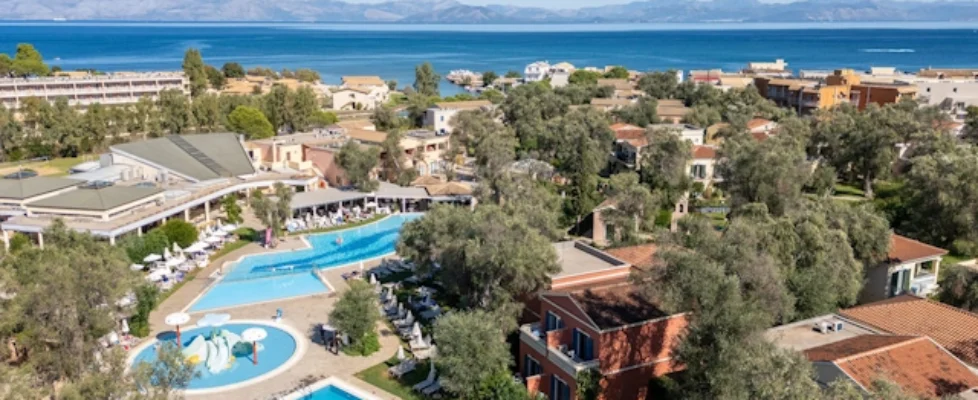
The Sentido Apollo Palace Hotel in Messonghi in Southern Corfu
Here’s our very select list of where to stay in Southern Corfu. It’s just five places but we’ve only picked ones that we can personally recommend from staying in them. They include stylish resort hotels and tucked-away hidden gems, and we’ve tried to spread it around a little geographically.
The Sentido Apollo Palace Hotel in Messonghi in Southern Corfu
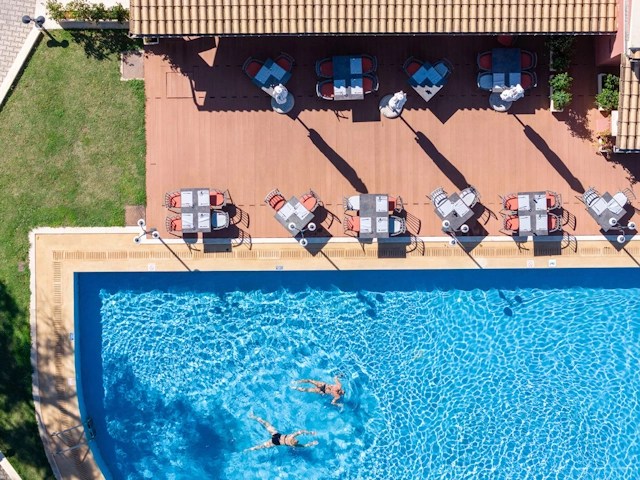
The Sentido Apollo Palace is an impressive and inexpensive option for the popular resort of Messonghi, its rooms mostly being in individual units spread around the large and lush gardens, almost like living in a little Greek village. It even has its own small church, but more conventional amenities too like swimming pools, bar, and restaurant. It’s also right by the beach, which is reached by a pleasant stroll through the grounds.
The Delfinia comprises three separate buildings all more or less facing the sea across trees and green lawns, and only five minutes from the centre of Moraïtika. There are a couple of pools, tennis courts, water sports at the beach, lots of indoor and outdoor activities for children, bars, and restaurants: in fact you hardly need leave the grounds.
The Golden Sands Hotel in Agios Georgios in Southern Corfu
Right by the beach in Agios Georgios that gives the hotel its name, the Golden Sands has 83 rooms with most of them having a view of the sea. All rooms are done out in modern hotel-style, nothing fancy but clean and comfortable. They all have fridge, TV, air-conditioning and direct-dial phones, and the hotel, which is about five minutes from the centre of town, provides two pools, a children’s playground, bars, a restaurant, and Greek dancing on summer evenings.
The salad bar at the The Valmar Corfu Hotel near Benitses
The Valmar Cordu is in Agios Ioannis Melitieon, a 5-minute drive south from Benitses. It’s a 4-star all-inclusive hotel that stands above the road overlooking a beach and the sea, and with wooded hills all around. It’s got two pools, a waterpark, a tennis court, other sporting facilities, organized children’s activities, a mini-market, and many other facilities.
The Hotel Paramonas in Paramonas in Southern Corfu
In the as-yet hardly developed little bay at Paramonas, with just a few tavernas and a sprinkling of low-key accommodation for company, the lovely spacious Hotel Paramonas is separated from the sea by a hundred metres of vines, vegetables, palm trees, and colourful flowers. You walk from the car park over a bridge that crosses a stream, which at night is filled with the sound of frogs… and a few ducks from a nearby house. It’s a modern property in which there are 22 very spacious rooms, 20 with sea views and balconies, and two more suites at the back, which are even bigger and with private terraces. It also has a bar, with breakfast served inside or on the front terrace.
See Greece shares its list of favourite places where you can eat in north-west Corfu, including in Paleokastritsa, Pelekas, and Ayios Stefanos.
View from the Golden Fox Restaurant overlooking Paleokastritsa in North-West Corfu
If you’re wondering where to eat in north-west Corfu then take a look at this list of our personal favourites, from restaurants in popular resorts like Paleokastritsa to family tavernas in mountain villages.
Look for the car park sign as you drive through Doukades and walk up to the little main square where you’ll find the immensely-popular Elizabeth’s. There’s a large dining room inside, the walls lined with drink bottles, while outside there’s only room for one row of tables as there has to be space for the occasional bus or tractor to squeeze by. It’s a good reason to eat late here, Greek time, so that the traffic has eased. Occasionally Elizabeth makes the truly authentic and hard-to-find cockerel pastitsada, but everything she does, she does beautifully.
Sample Dish at the Golden Fox Restaurant near Paleokastritsa
With the most spectacular setting in Corfu, bar none, the Golden Fox looks down over Paleokastritsa Bay. It’s part of the Golden Fox Hotel but is open to non-residents and well worth the drive to get to it. The food is priced higher than average, but not overly so given the standards, the service and of course that view from the dining terrace. You can push the boat out and have lobster spaghetti, a dish they are rightly proud of, though there are plenty of less expensive options too such as sofrito and rooster with spaghetti.
Musicians at Jimmy’s Restaurant in Pelekas in North-West Corfu
For over 50 years Jimmy and his wife Georgia have run their traditional restaurant in Pelekas, and now the children help out too though Jimmy still likes to do the cooking. It’s a lovely, friendly, family place, often enlivened by walking groups who stay in the rooms above. There are traditional Corfiot favourites such as stifado and sofrito, but often cooked from old family recipes making them that bit different. Definitely worth trying.
Sample dishes at Taverna Manthos in Ayios Stephanos
Open since 1976 in Ayios Stefanos, the owner still does 75% of the cooking and uses fresh local ingredients rather than frozen imports which many places buy to keep costs down. He mixes traditional Corfu and other Greek dishes with international dishes such as salmon in the oven with garlic, peppers and mushrooms, though his signature dish is crayfish in a tomato, onion and paprika sauce with spaghetti. Blue and white tables against a periwinkle blue floor on the large patio overlooking the beach give a sense of space and summer, and steps lead down to the beach past an overturned boat.
Fresh Fish at the Sunset Restaurant in Paramonas Beach
A terrace tastefully decorated with fishing nets and ropes provides a seating area looking out over the waves and of course the sunset at Paramonas Beach. Get there early to get a front row seat and be prepared to linger over a glass of wine as the orange sun sinks down. It’s a very friendly family-run place with one house speciality being lobster pastitsada, but check the price first as it’s done by weight. You can choose your lobster from the tank on the terrace.
No need to worry about what to order at Tripas in Kinopiastes as it’s a set menu and dish after dish is brought to your table till you groan and can eat no more. There’s entertainment every night too. If that sounds like a typical ‘Greek evening’ laid on for tourists, then it is a little similar but the food here is good enough to please Corfiots all year round and a great (and late) night out is guaranteed. Booking is highly recommended.
A perfect spot for one of the most popular restaurants in Paleokastritsa. It stands both on a rock overlooking the harbour here, and under the rocks of one of the Paleokastrítsa headlands. A long narrow terrace of outdoor seating ensures that almost everyone gets a good view over the water and the beach, and there is more seating inside. The menu is an absolutely standard list of typical Greek-Corfiot dishes, but the number of Greeks eating here lets you know that they’re doing them right.
Discover the turquoise bays, ancient monasteries, and dramatic cliffs of Paleokastritsa with the See Greece guide to Corfu’s loveliest coastal destination.
Paleokastritsa on Corfu
Nestled along the rugged northwestern coast of Corfu, Paleokastritsa is often described as the Jewel of the Ionian. While many Mediterranean resorts claim the title of paradise, Paleokastritsa earns it through a dramatic blend of lime-green olive groves, towering limestone cliffs, and water so brilliantly turquoise it looks almost fluorescent against the dark rocks.
Whether you’re a history buff, a nature lover, or someone simply looking to lose track of time by the sea, this village offers a quintessential Greek island experience.
1. The Lay of the Land: Location and Geography
Paleokastritsa is situated approximately 25 kilometers (15.5 miles) northwest of Corfu Town. Unlike the flat, sandy stretches found on the island’s southern coast, the geography here is vertical and intricate.
The town is famously built around six distinct bays:
• Agios Spiridon: The main, most accessible beach.
• Agia Triada: Known for its deep waters and beach bars.
• Platia Ammos: A quiet, pebbly retreat.
• Alipa: Home to the local marina.
• Agios Petros: A scenic spot near the monastery.
• Ampelaki: A secluded cove often favored by locals.
This cloverleaf layout means that even when the wind is blowing from one direction, there is almost always a sheltered bay where the water remains as still as a mirror.
Paleokastritsa
2. A Short History of Paleokastritsa
The name Paleokastritsa literally translates to Old Castle Place, a reference to the nearby Byzantine fortress of Angelokastro, which stands sentinel on a nearby peak.
Ancient Mythology
According to local legend and some interpretations of Homer’s Odyssey, Paleokastritsa is the site of the ancient city of the Phaeacians. It is said that Odysseus was shipwrecked here and met Princess Nausicaa on the shores of one of the bays. A rock formation in the sea nearby is even nicknamed The Ship of Odysseus, as legend says Poseidon turned the hero’s boat to stone in a fit of rage.
The Monastery of the Virgin Mary
The modern history of the town is centered around the Theotokos Monastery, founded in 1225. While the current buildings date mostly from the 18th century, the site has been a spiritual beacon for nearly 800 years. Throughout the Venetian, French, and British occupations of Corfu, the monks maintained their tradition of olive oil and wine production, which continues to this day.
The Rise of Tourism
Until the mid-20th century, Paleokastritsa was a quiet cluster of fishing huts and monastic lands. It was the British during their protectorate who first discovered its beauty as a holiday retreat, building the winding road that connects the village to Corfu Town to allow for easier access to its cooling sea breezes.
Paleokastritsa Boat
3. What to Do in Paleokastritsa
Paleokastritsa isn’t a place for ticking boxes; it’s a place for immersion. However, if you are planning a visit, these activities are essential.
The Holy Monastery of Paleokastritsa
Perched on the highest point of the northern promontory, the monastery is a must-visit. • The Courtyard: Filled with bougainvillea, jasmine, and resident cats, the gardens offer a peaceful atmosphere. • The Museum: A small but fascinating collection of Byzantine icons, holy vestments, and—curiously—the skeleton of a whale caught in the bay centuries ago. • The View: Walk to the very edge of the monastery grounds to find the Canon Viewpoint, offering a 270-degree panorama of the Ionian Sea.
Exploring the Sea Caves
The coastline is honeycombed with sea caves, the most famous being Nausicaa Cave and the Blue Eye. • Boat Taxis: From Alipa Port or Agios Spiridon, you can hire a small boat to take you into the caves. • Self-Drive Boats: For those who want more freedom, you can rent a motorboat without a license. This is arguably the best way to see the coast, as it allows you to find your own private hidden cove for the afternoon.
Hiking to Angelokastro
The Fortress of Angelokastro on Corfu
For the adventurous, a hike to Angelokastro (Angel’s Castle) is rewarding. Sitting at an altitude of over 300 meters, this Byzantine fortress was never conquered. Standing on the ramparts, you can see across the entire island and, on clear days, all the way to the mountains of Albania.
Diving and Snorkeling
Because of the rocky terrain, the water here is exceptionally clear. • Snorkeling: Even a few meters from the shore, you’ll see schools of bream and neon-blue damsel fish. • Diving: Paleokastritsa is the premier diving spot on the island. There are underwater tunnels, arches, and a diverse range of marine life that thrives in the cooler waters of the west coast.
4. Gastronomy and Relaxation
Bottles of Kumquat Liqueur on Corfu
Corfu has a distinct culinary identity influenced by centuries of Venetian rule. In Paleokastritsa, the focus is on fresh seafood and traditional Corfiot stews. Pastitsada: Rooster or veal slow-cooked in a spicy tomato sauce with cinnamon and cloves, served over thick pasta. Sofrito: Thin slices of veal cooked in a garlic and vinegar white wine sauce. Bourdeto: A spicy fish stew made with scorpionfish and red pepper. Kumquat Liqueur: The signature drink of Corfu, made from the tiny citrus fruits brought from Asia by the British.
5. Practical Tips for Visitors
• The Water Temperature: Be warned—the water in Paleokastritsa is notoriously colder than on the eastern side of the island due to deep-sea currents. It is refreshing in the July heat, but can be a bit of a shock in May! • Getting Around: While the village is walkable, it is very hilly. If you have mobility issues, consider staying near the main bay (Agios Spiridon). • Parking: In the peak months of July and August, parking can be difficult. Arrive before 10:00 AM to secure a spot at the main lot.
Paleokastritsa: Summary
Paleokastritsa remains one of the few places that manages to balance tourism with raw, natural beauty. It is a place where you can spend the morning in silent prayer at a medieval monastery and the afternoon jumping off rocks into neon-blue water. Its history, tied to both Homeric myths and Byzantine resilience, gives the landscape a weight and significance that goes beyond just a beach holiday.
Angelokastro is a 13th-century hilltop fortress with breath-taking views near Paleokastritsa on the Greek island of Corfu in the Ionian Islands.
The Fortress of Angelokastro on Corfu
Perched precariously on a 305-meter-high (1,001 feet) cliff on the northwestern tip of Corfu, Angelokastro—the “Castle of Angels”—stands as one of the most significant Byzantine fortresses in Greece. For centuries, it served as a silent sentinel, guarding the Ionian Sea and providing a literal and metaphorical “rock” for the people of Corfu. Today, its ruins offer some of the most dramatic panoramic views in the Mediterranean, but beneath the crumbling stones lies a history of defiance and strategic brilliance.
Inside Angelokastro
Angelokastro: A History of “The Impregnable”
The exact origins of Angelokastro are shrouded in the mists of the early Middle Ages. Archaeological evidence suggests that the site was inhabited as early as the 5th to 7th centuries AD, likely as a small lookout post or a rudimentary Christian settlement. However, the fortress we see today began to take shape in the 12th and 13th centuries.
The castle’s name is often attributed to Michael I Komnenos Doukas (known as Michael Angelos), the Despot of Epirus, who captured Corfu in 1214. His son, Michael II, is credited with further fortifying the peak to protect the island’s western frontier after the Byzantine Empire lost its territories in southern Italy.
By 1386, the fortress came under the control of the Republic of Venice. Recognizing its strategic value, the Venetians designated Angelokastro as the official capital of Corfu from 1387 until the 16th century. It became the seat of the Proweditore Generale del Levante, the commander of the Venetian fleet. Throughout this era, the castle was part of a “defensive triangle” with the castles of Kassiopi in the northeast and Gardiki in the south, ensuring no enemy ship could approach the island undetected.
The Fortress of Angelokastro on Corfu
The Ultimate Refuge: A Fortress That Never Fell
What makes Angelokastro truly legendary is its record in battle: it was never conquered. Despite its isolation, it weathered countless sieges by pirates, Genoese mercenaries, and the formidable Ottoman Empire.
During the Great Siege of 1537, an Ottoman force of 25,000 soldiers attempted to take the fortress. While much of the island suffered, the garrison at Angelokastro—led by a handful of local Corfiots and Venetian soldiers—successfully repulsed the invaders. Similar feats occurred in 1571 and during the second Great Siege in 1716.
The fortress was designed specifically to serve as a refuge for the local peasant population. When the signal fires from the peak warned of approaching sails, villagers from the surrounding olive groves would abandon their homes and scramble up the steep path, bringing their livestock and supplies with them.
Ingenious Water Supply: To survive long sieges, the defenders relied on three massive underground cisterns carved into the rock. These tanks collected rainwater, ensuring the population wouldn’t be forced to surrender by thirst.
Churches in the Clouds: Within the walls, the spiritual needs of the refugees were met by the Church of the Archangel Michael, built atop the ruins of an Early Christian basilica. There is also a unique chapel dedicated to Agia Kyriaki, built directly into a cave, which still houses 18th-century frescoes.
The Hermit’s Caves: Beyond the military barracks, the site contains small cells carved into the cliffside, used by monks who sought solitude while performing the duty of watching the horizon for enemy sails.
The Fortress of Angelokastro on Corfu
How to Get to Angelokastro: Routes and Distances
Angelokastro is located near the village of Krini. The final approach involves a narrow, winding road that is not for the faint of heart, but the reward is incomparable.
How to Get to Angelokastro: Routes and Distances
1. From Paleokastritsa (The Scenic Shortcut)
If you are staying in the popular resort of Paleokastritsa, Angelokastro is almost literally “above” you, though the road takes a circuitous route to reach the summit.
Distance: Approximately 9.2 km (5.7 miles).
Driving Time: Roughly 15–20 minutes.
Route: Drive inland from the bay toward the main road (GR-24) and follow the signs for Lakones and Krini. You will climb through the famous “Bella Vista” viewpoints, which offer a bird’s-eye view of the heart-shaped bays of Paleokastritsa. Once you pass through the narrow streets of Krini, the road leads directly to a small parking area at the foot of the castle.
2. From Corfu Town (The Cross-Island Trek)
Traveling from Corfu Town takes you across the lush center of the island, transitioning from the Venetian urban architecture to the rugged limestone cliffs of the west.
Distance: Approximately 28 km (17.4 miles).
Driving Time: Roughly 45–55 minutes.
Route: Take the main road westward toward Paleokastritsa. Before reaching the coast, look for the right-hand turn toward Lakones or Makrades. This route will take you through the traditional “handicraft” villages of the hills before arriving at Krini.
Pro Tip: The road between Lakones and Krini is exceptionally narrow—often only wide enough for one car. If you encounter a bus or a local truck, you may need to reverse into a “pocket” or pull-off area. Driving during the early morning or late afternoon is recommended to avoid heavy traffic and the midday heat.
Tips for Visiting Angelokastro
The climb from the parking lot to the citadel takes about 10 to 15 minutes on a steep, stone-stepped path. It is essential to wear sturdy shoes, as the stones are worn smooth and can be slippery even in dry weather. It isn’t easy for anyone with mobility problems.
Entrance Fee: Typically just a few euros.
The View: From the summit, you can see the entire bay of Paleokastritsa, the Diapontia Islands to the north, and on clear days, the mountains of the Greek mainland and the coast of Albania.
Photography: The best light for photography is in the late afternoon, as the sun begins to dip toward the Ionian Sea, illuminating the fortress walls in a golden hue.
As the sun sets over the Ionian, casting long shadows across the ancient battlements, it is easy to see why the Byzantines believed this place was protected by angels. It remains a testament to Corfiot resilience—a jagged crown on an emerald island that refused to bow to empires.
The church of Saint Spyrídon (Ayios Spyridon) in Corfu Town is a must-see site and contains the silver casket of the island’s patron saint.
Tower of the Church of St Spyridon in Corfu Town
Always busy with locals and visitors, this church seems surprisingly small considering its importance: it houses the relics of Saint Spyridon, Corfu’s patron saint. It is richly decorated with icons, frescoes, silver and gilt ornaments, and the elaborate coffin of the saint himself.
Born on the island of Cyprus, Saint Spyridon was a shepherd who became a monk and a bishop. He was credited with many miracles before his death in 350 AD. After the fall of Constantinople (now Istanbul) his remains were brought to Corfu in 1456, and a church was built to house them. It was later torn down, and the present church was built in 1590. Its red-domed bell tower is the tallest on the island, a landmark of Corfu Town.
Splendid Iconostasis
Tower of the Church of St Spyridon
The church’s plain facade belies the ornate interior. It contains a splendid iconostasis, or altar screen, made of white Cycladian marble. Set into its upper panels are scenes of the Annunciation, the Last Supper and the Transfiguration, as well as numerous religious figures.
The stunning ceiling murals depicting scenes from the life of Saint Spyridon were originally painted by Panayiotis Doxaras, master of the Ionian School; they were redone in the mid-19th century after the originals were damaged by damp. There are so many silver chandeliers, candelabras and thuribles (incense burners) that the church is said to contain the greatest weight of silver of any church in Greece, outside Tinos.
Honouring Saint Spyrídon
Saint Spyridon lies in an elaborate silver casket studded with a dozen enamel medallions, in a tiny chapel to the right of the altar. Hanging above it is a forest of silver thuribles, dangling with little silver ships and votive offerings. Spyridon is the patron saint of sailors, protecting them from shipwrecks and helping them to safe harbour during storms.
The faithful queue up to kiss his coffin and leave notes with prayers for help. Four times a year and on his name day, 12 December, the coffin is opened to expose the saint’s mummified face, under glass. On his feet are embroidered slippers. Each year he receives a new pair, as the old ones are said to show wear from his night-time strolls around town.
On Palm Sunday, Easter Sunday, 11 August and the first Sunday in November, the saint is paraded through town upright in his open casket. The four processions commemorate the four occasions when he saved the island from disasters: once from famine, twice from plague, and once from Turkish invasion. Throughout the year, the brass candle holder outside the church receives a stream of lighted offerings.
Top Tips
Dress appropriately. Don’t wear shorts and women should cover their shoulders. Avoid casual visits when services are in progress.
Hidden Gem
On the wall to the right of the iconostasis, look for the icon of Saint Spyridon dressed in a brown robe with a pattern of crosses. It was painted in the 18th century by Konstandinos Kondarinis and is one of the finest likenesses of the saint on Corfu.
The best things to do on Corfu include visiting Palaiokastritsa, a day trip to Albania, seeing the Achilleion Palace, and the museums in Corfu Town.
Mount Pantokrator on Corfu
The best things to do on Corfu include visiting Palaiokastritsa, taking a day trip to Albania, seeing the Achilleion Palace and Corfu Town’s Old Fort, and also the Archaeological, Byzantine and Asian Art Museums in Corfu Town. A walk around the Old Town of Corfu Town is another must, including a visit to the church of Ayios Spiridon, the island’s patron saint.
To the south of Corfu Town is the beautiful view from Kanoni, and the villa of Mon Repos which now houses the Museum of Palaiopolis. In the north of the island is its highest point, Mount Pantokrator, and the drive up here is another of the best things to do on Corfu.
Best Things to Do on Corfu
The Achilleion Palace
Achilleion Palace Staircase
The Achilleion is an over-the-top palace that was built for the Empress Elizabeth of Austria in the 1890s. Over the years it’s been a hospital, a casino, and starred in a James Bond movie. Today you can tour its rooms and gardens, with their many statues. See our full page all about The Achilleion Palace.
Albania Day Trip
Gjirokaster in Albania
Several companies do day trips and overnight visits to Albania, or you can simply take a regular ferry across to the port of Saranda and organise things for yourself. We did a trip of a couple of days with Sipa Tours, though they have subsequently moved to Albania and organise exciting tours within Albania.
Archaeological Museum, Corfu Town
The Gorgon Frieze in Corfu Town’s Archaeological Museum
This isn’t one of the biggest archaeological museums in Greece but it’s worth visiting just to see the amazing Gorgon Frieze, a huge 6th-century BC pediment from a temple that is absolutely stunning when you enter the room and first see it.
Byzantine Museum, Corfu Town
Byzantine Museum in Corfu Town
This lovely little museum is in a 15th-century church and brings together some fine examples of Byzantine carvings, icons and other items, mainly from the 16th and 17th centuries but some as old as the 13th century. Corfu had a fine tradition of icon painting, as renowned artists from Crete would stay here on their way to work in Venice, and some of them settled or returned to Corfu.
Church of Ayios Spiridon, Corfu Town
The body of St Spiridon, the island’s patron saint, is preserved here in a silver casket to the side of the altar. The 15th-century church is in the heart of the Old Town, its spire easily visible, and a visit here will reveal a constant queue of people waiting to pay homage to the saint by kissing the casket.
Corfu Old Town
The narrow streets of Corfu’s Old Town are filled with everything from the kind of souvenir shops you find anywhere to craft workshops, wood carvers, food shops and cafes. It’s easy to get lost in the narrow, winding streets, but it’s worth getting lost and there’ll always be someone to help you find your way out again.
Kanoni
Mouse Island at Kanoni in Corfu Town
The view of Mouse Island from Kanoni is one of the most recognisable scenes on the whole island, familiar from many photos. Of course the photos don’t show you that the airport runway is just off to one side – but it’s still a beautiful spot.
Mon Repos and Palaiopolis
Mon Repos is a beautiful neoclassical villa situated amidst lush parkland in the Paleopolis area, south of Corfu Town. Built in 1831 for the British High Commissioner Sir Frederick Adam and his Corfiot wife, it later became a summer residence for the Greek Royal Family. Today, the estate belongs to the Greek state, housing the Paleopolis Archaeological Museum within the villa and offering the surrounding gardens and ancient ruins of the former city of Paleopolis as a public park.
Mount Pantokrator
View from Mt Pantokrator on Corfu
Dominating the northeast corner of the island, Mount Pantokrator is the highest point on Corfu at 2972ft/906m. You can drive all the way to the top, and visit the monastery there. Fabulous views, of course, and a lovely drive through rural Corfu.
Museum of Asian Art, Corfu Town
Palace of St Michael and St George in Corfu Town
Sometimes called the Museum of Asiatic Art, a visit here also lets you see inside the Palace of St Michael and St George, which houses the museum. This contains over 10,000 items collected in the Far East by a Greek diplomat, and all we can say is that he had incredibly good taste. For us this is one of the best Greek museums outside Athens.
New Fort and Old Fort, Corfu Town
The two forts both provide lovely views over the rooftops of Corfu Town, and out to sea. The New Fort dates from the 16th/17th centuries and is only called the New Fort because the Old Fort already existed when it was built. The Old Fort complex contains a small museum and a church built by the British, while the New Fort just has a small cafe.
Palaiokastritsa
Palaiokastritsa on Corfu
If you have to single one resort out on Corfu then it has to be Palaiokastritsa. It is incredibly beautiful, with high cliffs and several indented coves, a lovely monastery to visit, and even if you don’t stay there it is worth a day’s visit, at least, just to see it.
So there you have our personal choice of the Best Things to Do on Corfu.
Corfu Town is the capital of Corfu and of the Ionian Islands and has museums, two forts, several museums, churches, and many other attractions.
Corfu Town
Nowhere is the pan-European background in the Ionians more evident than in Corfu Town. (It’s actually a city but everyone calls it Corfu Town.) It may have hole-in-the-wall Greek tavernas in its back streets, and its residents may celebrate Easter even more exuberantly than they do elsewhere in Greece, but it also has very strong influences from Britain, France and Italy in its architecture and its cuisine. Residents of Corfu Town quite rightly regard themselves as more sophisticated than people from other Greek island capitals.
Corfu Town Esplanade
And nowhere is this mix more evident than in the very centre of town, around the Esplanade. This combination of park and town square centres on a British cricket pitch, which used to be a Venetian firing range. At the far end, on a promontory sticking out into the Ionian Sea, stands the Old Venetian Fortress, which was completed in 1559 on a site believed to have been fortified since at least the 7th or 8th centuries AD. The Old Fortress (or Palaio Frotho) can be visited, with wonderful views over the town.
Palace of St Michael and St George
Palace of St Michael and St George in Corfu Town
At the north end of the cricket pitch stands the British-built Palace of St Michael and St George, constructed between 1819-24 as the residence of the British High Commissioner at the time. It was renovated in the 1950s and now contains administrative buildings, a library, the tourist office and, in one wing, the Corfu Museum of Asian Art. This collection, unique in Greece, was built up from 10,000 items amassed by Grigorios Manos (1850-1929), a Greek diplomat from Corfu who traveled extensively in the Orient.
The Liston
The Liston in Corfu Town at Night
At the western end of the cricket pitch is a row of cafes and shops that could only be French: the Liston. It was built by a Frenchman in 1807 at the behest of Napoleon, who wanted its colonnades to echo the rue de Rivoli in Paris. Its name is Venetian, deriving from the ‘List’ of noble families whose names were kept in the Golden Book, the Libro d’Oro. The cafes along the Liston are where everyone comes to socialise, a buzz of activity at lunchtime and early evenings, with people meeting friends or relaxing with newspaper and coffee. Your coffee will cost more here than anywhere else in Corfu, but it’s the place to be.
Enosis Monument
At the southern side of the cricket pitch is a park with a splendid fountain and, nearby, the Enosis Monument. This Unification Monument celebrates the occasion in 1864 when the Ionian islands were at last united with the rest of Greece after their final period of foreign, British, rule.
Archaeological Museum
The Gorgon Frieze in Corfu Town’s Archaeological Museum
There are numerous sites and museums around Corfu Town that ought to be seen, and which would merit a stay of at least a few days. Naturally the Archaeological Museum of Corfu is one of these, although it does not have the richness in its collection that you might expect from such a thriving town. Its star attraction is worth the visit alone, though, a fearsome Gorgon frieze which was made in the 6th century BC for the Temple of Artemis in the southern suburbs of Corfu Town.
The Banknote Museum
The Banknote Museum sounds as if it might only have appeal to those with a specialist interest, but it is in fact a really enjoyable museum which tells not only the fascinating story of how bank notes are made, but also shows how Corfu’s currency reflects the political changes, including notes in German and Italian currency during World War II when inflation was rampant.
Byzantine Museum
The Byzantine Museum’s official name is the Antivouniotissa Museum as it’s in the church of the Panagia Antivouniotissa and has a small and stylishly displayed collection of icons, some as old as the 15th century. Included are examples of work by the so-called Cretan school, from the days when Venice also ruled Crete and Cretan artists would visit Corfu on their way to study with the masters in Venice.
Church of Agios Spyridon
Tower of the Church of St Spyridon in Corfu Town
One church that must be visited in Corfu Town is dedicated to the island’s patron saint, Agios Spyridon. His mummified body is contained in a silver casket inside, and on four occasions a year this is paraded through the streets to celebrate the occasions when the saint is believed to have come to the rescue of the islanders, during battles and plagues. It is a marvellous time to be in Corfu Town (Palm Sunday, Easter Saturday, August 11 and the first Sunday in November) to see the way that Greeks combine religious fervour with abundant partying.
See Greece recommends where to stay in Corfu Town including hotels near the port, near the airport and in the town centre, with budget and luxury options.
The Bella Venezia Hotel in Corfu Town
Corfu Town is a lovely town and we highly recommend staying there for a few days when visiting Corfu, if you can. We once stayed there for two whole weeks while researching a guidebook and didn’t run out of things to do. We found great new places to eat every night we were there, from fancy restaurants to back-street souvlaki joints.
There’s an excellent range of hotels, too, and we moved between some of them during our visit, including some of the ones listed below. Here, then, is our list of suggestions on were to stay in Corfu Town, based on several visits.
A lovely shining curved wooden reception desk greets you as you enter the friendly Arcadion Hotel, which combines classical looks and history with modern comfort. The entrance is around the corner on Vlasopoulou, though the building looks out over Kapodistriou, the southern end of the Liston and the Spianada, an ideal location. Try to get one of the front rooms if you can, though the side ones looking out over the Old Town are also attractive.
The Hotel Arion is only a minute or so from the entrance to the Mon Repos estate, in the quiet, village-like suburb of Anemomylos. It’s a pleasant 15-minute walk around Garitsa Bay into the town centre, too. The Arion is a smart, modern hotel at a very reasonable price. It has 105 comfortable rooms, a large lounge/reception area and a big rooftop terrace with seating, a bar and wonderful sea views.
The Atlantis Hotel is conveniently placed near the port, if you’re arriving or leaving by ferry, and right on the edge of the old town too. Most of the rooms and suites have balconies and views over the Ionian Sea, and although it’s only a 2-star hotel and inexpensive, it is clean and friendly and all rooms have air-conditioning, TV, direct-dial phones and ensuite bathrooms.
The Bella Venezia is in a neo-classical mansion, once a girl’s high school, and it oozes the kind of character that many hotels these days lack. Rooms are large with high ceilings, breakfast is in a garden pergola, and it is only a short walk down to Town Hall Square.
The Hotel Bretagne is a budget but very comfortable option for those with late or early flights, as it is within walking distance of the airport. This proximity does mean that airport noise at other times can be a problem, so bring your ear-plugs. It is modern and cheerful and has its own bar and restaurant… which are also well worth knowing about if you have airport delays.
Everybody in Corfu Town knows the Cavalieri Hotel, as in summer its rooftop bar is one of the places to have a drink. It’s rather a plush place in a 17th-century mansion, and though some of the 50 rooms are small it does have class and character. All rooms have balconies, with the front ones offering lovely views of the sea and the New Fortress.
This 4-star hotel is out on the Kanoni peninsula, a 5-minute drive from the airport. Despite being about 3 kms (1.9 miles) from the town centre, and 1.5 kms (0.9 miles) from the beach at Mon Repos, it still proves immensely popular with people looking for an all-inclusive resort-style hotel, where every facility is available. It has luxury rooms and suites, and its two conference centres also make it a top business choice.
The Corfu Holiday Palace is a huge complex with a few hundred rooms, suites and bungalows, conference facilities, and the island’s only casino. Located out on the Kanoni peninsula, it overlooks Mouse Island, one of the best views in Corfu.
The swishest hotel in Corfu Town itself, in the 5-star Luxury class Hotel Corfu Palace, overlooking Garitsa Bay. It’s where visiting politicians and other dignitaries are usually housed. It has a beauty and fitness centre, two swimming pools, two restaurants, large well-kept grounds and all its rooms and suites overlook the sea.
Built in 1862 the Konstantinoupolis oozes old-world elegance, with marble steps and a spiral wooden staircase leading you up to the rooms (and an old-fashioned elevator too). It’s handy for Old Port and Old Town alike, and though some of the rooms are small they are charming, with bright blue tiled baths. The breakfast room is also bright and cheerful, and there’s 24-hour room service too. Don’t let the 2-star rating mislead you, it’s exceptionally good.
The Mon Repos Palace is a very attractive adults-only resort-style hotel with 114 rooms, all of them having TV, air-conditioning, phone, fridge, and balconies. It’s at the southern end of Garitsa Bay, very close to the Mon Repos estate and an enjoyable 10-minute walk around the bay into Corfu Town. It has its own small plunge pool and sunbathing terrace, but is right by the Mon Repos beach too.
See Greece picks the best time to visit Kefalonia, with a monthly summary of the weather, plus hotel prices and special events to help plan a visit.
Kefalonia Sunset
Kefalonia, the largest of the Ionian Islands in western Greece, is a paradise of stunning beaches, charming villages, and breathtaking landscapes. The island’s climate is typically Mediterranean, with hot, dry summers and mild, wet winters.
But when is the best time to visit Kefalonia? Let’s take a month-by-month look at the island’s weather, special events, and hotel prices to help you plan your trip.
Best Time to Visit Kefalonia Month-by-Month
January is the coldest month in Kefalonia, with average temperatures ranging from 41°F (5°C) to 55°F (13°C). Rainfall is quite high, averaging around 3.5 inches (89mm). Snowfall is rare but can occur in the higher elevations. Hotel prices are at their lowest, making it a great time for budget travelers. However, there are no significant events during this month.
February sees similar weather to January, with temperatures between 41°F (5°C) and 55°F (13°C), and rainfall averaging 3.1 inches (79mm). Snowfall is still possible in the mountains. Hotel prices remain low, and the island celebrates Carnival with parades and parties, a fun time for visitors.
In March, temperatures begin to rise, averaging between 44°F (7°C) and 59°F (15°C). Rainfall decreases to about 2.4 inches (61mm). The island celebrates Greek Independence Day on March 25th with parades and festivities. Hotel prices remain relatively low.
Kefalonia
April sees a significant improvement in weather, with temperatures ranging from 50°F (10°C) to 66°F (19°C) and rainfall dropping to 1.6 inches (41mm). Easter is a major event in Kefalonia, with processions, feasts, and fireworks. It usually takes place in April but not always, so check. Hotel prices start to increase.
May marks the beginning of the tourist season in Kefalonia. Temperatures range from 57°F (14°C) to 75°F (24°C), and rainfall is minimal at 0.8 inches (20mm). The island celebrates May Day with flower festivals. Hotel prices continue to rise.
June brings summer to Kefalonia, with temperatures ranging from 64°F (18°C) to 84°F (29°C) and rainfall at a mere 0.4 inches (10mm). Hotel prices are high, reflecting the start of the peak tourist season.
Fiskardo in Kefalonia
July is the hottest month in Kefalonia, with temperatures between 70°F (21°C) and 88°F (31°C). Rainfall is almost non-existent. The International Folklore Festival is a highlight of July, featuring traditional music and dance. Hotel prices are at their peak.
August continues the hot, dry trend with temperatures from 70°F (21°C) to 88°F (31°C) and minimal rainfall. The Feast of the Assumption on August 15th is a major event, with religious processions and celebrations. The International Music Festival takes place in August in Argostoli, attracting music lovers from around the world. Hotel prices remain high.
September sees a slight drop in temperatures, ranging from 64°F (18°C) to 82°F (28°C), and rainfall increases slightly to 0.8 inches (20mm). Hotel prices begin to drop.
Assos in Kefalonia
October brings cooler weather to Kefalonia, with temperatures between 57°F (14°C) and 73°F (23°C), and rainfall increasing to 2.8 inches (71mm). The island celebrates Ochi Day on October 28th, commemorating Greece’s resistance in WWII. Hotel prices continue to drop.
November sees a further drop in temperatures, ranging from 50°F (10°C) to 64°F (18°C), and rainfall increases significantly to 3.5 inches (89mm). There are no significant events in November, and hotel prices are low.
December brings the year to a close with temperatures between 44°F (7°C) and 59°F (15°C) and high rainfall at 4.3 inches (109mm). Christmas is celebrated with local traditions and festivities. Hotel prices remain low.
Kefalonia
Best Time to Visit Kefalonia Summary
In conclusion, the best time to visit Kefalonia depends on what you’re looking for. If you want hot, sunny weather and don’t mind the crowds, July and August are ideal.
If you prefer milder temperatures and fewer tourists, May, June, and September are great choices.
For budget travelers, the winter months offer the lowest hotel prices. But no matter when you choose to visit, Kefalonia’s beauty and charm are sure to captivate you.
See Greece picks the best things to do on Kefalonia, including beaches, caves, pretty villages, wineries, monasteries, museums and hikes.
Myrtos Beach on Kefalonia
Kefalonia, the largest of the Ionian Islands in western Greece, is a paradise of pristine beaches, charming villages, and fascinating historical sites. One of the best experiences on Kefalonia is simply exploring its diverse landscapes, from the towering Mount Ainos to the deep blue waters of the Ionian Sea.
Best Things to Do on Kefalonia
Start your adventure at Myrtos Beach, often hailed as one of the most beautiful beaches in the world. Its white pebbles, turquoise waters, and surrounding cliffs create a breathtaking panorama. It’s the perfect spot for sunbathing, swimming, or simply enjoying the view. It’s on the west coast about midway between Argostoli and Fiskardo.
For history buffs, the Archaeological Museum of Argostoli is a must-visit. It houses a rich collection of artifacts from the Mycenaean, Hellenistic, and Roman periods, offering a glimpse into Kefalonia’s ancient past. It’s located at 12 Kavvadias Street, Argostoli, and their phone number is +30 2671 028400.
The Melissani Cave on Kefalonia
Explore the fascinating Melissani Cave, a natural wonder filled with stalactites and stalagmites, and a lake that changes color with the sunlight. Boat tours are available, offering a unique way to experience this geological marvel. The cave’s not too far from Sami, on the east coast. Visit melissani-cave.com for more details.
Fiskardo in Kefalonia
Take a leisurely stroll around Fiskardo (or Fiscardo), a picturesque fishing village with colorful Venetian-style houses, waterfront cafes, and a bustling marina. It’s a great place to sample local cuisine and enjoy the laid-back island life, at the northern tip of the island. More information can be found at fiscardo.com.
For a taste of Kefalonia’s lively culture, visit the Korgialenio Historic and Folklore Museum in Argostoli. It showcases traditional costumes, household items, and photographs, providing a fascinating insight into the island’s rural life in the 19th and 20th centuries. The museum is located at 12 Rizospaston Voulevard, Argostoli, and their phone number is +30 2671 028400.
Cork Forest on Kefalonia
Hiking enthusiasts will love the Mount Ainos National Park, home to Kefalonia’s highest peak (1,628 meters/5,341 feet). The park offers several trails with stunning views of the island and the surrounding sea. It’s also home to the unique Kefalonian Fir tree. For more information, visit visitgreece.gr.
Experience the water sports at Makris Gialos Beach. From jet-skiing and parasailing to paddleboarding and snorkeling, there’s something for everyone. The beach is located in Lassi, in the south of the island.
Visit the Monastery of Agios Gerasimos, the patron saint of Kefalonia. This sacred site is a place of pilgrimage and offers a serene atmosphere amidst beautiful surroundings. It’s located at Omala, about a half-hour drive east of Argostoli, and their phone number is +30 2671 088911.
Explore the Drogarati Cave, a 150-million-year-old natural wonder known for its impressive stalactites and stalagmites. It’s also famous for its excellent acoustics, making it a unique venue for concerts. It’s a five-minute drive south from Sami. Visit greeka.com for more information.
Ithaca
Take a boat trip to the nearby island of Ithaca, the legendary home of Odysseus. It’s a great opportunity to explore another beautiful but much smaller Ionian island, with its own unique charm. Boat trips can be booked through various local operators and there are regular ferries from Sami and from Fiskardo.
Visit the Castle of Saint George, a 16th-century Venetian fortress offering panoramic views of the island. It’s a great place to learn about Kefalonia’s history and enjoy a scenic picnic. The castle is located near Peratata, a few kilometers east from Lassi.
For wine lovers, a visit to the Robola Wine Cooperative is a must. Here, you can learn about the island’s winemaking tradition, tour the vineyards, and sample the famous Robola wine. The winery is located at Omala, a half-hour drive east from Argostoli, and their phone number is +30 2671 082111.
Enjoy a relaxing day at Antisamos Beach, a stunning pebble beach with crystal clear waters, surrounded by lush greenery. It’s also the location of several scenes from the movie Captain Corelli’s Mandolin. The original book is set on Kefalonia.
Visit the Kefalonia Botanica, a beautiful garden showcasing the island’s diverse flora. It’s a peaceful place to enjoy a leisurely walk and learn about local plant species. The garden’s in Argostoli and their phone number is +30 2671 025930.
Take a bike tour around the island to explore its scenic countryside, charming villages, and hidden beaches. Several local companies offer bike rentals and guided tours. More information can be found at samitrekking.com..
Visit the De Bosset Bridge in Argostoli, the longest stone bridge over the sea in the world. It’s a great place for a leisurely walk, with beautiful views of the Koutavos Lagoon and the town.
Explore the ruins of the Ancient City of Sami, an important archaeological site dating back to the Paleolithic era. It’s a great place to learn about the island’s ancient history. The site is located near Sami, about halfway up the east coast, and more information can be found at greeka.com.
Tassia’s Restaurant in Fiskardo
Enjoy a traditional Greek meal at one of the island’s many tavernas. Try local specialties like Kefalonian meat pie, fresh seafood, local cheeses, and local wines. Our favourite eating spot is difficult to choose but it’s hard to beat Tassia’s on the harbour at Fiskardo with views across to Ithaca. We’ve eaten there several times and never been disappointed. Their phone number is +30 2674 041130.
Visit the Lighthouse of Saint Theodoroi, a distinctive circular building offering beautiful views of the sea. It’s a great place to watch the sunset. The lighthouse is a few kilometres north of Argostoli, about an hour’s walk. Just keep going till you run out of land!
Take a scuba diving trip to explore Kefalonia’s underwater world. The island’s clear waters are home to a rich marine life and several interesting dive sites. Several local companies offer diving courses and trips, including kefaloniadivingcenter.gr.
Visit the Natural History Museum of Kefalonia and Ithaca, a great place to learn about the island’s diverse flora and fauna. The museum is located at Davgata, a 15-minute drive north of Argostoli, and their phone number is +30 2671 085300.
Enjoy a horse riding tour through Kefalonia’s beautiful countryside, or along the beaches. It’s a unique way to explore the island’s scenic landscapes and traditional villages. More information can be found at kefaloniashorseridingstable.com..
Visit the Monastery of Panagia Atrou, one of the oldest monasteries in Kefalonia. It’s a peaceful place with beautiful frescoes and stunning views of the sea. The monastery is located near Poros on the east coast, and their phone number is +30 2674 072230.
Explore the Venetian-style Assos Castle, a 16th-century fortress offering panoramic views of the village of Assos and the sea. It’s a great place for a scenic hike. More details can be found here.
Finally, support the work of the Sea Turtle Protection Society in Argostoli, where you can learn about these fascinating creatures and the conservation efforts to protect them. Contact them through their website, and their phone number is +30 2671 022593.
Life as a Greek Waiter tells what it’s like to work in a Greek restaurant on Zakynthos and see behind the scenes in a family taverna.
Mantalena Restaurant in Alikanas on Zakynthos
A few years ago Mike went to Alykanas on Zakynthos in the Ionian Islands to get a behind the scenes look at one of his favourite Greek restaurants: the Mantalena. He wrote a piece for The Times about a day in the life of the Mantalena, but didn’t expect to be challenged by the manager, Tasos, to work as a waiter in the evenings!
He discovered just how hard those waiters work on a busy night, from setting up the tables before the doors open till the early hours of the morning when the final customers have left and all the staff wind down together with their own meal.
Here’s Mike’s account of what it was like:
Dessert at the Mantalena Restaurant in Alikanas on Zakynthos
Life as a Greek Waiter
‘Smile!’ Tasos tells me as I stand in front of the Mantalena Restaurant in Alykanas on the Greek island of Zakynthos. ‘The customers want to have a good time. They don’t know it’s your first night as a Greek waiter, so act confident.’
I’d been staying with Tasos all week, so it seemed only fair to help out in his restaurant. After all, I had the white shirt and the Tom Conti beard. I may not have been Greek but then neither were most of the customers in summer, though the Mantalena stays open all winter catering to the islanders who know good Greek food. And there is such a thing. Try their stuffed vine leaves, or chicken stuffed with rice, onion, garlic, herbs and minced beef. ‘They’re mostly family recipes,’ Tasos told me. ‘The chicken one is from my auntie. Everyone says you can’t put minced beef into chicken but it tastes wonderful.’
I wouldn’t be taking the orders as I don’t write Greek and the kitchen staff don’t read English, but I could greet people, seat people, bring them a menu and the complimentary glass of ouzo, then clear away the debris afterwards. It would take a bit of pressure off the others. It was only early June, but by mid-evening all fifty tables would be full: That’s at least a hundred people needing menus, ouzos, bread, wine, starters, main courses, puddings, brandies, coffees or their bills.
Mantalena Restaurant in Alikanas on Zakynthos
I soon discovered that the one thing a waiter doesn’t do is wait. There’s no time. Hello, good evening, please have a glass of ouzo with our compliments, another beer of course, should I clear those plates away, take two moussakas to table 24 and they need some new knives and forks and pick up a chicken souvlaki from the grill on the way, we’re running low on ouzo, I’ll get your bill at once, hello, there are some empty tables around the side, please have a glass of ouzo, now whose is the stuffed squid, another carafe of house white, certainly, your bill, thank you, I’ll just get your change, two coffees and a walnut cake table 13, where are the clean tablecloths, is there a spare bottle opener, hello, how are you, would you like a glass of ouzo?
Occasionally you take a sip of water and wipe away the sweat caused by running around on a hot evening, into and out of the kitchen. It’s almost midnight before Tasos takes the final bill. As the last customers leave, we bring in the salt and pepper sets, the ashtrays, the menus, the final trays full of debris. Natasa is sweeping up, and the kitchen staff are madly washing down the surfaces. Tasos’s mother Soula starts cooking at 5.30 in the morning, and demands a clean kitchen when she arrives.
Zoe is cooking one last meal – for the staff. At 12.45 we tuck into tsatsiki, chips, salad, pork, chicken, moussaka, stifado, rice and a few bottles of beer. ‘Early tonight,’ says Tasos. ‘In August we’d still be serving now.’ Afterwards he empties the tips bowl and divides it amongst the real waiters. While Tasos and Zoe work out what’s wanted for the next day, I crawl away to my bed, take off my sweat-soaked white shirt, and resolve to leave bigger tips in future.
Mike’s stint as a waiter at the Mantalena Restaurant in Alykanas on Zakynthos was a few years ago now, but the restaurant is still there so check out the website for the Mantalena.
See Greece picks the best time to visit Corfu, with a monthly summary of the weather, plus hotel prices and special events to help plan a visit.
Corfu
Corfu in the Ionian Islands is a haven of lush greenery, stunning beaches, and enchanting history. Nestled in the Ionian Sea, it’s a destination that delights tourists with its unique blend of natural beauty and cultural heritage.
Its climate is typically Mediterranean, with mild winters and warm, sunny summers. The changing seasons offer a diverse range of experiences, making it a year-round destination. As such, understanding the weather, hotel prices, and special events is essential while planning your visit to determine the best time to visit Corfu.
Marbella Beach Hotel on Corfu
Best Time to Visit Corfu Month-by-Month
January in Corfu is a month that presents a mild winter climate. Average temperatures oscillate between 41°F (5°C) and 55°F (13°C), with an average rainfall of about 5.1 inches (130mm). Snowfall is uncommon, but it can give a special charm to the scenery when it does happen. Despite cold conditions, certain budget-friendly hotels are available due to fewer tourists.
February experiences similar weather to January, with average temperatures ranging from 41°F (5°C) to 57°F (14°C). Rainfall measures about 4.3 inches (110mm). The celebrated carnival of Corfu takes place in February, attracting tourists with colorful parades and festivities. Prices for accommodation remain low.
March heralds the onset of spring in Corfu. Temperatures average between 45°F (7°C) and 61°F (16°C), while rainfall reduces to approximately 3.5 inches (90mm). Orthodox Easter usually falls in either March or April, and is a significant event on the island, making it an appealing time to experience the local culture. Despite this, hotel prices tend to remain relatively affordable.
The Corfu Trail
April sees beautiful spring weather, with average temperatures between 50°F (10°C) and 68°F (20°C). Rainfall is about 2.4 inches (60mm). Corfu Easter celebrations, if not in March, can offer unique cultural experiences. Hotel prices start to increase slightly with the rising tourist influx.
In May, you can expect warmer weather, with average temperatures between 57°F (14°C) and 77°F (25°C). Rainfall is minimal, averaging only 1.6 inches (40mm). Green Corfu is exceptionally vibrant in May, and hotel prices, while climbing, remain modest compared to peak summer months.
June marks the official arrival of summer, with temperatures ranging from 68°F (20°C) to 84°F (29°C), and significantly reduced rainfall of about 0.8 inches (20mm). As summer festivals begin to take place, the island becomes livelier and hotel prices start to rise.
Glyfada Beach on Corfu
July is a peak summer month, featuring temperatures between 70°F (21°C) to 91°F (33°C) and minimal rainfall. The Corfu Beer Festival, a highlight of the summer, is a treat for beer enthusiasts. Accommodation rates, however, are at their highest.
August continues the summer heat with similar temperatures to July. The Varkarola Festival with its spectacular displays of music and fireworks is a significant event this month. Hotel prices remain high, consistent with the peak season.
September ushers in autumn with average temperatures still quite warm, ranging between 70°F (21°C) and 84°F (29°C). Rainfall begins to increase slightly to about 1.6 inches (40mm), and hotel prices start to drop, making it an excellent choice for budget-savvy travelers who are still aiming for good weather.
Corfu Beach
October offers a mix of warm and cool weather, with temperatures between 59°F (15°C) and 75°F (24°C). Rainfall increases to around 3.9 inches (100mm). The Corfu Wine Festival takes place in October, making it a great time for wine aficionados. Hotel prices continue to decrease with the departing summer crowds.
In November, temperatures typically range from 52°F (11°C) to 66°F (19°C), and the rainfall increases to about 6.3 inches (160mm). The island’s quiet atmosphere and affordable accommodation make it a good choice for travelers seeking tranquility.
December is the coolest month, with temperatures between 46°F (8°C) to 59°F (15°C) and high rainfall of about 7.1 inches (180mm). Christmas celebrations offer a unique festive charm to Corfu at this time. Hotel prices are generally lowest during this month, creating an opportunity for budget travel.
Palaiokastritsa on Corfu
Best Time to Visit Corfu Summary
Choosing the best time to visit Corfu depends largely on personal preferences. Those who enjoy the heat and don’t mind crowds should opt for the high summer season from June to August. This period offers the warmest weather, vibrant summer festivals, and best conditions for beach activities.
For travelers who prefer sunbathing without the bustling crowds, the shoulder seasons of May and September can be the best time. The weather is still warm, there are plenty of events, and accommodation rates are comparatively moderate.
Autumn, specifically October, can be an ideal choice due to its comfortable temperatures and the fun Corfu Wine Festival. The islands’ relaxed atmosphere and rich cultural experiences strike an appealing balance during this season.
Those who prefer cooler temperatures and tranquillity can opt for the winter months from November to February. It’s the time when you can enjoy easy-paced exploration and secure budget-friendly accommodation.
Make sure you pay attention to the shifting hotel prices. While luxurious accommodations might retain their pricing, budget-oriented and mid-range options often fluctuate depending on the season.
So, your choice of the best time to visit Corfu will depend greatly on the type of traveler you are: whether you thrive in the energy of peak seasons, or relish the peacefulness of off-peak times.
The Achilleion Palace is one of the most visited sights on Corfu and contains a museum and impressive gardens with wonderful views over the coast.
Achilleion Palace
For the culture-loving and history-loving visitor to Corfu in the Ionian Islands, the first stopping off point south of Corfu Town is the Achilleion Palace. It’s not to everyone’s taste with its mish-mash of styles, but you cannot deny that it is unique. It was also ‘a monstrous building’, according to the British writer Lawrence Durrell, who grew up on Corfu with his brother Gerald, the naturalist and writer.
The Achilleion Palace is one of the most visited sights on Corfu, and it is easy to see why. The main house is an impressive white and cream building sitting on top of a hill, there are some fascinating historical artifacts inside, and the gardens with their collection of statuary and fine views over the coast top off an enjoyable visit.
The Dying of Achilles
The most impressive statue is The Dying of Achilles, a colossal work that dominates the far end of the gardens. The house takes its name from Achilles, who in Greek mythology was the greatest of all warriors and whose mother had made him immortal by dipping him into the waters of the River Styx. He was immortal, of course, except for the heel by which his mother had lowered him into the water: the Achilles heel.
Achilleion Palace Staircase
History of the Achilleion Palace
The story of Achilles became an obsession of the Empress Elizabeth of Austria, for whom the Palace was built as a summer home in 1890-91. There are statues of Achilles dotted around the grounds and paintings of him inside the house, and if she were still alive today no doubt she would be using an Achilles mouse mat.
The Palace was partly planned for Elizabeth to retreat to, to take her mind off the political upheavals of the Hapsburg Court, and her personal problems back in Austria. She only got a few years of solace here, though, as she died in 1898, assassinated by an Italian anarchist, which perhaps helps explain why there is an air of sadness and melancholy lingering in the house.
The Achilleion Palace Today
Achilleion Palace Gardens
The ground floor is now open as a museum, with a small but enjoyable enough collection of paintings, smaller statues, furniture, costumes and personal items from the Palace’s past. It has certainly had a colourful history since the Empress passed on, having been used among other things as a hospital during World War I, as a location for the James Bond movie For Your Eyes Only and until 1997 the site of the island’s only casino.
Achilleion Palace Gardens
Today the gardens are perhaps its best feature, being attractive and well-maintained with palm trees, roses, prickly pears, callow lilies and many more plants and trees. And at the end there is that splendid view, looking down from some 152 meters (500 feet) above the sea. No wonder everyone poses for photos here, beneath the watchful eye of Achilles.
Top Tips
There isn’t a car park so park by the roadside where you can, but preferably well away from the entrance as tour buses often park here and can make turning and leaving difficult.
The Palace is immensely popular with coach parties so if you prefer to visit at quieter times try to get there soon after it opens. Few coach parties make it that early!
Must See
The view from the far end of the gardens.
The Kaiser’s saddle in one of the ground floor rooms, a rotating oak saddle-shaped stool.
Walking on Paxos is the best way to discover this tiny island south of Corfu in the Ionian Islands, with its wooded hills and terraces of olive trees.
Paxos
Vassili was in his boat on the edge of the harbour in Loggos, on Paxos, filleting a huge fish. It looked like a tuna, its body as big and as round as a dinner plate, and as we watched him slice it into juicy steaks we knew where we would be eating that night.
In any case, a travel writer friend of mine who goes to Paxos regularly had already told me that Vasilli’s serves the best food on Paxos, the small island just south of Corfu in the Ionian group. It’s been in business in the same family since 1957 so is clearly doing something right. Fresh fish in a waterfront taverna, after a good day’s walking, is one of the reasons we keep going back to the Greek islands year after year.
Near Gaios on Paxos
Walking on Paxos
Paxos is a tiny island, so small in fact that you could walk from one end to the other in a few hours, if you wanted to. Or you can do what sensible walkers do – spend a week or two meandering the many paths through its olive groves, even walking along its handful of quiet main roads, discovering new beaches, getting lost, but usually ending up somewhere beautiful to have a swim and a meal before meandering back again.
Loggos
Walking on Paxos from Loggos to Dendiatika Map (c) Google Maps
Loggos (also written as Longos in English) is one of the island’s three small main towns, all down the more sheltered east coast. It’s little more than a clutch of houses and shops, and villas to rent, around a harbour with a decent little beach about five minutes’ walk away.
For our first short walk, to start to get our bearings around Loggos, we chose to go to the village of Dendiatika, which stands in the wooded hills above Loggos. A self-guided walk leaflet that we’d found guided us past an abandoned olive oil factory and up through the terraces of olive trees that are such an important part of the island’s economy.
Paxos Olive Oil
Vassilis Taverna on Paxos
Paxos is said to produce some of the best olive oil in Greece, and groves of trees cover the island. Terraces made from dry-stone walling are everywhere, and ancient tracks through the trees from village to village are a delightful way of getting about, frequently shaded from the fierce Greek sun.
Beneath the trees we see the black olive nets curled up like cats, while olive warblers and blackcaps flit from branch to branch. In winter, when the summer visitors have gone, the Paxiots will spread their nets on the ground to catch the olives. Unlike in the rest of Greece, where the branches will be hit with sticks when the olives are thought to be ready, here in the Ionian Islands they prefer to let nature take its course.
When we reach Dendiatika the few streets are quiet, the church is closed, and the white houses are mostly shut against the intense summer heat. Only Englishmen, but thankfully no mad dogs, seem to be out in the middle of the day in midsummer.
Walking on Paxos from Loggos to Lakka
Walking on Paxos from Loggos to Lakka Map (c) Google Maps
For our next walk from Loggos to Lakka we turned to a delightful hand-drawn walking map of Paxos we found in one of the local shops. It’s full of detailed landmarks like ‘villa with red/brown shutters’, which we hope hasn’t recently been repainted. The same goes for the ‘hut with blue door’ and ‘hut with green door’.
We get lost, as we often do, and scramble up along unmarked tracks through olive groves, thankful that the Greeks are very tolerant of walkers. According to the map, we should come out near the Villa Ina (‘they play classical music a lot’), but with no sounds or signs to guide us we improvise, which proves to be an important part of walking on Paxos.
Although there are a surprising number of guides and maps for such a small island, indicating its popularity, none of them seem to agree with each other. It’s the perfect way to approach walking in the Greek islands. You may set off with a particular destination in mind, but be prepared to change your plans and just enjoy whatever comes along.
Deprived of the pleasure of a coastal walk, we did a big loop inland, walked along the quiet main road that runs north-south down the spine of Paxos, and veered off again down a new bulldozed track to Monodendri Beach. The reward was a terrific little tavern right on the sand, with a wood-fired oven making the tastiest pizzas and a charcoal grill for the tuna steaks.
Paxos Walking: Loggos to Magazia
Walking on Paxos from Loggos to Magazia Map (c) Google Maps
We had no trouble filling a week with our wanderings, walking up to hill villages like Magazia, then on across to the rugged west coast with its high cliffs and squawking seabirds. We walked back in the late afternoon, as the sky grew dark and were reminded that there is a reason why the Ionian Islands are so green and fertile: it rains!
Yes, even in the first few days of September the rain came bucketing down, soaking our t-shirts and shorts. Who would think to take a waterproof jacket with them when setting off for a walk in the 26-degree heat (79F) of the morning?
Never mind. Greece teaches you to be philosophical. It is, after all, the land where the bus may or may not come, today or tomorrow, and the country whose slogan ought to be ‘No problem!’
Sample Dish at Vassilis Taverna on Paxos
There comes a point when you know you can’t possibly get any wetter, so we splashed our way back to our cottage, showered, changed, and when the rain at last eased we made our way down to Loggos harbour for an early evening ouzo and a walk past Vasilli’s taverna to try to see – or smell – what was cooking.
See Greece picks the best time to visit Zakynthos, with a monthly summary of the weather, plus hotel prices and special events to help plan a visit.
Zakynthos
Zakynthos in the Ionian Islands is a paradise known for its Mediterranean climate, with warm summers and mild winters. It’s a place where you can enjoy the sun, sea, and sand, but also explore historical sites, enjoy local cuisine, and participate in cultural events.
But when is the best time to visit Zakynthos? Let’s take a month-by-month look at the island’s weather, hotel prices, and special events.
Best Time to Visit Zakynthos: Month-by-Month
January is the coldest month in Zakynthos, with average temperatures ranging from 41°F (5°C) to 55°F (13°C). The average rainfall is around 3.9 inches (99mm), and snowfall is rare. Hotel prices are at their lowest, making it a good time for budget travelers.
February sees similar temperatures to January, with averages between 41°F (5°C) and 57°F (14°C). Rainfall averages at 3.1 inches (78mm). Hotel prices remain low, and while there are no major events, the island’s natural beauty is still a draw.
In March, temperatures start to rise, averaging between 45°F (7°C) and 60°F (16°C), with rainfall decreasing to 2.4 inches (61mm). Hotel prices remain relatively low, and the Zakynthos Carnival, a vibrant event filled with parades and parties, takes place.
April sees a significant increase in temperature, with averages between 50°F (10°C) and 66°F (19°C). Rainfall further decreases to 1.6 inches (41mm). Hotel prices start to rise slightly, but it’s still a good time to visit before the peak season. Greek Easter often falls in April, a very special time to visit Zakynthos.
May marks the beginning of the warm season, with temperatures ranging from 57°F (14°C) to 75°F (24°C). Rainfall is minimal at 0.8 inches (20mm). Hotel prices continue to rise, but it’s a great time to visit for the Zakynthos Flower Festival, a celebration of spring and nature.
June is a popular month to visit Zakynthos, with temperatures between 64°F (18°C) and 84°F (29°C). Rainfall is almost non-existent at 0.4 inches (10mm). Hotel prices are high, but the island’s beaches and waters are at their best.
July is the hottest month, with temperatures ranging from 70°F (21°C) to 89°F (32°C). Rainfall is minimal, and hotel prices are at their peak. The Zakynthos International Music Festival also offers a unique cultural experience.
August continues the heat, with temperatures between 70°F (21°C) and 88°F (31°C). Rainfall remains low, and hotel prices are still high. The island’s nightlife is best during this month, with numerous beach parties and music events.
September sees a slight decrease in temperature, averaging between 64°F (18°C) and 82°F (28°C). Rainfall is still low at 0.8 inches (20mm). Hotel prices start to decrease, making it a good time to visit for those looking for a balance between good weather and affordability.
October brings cooler temperatures, ranging from 57°F (14°C) to 73°F (23°C), and rainfall increases to 2.8 inches (71mm). Hotel prices continue to decrease, and the Zakynthos Autumn Festival, a celebration of local culture and cuisine, takes place.
In November, temperatures drop further to between 50°F (10°C) and 64°F (18°C), with rainfall increasing to 3.5 inches (89mm). Hotel prices are low.
December marks the beginning of winter, with temperatures between 45°F (7°C) and 59°F (15°C), and rainfall at its highest at 4.3 inches (109mm). Hotel prices are at their lowest, making it a good time for budget travelers.
Best Time to Visit Zakynthos: Summary
In conclusion, the best time to visit Zakynthos depends on what you’re looking for. If you’re after warm weather and don’t mind the crowds or higher prices, June to August is your best bet.
If you prefer milder weather, fewer tourists, and lower prices, consider visiting during the shoulder seasons of April to May or September to October.
And if you’re a budget traveler who doesn’t mind cooler weather and fewer events, the winter months of November to March could be for you. Regardless of when you choose to visit, Zakynthos is sure to offer a memorable experience.
See Greece picks five of the best drives on Corfu, including Corfu Town to Paleokastritsa, around the south coast & a drive around Mount Pantokrator.
View from Mount Pantokrator on Corfu
Five of the Best Drives on Corfu
Corfu, the lush Ionian island known for its Venetian architecture, turquoise waters, and rolling green hills, is a paradise for road-trippers. With winding coastal roads, mountain passes, and charming villages, driving here is as much about the journey as the destination. Below are five of the best scenic drives on the island, each offering breathtaking views, cultural gems, and unforgettable experiences.
Paleokastritsa on Corfu
1. Corfu Town to Paleokastritsa (The West Coast Adventure)
Distance: ~25 km | Duration: ~45 minutes (without stops)
One of Corfu’s most famous routes takes you from the bustling capital to the stunning beaches of Paleokastritsa, a journey filled with postcard-perfect scenery.
Route Highlights:
– Start in Corfu Town, passing by the historic Liston Promenade and the Old Fortress.
– Head west through Gouvia, a popular marina town, before ascending into the hills.
– Stop at Bella Vista, a viewpoint offering panoramic views of the island’s west coast.
– Wind through olive groves and cypress trees before descending into Paleokastritsa, where turquoise bays and the Paleokastritsa Monastery await.
Why Drive It?
This route combines history, coastal beauty, and mountain scenery. The winding roads offer thrilling turns with rewarding vistas at every bend.
View from Mt Pantokrator on Corfu
2. Mount Pantokrator Circuit (The High Mountain Challenge)
Distance: ~50 km (loop) | Duration: ~2 hours (without stops)
For those who love mountain drives, the ascent to Mount Pantokrator (906m)—Corfu’s highest peak—is a must. The route starts near Acharavi in the north and loops around the mountain.
Route Highlights:
– Begin in Acharavi or Kassiopi, heading inland toward Old Perithia, Corfu’s oldest village.
– The steep, narrow road to the summit is an adventure, with hairpin turns and jaw-dropping views.
– At the top, visit the Pantokrator Monastery and enjoy a 360° view of Albania, the Ionian Sea, and much of Corfu.
– Descend toward Spartilas or Nissaki, passing through traditional villages.
Why Drive It?
This is Corfu’s most exhilarating drive, with dramatic elevation changes and some of the island’s best viewpoints.
Panorama from fortress of Kassiopi on Corfu
3. The Northeast Coast: Kassiopi to Kouloura (The Hidden Gems Route)
Distance: ~20 km | Duration: ~40 minutes (without stops)
The northeast coast is Corfu’s most exclusive and unspoiled region, with secluded coves and aristocratic estates.
Route Highlights:
– Start in Kassiopi, a charming fishing village with a Byzantine castle.
– Follow the coastal road south, passing Kalami, where author Lawrence Durrell once lived (his White House is now a taverna).
– Continue to Agni Bay, a tiny pebble beach with excellent seafood tavernas.
– End in Kouloura, a peaceful bay with crystal-clear waters.
Why Drive It?
This drive is peaceful, luxurious, and full of hidden beaches perfect for a quiet swim.
4. The South Coast: Corfu Town to Lefkimi (The Scenic Seaside Route)
Distance: ~40 km | Duration: ~1 hour (without stops)
The southern part of Corfu is less touristy, offering long sandy beaches, salt marshes, and traditional villages.
Route Highlights:
– Depart from Corfu Town, heading south along the coast.
– Pass Benitses, once a fishing village, now a relaxed resort.
– Stop at Lake Korission, a stunning lagoon with dunes and wild flamingos.
– Continue to Boukaris Beach near Lefkimi for a quiet seaside escape.
Why Drive It?
This route showcases Corfu’s diverse landscapes—from wetlands to long sandy beaches—without the crowds.
5. The Central Villages: Pelekas to Sinarades (The Traditional Heartland)
Distance: ~30 km (loop) | Duration: ~1 hour (without stops)
For an authentic taste of rural Corfu, this drive takes you through olive groves, vineyards, and timeless villages.
Route Highlights:
– Start in Pelekas, known for its sunset views from Kaiser’s Throne.
– Drive through Sinarades, a traditional village with a fascinating folklore museum.
– Pass by Gastouri, home to the Achilleion Palace, Empress Sisi’s neoclassical retreat.
– End in Vatos or Skripero, where old stone houses and family-run tavernas await.
Why Drive It?
This is the best way to experience Corfu’s countryside, rich in history and local culture.
Final Tips for Driving on Corfu
– Road Conditions: Many roads are narrow and winding—drive cautiously.
– Fuel Up: Gas stations can be sparse in rural areas.
– Parking: Easy in villages but challenging in tourist hotspots like Paleokastritsa.
– Take Your Time: The best stops are often unplanned—pull over for photos and impromptu swims!
Whether you seek coastal beauty, mountain thrills, or cultural charm, these five drives showcase the very best of Corfu. Happy road-tripping! 🚗💨