See Greece chooses its top ten Athens restaurants with Acropolis views, perfect for dining by day or by night, including places with Michelin stars.
Thissio View Restaurant with an Acropolis View
You can dine well in Athens, all over the city, but there’s something about those restaurants with Acropolis views that adds a touch of magic to the meal. Most of them offer top-rate food, too, and are definitely for a special occasion. Here are our favourites:
Restaurants with Acropolis Views
Tudor Hall
Tudor Hall Restaurant with Acropolis View
One of the best meals we’ve ever had in Athens was at the Tudor Hall Restaurant, on the 7th floor of the King George Hotel on Syntagma Square and with fantastic Acropolis views. Fantastic food, too, from their Michelin-star-winning chef Asterios Koustoudis, who creates a menu of contemporary Greek cuisine, featuring seasonal ingredients with a modern twist. tudorhall.gr
GB Roof Garden Restaurant
GB Roof Garden Restaurant with its Acropolis View
Right next door to the Tudor Hall, and one floor higher, is the Grande Bretagne’s GB Roof Garden Restaurant. Asterios Koustoudis is also the man in charge of this kitchen, and his menu includes Mediterranean dishes like zucchini risotto with basil and tsalafouti cheese from the Pindus Mountains. gbroofgarden.gr
Hytra Restaurant & Bar
A Work of Art from the Hytra Restaurant in Athens
This Michelin-starred restaurant boasts one of the most extraordinary fine dining experiences in Athens. The luxurious rooftop restaurant occupies the top floor of the Onassis Stegi cultural center, enjoying a magnificent view of the Acropolis. Their menu offers degustation menus and a la carte options that redefine Greek gastronomy hytra.gr
The Zillers Rooftop Gastronomy
Acropolis View from Ziller’s Rooftop Gastronomy Restaurant
Located at the foot of the Acropolis, this charming boutique hotel has a restaurant with a lovely terrace hidden away on the rooftop. The lush roof garden offers an unbeatable view of the Acropolis, especially magical at night when the Parthenon is lit up. Chef Pavlos Kiriakis, who has experience working for legendary Parisian chef Pierre Gagnaire, offers a menu that has been rewarded with a Michelin star. thezillersathens.com
Strofi Athenian Restaurant
Strofi Athenian Restaurant with Acropolis View… and Fireworks!
Located under the shadow of the Acropolis, Strofi is a historic Athenian landmark serving authentic, traditional Greek cuisine since 1975. Its menu features timeless classics like moussaka, grilled octopus, and their signature roast lamb stuffed with Greek cheese and wrapped in vine leaves, all paired with stunning Parthenon views. strofi.gr
Thissio View
Thissio View Restaurant with an Acropolis View
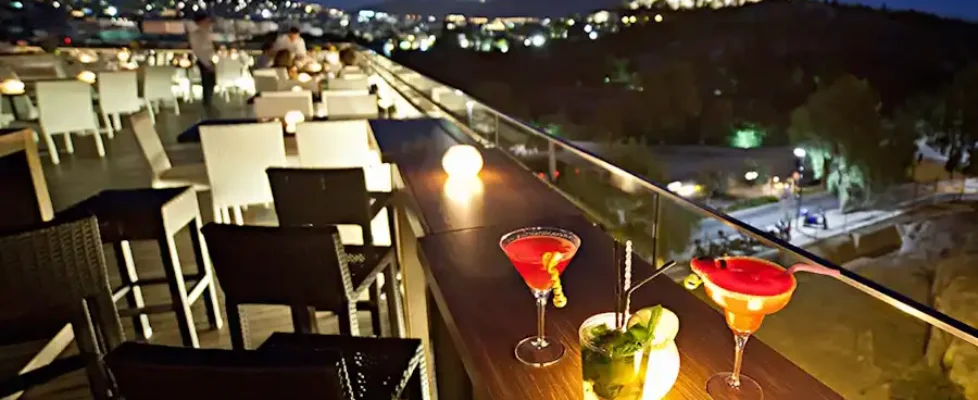
Thissio View is a popular restaurant with a casual atmosphere and a large terrace offering panoramic views of the Acropolis. They offer a wide variety of Greek and Mediterranean dishes, making it a great option for any time of day, or at night. You can also just enjoy a drink in their cocktail bar… and drink in the view at the same time! thissioview.gr
Dionysos Zonar’s
Dionysos Zonar’s Restaurant in Athens with its Acropolis View
Known for its elegant atmosphere and panoramic views of the Acropolis and the Parthenon, this restaurant offers a fine dining experience with a range of Mediterranean and Greek dishes. The fish is always fresh from the sea and they specialise in serving Black Angus beef in a variety of cuts. dionysoszonars.gr
360 Degrees
360 Degrees Restaurant with its Acropolis View
As the name suggests, this rooftop bar and restaurant just off Monastiraki Square offers a breath-taking 360-degree panoramic view of Athens, including the Acropolis. It has an amazing cocktail list, many of the drinks named after Greek towns and islands, but they do classics too. Try their spicy margarita which is made with both tequila and mezcal. You can snack in the bar, or go full out in the restaurant. three-sixty.gr
A for Athens
A for Athens Bar-Restaurant with its Acropolis View
Located on top of the A for Athens hotel near Monastiraki Square, this rooftop bar and restaurant provides a spectacular view of the Acropolis along with a contemporary Mediterranean menu. Their Greek salad uses three different types of tomato along with cheese from Chios, rather than the ubiquitous feta. aforathens.com
Greek House Attikos
Greek House Attikos Restaurant with its Acropolis View
Offering traditional Greek dishes, this place provides a cosy atmosphere with a terrace that offers a good view of the Acropolis. They offer traditional dishes like sofrito from Corfu and moussaka, along with fish, beef, and vegetarian options – and save room for dessert! This is one of the more affordable Athens restaurants with an Acropolis view. ghattikos.gr
The ancient site of Marathon and the site of the Battle of Marathon are in Attica and naturally about 26 miles or 42 kilometres from the centre of Athens.
Battle of Marathon Burial Mound
The word ‘marathon’ has passed into the language of the world and while the rough story of how a Greek village came to give its name to a long-distance race is well-known, the full details of that story may be less familiar.
The Battle of Marathon
In September of 490BC the Athenians were under attack and heavily outnumbered by the Persian army. No exact figures are known but it’s estimated that as many as 25,000 Persian troops were fighting 10,000 Athenians. Persian warships brought their army ashore in the Bay of Marathon and they thundered onto the Plain of Marathon towards the outnumbered Greeks, who had never beaten the Persians in a battle.
The people in the city of Athens knew that their fate was being decided by soldiers on the plains of Attica and waited anxiously for news of the outcome. The Athenians duly fought for their lives and managed to defeat the Persian armies. The heroic and remarkable nature of the victory is indicated by the fact that some 6,400 Persians were killed while the Athenians lost only 192 men.
News of the victory was carried back to the city by one of the victorious soldiers, Phedippedes, who ran all the way from Marathon to the Acropolis in full armour, having already fought in the battle and in the heat of September. Unsurprisingly, he died on the spot from his exertions the moment he’d delivered the message.
The Athens Marathon
Marathon Runner in Athens
The present-day marathon race of 26 miles 385 yards (42.195 kms) commemorates that brave feat, although the extra 385 yards were only added in the London Olympics of 1908 so that the finishing line of the race could be in front of the Royal Box. This was ratified as the official distance in 1921.
Each October, the Athens Open International Marathon is run over the probable route that Phedippedes took – minus the full armour and in slightly cooler conditions – and ends in the Panathenaic Stadium where the first modern Olympic Games were held in Athens in 1896.
What we know of the Battle of Marathon comes from the Greek historian Herodotus, who recorded the events about 50 years after they happened. The Athenian dead were buried under a simple earthen mound that’s only 33 feet (10 m) high but 590 feet (180 m) in circumference. Its very simplicity makes it all the more striking.
The Marathon Burial Mound
The burial mound is about 2.5 miles (4 kms) south of the modern town of Marathon, down a side road that is off to your right if you are driving north towards the town. The site was originally marked by a gravestone that showed a soldier fallen in battle. This can now be seen in the National Archaeological Museum in Athens, with a copy on display at the site.
Marathon Archaeological Museum
If you continue north towards Marathon, a left turn takes you to the Archaeological Museum. This small collection is well worth seeing. It displays items found on the field of battle, and on the estate of the wealthy arts patron Herodes Atticus (AD 101-177), who came from this area. The finds include statues, urns, gravestones, an unusual bronze mirror, and part of the memorial erected by the Greeks at the time to celebrate the victory.
Mound of the Platalans
Behind the museum you can climb the Mound of the Platalans, which was only discovered in 1970. Allies of the Athenians, the Platalans also joined in the Battle of Marathon. They lost 11 of their own soldiers, including a 10-year-old boy. The dead soldiers are buried here in this mound.
The Town of Marathon
Marathon itself is a fairly ordinary little town, worth a stop if you want to buy provisions or petrol but otherwise unremarkable. A short drive to the west of Highway 83 takes you past the impressive Lake Marathon. The reservoir owes its existence to a marble dam that was built in 1925-31 to trap the waters coming down from the Mount Parnitha range. Until the 1950s it was the main water supply for the city of Athens.
Even if your interest in the historical significance of this place is what’s brought you here, you can still round off your visit by heading for some pleasant small beaches along the coast, the best being at Skhinias.
Cape Sounion and the East Coast of Attica are easily reached from Athens and make for a good day out, visiting the port of Rafina too.
The Temple of Poseidon at Cape Sounion
Athens is blessed with beaches on its doorstep and beautiful islands just a short ferry ride from the port of Piraeus. Visitors should do what the Greeks so and head for the beach playgrounds of the Athens Riviera in the city’s suburbs as summer temperatures soar. You’ll be in good company as everybody wants to cool off, and it reveals a very different side of a city better-known for its ancient sites.
For a day out from the city you need to head south and east. The first major resort, less than 30 minutes from central Athens, is Glyfada, which merges into Voula to the south. While neither could be described as a peaceful beach resort, if you’re travelling with children and they want a break from the city, this strip of the Apollo Coast, also known as the Athens Riviera, will provide them with sea, sand, and entertainment. Parents can enjoy a seafood lunch at a waterside restaurant.
As you head south along the coast and further from Athens, the resorts are quieter and more spread out. Whether you travel along here by bus or rental car, there’s no mistaking the magnificent spectacle of the temple that stands proud on the 200-foot (60-metre) headland of Akra Sounion (Cape Sounion).
Temple of Poseidon
The Temple of Poseidon at Cape Sounion in Attica
The Temple of Poseidon on the headland was built in 444BC out of local grey marble. Of the temple’s original 34 columns, 15 are still standing to their full height, one of them bearing the initials of the British Romantic poet Lord Byron. Byron visited the site in 1810 and carved his initials on the column nearest the entrance. Unfortunately you won’t be able to get close enough to see as the remains of the temple are now roped off to prevent further damage by the thousands of people who come here every year. Imagine if they all wanted to carve their initials!
The temple stands on the remains of an even older building, though to have dated from 490BC. The present temple is dedicated to the God of the Sea, Poseidon, and there could be no more fitting setting for it than this cape overlooking the Aegean Sea. The temple may have been designed by the same unknown architect responsible for the elegant Temple of Hephaistos in the Roman Agora in Athens.
Cape Sounion Sunsets
Cape Sounion is famous for its impressive sunsets, which often give breathtaking vivid blood-red and fiery orange skies. There’s a perfectly-located café-restaurant here, so you can enjoy the sunset in comfort and have a nice meal or a drink here. Below the promontory is a beach with accommodations, if you choose to stay overnight.
You can get the bus here from central Athens. They run about once an hour and take about 90 minutes, so if you have several days in Athens, you could plan to spend a romantic evening out at Cape Sounion, and get the bus back the next day, as the best chance to avoid the crowds is to visit the temple when it opens in the morning.
Kea
The largest island near the cape is Kea, one of the smaller Cycladic islands and the closest of the group to Athens. From here if you look west towards the setting sun you should also be able to make out the island of Aegina in the Saronic Gulf Islands. What you see beyond Aegina, if it’s clear, is the east coast of the Peloponnese.
Lavrion
Heading north from Cape Sounion up the east coast of Attica brings you to Lavrion. This small town may not look anything special today but it was famous in antiquity for its silver mines. These huge mines provided silver to make coins and helped to finance the building of Periclean Athens, the Golden Age of Athens.
They also provided the wealth that paid for the Powerful Athenian navy which defeated the Persians and established Greece as one of the great maritime nations. The mines closed in the 19th century and a small mineralogical museum in Lavrion tells the story.
Porto Rafti
Further up the east coast is the more attractive – and today more prosperous -resort of Porto Rafti. Its lively fishing harbour, good restaurants and bars make it a popular weekend retreat for Athenians. Its harbor is one of the finest in Greece and just off the coast is the island that gives the port its name: Rafti.
There’s a huge marble statue of a seated woman here, made in Roman times and used over the years as a safety beacon for ships. It’s known as ‘The Tailor’ (raftis in Greek) because it is thought that the statue’s hands (one arm is now missing) once held a pair of scissors. It’s also possible that the missing arm once held either bunches of fruit or sheaves of wheat, as a symbol of fertility. It was from Lavrion that the first fruits of the year from the Greek mainland were sent to the sacred island of Delos.
Markopoulon and Koropi
If you head inland you come to the enjoyable market town of Markopoulon, which you can read more about on our Drive around Attica page. A few miles west of here is Koropi, which is noted for its extensive wine production. In particular it’s famous for its production of retsina, the unique white wine of Greece that is flavoured with pine resin and which you either love or hate. See our separate page about retsina to learn more.
On the southeast outskirts of Koropi is the church of the Metamorphosis Sotiras, which dates back to the 10th century and is therefore one of the oldest churches in Attica.
Rafina
Rafina Harbour
The port of Rafina, on the eastern coast of Attica, has increased in size and importance since the new airport was built east of the city, about a 30-minute drive from Rafina. It makes it much easier for foreign visitors to get to Rafina, which has ferries to the Cyclades, Dodecanese and other islands, than to go across the city to Piraeus.
The heart of Rafina is its old fishing harbour, which remains wonderfully picturesque and has been enhanced by the addition of many fine seafood restaurants, most with rooftop terraces overlooking the boats bobbing in the water below. Here you’ll find Athenians relaxing and escaping the city’s pace, especially on weekends, and demanding the best fresh fish, whether they plan to catch a ferry out to the islands or return to the city. Around the harbour is also where you’ll find the main ferry departure point.
Away from the town centre, coastal developments serve as a reminder that Rafina is a popular resort in its own right, and not just a port and gateway to the islands. There’s no shortage of pleasant, affordable hotels, places to swim, and watersport opportunities. Several small beaches lie either side of Rafina, and the coast is dotted with vacation villas for Athenian residents. Beyond beaches, little remains from the old settlements that have always existed here.
Inland from the harbour and slightly uphill is the large main square, where you can escape the bustle of the harbour and feel like you’re in any Greek town, with children playing while grandmothers watch them.
To the north of Rafina is another resort, Mati, slightly quieter and without the busy ferries and cars and crowds getting on and off them. From the slopes behind Mati a fabulous view takes in the Bay of Marathon. Nearby is a good bathing beach, Agios Andreas. If you’re taking a ferry to or from Rafina, where hotels can get booked up well ahead, it’s worth thinking about staying at Mati and taking a taxi for the 10-minute drive.
Easter in Athens is the biggest religious celebration of the year and this page on See Greece tells you what to expect over the Easter weekend.
Easter in Athens
Easter in Athens
Easter in Greece, or Pascha as it’s known, is not merely a holiday; it’s the most significant and deeply revered celebration in the Orthodox Christian calendar. Far surpassing Christmas in its spiritual importance and festive spirit, it’s a time of profound reflection, vibrant tradition, and joyous communal celebration.
While the heart of Pascha beats strongly across every corner of Greece, experiencing Easter in Athens offers a unique blend of ancient customs inside a bustling modern metropolis. It’s a chance to witness centuries-old rituals unfold against a backdrop of historical sites, a truly unforgettable experience.
The Heartbeat of Greek Easter
To understand Easter in Athens, you must first understand the pervasive significance of Pascha throughout Greece. It’s a time of renewal, hope, and the triumph of life over death, observed with an intensity that can be felt in the air for weeks leading up to the main event.
The 40-day period of Great Lent (Sarakosti) precedes Easter, a time of fasting, prayer, and introspection. For many devout Greeks, this involves abstaining from meat, dairy, and often olive oil and wine. This period culminates in Holy Week (Megali Evdomada), a week of escalating religious services and preparations that build to the Resurrection.
Each day of Holy Week holds special significance, with church services becoming longer and more elaborate. You’ll notice an increasing solemnity in the air as the week progresses, a quiet anticipation that builds to an explosive climax. The aroma of traditional Easter baking, like tsoureki (a sweet brioche-like bread) and koulourakia (butter cookies), starts to waft from homes, hinting at the feast to come.
Easter in Greece
Athens: Where Ancient Echoes Meet Modern Devotion
So, what makes Easter in Athens different? While the core traditions remain steadfast, Athens offers a unique tapestry where the grand scale of the capital city intertwines with intimate neighborhood customs. You’ll find yourself drawn into the rhythm of ancient Byzantine churches nestled among neoclassical buildings, their bells echoing through traffic-filled streets.
One of the most striking differences is the sheer variety and accessibility of churches. From the majestic Metropolitan Cathedral of Athens to countless smaller, historic churches tucked away in the Plaka or Anafiotika, each offers a unique experience. The city’s diverse population also means you might encounter various local customs and community expressions of faith.
While island or village Easters are often characterized by their idyllic charm and close-knit community feel, Athens provides a more expansive, yet equally authentic, experience. The city truly transforms, embracing the spiritual gravity and eventual euphoria of the season.
Easter in Athens
Your Easter in Athens Weekend: A Day-by-Day Guide
Let’s go through what you can expect during the Easter weekend in Athens:
Holy Thursday (Megali Pempti): The Day of Mourning and Preparation
Holy Thursday is a day of profound solemnity. Churches are packed for the evening service, which focuses on the Last Supper and the Betrayal of Jesus. It’s a long and moving service, often lasting several hours, punctuated by the reading of the 12 Gospels. Many women spend the day baking tsoureki and dyeing hard-boiled eggs a vibrant red, symbolizing the blood of Christ and his resurrection. In the evening, the air is heavy with a sense of anticipation and sorrow.
Greek Red Easter Eggs
Good Friday (Megali Paraskevi): The Epitaphios Procession
Good Friday is arguably the most poignant day of Holy Week. It’s a day of strict fasting, and many abstain from even water until after the evening service. The churches are adorned in black, and the morning services are exceptionally moving, recounting the crucifixion.
The highlight of Good Friday is the evening procession of the Epitaphios. This is a beautifully carved and decorated bier, symbolizing the tomb of Christ, adorned with thousands of fresh flowers by women and children throughout the day. In the evening, the Epitaphios is carried out of the church on the shoulders of the faithful, typically young men, and paraded through the streets of the neighborhood.
In Athens, these processions are particularly atmospheric. Imagine hundreds, even thousands, of people walking silently through the illuminated streets, holding candles, following the Epitaphios and the chanting of the priests. The air is thick with incense and the melodic, mournful hymns. Some of the most impressive processions can be found in the historic center, particularly around the Plaka, where the narrow streets amplify the spiritual intensity.
You might even see several processions from different churches converging at a central point before returning to their respective parishes. The contrast of these ancient rituals against the modern city is truly special.
Easter in Athens
Holy Saturday (Megalo Savvato): The Resurrection – A Blaze of Light!
Holy Saturday begins as a day of quiet anticipation. However, the atmosphere shifts dramatically as evening approaches. This is the night of the Resurrection, the culmination of Holy Week, and it is an experience not to be missed.
Around 11 PM, churches begin to fill to overflowing. Everyone holds an unlit white candle. The lights in the church are dimmed, creating a hushed, almost expectant darkness. Just before midnight, the priest emerges from the altar, carrying the Holy Light (Fos). He chants “Δεύτε λάβετε Φως” (Deftere Lavete Fos – Come, receive the Light), and passes the flame to the congregation.
What follows is an extraordinary spectacle: the light rapidly spreads from candle to candle, illuminating the entire church in a matter of moments.
At the stroke of midnight, the bells peal joyously, fireworks explode across the Athenian sky, and the priest proclaims “Christos Anesti!” (Christ is Risen!). The congregation responds with “Alithos Anesti!” (Truly, He is Risen!).
The air is filled with cheers, hugs, and the cracking of red eggs (tsougrisma), a game where you try to crack your opponent’s egg without breaking your own, symbolizing the breaking open of the tomb. Many people then take their lit candles home, carefully protecting the flame, and use it to make the sign of the cross with soot above their doorway, believing it brings good luck for the year.
After the service, families head home for the traditional “Resurrection Supper” (Magiritsa), a rich lamb offal soup that breaks the Lenten fast. It’s a comforting and flavorful dish, often enjoyed with tsoureki and the red eggs.
Easter Sunday (Kyriaki tou Pascha): The Feast!
Easter Sunday is a day of pure joy and celebration. After 40 days of fasting, it’s time for the ultimate feast! The centerpiece of the day is the traditional roasting of lamb or goat on a spit (souvla). Throughout Athens, you’ll find the intoxicating aroma of roasting meat wafting from balconies, gardens, and tavernas.
The See Greece guide to Rhodes food and drink recommends five must-try Rhodes dishes and other island specialities, including beer and spirits.
Octopus Stew at the Ouzokafenes Restaurant in Rhodes Town
Exploring Rhodes food and drink reveals a distinct culinary identity shaped by the island’s unique position between East and West. Unlike more typical Aegean fare, Rhodian cooking is defined by the heavy use of cumin, ancient grains, and sun-drenched honey, creating a robust, aromatic palate that reflects its fertile plains and mountain traditions.
Five Must-Try Rhodes Dishes
The cuisine of Rhodes is a fascinating blend of Mediterranean ingredients—wheat, olive oil, and wine—enriched by centuries of history. While you will find Greek staples like Moussaka and Souvlaki everywhere, the island has several unique dishes that define its specific culinary identity.
Cumin
One of the most defining characteristics of Rhodian cooking is the heavy use of cumin (often called “long smell” or makryo myroudi by locals), which appears in much higher quantities than in the rest of Greece.
Here are five dishes closely associated with the island of Rhodes:
1. Pitaroudia (Chickpea Fritters)
These are perhaps the most famous appetizer on the island. Unlike the standard Greek keftedes (meatballs), Pitaroudia are savory fritters made from mashed chickpeas, onions, tomatoes, and plenty of mint. They are seasoned heavily with the island’s signature cumin and fried until crispy and golden.
Where to find it: Most traditional tavernas in Rhodes Old Town and mountain villages like Embonas.
2. Lakani (Slow-Cooked Meat and Chickpeas)
Lakani is the quintessential Sunday family meal of Rhodes. It is a slow-cooked stew traditionally prepared in a large ceramic pot (the lakani). It typically consists of goat or beef, chickpeas, and chondros (cracked wheat or bulgur), seasoned with tomato sauce, cinnamon, and cumin. In the past, families would take their pots to the communal wood-fired oven on Saturday night to be ready for Sunday lunch.
3. Melekouni (Sesame and Honey Treat)
Melekouni is the “gastronomic ambassador” of Rhodes. While it resembles a common pasteli (sesame bar), it is much softer and more aromatic. It is made with local thyme honey, toasted sesame seeds, whole almonds, and flavored with orange zest, cinnamon, and nutmeg. It is a symbol of joy and is traditionally served at weddings and baptisms.
4. Kamilakia (Stuffed Cyclamen Leaves)
While most of Greece is famous for Dolmades (stuffed grape leaves), Rhodes has a unique variation called Kamilakia. These are small rolls made from the tender leaves of the cyclamen flower. The leaves are blanched to remove bitterness and then stuffed with a mixture of rice, onions, and herbs, often served with a tangy avgolemono (egg-lemon) sauce.
5. Matsi (Handmade Rhodian Pasta)
Rhodes has a rich tradition of handmade pasta. Matsi is a local variety made from flour and water (sometimes milk), shaped into small strips or squares. It is often boiled in goat or beef broth and served simply with a mountain of grated local mizithra cheese and “syvrasi” (onions sizzled in butter).
Local Drinks to Pair
Souma: A strong, clear spirit made from grape pomace, similar to Raki or Grappa. It’s often served as a welcoming drink.
Kanelada: A refreshing, non-alcoholic local soft drink made from cinnamon syrup and ice-cold water.
Other Rhodes Food and Drink
Sharing Meze
Mezédhes (starters)
Making a meal of it in a Greek taverna may mean that you never get past the mezédhes (or meze, for short). The Greek style of eating mezédhes is to order half a dozen mixed plates and then for everyone to dig in.
Mezédhes worth trying on Rhodes include manitaria (mushrooms), keftedes (spicy meatballs), dolmadakia (rice wrapped in vine leaves), kotópoulo (chicken portions), saganáki (fried cheese), khtapódhi (octopus), spanokeftedes (spinach balls) and bourekakia (meat pies). Add to all this a couple of dips such as tzatziki (garlic and cucumber yoghurt) or melitzanosalata (aubergine and garlic).
Horiatiki (Greek Salad)
A Healthy Greek Salad
A Greek salad (horiatiki) is a good way to start any meal or is just right for a light lunch. The best horiatiki are plentiful and comprise a marvellous mix of green salad with cucumber, tomatoes and onions, the whole capped with a generous slice of feta cheese sprinkled with herbs. It’s also sometimes called a Country Salad or a Peasant Salad.
Meat Dishes
Greek Stifado
Meat dishes on Rhodes follow the Greek standards of moussaka, souvlaki (shish kebab with meat, peppers, onions and tomatoes), pastitsio (lamb or goat meat with macaroni and tomatoes), stifádo (beef stew with tomato sauce and onions) and padakia (grilled lamb or goat chops). Souvlaki is a good standby, but you might be better settling for chicken (kotópoulo) souvlaki, because veal or pork on the grill can be tough in some tavernas. Lamb souvlaki is usually good but not easily found. Any meat dish that is braised or stewed is usually good.
Fish Dishes
fresh fish sign at greek restaurant
Rhodes has always been noted for its fish and the island boasts some outstanding psarotavernas (fish restaurants). But overfishing, pollution and a general rise in prices has meant that while the choice is still good, fish dishes can often be very expensive. It is also difficult to know whether fish on offer is locally caught or is imported, frozen or farmed versions.
Reasonably-priced dishes include marídhes (whitebait deep-fried in olive oil and sprinkled with lemon), and swordfish, either in meaty steaks or as xsifhia, chunks on a kebab. Kalamarákia (fried baby squid) is another favourite. Red mullet and lobster tend to be more expensive.
Drink
Rhodian wines have a good reputation and provided you are not a wine snob, you will enjoy some excellent vintages from the major island wine producers CAIR and Emery Wineries, the latter based at Embonas. CAIR labels worth trying include Ilios, a dry white wine produced from the Athiri grape; Chevalier de Rhodes, a superior red, and the Moulin range of white, rosé and red wine.
Free tastings are available at the CAIR winery, located a couple of kilometres outside Rhodes town on the Lindos road. Good Emery wines include the Cava red and first-class Chablis-style Villare dry white. Distinctive wines from smaller Rhodian wineries, such as the Anastasia Triantafillou Winery, are available in some island restaurants.
Kourtaki Retsina
Most tavernas have their own house wine, which can often be reasonable. Retsina, resinated white wine, is an acquired taste but the best is excellent. Kourtaki is a decent retsina to try, although it isn’t specifically from Rhodes. Light beers and lagers, such as Amstel, Heineken and the Greek Mythos, are widely available.
Rhodes Beer
While Rhodes is traditionally known for its local wines and ouzo, it has a small and rapidly growing craft beer scene. The island is home to a few dedicated breweries and specialised taprooms where you can sample everything from traditional lagers to artisanal, unfiltered craft ales. Look for names like The Mule’s Brew, Magnus Magister and Kouyos, and visit Charlie’s Craft Beer Garden at Archelaou 3 in Rhodes Old Town.
Rhodes Distilleries
Rhodes has several professional distilleries and a deep tradition of home distilling in its mountain villages. While the island is most famous for wine, its spirit production—specifically Souma (a potent grape marc distillate similar to Raki) and Ouzo—is a major part of the local culture.
1. Aigaion Distillery (Rhodes Town area)
This is one of the most prominent professional distilleries on the island. Operating since the 1940s, they are famous for their Ouzo Aigaion and their high-quality Souma. • What to try: Their “Ouzo Venus” (stronger and more aromatic) and their “Soumamelo” (a honey-based spirit similar to Rakomelo). • Location: 6th km Rhodes-Kallithea Ave.
2. CAIR (Rhodes Town / Lindos Road)
While primarily known as a historic winery founded in 1928, CAIR also operates a distillery. They are famous for being the first to produce sparkling wine in Greece, but they also produce spirits, liqueurs, and a highly-regarded 40-year-old Reserve Vermouth. • What to try: Their traditional distillates and herb-infused liqueurs.
3. Estate Anastasia Triantafyllou (Paradisi)
This family-run estate is unique because it holds a professional license to produce Tsipouro and Souma on-site. It’s a great place for a more intimate experience than the larger factories. • The Experience: They offer a “Full Experience Tour” that includes the distillery, vineyard, a cooking class, and a 10-course lunch.
4. Village Distilleries (Siana and Embonas)
If you want to see the more traditional side of distilling, head to the mountain villages of Siana and Embonas. • The Experience: These villages are the “heart” of Souma production. You will find many small, family-run “cavas” (like Cava Stafylos) where you can see the copper stills (called kazani) used to boil the grape marc. • Timing: If you visit in late September or October, you may catch the local festivals where the stills are fired up, and the whole village celebrates the first “run” of the season.
Tips for Spirit Tasting • Souma is strong: It often exceeds 40–45% ABV (and sometimes hits 60% in villages). Always pair it with meze (small snacks) to pace yourself. • The “Long Smell”: In some village distilleries, you might find Souma flavored with the island’s signature cumin—ask for “Souma me kymino.”
See Greece recommends where to stay in Irakleio, the capital of Crete, including nearby beach resort hotels and accommodation in the city centre.
Lato Boutique Hotel in Irakleio
Wondering where to stay in Irakleio? Here are a few prime suggestions, from city centre hotels to nearby beach resorts, and ranging from budget to luxury. We can personally recommend every one of them. The list is only short but we can assure you it’s select.
Where to Stay in Irakleio
Apollonia Beach Resort and Spa
Apollonia Beach Resort near Irakleio
The upmarket Apollonia Beach Resort and Spa has its own beach, only 6 km (3.7 miles) west of the centre of Irakleio, and the local bus stops right outside the hotel entrance. It has rooms, bungalows and suites spread around the large gardens, and they all have either balcony or terrace, and all the facilities you would expect from a hotel of this standard. There are two outdoor pools, a children’s pool and a heated indoor pool, as well as numerous sports facilities including watersports, cycling and horse-riding. With two discos too, it’s ideal for children of all ages.
Check room rates and availability: expedia.com
Capsis Astoria Heraklion
Capsis Astoria Hotel in Irakleio
Right on Irakleio’s main square, the Capsis remains quiet inside and offers stylish accommodation that is not too expensive. All the rooms are bright and modern with a predominantly blue décor and lots of wood furnishings. They all have plenty of closet space, TV, phone, mini-bar, air-conditioning and ensuite facilities (baths not showers). The rooftop pool is open till 10pm and has great views over the city.
Check room rates and availability: expedia.com
Aquila Atlantis
Aquila Atlantis Hotel in Irakleio
The 5-star Aquila Atlantis is the best hotel in the centre of Irakleio, and though it has some 160 rooms and suites you would still be advised to book ahead in high season as it is popular with tour groups and business conferences. Close by the Archaeological Museum and only a short walk to most other city attractions, the Atlantis also has so many of its own facilities that you hardly need to leave it: gym, pool, laundry, bars, restaurant, shops, and even a rooftop garden.
Check room rates and availability: expedia.com
Candia Maris
Candia Maris Hotel near Irakleio
Only 3 km (1.9 miles) west of the city centre but with a quick and regular bus service into Irakleio, the Candia Maris makes an ideal base if you want to explore the city but also enjoy the beach and all the other hotel facilities. These include fitness centre, tennis and squash courts, three swimming pools plus one for children, watersports, indoor games room, three restaurants and four bars. The rooms are spacious and bright, and the rates very reasonable for a deluxe hotel of this class.
Check room rates and availability: https://www.candiamaris.gr
Kronos Hotel
Kronos Hotel in Irakleio
The simple and inexpensive family-run Kronos Hotel is friendly and clean and right on the waterfront road. This does mean some traffic noise at night in the front rooms, but you do get the bonus of a sea view. That aside, it offers excellent value accommodation in the centre of town. Downstairs is a lounge that doubles as the breakfast room, and a bar with a soft drinks cabinet. The rooms are a good size and have everything needed for a few nights’ stay: balconies, phone, TV, wardrobes, ensuite facilities.
Check room rates and availability: expedia.com
Lato Boutique Hotel
Lato Boutique Hotel in Irakleio
The modern lobby to the stylish Lato Boutique Hotel is immediately welcoming, with lots of space and marble décor. A wall of water at one end is very eye-catching, and off the lobby is a bar, restaurant and a lounge with an old-fashioned fireplace. Ask for one of the rooms on the upper floors, as some of these have impressive views of Irakleio, but all rooms have phone, TV, mini-bar, air-conditioning, and bathroom with both bath and shower.
Check room rates and availability: expedia.com
Here are some of the things you’ll see when walking around Irakleio, the capital of Crete, including churches, squares, and the beautiful Venetian Loggia.
The Venetian Loggia in Irakleio
Platia Eleftherias
Its name translates as ‘Liberty Square’, and this large open space at the top of Dedalou Street, provides freedom from the sometimes claustrophobic feel of the city. Traditionally this square was the centre of the city, and though the ring of rushing traffic around the edge has somewhat dampened its appeal, locals still frequent it for an evening stroll. There are shady benches beneath the palms and acacias, and a string of cafés and restaurants alongside.
Áyios Títos
Church of Agios Titos in Irakleio
Áyios Títos sits back from the main road on a lovely square. With its sky-blue ceiling and dome, three-tiered carved wood chandelier and modern stained-glass windows, it has a light, airy feel in contrast to most of the churches you’ll visit on the island. Built during Byzantine times, it was the seat of the Metropolitan (bishop) of Crete. During the Turkish occupation it was converted into a mosque, and was entirely rebuilt following its destruction in an earthquake in 1856.
When the Turkish population left Crete in 1923, it was reconsecrated to the Apostle Titus, Crete’s first bishop. His remains had been kept here for 700 years until the Venetians took them to Venice in 1669. They were returned in 1966, and the saint’s skull now lies in a gold reliquary.
Venetian Loggia
The Venetian Loggia in Irakleio
This is Irákleio’s most handsome building after the fortress. Built in 1628 by Francisco Morosini, it was a place of meeting and recreation for the Venetian nobility. Its Palladian style combines Doric order on the lower floor with Ionic on the upper floor.
The ground floor porch, with its elegant arches, is decorated with medallions of famous Cretans. The loggia is part of a larger building with once held the Venetian armoury, and now houses the Town Hall. It stands opposite the Morosini Fountain.
Áyios Márcos
The Church of St Mark was first built in 1239 and was the church of the Duke, ruler of the island. It became a cathedral in Venetian times and, like most other Irákleio churches, it was converted into a mosque by the Turks. Unlike the others it was not reconsecrated after their departure and in 1923 it became the National Bank.
Now restored to its original form, with a striking colonnaded porch and marble doorway, it is used as a concert hall and art gallery. The arched ceiling, fat pillars and stone walls of the interior make a superb display space for changing exhibitions of contemporary art.
Platia Venizelou
This small central square is one of the liveliest in the capital and a popular focal point for tourists and locals alike. It is named for the great Cretan statesman, Eleftherios Venizelos, who became prime minister of Greece. Also known as Lion Square or Fountain Square, its centrepiece is the Morosini Fountain.
This regal work was built in 1628 by Francisco Morosini, the Venetian governor of the city. A 16 km (9.9 miles) aqueduct brought water from the mountains to the fountain. The four stone lions supporting the central basin have great character and are even older; dating to the 14th century, they are thought to have come from another fountain. The curvaceous marble base is decorated with marine carvings of mermaids, tritons and other figures.
The square has plenty of cafés and restaurants where you can have a coffee, an ice cream or the custard-filled Cretan speciality, bougátsa. It’s a perfect vantage point on the passing scene, but if you prefer a quieter retreat try the adjacent El Greco Park, behind the yellow sub-post office. It has pretty gardens and a children’s playground at one end.
Platia Kornarou
Irákleio’s street market ends at Platia Kornarou. This small, quiet square is a pleasant place to stop for a break. The stone kiosk in the centre, which once housed a Turkish fountain, has been converted into a small café. Beside it is the Bembo Fountain, named after the Venetian commander Zanne Matteo Bembo, who first supplied the town with running water. It was erected in 1588 and incorporates the torso of a Roman statue from Ierápetra.
Irakleio’s Icon Museum in the church of Ayia Aikaterini is a small but impressive collection from the world’s best icon painters.
Irakleio’s Icon Museum
Cretan icon painters were considered the best in the world, and here in Irakleio‘s Icon Museum you can see some of the finest works by one of the great masters of the art, Michael Damaskinos, as well as other beautiful religious items.
The museum is contained in the small church of Ayía Aikateríni, rather dwarfed by the nearby large cathedral of Áyios Mínas, but step inside its doors and you find this excellent collection of icons, not to mention religious vestments, Bibles, illuminated manuscripts, coins and frescoes. Its official name is the Museum of St Catherine.
Church of Ayia Aikaterini
The collection features some of the best items on the island, rescued from or donated by churches and monasteries all over Crete. The church that houses them was built in 1555, but the seating has been removed to expose the marble floors and provide space for the display cabinets in the aisles and around the sides. Icons grace the walls.
Irakleio’s Icon Museum
Michael Damaskinos
The ticket desk is just inside the door, and on the wall opposite are six hugely impressive 16th century icons, the work of Michael Damaskinos. Damaskinos was the only Cretan painter of his era to rival the talents of El Greco himself. Like the Master, Damaskinos went to Venice, but afterwards he returned to his native island and the six icons hanging here are considered to be among his finest works.
The icons depict various Biblical events such as The Adoration of the Magi, The Last Supper and The Burning Bush. They were all painted in the period 1582-91 for the Moní Vrontísiou (Vrontisiou Monastery) northwest of Záros. In 1800 they were brought to Irakleio to save them from destruction by the Turks. They have a liveliness, a depth of image and of colour that makes them appear as if they were done yesterday.
Irakleio’s Icon Museum
Other Exhibits in Irakleio’s Icon Museum
In the central aisle are two cases containing Byzantine coins and holy manuscripts. On the left aisle is a series of large icons saved from mountain chapels and monasteries, mostly from the 15th and 16th centuries, and anonymous. Note the nearby case of lovely illuminated manuscripts dating from the 16th century and from the Monastery of Epanosiphi and, opposite these, the ornately carved wooden Bishop’s Throne from the Monastery of Kera.
Last Judgement
There are more icons as you approach the high altar, including a very vivid 17th century Last Judgement, where naked souls are cast down into hell where they are being eagerly greeted by evil devils throwing them into the fiery furnace.
Following round to the left of the altar the collection broadens out to include some brightly-coloured frescoes and a large stone iconostasis. Two cases contain some chalices, Bible covers and a holy cross.
Leaving Irakleio’s Icon Museum
On leaving the church, walk across the Platia to see the small church of Áyios Mínas, if open, and the large 19th century cathedral of the same name, with its elaborate metal chandeliers, beautiful painted ceilings, and vast stone pulpit.
Church of Ayios Minas (left) and Cathedral (right)
Top Tips
The opening hours do change so check the website
With no air-conditioning the building can get very hot and stuffy, so visit early in the day if possible.
Hidden Gem
In what would be the south chapel of the church, look for the exceptional icon of Lady of the Kardiotissa from the Monastery of Kera. The Virgin, dressed in red, has sorrowful eyes that seem to stare right into your soul.
Irakleio’s Historical Museum is officially called the Historical Museum of Crete and contains the only work by El Greco that is still on his native island.
Historical Museum of Crete
Where is Irakleio’s Historical Museum?
If you walk west along the waterfront from the Venetian Port you will reach Irakleio’s Historical Museum in about five minutes. It’s on the left in a handsome neoclassical building dating from 1903.
Map )c) Google Maps
Highlights of Irakleio’s Historical Museum
For an overview of the history of both Crete and Irákleio, a visit to this small but informative museum is a must. Highlights include the study of Nikos Kazantzakis and the only work by El Greco still on his native island.
At the ticket desk be sure to pick up one of the leaflets, available in Greek, English or German, which gives a map of the museum and a brief note of what is in each room. Most of the displays also have information displays in both Greek and English, although on some the details given are fairly basic.
First Room
In the first room, to your right as you enter, the information panels are anything but basic. They cover in some detail four of the major periods in Crete’s history, and correspond to four shelves of objects from those periods: the First Byzantine (330-827/8), the Arab Occupation (827/8-961), the Second Byzantine (961-1204) and Venetian Rule (1204-1669.
The major display in this room is a wonderful 1:500 scale model of Irakleio in 1645, when it was known as Chandax. This is the name given to the city when the Arabs made it the island capital in the early 9th century, possibly from the Arabic words Rabdh el-Khandaq, the Fortress of the Moat. On the walls beside it maps show the development of the city over the years, and note the buttons beneath the displays which illuminate the relevant parts of the model.
Scale Model of Irakleio in Irakleio’s Historical Museum
Around Irakleio’s Historical Museum
The museum tour continues behind the ticket desk, with the rooms spread on several levels. Room 2 is the Ceramics Room and has some beautiful bowls and plates imported from Italy during the Venetian period. These are cleverly displayed side-by-side with locally-made pottery from the same period, clearly showing the Italian influence on local designs. There are also some lovely, delicate jugs and bowls from the Arab Occupation of the island.
The rest of the ground floor has several rooms containing Byzantine items, Venetian coats of arms and carvings (note the fountain from a 17th-century Palazzo in Room 6), with stairs leading up to the second level.
El Greco Painting
The Monastery of St Catherine beneath Mount Sinai in Egypt’s Sinai Desert by El Greco
The highlight of Level B is undoubtedly the small dimly-lit room containing El Greco’s painting of The Monastery of St Catherine beneath Mount Sinai in Egypt’s Sinai Desert. This, his only work to remain on Crete, was painted in 1570 and some background to the work is given in extracts from books about it which are also on display.
Cretan Icons
Elsewhere on this floor are several icons from the Cretan school, the more typical style of Greek art, and at the rear one room is given over to the struggle for independence against the Turks.
Nikos Kazantzakis
The major display on Level C is the writer Nikos Kazantzakis’s study from when he lived in Antibes 1948-57, complete with manuscripts of his works, his library of books, and copies of his own books translated into many languages around the world.
Folklore Collection
The museum’s top floor contains a folklore collection based on the theme of the life cycle of birth, marriage and death. The museum has a fine collection of weavings, embroidery, old costumes, household items, musical instruments and many other objects.
Hidden Gems
Slightly overshadowed by the other displays in the first room are some cabinets in the centre containing objects, including fascinating glass and clay hand grenades, found on a galleon that sank in 1669.
One to Miss
The Emmanuel Tsouderos room, opposite the Nikos Kazantzakis room, is unlikely to appeal unless you have a deep interest in Greek politics.
Must See
El Greco’s painting, Monastery of St Catherine beneath Mount Sinai in Egypt’s Sinai Desert.
Here’s See Greece’s guide on how to see the best of Irakleio in a day including the Archaeological Museum, Icon Museum, Historical Museum & Venetian Harbour.
The Venetian Loggia in Irakleio
You can just about fit Irákleio’s main sights into one long day if you take advantage of early and late opening times. But check the hours for each attraction first, as you may need to switch this itinerary around a little on certain days.
Irakleio in a Day: Morning
Irakleio’s Archaeological Museum
8:00am Get an early start at the Archaeological Museum. If you haven’t had breakfast yet, start your visit with a coffee and pastry in the museum coffee shop. Don’t miss our detailed page all about the Archaeological Museum.
10.30am Walk down Odos Dedalou, the main shopping street, and turn right when you reach the end at Platia Venizelou. Continue down Odos 25 Augoustou, stopping to admire the Venetian Loggia. Just beyond, peek into the lovely Áyios Títos church, set back on a small square. Continue to the end of the street, where it reaches the waterfront.
11.30am Walk out along the colourful harbour and visit the Venetian Fortress. Be sure to climb to the top for the city’s best views.
Irakleio Venetian Fortress
Irakleio in a Day: Lunch
12.30pm Have an early lunch by the waterside at Ippokampos. It’s close to the Venetian Harbour, and you can’t eat right on the harbour as there are no restaurants there, but Ippokampos buys direct from the fishermen and you’re spoiled for choice if you like your seafood: squid, octopus, mussels, shrimp, catch-of-the-day and much more.
Irakleio in a Day: Afternoon
Historical Museum of Crete
1.30pm From Ippokampos, walk west along the waterfront to the Historical Museum, which is only five minutes away. It’s not a huge museum and you’ll probably spend an hour or so here. You can certainly see the highlights in that time.
3.00pm Return to Platia Venizelou and have a closer look at the Morosini Fountain. You’ve got some time to kill, but there’s no better spot for people-watching. Have a welcome rest at Bougatsa Kirkor and try Crete’s traditional custard pastry, the bougátsa, or relax in the adjacent El Greco Park.
4.30pm Visit the Icon Museum, which should take you less than an hour, and see the cathedral and church of Áyios Mínas, both on the same square. See our full page on Irakleio’s Icon Museum.
Irakleio’s Archaeological Museum
Afterwards, there’s still time for a last look at the Minoan treasures in the Archaeology Museum, which is open until 8pm. You can then have a pre-dinner drink in one of the bars behind Dedalou Street and congratulate yourself for seeing Irakleio in a day!
Irakleio’s Harbour is one of its most attractive features, and a stroll around here with a visit to the Venetian Fortress that guards it is a treat.
Irakleio Harbour
From the Fortress you get an excellent view not only of the city but of the remains of the Venetian shipyards, or Arsenali, across the water.
Venetian Shipyards
The Venetian Shipyards (also known as the Arsenali) in Irakleio are monumental remnants of the island’s period under the Republic of Venice (1204–1669). Located at the city’s old harbor, these structures were the heartbeat of Venetian maritime dominance in the Eastern Mediterranean.
Irakleio Harbour
Irakleio, then known as Candia, served as the strategic “Venice of the East,” and these dockyards were essential for the construction, repair, and winter housing of the formidable Venetian galleys.
Architecture and Design
The shipyards were designed as long, vaulted stone halls, uniquely engineered to withstand the weight of ships and the corrosive salt air. Originally, there were 19 shipyards divided into three distinct complexes:
Arsenali Antichi (Old)
Arsenali Vecchi (Aged)
Arsenali Nuovi (New)
Each bay measured approximately 50 meters in length and 9 meters in width. Their high, barrel-vaulted roofs were designed to accommodate the massive masts of galleys, while the open-ended design facing the sea allowed vessels to be floated directly into the dry-docking area for maintenance.
Historical Legacy
During their peak in the 16th century, the shipyards were part of a sophisticated industrial network that included a massive water tank (the Zane Tank) and a salt warehouse. Today, only a portion of the original structures remains, as many were demolished in the early 20th century to make way for modern coastal roads. Those that stand today have been beautifully restored and serve as cultural hubs for exhibitions and events, standing as a stony testament to Heraklion’s identity as a former Mediterranean naval powerhouse.
The Fortress
Irakleio Venetian Fortress
The Fortress which dominates the harbour entrance was built in the period 1523-40, though there have been several earlier forts on the site, one being destroyed in an earthquake in 1303. The Venetians rebuilt it and named it the Rocca al Mare, the Rock in the Sea, and the impressive name is appropriate for the impressive building you discover beyond the entrance gate.
Inside you step into a huge and dark vaulted room, with other rooms and passageways leading off it. Ahead and to the right, a long and steep slope leads to the upper levels, where visitors can climb the walls for the impressive views of the harbour and city beyond, or out to sea. The walls have some towers too which can be entered, for even greater height.
Fishermen in Irakleio Harbour
Turkish Seige
While here, mull over the most significant episode in the history of the Fortress. In 1647 the Venetian rulers of Irakleio and the rest of Crete retreated into the Fortress under siege from Turkish invaders. That siege was to last until 1669 and so became one of the longest in history. Eventually after 22 years the Venetians had to succumb, but only after a long and bloody struggle during which it is said that 30,000 Venetians and 118,000 Turks lost their lives.
The Fortress has been extensively refurbished and some say it now looks more like a film set, but its scale remains remarkable. It now sometimes houses temporary exhibitions, and occasional plays and concerts on a stage set up in the upper level.
The Winged Lion
The winged lion of St Mark the Evangelist was the emblem of the Venetian Republic. It was depicted in all areas under its dominion, carved in limestone or marble above gateways or on public buildings and fortifications. Some 80 reliefs have been recorded on Crete.
Top Tip
When an exhibition is on the opening hours sometimes change, so you may want to check in advance if planning a special visit. See the official website here.
The largest of the Greek islands, Crete has one UNESO World Heritage Site but it is spread over six places.
The Ruins of Knossos on Crete
As of 2025, the island of Crete is home to one official UNESCO World Heritage Site: the Minoan Palatial Centres.
While this counts as a single entry on the UNESCO list, it is a “serial property,” meaning it is composed of six distinct archaeological sites scattered across the island. These sites were collectively inscribed in July 2025 during the 47th session of the World Heritage Committee. They represent the peak of the Minoan civilization, which flourished between 1900 and 1100 BCE and is widely considered the first advanced urban society in Europe.
The Six UNESCO Palatial Centres
Each of these six locations offers a unique perspective on Minoan life, from mountain retreats to bustling maritime ports.
1. Knossos: The Labyrinthine Heart
The Ruins of a Temple at Knossos
Located just a few kilometers south of the modern capital, Irakleio, Knossos is the largest and most famous of the Minoan palaces. It spans approximately 20,000 square meters and was the ceremonial and political heart of the Minoan world. See our full guide to Knossos.
Key Features: The site is famous for its “Throne Room,” the Central Court used for public gatherings, and the vibrant (though reconstructed) frescoes like the Bull-Leaping Fresco and the Prince of the Lilies.
Innovation: Knossos featured advanced engineering, including multi-story buildings, light wells for natural illumination, and a sophisticated terracotta pipe drainage system that provided running water and sanitation.
Mythology: This is the legendary site of the Labyrinth, designed by Daedalus to hold the Minotaur, and the seat of the powerful King Minos.
2. Phaistos: The Architect’s Jewel
Phaistos Minoan Palace
Situated on a hill overlooking the fertile Messara Plain in southern Crete, Phaistos is often praised for having the most impressive architectural layout and the most beautiful natural setting of all the palaces. See our full page on Phaistos.
Key Features: The palace is organized around a grand central courtyard with monumental staircases. Unlike Knossos, Phaistos has not been extensively reconstructed with concrete, allowing visitors to see the original stone masonry as it was found.
Discovery: This is where the famous Phaistos Disc was discovered—a clay disc featuring 241 symbols in a spiral, which remains one of the world’s most famous undeciphered scripts.
History: The site shows two distinct phases: the “Old Palace,” destroyed by an earthquake around 1700 BCE, and the “New Palace” built directly on top of the ruins.
3. Malia: The Commercial Crossroads
Malia Palace
Located on the northern coast, Malia is the third-largest palace and provides a clearer look at how a Minoan town functioned, as the ruins of the surrounding residential neighborhoods are well-preserved. Don’t miss our full Malia page.
Key Features: Malia is known for its massive pithoi (giant storage jars) and its industrial areas. A unique feature is the Kernos of Malia, a large circular stone table with small cups around its edge, likely used for liquid offerings or religious rituals.
Artifacts: The world-famous “Gold Bees of Malia” pendant, a masterpiece of Minoan jewelry, was found in a nearby necropolis.
Role: Its proximity to the sea suggests it was a vital hub for maritime trade and the collection of agricultural surplus from the surrounding plains.
4. Zakros: The Gateway to the East
Kato Zakros on Crete
Tucked away in a remote bay at the easternmost tip of Crete, Zakros was the last of the four major “classic” palaces to be discovered. Because it was never looted in antiquity, it has yielded an incredible wealth of artifacts.
Key Features: The palace is smaller than the others but follows the same sophisticated plan. It is unique for its “Lustral Basin”—a sunken room used for ritual cleansing—and its royal apartments that feature built-in drainage.
Trade Hub: Excavations here revealed luxury items from ancient Egypt and the Near East, such as ivory, elephant tusks, and precious stones, proving that Zakros was Crete’s primary gateway for eastern Mediterranean trade.
Environment: It is located at the end of the “Valley of the Dead,” a gorge where the Minoans buried their deceased in caves.
5. Kydonia: The Urban Mystery
Kydonia is unique because the ancient Minoan palatial center lies directly beneath the modern, bustling city of Chania. Specifically, the site is located on the Kastelli Hill overlooking the old Venetian harbor.
Key Features: Much of the site remains unexcavated because it is covered by modern buildings, but the portions that have been uncovered show monumental walls and high-quality masonry.
The “Seal of the Ruler”: One of the most important finds here is a seal impression showing a powerful male figure standing atop a multi-story building, which has provided deep insights into Minoan leadership.
Linear B: Kydonia was a major center in the later “Post-palatial” period, and numerous clay tablets with Linear B script have been found here, linking the site to the later Mycenaean administration.
6. Zominthos: The Mountain Stronghold
High in the foothills of Mount Psiloritis (Mount Ida) at an altitude of nearly 1,200 meters, Zominthos is the only Minoan palace located in a mountainous region rather than a coastal plain.
Key Features: It is a massive, well-preserved multi-story building with over 100 rooms. The architecture is exceptionally sturdy to withstand the harsh mountain winters, utilizing local stone and thick timber beams.
Religious Significance: Zominthos likely served as a seasonal administrative center and a “way station” for pilgrims traveling from Knossos to the Ideon Andron (the sacred cave where Zeus was said to be born).
Economics: The site was a hub for managing mountain resources, specifically wool production from sheep and the harvesting of medicinal mountain herbs and timber.
The Tentative List
While they are not yet full World Heritage Sites, Greece has officially proposed the following for future inclusion:
The Fortress of Spinalonga: A Venetian fortress that later became one of Europe’s last active leper colonies. It is praised for its historical architecture and its poignant human story.
Samaria Gorge: Currently a Biosphere Reserve, but undergoing the process to be listed as a natural World Heritage Site due to its unique biodiversity and geological importance.
Syntagma Square or Constitution Square is the main square in Athens and has a metro station, the Greek Parliament building, hotels, cafes, and a post office.
Syntagma Square in Athens
Syntagma Square: The Beating Heart of Modern Greece
Syntagma Square—Πλατεία Συντάγματος in Greek—is more than a central plaza in Athens. It is the symbolic, political, and emotional core of the modern Greek state. Located directly in front of the Old Royal Palace, which has housed the Greek Parliament since 1934, the square has served for nearly two centuries as the stage upon which the nation’s most defining moments have unfolded. Today, it remains a vibrant crossroads where history, civic life, and everyday Athenian rhythms converge.
Syntagma: A Square Born from Revolution and Reform
The name “Syntagma” means “Constitution,” and it commemorates the historic uprising of September 3, 1843, when citizens and the military demanded that King Otto grant Greece its first constitution. This event marked a turning point in the young nation’s political development, transforming the square into a symbol of democratic aspiration. The uprising was not merely a protest but a foundational moment that shaped the political identity of modern Greece.
The square itself was designed in the 1830s by Bavarian architect Michael Koch as part of King Otto’s vision for a modern European capital. Its neoclassical layout, broad open space, and alignment with the royal palace were intended to project stability and grandeur. Over time, however, the square evolved from a royal forecourt into a public arena where Athenians could gather, celebrate, and challenge authority.
The Changing of the Guard in Syntagma Square
The Parliament and the Tomb of the Unknown Soldier
Dominating the north side of the square is the Hellenic Parliament building, originally constructed as the Old Royal Palace. Its austere neoclassical façade overlooks the plaza, reinforcing the square’s role as the country’s political center. At its base lies the Tomb of the Unknown Soldier, guarded by the Evzones—elite presidential guards whose ceremonial changing of the guard has become one of Athens’ most iconic spectacles. See our full page about the Changing of the Guard in Athens.
A Hub of Movement and Connection
Ask any Athenian, and they will tell you that Syntagma Square is the city’s true center. Distances to towns across Greece are measured from this point, and its metro station—one of the busiest in the country—connects major lines that weave through the capital. The square is also within walking distance of many of Athens’ most important landmarks, including the Acropolis, the Ancient Agora, the National Garden, and the Temple of Olympian Zeus.
This centrality makes Syntagma not only a transportation hub but also a natural meeting point. Whether people are heading to work, shopping on Ermou Street, or strolling toward Plaka, they often pass through the square. Its fountains, benches, and shaded areas offer a moment of rest amid the city’s bustle.
A Stage for History: From the 19th Century to Today
Syntagma Square has witnessed nearly every major political and social upheaval in modern Greek history. Beyond the 1843 uprising, it was a focal point during the “Dekemvriana” of 1944, a series of violent clashes that marked the beginning of the Greek Civil Wars. In more recent decades, the square has hosted mass demonstrations, labor strikes, and public celebrations.
During the economic crisis of the 2010s, Syntagma became the epicenter of nationwide protests. Thousands gathered to voice frustration over austerity measures, unemployment, and political instability. The square’s steps, fountains, and open spaces transformed into a living forum for debate, solidarity, and dissent. This role as a civic arena underscores the square’s enduring importance in Greek public life.
Architecture, Atmosphere, and Urban Life
Despite its heavy political symbolism, Syntagma Square is also a place of everyday joy and movement. Its layout combines open plazas with landscaped areas, creating a balance between formality and relaxation. The central fountain, often illuminated at night, serves as a visual anchor. Surrounding the square are luxury hotels, cafés, restaurants, and shops that contribute to its lively atmosphere.
The square’s design encourages both transit and lingering. Office workers cross it briskly during the day, while families, tourists, and street performers animate it in the evenings. During holidays, the square becomes a festive space filled with lights, music, and public events.
The National Garden: A Green Refuge Next Door
Adjacent to the square lies the National Garden, a lush 38-acre park commissioned by Queen Amalia in the 19th century. Its shaded pathways, ponds, and botanical variety offer a peaceful escape from the city’s intensity. Many visitors pair a visit to Syntagma with a stroll through the garden, enjoying the contrast between the square’s civic energy and the garden’s tranquility.
Syntagma as a Gateway to Athens
One of the square’s greatest strengths is its proximity to so many of Athens’ cultural treasures. From Syntagma, visitors can easily reach:
Ermou Street, one of the city’s main shopping avenues
Plaka, the historic neighborhood at the foot of the Acropolis
Monastiraki, known for its flea market and vibrant street life
Kolonaki, an upscale district filled with boutiques and galleries
The Zappeion and Panathenaic Stadium, key sites in modern Olympic history
This makes Syntagma not just a destination but a starting point—a gateway to exploring the layers of Athens.
A Square That Reflects the Greek Spirit
What makes Syntagma Square so compelling is the way it encapsulates the Greek experience. It is a place where ancient ideals meet modern realities, where political expression coexists with everyday life, and where the weight of history blends with the spontaneity of the present.
The square’s ability to transform—hosting protests one day and celebrations the next—reflects the resilience and dynamism of the Greek people. It is a space that invites participation, whether through civic engagement, cultural exploration, or simple enjoyment of the city’s pulse.
Why Syntagma Square Matters
Syntagma is more than a landmark. It is a living symbol of Greece’s democratic journey, a crossroads of culture and community, and a testament to the enduring vitality of Athens. Whether you are watching the Evzones, meeting friends by the fountain, or simply passing through on your way to another part of the city, Syntagma Square offers a glimpse into the soul of Greece.
The Changing of the Guard in Athens takes place outside the Parliament building at the top of Syntagma Square and is a must-see for visitors.
The Changing of the Guard in Syntagma Square
Witnessing the Changing of the Guard
In the heart of Athens, amidst the bustling rhythm of a modern European capital, a timeless spectacle unfolds several times a day – the Changing of the Guard ceremony. More than just a military ritual, it’s a vibrant tapestry woven with history, national pride, and a uniquely Athenian flair.
For visitors and locals alike, witnessing the Evzones, Greece’s elite presidential guard, perform their meticulously choreographed duties is an unforgettable experience, a powerful link to the nation’s past and present.
Where is the Changing of the Guard?
The primary stage for this captivating performance is Syntagma Square, or Constitution Square, the beating heart of Athens. Dominating the eastern side of the square stands the Hellenic Parliament Building, a majestic edifice that once served as the Royal Palace. It’s in front of this historic structure, specifically at the Tomb of the Unknown Soldier, that the most elaborate and frequently witnessed changing of the guard takes place.
The square itself is a hub of activity, a convergence point for major avenues, public transport, and a constant flow of Athenians and tourists. This setting adds to the ceremony’s grandeur, placing it at the crossroads of daily life and national significance.
Changing of the Guard in Athens
When is the Changing of the Guard?
The Changing of the Guard at the Tomb of the Unknown Soldier occurs hourly, 24 hours a day, 7 days a week. Every hour on the hour, a pair of Evzones, standing as silent sentinels, exchange places with their comrades. While these hourly changes offer a consistent glimpse into the Evzones’ distinctive drill, the most impressive and popular ceremony takes place on Sunday mornings at 11:00 AM.
This larger-scale event features a full marching band and a greater number of Evzones, making for a truly impressive experience. The rhythmic thump of their hobnailed boots, the precise swinging of their arms, and the vibrant colors of their traditional uniforms create a mesmerizing display that draws considerable crowds. Arriving early on Sundays is highly recommended to secure a good viewing spot.
History of the Changing of the Guard
The history of the Changing of the Guard ceremony is intrinsically linked to the history of the building it protects. The Hellenic Parliament Building, a neo-classical masterpiece, was originally commissioned by King Otto, the first king of Greece, and served as the Royal Palace from 1843 until 1935. Following the abolition of the monarchy and the establishment of the Hellenic Republic, the building was converted into the seat of the Greek Parliament in 1935.
The tradition of a ceremonial guard protecting the nation’s most important institutions, whether a palace or a parliament, is a common thread in many countries. In Greece, however, this tradition took on a uniquely national character with the establishment of the Evzones.
The Tomb of the Unknown Soldier, unveiled in 1932, further solidified the importance of the guard, transforming their duty into a solemn tribute to all Greek soldiers who have fallen in the defense of their homeland. The ceremony, therefore, is not merely a display of military discipline, but a living memorial, a continuous act of remembrance and national pride.
Changing of the Guard in Athens
The Evzones
At the heart of the ceremony are the Evzones, an elite light infantry unit of the Hellenic Army. Their name, meaning “well-girt” or “lightly armored,” hints at their historical role as agile and formidable fighters. What truly sets them apart, however, is their iconic and elaborate traditional uniform. This uniform is not merely decorative; it is deeply symbolic, a tangible link to the various regions and historical struggles of Greece.
Key elements of their unusual uniforms are:
The Foustanella: Perhaps the most recognizable element is the foustanella, a white kilt-like garment with 400 pleats. Each pleat is said to represent one year of Ottoman rule over Greece, making it a powerful symbol of national resilience and liberation.
The Farion: On their heads, they wear the farion, a red felt cap with a long black tassel. This cap is often adorned with the Greek national emblem.
The Doulamas: Depending on the season and specific occasion, the Evzones wear different jackets. The winter uniform features a heavy, dark blue woolen jacket, while the summer uniform includes a lighter, khaki-colored one. Both are intricately embroidered.
The Krossia: The black fringes on their sleeves, known as krossia, are another distinctive feature.
The Tsarouchia: Their footwear, the tsarouchia, are perhaps the most fascinating and challenging part of the uniform. These heavy, red leather clogs are adorned with a large black pompom at the toe. Each shoe weighs approximately 3 kilograms (6.6 pounds) and is fitted with 60 nails in the sole, which produce the characteristic rhythmic sound during their synchronized march. The meticulous polishing of the tsarouchia is a constant and demanding task for the Evzones.
The White Stockings and Garters: Completing the ensemble are white woolen stockings held up by black garter belts.
The precision with which the Evzones execute their movements, from the slow, deliberate “parade step” to the high-kicking “skipping” step, is a testament to their rigorous training and discipline. Their movements are designed not only for ceremonial purposes but also to allow them to maintain alertness and blood circulation during long periods of motionless duty.
Explore the legacy of Aeschylus, Sophocles, Euripides, and Aristophanes and discover how these great Greek dramatists shaped Western drama and storytelling.
Great Greek Dramatists
The Masters of Greek Classical Drama
The sunlight beating down on the stone tiers of the Theater of Dionysus in Athens wasn’t just illuminating a performance; it was witnessing the birth of Western storytelling. In the 5th century BCE, the Greeks transformed simple choral hymns into a complex, visceral, and intellectually demanding art form. At the heart of this cultural explosion were four titans: Aeschylus, Sophocles, Euripides, and Aristophanes.
These dramatists didn’t just write plays; they constructed the moral and psychological architecture of Western civilization. Their works explored the tension between divine will and human agency, the corruption of power, and the absurdity of the human condition—themes that remain as urgent today as they were two and a half millennia ago.
Aeschylus: The Father of Tragedy
Before Aeschylus, drama was largely a dialogue between a single actor and a large chorus. Aeschylus changed the course of history by introducing a second actor. This seemingly simple shift allowed for actual dialogue and conflict between characters, moving the focus from narration to action.
Aeschylus was a soldier-poet who fought at the Battle of Marathon, and his work carries the weight of a man who seen the fragility of empires. His masterpiece, The Oresteia—the only complete trilogy to survive from antiquity—traces a bloody cycle of revenge within the House of Atreus. Through the characters of Agamemnon, Clytemnestra, and Orestes, Aeschylus explores the transition from primitive eye-for-an-eye justice to the rule of law and the establishment of the jury system.
His style is grand, linguistic, and deeply concerned with the “Moira” (Fate) and the gods. In his hands, tragedy was a civic tool used to remind the citizens of Athens that pride (hubris) inevitably leads to ruin (ate).
Sophocles: The Master of Irony and Structure
If Aeschylus gave tragedy its bones, Sophocles gave it its heartbeat. Sophocles added a third actor, further reducing the role of the chorus and allowing for more intricate character development. He is perhaps the most perfect of the dramatists in terms of plot construction and the use of dramatic irony.
In his most famous work, Oedipus Rex, Sophocles creates a psychological thriller where the protagonist is the detective hunting a murderer, only to realize that the criminal is himself. Aristotle later cited Oedipus Rex as the supreme example of tragedy. Sophocles’ characters are often noble figures caught in an impossible vice between their own integrity and an indifferent universe.
In Antigone, he pits the unwritten laws of the gods against the laws of the state, a conflict that has served as the blueprint for civil disobedience throughout history. Sophocles shifted the focus from the cosmic struggles of Aeschylus to the internal struggles of the individual, making the suffering of his heroes feel devastatingly personal.
Euripides: The Iconoclast and Realist
While Sophocles showed men as they ought to be, Euripides showed them as they are. He was the rebel of the trio, frequently criticized in his own time for his unconventional depictions of the gods and his focus on the marginalized—women, slaves, and the defeated.
Euripides was a master of psychological realism. In Medea, he portrays a woman driven to infanticide not by some abstract divine madness, but by the very human engines of betrayal, rage, and social isolation. His plays often utilized the Deus ex Machina (God from the machine) to resolve complex plots, a technique that some saw as a critique of the gods’ arbitrary interference in human lives.
His work is characterized by a deep skepticism and a proto-feminist sensibility. Plays like The Trojan Women are among the most powerful anti-war statements ever written, focusing not on the glory of the victors, but on the agonizing grief of the survivors. Euripides paved the way for the Hellenistic New Comedy and the later development of the modern novel.
Aristophanes: The Prince of Old Comedy
Drama was not all tears and blood. The Great Dionysia festival also featured Old Comedy, and its undisputed king was Aristophanes. If the tragedians looked at the stars and the depths of the soul, Aristophanes looked at the gutters and the marketplace.
Aristophanes used biting satire, surreal fantasy, and ribald toilet humor to mock the politicians, philosophers, and even his fellow dramatists. In The Frogs, he depicts a contest in the underworld between Aeschylus and Euripides to see who is the better poet. In The Clouds, he famously lampoons Socrates, depicting him as a head-in-the-clouds charlatan.
His most enduring work, Lysistrata, features a sex strike by the women of Greece to force their husbands to end the Peloponnesian War. Despite the laughs, Aristophanes was a deeply political writer; his plays were a vital part of Athenian democracy, acting as a checks and balances system that used ridicule to puncture the egos of the powerful.
Great Greek Dramatists
Other Great Greek Dramatists: Menander and Beyond
While the Big Four dominate the conversation, it is essential to acknowledge those who shaped the later stages of Greek drama.
Menander (c. 342–290 BCE) was the leading figure of New Comedy. Unlike the political satire of Aristophanes, Menander’s plays focused on domestic life, romantic complications, and stock characters like the grumpy old man or the clever slave. His work heavily influenced the Roman playwrights Plautus and Terence, who in turn influenced Shakespeare and Molière. Without Menander, the modern sitcom might not exist.
We should also remember Thespis, the semi-legendary figure who is credited with being the first person ever to step out of the chorus and speak as an individual character. Though none of his works survive, his name lives on in the word thespian.
Finally, there is Phrynichus, an early contemporary of Aeschylus. He is famous for his play The Capture of Miletus, which moved the entire Athenian audience to tears by depicting a recent military defeat. The Athenians actually fined him for reminding them of their misfortunes, proving that from its very inception, Greek drama had the power to shake the foundations of a city.
The Legacy of the Stage
The genius of the Greek dramatists lies in their discovery of the Universal. When we watch a play by Sophocles or Euripides today, we do not see dusty relics of a dead civilization. We see our own reflection.
We see the danger of the echo chamber in The Bacchae; we see the struggle for justice in The Eumenides; and we see the absurdity of war in Lysistrata. These writers understood that humans are essentially political animals who are simultaneously capable of divine nobility and horrific cruelty.
By creating a space—the theater—where a community could collectively witness these truths, the Greek dramatists did more than entertain. They taught us how to empathize, how to question authority, and how to face the inevitable tragedies of life with dignity. Their voices continue to echo from the stone tiers of the past, reminding us that the human drama is a play that never truly reaches its final act.
Greek literature has influenced the world, from the works of Homer, called the world’s first novelist, through its great poets and dramatists to modern authors.
Homer and The Odyssey
The influence of Greece on the literature of the world has been profound and the country’s literary past resonates down through the centuries. Modern literature has its roots in Homer, and those roots still nourish Greece’s – and the world’s – literary tree. Arguably the greatest novel of the 20th century was Ulysses, by the Irish writer James Joyce, who based the plan for his complex and experimental book on Homer’s Odyssey.
Greek Literature: Travel Writing
It could be said that the Greeks invented travel writing, too, as the first such book was Hellados Periegesis (Description of Greece) by the historian and traveller Pausanias, who lived in the 2nd century AD and provided this guide for Roman visitors to Greece’s classical sites. Yes, tourism goes back that far! Pausanias’s book is as useful today as it was back then, as indeed are several books by historians that give us literary accounts of life in ancient Greece, notably the Histories by Herodotus (circa 484-425 BC) and The History of the Peloponnesian War by Thucydides (circa 460-400 BC).
Herodotus and Thucydides
Herodotus has been called the Father of History, and his book is regarded as the first major work of nonfiction, just as Homer produced the first major works of fiction. Herodotus’s book slightly predates Thucydides’s The History of the Peloponnesian War. It includes sections on the Persian Wars (490 and 481-479 BC) but also illuminates life in those days with accounts of legends, customs, beliefs, traditions, and everyday events that bring the period vividly alive once again.
The value of Thucydides’s book is immense for several reasons, not least because of the chronicle it gives of the war itself. Though Thucydides participated in the war as an Athenian commander, he also saw the value of recording events, and of trying to give an objective rather than partisan account. He interviewed combatants and quotes the speeches of the leaders in a manner that serves as a template to this day.
Greek Literature: Great Greek Poets
The great Greek poets, from Homer to Elytis, are described on our Great Greek Poets page.
Modern Greek Writers
Greece has many other fine writers that are perhaps less well-known to the outside world, simply because of the language they write in. The enterprising Athenian publisher Kedros has published a superb series called Modern Greek Writers, translating some contemporary works into English for the first time.
Greek writers still battle with the big themes, as shown by Dido Sotiriou (1909-2004) in her novel Farewell Anatolia. A best-seller in Greece since it was published in 1962, the book recounts the forced exchange of Greek and Turkish populations in 1923. Its publication in a Turkish translation in 1970 was welcomed as providing a greater understanding of the suffering on both sides, and in 1990 the author was awarded the highest literary award in Greece, the prize of the Academy of Athens.
Eugenia Fakinou (born 1945) is another female writer whose books deal with what it means to be Greek. Her first novel, Astradeni, has remained in print in Greece since it was published in 1982, and has also been translated into English. It tells a tale familiar to many Greeks, of a family forced by circumstance to leave its island home to move to Athens in search of a better life. The young girl who tells the story, Astradeni, depicts the changes with the bold and simple gaze of a child.
Petros Abatzoglou (1931-2004) wrote several novels and collections of stories, but for an outsider perhaps the most interesting would be What Does Mrs Freeman Want? It gives the Greek perspective on a pair of English tourists who come to soak up the sun, while the book’s narrator observes them and soaks up the ouzo.
There have been several great Greek poets, with two authors winning the Nobel Prize for Literature, the most famous being Sappho, Cavafy, Seferis and Elytis.
The Great Greek Poet Sappho
For such a small nation, Greece has produced an astonishing number of exceptional poets, including two winners of the Nobel Prize for Literature: George Seferis and Odysseus Elytis. The names of other great Greek poets like Sappho and Cavafy are known all over the world.
Sappho
Homer can justifiably be regarded as the father of all poetry, though he is far from being the only Greek figure of importance in the world of verse. Consider the female poet Sappho (650-c.590 BC), whose very name has entered the language in the term ‘sapphic’ to describe lesbian love. The word lesbian itself comes from the fact that Sappho was born on the island of Lesbos in the North-East Aegean. In fact there is no concrete evidence to prove that Sappho was herself a lesbian, and much to indicate the opposite.
Sappho is said to have been a lover of the male poet, Alcaeus (c.620-c.580 BC), to have married and had a child by another man, and to have committed suicide by throwing herself off a clifftop on the island of Lefkas due to unrequited love for a boatman. The belief in her lesbianism came from another poet, Anacreon (c.572-488 BC), who claimed that Sappho was sexually attracted to the women to whom she taught poetry.
Of the poetry itself only fragments survive from the nine books that she wrote, but she was so highly regarded that long after her death the philosopher Plato (c.428-347 BC) described her as being the tenth muse. You can find her Complete Poemshere.
Cavafy
Constantine P. Cavafy (1863–1933) stands as one of the most influential figures in modern Greek literature, yet he spent nearly his entire life in Alexandria, Egypt. Known as the poet of the city, his work serves as a bridge between the glorious Hellenistic past and the melancholic reality of the modern world.
Cavafy’s body of work is generally categorized into three distinct themes:
• Historical: He often ignored the classical Golden Age of Athens, preferring the complex, decaying empires of the Ptolemies and Byzantium. His poems capture pivotal moments of transition or impending doom.
• Sensual: Cavafy was remarkably honest for his time, writing evocative, elegiac poetry about desire and the lingering memory of brief encounters.
• Philosophical: He explored themes of regret, fate, and the dignity of failure, most famously in poems like ‘The City’ and ‘Ithaka’.
His style is distinctive for its economy and lack of artifice. He avoided the flowery metaphors typical of his contemporaries, opting instead for a dry, ironic, and precise tone. Interestingly, Cavafy never published a full book in his lifetime; he distributed his poems on broadsheets to a select circle of friends. Today, his voice remains hauntingly modern, reminding us that while empires crumble, human longing and the weight of history remain constant. You can find his Collected Poemshere.
George Seferis
George Seferis (1900–1971) stands as a monumental figure in 20th-century literature, serving as the first Greek to be awarded the Nobel Prize in Literature, in 1963. Born in Smyrna, he was a witness to the Asia Minor Catastrophe of 1922, an event that instilled a lifelong sense of displacement, loss, and wandering in his work.
Seferis’s poetry is defined by its modernist restraint and a profound dialogue between the ancient and contemporary worlds. Unlike the flowery rhetoric of earlier Greek poets, Seferis used a spare, precise vernacular. He famously blended Homeric myths with the gritty reality of modern exile, most notably in his masterpiece Mythistorema (1935), where the journey of Odysseus becomes a symbol for the modern Greek soul searching for its identity amidst a landscape of broken stones.
A career diplomat, Seferis lived much of his life abroad, eventually serving as the Greek Ambassador to the United Kingdom. This professional distance allowed him to observe his homeland with both intense longing and critical irony. In his final years, he became a symbol of moral resistance by publicly denouncing the military junta. His funeral in 1971 turned into a massive silent protest, cementing his legacy as the conscience of the nation.
Odysseus Elytis
Odysseus Elytis (1911–1996) was a towering figure of the Generation of the ’30s and the second Greek author to receive the Nobel Prize in Literature (1979). While his contemporary Seferis often dwelled on the shadows of history and exile, Elytis became the poet of light, transparency, and the metaphysical power of the Aegean Sea.
His early work was heavily influenced by Surrealism, which he adapted to the Greek landscape to create a solar metaphysics. For Elytis, the sun was not just a physical object but a moral force capable of revealing the purity of the world. His most celebrated work, Axion Esti (1959), is a monumental poetic cycle that blends the structure of the Orthodox liturgy with modern history and personal mythology. It famously captures the Greek spirit’s resilience through the horrors of World War II and the subsequent Civil War.
Elytis’s language is characterized by its sensual precision and a deep belief in the small miracles of existence—a pebble on a beach, the scent of wild thyme, or the glint of a wave. He sought to reconcile the physical beauty of the Mediterranean with a profound spiritual depth, asserting that poetry is a tool for attaining a state of grace.
The See Greece guide to tipping in Greece from two Greece travel experts, including when to tip, what to tip and when not to tip.
Tipping in Greece
Tipping in Greece is different from tipping habits in many other countries. Before writing this page, based on a few decades of travelling in Greece regularly and having many Greek friends, we checked what other websites say about tipping when you’re in Greece. We were shocked by the amount of misinformation that’s out there.
So many websites exaggerate the need for tipping and the amount you should tip. They are clearly written by American travellers who have taken their own country’s tipping habits to Greece and assumed it’s the same over there. Or they’re written by people who have never been to Greece and just made it up (it happens).
One website even said that it’s common in Greece for restaurants to round up your bill to include the service. This is nonsense. We’ve had probably thousands of meals in Greece and never once has a restaurant rounded up the bill. The bill is the bill and will be itemised like it is everywhere else in the world.
Here is what you really need to know.
Tipping in Restaurants in Greece
In many restaurants the service charge is already included in the bill. Some menus show two prices for a dish – one without service and one with service. This means service will be included. Otherwise check the bill.
There is no need to add a tip, though it’s considered polite to round it up or say ‘keep the change’. If you have received good service then by all means add some extra. Waiters still reply on their tips. See our page on Life as a Greek Waiter on Zakynthos.
In Greece there is usually also an automatic cover charge, which is for the bread, water and any nibbles that are there when you sit down.
If service is not included then a tip of about 10% would be appropriate. Greece is not like the USA where generous tips of 15-20% are considered almost mandatory unless the waiter is awful. It’s also common practice to leave a few coins on the table for the person who clears away.
The general rule is not to get into a tizzy about tipping in Greece, especially if you’re from the USA. Tipping is not expected, though of course always appreciated. It’s simply not the big deal that it is in other countries. In touristy places it has become more the norm, but always remember that many Greeks will only give a modest tip, at the most.
Just as an aside, you won’t get the bill in Greece until you ask for it. It’s not like the USA where the bill is often brought automatically when the waiter thinks you’ve finished. In Greece they assume you’re not finished until you let them know.
Tipping Taxis in Greece
If taking a taxi in Greece then round up the bill by a few euros, depending on the size of the fare. Either that or tell the driver to keep the change if it’s about the right amount. The driver will automatically include a charge for any luggage that he has to handle. That is the norm in Greece, so no need to tip him extra because he helps you with your luggage – you’re already paying for it.
Tipping in Hotels in Greece
If someone carries your bag for then give them one euro per bag. For the chambermaid leave one euro per day.
You might also tip a few euros to the concierge if they have been very helpful – as most of them are.
Tipping Tour Guides in Greece
You would normally tip your tour guide if they have been good, as many are. It depends on the length and price of the tour, but maybe €5 for a half-day tour or €10 for a longer one. You can base this tip on about 10-15% of the tour price.
Tipping in a Bar in Greece
Tipping in a bar in Greece is not expected. You buy a drink and you pay for it. If a drink costs €9.50, say, you’d give €10 and say ‘keep the change’. If it costs €10, you don’t need to add on anything. If you have a few rounds of drinks, leave a few euros on the table when you leave. Even that is not expected, but it’s considered a nice gesture if you’ve had good service.
See Greece tells the story of Alexander the Great, the son of Philip II of Macedonia, who gave Greece the greatest empire it has ever known.
Statue of Alexander the Great on the Thessaloniki Waterfront at Sunset
Greece is rightly proud of the King of Macedonia, Alexander the Great (356-323 BC), as the Greek Empire was at its mightiest during his reign. By the time of his death his armies had conquered lands throughout the Middle and Near East, as far as the Punjab, and down into Egypt, where he founded the city of Alexandria and where he is somewhere thought to be buried – although he actually died in Babylon.
Philip of Macedonia
Statue of Alexander the Great in Thessaloniki
Alexander’s father, Philip II of Macedonia, was already extending his Empire and gave his son, who was born in Alexander the Great, the very best start in life. He had the finest teachers, including Aristotle, and he was commanding part of the Macedonian Army by the age of eighteen. Two years later his father Philip was assassinated as he prepared to invade Persia, and it cannot be certain that Alexander did not actually have a hand in this.
Alexander immediately took command of the Macedonian troops, and in 334 BC took an army of some 35,000 of them across the Hellespont (now the Dardanelles) and although outnumbered they defeated the Persian Army allegedly with the loss of only 110 of their own men. He had already swiftly put down rebellions in some of the Greek city-states, notably Thebes, which he burned to the ground.
From Persia he turned his attention to the Middle East, conquering Damascus, then Palestine, and finally marching into Egypt. Here he was welcomed for liberating the country from the Persians, and in 331 BC he founded Alexandria, having by this time complete control of the Eastern Mediterranean. Not satisfied with his, he headed for India, where he won more victories but at the cost of great numbers of men.
The Death of Alexander the Great
Alexander the Great was back in Babylon in 323 BC, turning his attentions to conquering more of Arabia and further west into North Africa, when he was taken ill with a fever after a banquet and died eleven days later. His body was taken in a gold casket to Alexandria, but his burial place has never been firmly established. Some recent archaeological digs claim to have found his tomb in the Egyptian desert, but without convincing proof.
Alexander the Great’s Legacy
There is no doubt that Alexander was indeed one of the greatest leaders in history, noted for his tactical ability, his charisma in leading his men and inspiring bravery in his troops, and for his own bravery too. Like all such leaders, though, he had his ruthless side and didn’t hesitate to eliminate potential rivals just as swiftly and as brutally as he wiped out his enemies.
It is also said that he had a vision not merely to conquer the world but to unite both East and West in one large harmonious Empire. Certainly the cities he founded were all civilised and cultured places, and he fervently spread Greek culture and language while taking an interest in the cultures of the lands he conquered. He might well even be regarded as the most important Greek who ever lived.
Museums in Rhodes Town include an archaeological museum, Byzantine museum, a museum of decorative arts, and exceptional collections of modern Greek art.
Museum of Modern Greek Art in Rhodes Town
There are several museums in Rhodes Town that are well worth a visit, and if you are staying on Rhodes you should plan to spend at least one day in Rhodes Town, but preferably two or three.
Archaeological Museum
Archaeological Museum of Rhodes
Rhodes’s Archaeological Museum is located in the old Hospital of the Knights, a rather severe, but impressive, 15th-century Gothic building. A steep staircase leads to the magnificent infirmary hall with its central colonnade, the capitals of which are carved with heraldic devices.
The smaller side chambers of the upper gallery contain some fine artefacts including the celebrated, yet unglamorous, Marine Venus, a sea-eroded 4th-century BC statue of Aphrodite, which inspired the writer Lawrence Durrell to call his book about Rhodes, Reflections on a Marine Venus.
In other chambers are superb Rhodian amphorae, some fine Attic pottery pieces, and Mycenaean jewellery. Look for the 4th-century gravestone of Kalliarista and its touching epigram inscribed by her husband, as well as the tiny vases and bowls that formed a child’s funerary gifts. Beyond the upper gallery is a sunlit sculpture garden.
Rhodes is the proud guardian of one of the finest collections of modern Greek art in existence. The collections are housed in separate galleries. Two are in the Old Town; the Municipal Art Gallery, which contains a collection of fine engravings, while the second, the smaller Centre of Contemporary Art, exhibits and promotes work by contemporary artists.
Pride of place goes to the splendid Nestoridion Melathron, housed in the one-time Olympic Hotel at the heart of New Town’s hotel district. The building has been thoroughly modernised and contains superb collections from the 1860s to the present day. The displays include an extensive number of paintings and prints, together with sculptures and drawings by celebrated Greek artists.
Nestoridion Melathron, 1 Haritou Square, mgamuseum.gr
Centre of Contemporary Art, 179 Sokratous Street
Decorative Arts Collection of Rhodes
Decorative Arts Collection of Rhodes
The Decorative Arts Collection of Rhodes is housed in a ground floor room that was once part of the armoury of the Knights of St John. It is more of a folk art museum than its name implies, and has a charming and colourful collection of domestic goods from the 16th to the early 20th century.
These include folk costumes from the islands of Symi and Astypalaea, carved and painted chests and bedsteads, carved wall cupboards and other furnishings. There is a large collection of ceramics and fabrics, including carpets and such distinctive items as embroidered bed tents.
The Byzantine Museum is housed in the splendid Church of Panagia tou Kastrou, the Virgin of the Castle. This 11th-century building has had a remarkable history. Originally it was the Byzantine Cathedral of Rhodes and had a classic Byzantine ‘cross-in-square’ form, with a central dome. The church was converted to a Roman Catholic cathedral by the Knights of St John, who replaced the dome with a barrel vault and cross vaults.
During the Turkish occupation of Rhodes the building was converted into a mosque complete with minaret, removed during the Italian reconstruction. Today, the church contains a few Byzantine and post-Byzantine icons and wall-paintings, sculptures and mosaic fragments.
Located within the Palace of the Grand Masters, this is an outstanding collection of artefacts that leads you through a series of displays from the Stone Age settlement of Rhodes through the classical to the Roman period. Among the many exhibits is a fine head of the Sun God Helios, Rhodes’ mythic founder.
A mosaic floor of the Middle Hellenistic period displays a superb ‘New Comedy Mask’ that you would swear was a painting rather than an intricate mosaic. Look out for the little bronze figures of bulls and grasshoppers. There are splendid collections of pottery and household goods from all periods displayed in an imaginative way.