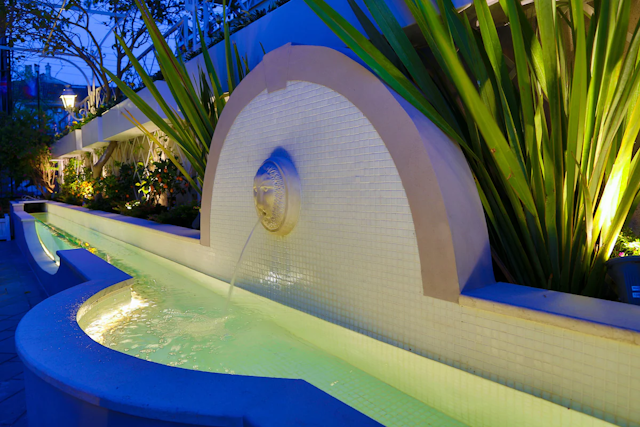
Corfu Town is the capital of Corfu and of the Ionian Islands and has museums, two forts, several museums, churches, and many other attractions.
Corfu Town
Nowhere is the pan-European background in the Ionians more evident than in Corfu Town. (It’s actually a city but everyone calls it Corfu Town.) It may have hole-in-the-wall Greek tavernas in its back streets, and its residents may celebrate Easter even more exuberantly than they do elsewhere in Greece, but it also has very strong influences from Britain, France and Italy in its architecture and its cuisine. Residents of Corfu Town quite rightly regard themselves as more sophisticated than people from other Greek island capitals.
Corfu Town Esplanade
And nowhere is this mix more evident than in the very centre of town, around the Esplanade. This combination of park and town square centres on a British cricket pitch, which used to be a Venetian firing range. At the far end, on a promontory sticking out into the Ionian Sea, stands the Old Venetian Fortress, which was completed in 1559 on a site believed to have been fortified since at least the 7th or 8th centuries AD. The Old Fortress (or Palaio Frotho) can be visited, with wonderful views over the town.
Palace of St Michael and St George
Palace of St Michael and St George in Corfu Town
At the north end of the cricket pitch stands the British-built Palace of St Michael and St George, constructed between 1819-24 as the residence of the British High Commissioner at the time. It was renovated in the 1950s and now contains administrative buildings, a library, the tourist office and, in one wing, the Corfu Museum of Asian Art. This collection, unique in Greece, was built up from 10,000 items amassed by Grigorios Manos (1850-1929), a Greek diplomat from Corfu who traveled extensively in the Orient.
The Liston
The Liston in Corfu Town at Night
At the western end of the cricket pitch is a row of cafes and shops that could only be French: the Liston. It was built by a Frenchman in 1807 at the behest of Napoleon, who wanted its colonnades to echo the rue de Rivoli in Paris. Its name is Venetian, deriving from the ‘List’ of noble families whose names were kept in the Golden Book, the Libro d’Oro. The cafes along the Liston are where everyone comes to socialise, a buzz of activity at lunchtime and early evenings, with people meeting friends or relaxing with newspaper and coffee. Your coffee will cost more here than anywhere else in Corfu, but it’s the place to be.
Enosis Monument
At the southern side of the cricket pitch is a park with a splendid fountain and, nearby, the Enosis Monument. This Unification Monument celebrates the occasion in 1864 when the Ionian islands were at last united with the rest of Greece after their final period of foreign, British, rule.
Archaeological Museum
The Gorgon Frieze in Corfu Town’s Archaeological Museum
There are numerous sites and museums around Corfu Town that ought to be seen, and which would merit a stay of at least a few days. Naturally the Archaeological Museum of Corfu is one of these, although it does not have the richness in its collection that you might expect from such a thriving town. Its star attraction is worth the visit alone, though, a fearsome Gorgon frieze which was made in the 6th century BC for the Temple of Artemis in the southern suburbs of Corfu Town.
The Banknote Museum
The Banknote Museum sounds as if it might only have appeal to those with a specialist interest, but it is in fact a really enjoyable museum which tells not only the fascinating story of how bank notes are made, but also shows how Corfu’s currency reflects the political changes, including notes in German and Italian currency during World War II when inflation was rampant.
Byzantine Museum
The Byzantine Museum’s official name is the Antivouniotissa Museum as it’s in the church of the Panagia Antivouniotissa and has a small and stylishly displayed collection of icons, some as old as the 15th century. Included are examples of work by the so-called Cretan school, from the days when Venice also ruled Crete and Cretan artists would visit Corfu on their way to study with the masters in Venice.
Church of Agios Spyridon
Tower of the Church of St Spyridon in Corfu Town
One church that must be visited in Corfu Town is dedicated to the island’s patron saint, Agios Spyridon. His mummified body is contained in a silver casket inside, and on four occasions a year this is paraded through the streets to celebrate the occasions when the saint is believed to have come to the rescue of the islanders, during battles and plagues. It is a marvellous time to be in Corfu Town (Palm Sunday, Easter Saturday, August 11 and the first Sunday in November) to see the way that Greeks combine religious fervour with abundant partying.
The best drives in Greece chosen by See Greece include from Ioannina to Meteora, the Prespa Lakes, the Nestos Valley, the Amari Valley on Crete, and the Mani.
Choosing the best drives in Greece isn’t easy, as there are so many wonderful experiences, but we can at least say that we have driven over most of the Greek mainland and on many of the major islands, including Crete, so we have plenty of experience. The drive between Athens and Thessaloniki has some wonderful moments – and some awful ones too. Driving round the Pelion was also impressive. So too was… but we could go on choosing forever.
So here is our final choice of five of the best drives in Greece, in no particular order:
Best Drives in Greece
The Nestos Valley
River Nestos
The Nestos River marks the boundary between Thrace and Macedonia in north-eastern Greece, a part of the country where few foreign visitors other than the adventurous backpackers venture. It’s mainly a low-lying landscape of cotton fields and tobacco plantations, but to the north are the Rodopi Mountains that separate Greece from Bulgaria.
The two major towns at either end of the valley are Drama and Xanthi. Xanthi has a delightful eastern feel to it, letting you know that Turkey isn’t too far away, and some impressive mansions that once belonged to wealthy tobacco barons are one of the town’s most attractive features. Take the road north to Stavroupoli, where the main road meets the Nestos River and heads off into the foothills of the mountains. Or, in winter, sometimes doesn’t: winter snow can block this road, so watch for the warning road signs.
At any other time of year it’s a wonderful drive, partly through wooded areas, and passing by (or stopping to visit) several remote rural villages along the way. At Paranesti the road leaves the river valley (the river rises in Bulgaria), and instead heads south to run alongside the railway tracks and down into Drama – appropriately enough for this dramatic drive.
The Amari Valley
On Crete the tour buses head east from Irakleion to do the circular drive around the Lasithi Plateau. It is a beautiful drive, though the sheer numbers of tour buses and other drivers can spoil it a little. If you have your own wheels head west from Iraklion, and south to the Amari Valley, a much quieter but equally beautiful part of the island, also easily accessible from Rethymnon on the north coast or the resorts of Ayia Galini and Matala in the south.
From wherever you start, you can do a circular tour of the valley to get you back to base, or drive through the valley while heading from one coast to the other. Just be sure to include the town of Amari itself, the main one in the valley though no more than a large village, with a tiny main square where there’s the inevitable friendly taverna with a few rooms. Yerakari is another must-see, the centre of the cherry-growing trade in the valley. The whole of the Amari Valley is fertile and filled with orchards, olive groves and vineyards. Surrounded as it is by mountains, with the Psiloritis range to the east, it’s a fabulous place to tour and see the Crete that lies behind the tourist resorts.
See our detailed driving directions for this drive here.
From Ioannina to Meteora
The region of Epirus in north-west Greece is one of the most stunningly beautiful in the whole country… indeed, in the whole of Europe, in my opinion. There are pretty lakeside towns like Ioannina and Kastoria and the awe-inspiring Pindus Mountains. A drive east from Ioannina takes you through the mountains, over a high pass that can be closed in winter, and down into the region of Thessaly, and one of the most distinctive and magical sights in the world: the monasteries of Meteora.
Aerial View of Ioannina
The capital of Epirus, Ioannina, is one of our favourite towns. It has a character all its own, sitting on the shores of a lake in the middle of which is a small island called Nissi, which means ‘the island’. You could easily spend several days in and around Ioannina, and you should drive out on the road towards the Perama Caves – well worth stopping off to explore the cave network. The road then rises around the lake to give lovely views back of Ioannina, before winding upwards into the mountains.
Another essential stop is the mountain town of Metsovo, a ski resort in winter and another very distinctive Greek community. Beyond here is the Metsovon Pass, the highest in Greece at 1705m, but don’t set out on this drive in winter without checking the state of the roads. Even if the pass is open, the sharp bends and sheer drops can be dangerous for the driver unused to them.
At other times the rewards are enormous, not just here in the high mountains, but the descent into the lusher plains of Thessaly and, at the very end, the amazing sight of the monasteries of Meteora sitting on top of the rock formations jutting out of the plain. This has to be one of the best drives in Greece.
From Kastoria to the Prespa Lakes
Kastoria
This is only a short drive, but one that will live long in the memory. Like Ioannina, Kastoria is a pretty lakeside town of the kind not normally associated with Greece. There are handsome mansions, one of them now a folk museum, and a wealthy history because of its fur-trading past. Head north out of the town and you climb through woods and head towards Greece’s northern frontier. Greece’s brash holiday resorts seem to belong to another planet.
It’s only just over an hour or so until you start to descend, and round a corner you will get your first glimpse of the Prespa Lakes. The whole area here is a National Park, and there’s wildlife in abundance. There are small fishing communities on the shores of the lakes, and it is one of the most peaceful areas of Greece.
Prespa Lakes
A visitor centre in the main village of Ayios Germanos gives information about walks and wildlife, and you may be able to take a boat trip out onto the lakes with one of the local fishermen, if you ask around. In the middle of the Great Prespa Lake is the border point where Greece meets Albania and the new country of Macedonia. You can’t get much more off the beaten track than this.
Around the Mani The Mani in the extreme south of the Peloponnese is no longer the remote region it once was, and visitors have been quick to pick up on its rugged charms. To drive around the peninsula is to discover another very distinctive part of Greece, where tall, tower houses reach into the skies. These fortified houses were built to protect the families because of the feuds that went on in this wild west of a place for centuries. But don’t worry – they’ve calmed down a bit these days.
Coast of the Mani
The main town of the Inner Mani (the southernmost part of the peninsula) is Areopoli, so drive south from here and you will quickly come to the Diros Caves, where boats take visitors into the underground cave networks. Back on the road, the route is easy to follow as the main road is basically a circular route around the Inner Mani.
One turning to watch for is in Alika, where a right turn is signposted for Vathia. Take this diversion, as Vathia has some of the finest tower houses and you can continue on the road all the way to the end, which is Cape Matapan, the southernmost point of the Greek mainland.
Return to Alika and carry on along the main road, which then heads north up the eastern coast with fabulous coastal and mountain views. There are several small villages and some quiet beaches, with views across to the eastern-most of the three peninsulas that look like fingers dangling off the Peloponnese. The road eventually heads inland and crosses the Mani, back to Areopoli.
So there you have it: our best drives in Greece. For the moment, anyway, until we discover another one.
The region of Attica, which includes and surrounds Athens, offers visitors high hills, beach resorts, small villages, and classical sites like Marathon.
Temple of Poseidon at Cape Sounion near Athens
Taking in the best of Attica’s attractions, this route begins in central Athens and winds along the coast, finishing at Halkida, the gateway to the island of Evia, the second largest in Greece after Crete. If you don’t want to do the full drive, you could head back for the center of Athens when you’ve finished visiting Marathon.
The full route is about 120 miles (190 kms) and should take about three hours without allowing for stops.
From the center of Athens follow Leoforos Syngrou which heads southwest out of the centre and becomes Highway 91. This eventually swings left to take you southeast along the coast, the Athens Riviera, with the Aegean Sea on your right. It’s a welcome relief after the bustle of the city.
After driving for about 15 minutes along the coast you come to the Athens seaside suburb of Vouliagmeni. This is a popular beach resort and a welcome escape, especially in the summer, for those who live right in the city. Here you could take a break to stroll along the sandy beaches, do some windsurfing, paragliding, sailing, or scuba diving, or simply relax in an outdoor cafe.
Cape Sounion
The Temple of Poseidon at Cape Sounion
Continue south along the coastal road and after about 45 minutes the impressive ruined Temple of Poseidon comes into view, sitting on top of the headland of Akra Sounion, Cape Sounion, and visible from miles away. It’s a popular spot at sunset, when Athenians drive out for a meal at one of the tavernas here.
After visiting the temple return to Highway 91 and turn right. Almost immediately this becomes highway 89 and takes you north up the eastern coast of Attica. It veers inland through the fertile interior to the small but busy market town of Markopoulon, which is about 40 minutes from Cape Sounion. Here you can stock up on provisions, fill up with petrol, or have a walk round and stretch your legs.
Vineyards spread out around the town, and several tavernas will provide you with an authentic Greek lunch – no tourist menus here. Look out for a bakery and try some of the local bread for which Markopoulon is known. There are also some small chapels you can visit. Look for a bell to ring to gain admission, or ask the first person you see where the key-holder can be found.
Rafina
Rafina Harbour
When you’ve finished in Markopoulon retrace your route back to Highway 89 and turn left. Almost immediately you should turn right onto Highway 85, which brings you to Rafina, after about 30 minutes of pleasant coastal driving. Rafina is a port and a resort, and if you want to stop just follow the signs for ‘Ferries’ and you should be able to find somewhere to park.
Lots of ferries to via, the Dodecanese, the Cyclades, and the North-East Aegean Islands go from here. If you haven’t yet eaten it also makes a good spot for lunch in one of the many waterfront restaurants.
From Rafina head west out of town to reach highway 83 and continue north. In about 10 minutes, passing vacation homes and villas on the way, you reach the smaller resort of Nea Makri. Five minutes or so beyond here you reach the town and ancient site of Marathon.
The Battle of Marathon
Battle of Marathon Burial Mound
This is where the Battle of Marathon took place in 490BC, when the Athenians defeated the much larger Persian army. The route that was taken by the messenger who was sent to relay the news to Athens covers 26 miles 385 yards (42.195 kms), the length of the marathon race. The messenger died after delivering his news.
The Athenian dead were buried under a simple but large burial mound. Watch for the sign before you reach the town of Marathon itself. After visiting the site continue north on Highway 83 and you’ll soon reach the small but very informative Archaeological Museum.
Continue on the winding Highway 83 until you reach the village of Agios Stefanos, where you have a choice. Just beyond the village is the main Athens-Thessaloniki highway. This is Highway 1 but in places is confusingly also the E75. If you want to return to Athens, turn left on Highway 1.
To continue the drive turn right onto the highway and after about 45 minutes watch for a right turn marked for Evia and Chalkida, its capital. Alternatively, continuing north on highway 1 would get you to Volos and the Pelion Peninsula in about three hours. Another 2-3 hours beyond Volos and you would reach Thessaloniki.
If you want to print out a PDF of this drive then click here.
See Greece recommends where to stay in Corfu Town including hotels near the port, near the airport and in the town centre, with budget and luxury options.
The Bella Venezia Hotel in Corfu Town
Corfu Town is a lovely town and we highly recommend staying there for a few days when visiting Corfu, if you can. We once stayed there for two whole weeks while researching a guidebook and didn’t run out of things to do. We found great new places to eat every night we were there, from fancy restaurants to back-street souvlaki joints.
There’s an excellent range of hotels, too, and we moved between some of them during our visit, including some of the ones listed below. Here, then, is our list of suggestions on were to stay in Corfu Town, based on several visits.
A lovely shining curved wooden reception desk greets you as you enter the friendly Arcadion Hotel, which combines classical looks and history with modern comfort. The entrance is around the corner on Vlasopoulou, though the building looks out over Kapodistriou, the southern end of the Liston and the Spianada, an ideal location. Try to get one of the front rooms if you can, though the side ones looking out over the Old Town are also attractive.
The Hotel Arion is only a minute or so from the entrance to the Mon Repos estate, in the quiet, village-like suburb of Anemomylos. It’s a pleasant 15-minute walk around Garitsa Bay into the town centre, too. The Arion is a smart, modern hotel at a very reasonable price. It has 105 comfortable rooms, a large lounge/reception area and a big rooftop terrace with seating, a bar and wonderful sea views.
The Atlantis Hotel is conveniently placed near the port, if you’re arriving or leaving by ferry, and right on the edge of the old town too. Most of the rooms and suites have balconies and views over the Ionian Sea, and although it’s only a 2-star hotel and inexpensive, it is clean and friendly and all rooms have air-conditioning, TV, direct-dial phones and ensuite bathrooms.
The Bella Venezia is in a neo-classical mansion, once a girl’s high school, and it oozes the kind of character that many hotels these days lack. Rooms are large with high ceilings, breakfast is in a garden pergola, and it is only a short walk down to Town Hall Square.
The Hotel Bretagne is a budget but very comfortable option for those with late or early flights, as it is within walking distance of the airport. This proximity does mean that airport noise at other times can be a problem, so bring your ear-plugs. It is modern and cheerful and has its own bar and restaurant… which are also well worth knowing about if you have airport delays.
Everybody in Corfu Town knows the Cavalieri Hotel, as in summer its rooftop bar is one of the places to have a drink. It’s rather a plush place in a 17th-century mansion, and though some of the 50 rooms are small it does have class and character. All rooms have balconies, with the front ones offering lovely views of the sea and the New Fortress.
This 4-star hotel is out on the Kanoni peninsula, a 5-minute drive from the airport. Despite being about 3 kms (1.9 miles) from the town centre, and 1.5 kms (0.9 miles) from the beach at Mon Repos, it still proves immensely popular with people looking for an all-inclusive resort-style hotel, where every facility is available. It has luxury rooms and suites, and its two conference centres also make it a top business choice.
The Corfu Holiday Palace is a huge complex with a few hundred rooms, suites and bungalows, conference facilities, and the island’s only casino. Located out on the Kanoni peninsula, it overlooks Mouse Island, one of the best views in Corfu.
The swishest hotel in Corfu Town itself, in the 5-star Luxury class Hotel Corfu Palace, overlooking Garitsa Bay. It’s where visiting politicians and other dignitaries are usually housed. It has a beauty and fitness centre, two swimming pools, two restaurants, large well-kept grounds and all its rooms and suites overlook the sea.
Built in 1862 the Konstantinoupolis oozes old-world elegance, with marble steps and a spiral wooden staircase leading you up to the rooms (and an old-fashioned elevator too). It’s handy for Old Port and Old Town alike, and though some of the rooms are small they are charming, with bright blue tiled baths. The breakfast room is also bright and cheerful, and there’s 24-hour room service too. Don’t let the 2-star rating mislead you, it’s exceptionally good.
The Mon Repos Palace is a very attractive adults-only resort-style hotel with 114 rooms, all of them having TV, air-conditioning, phone, fridge, and balconies. It’s at the southern end of Garitsa Bay, very close to the Mon Repos estate and an enjoyable 10-minute walk around the bay into Corfu Town. It has its own small plunge pool and sunbathing terrace, but is right by the Mon Repos beach too.
Irakleio’s Archaeological Museum is Crete’s most important museum and contains some of Crete’s oldest artefacts, Minoan frescoes and the Phaistos Disc.
Irakleio Archaeological Museum
Irákleio’s Archaeological Museum is not only the major museum on Crete: it is the largest repository of Minoan antiquities anywhere, and stands among the finest museums of the ancient world. This magnificent collection of pottery, frescoes, jewellery, ritual objects and utensils brings the Minoan world to life.
Come here first before visiting the ancient palaces and your view of the ruins will be enlivened with a sense of the colour, creativity and richness of the fascinating culture that once flourished on this island.
Irakleio’s Archaeological Museum
The Archaeological Museum covers 5,500 years of Cretan history, dating from Neolithic times (5000-2600 BC) to the end of the Roman era (4th century AD). The two-storey building, which contains 20 galleries, was built in 1937-40 and both the collection and the present-day summer crowds have outgrown this space. There are plans to renovate the museum over the next few years to create new exhibition areas. Thus some rooms may be closed or displays rearranged while work is in progress.
Map (c) Google Maps
Visiting Irakleio’s Archaeological Museum
Buy your tickets at the kiosk in the courtyard. Beyond is a small garden and a coffee shop on the terrace behind the main building. Inside the entrance hall is a large desk where you can buy postcards and a museum guide. This is not essential, as most of the major exhibits are labelled in both Greek and English, though not in great detail.
The collection is arranged chronologically from room to room, with finds from the major Minoan periods also grouped according to the sites where they were discovered.
Irakleio’s Archaeological Museum
Timeline
Archaeologists categorise the museum’s artefacts into the following periods:
Pre-palatial period: 2600—1900 BC
Old Palace period: 1900—1700 BC
New Palace period: 1700—1450 BC
Late Palace period: 1450—1400 BC
Post-Palace period: 1400—1150 BC
Sub-Minoan, Geometric, Oriental and Archaic periods: 1150—6th century BC
Classical, Hellenistic and Roman periods: 5th century BC—4th century AD
Minoan Motifs
Look for the major motifs which appear on artefacts throughout Minoan times: the double ax, the spiral and the horns of consecration were often painted or etched on pottery, while votive figurines were shaped like bulls or goddesses with upraised arms.
Irakleio’s Archaeological Museum Room I
Room I contains some of Crete’s oldest artefacts, ranging from Neolithic stone tools and crude idols, to early Minoan pottery, figurines and jewellery from the Pre-palatial period. The ancient origins of bull sports, later an important ritual in palace life, are depicted by the small clay figures of bulls with acrobats grasping their horns, in case 12-13 and case 15.
Look out too for early signs of Minoan craftsmanship in the Vassilikí pottery from eastern Crete, with graceful, elongated spouts and deep red and black mottling, obtained by uneven firing. Also noteworthy are the early seal stones.
Irakleio’s Archaeological Museum
Irakleio’s Archaeological Museum Room II
Room II contains Old Palace finds from Knossos and Mália. The painted and glazed earthenware plaques of the Town Mosaic (case 25) depict the multi-storey dwellings of Minoan architecture. The many human and animal figurines were votive offerings found in peak sanctuaries.
Clay taximata, representing feet, arms or other parts of the body needing cures, are forerunners of the silver ones pinned to icons in churches today. Pottery is more elaborate with the white and red polychrome decoration of Kamáres ware, and the delicate ‘egg shell’ cups.
Irakleio’s Archaeological Museum Room III
The style reaches its height in Room III, devoted to finds from the same period at Phaistos palace. Here large amphorae sport elaborated spirals, fish and other designs, while the royal banquet set (case 43) includes a huge fruit stand and a jug with relief decoration of big white flowers. However, the highlight of this room is the Phaistos Disc with its intricately carved hieroglyphic characters, possibly from a ritual text. It stands alone in a central case.
Irakleio’s Archaeological Museum
Irakleio’s Archaeological Museum Room IV
Room IV contains some of the finest artworks in the museum, dating from the New Palace period when Minoan art reached its peak. As you enter, in the left corner is an exquisite gaming board from Knossos, made of ivory with gold casing and inlaid decoration of rock crystal and lapis lazuli.
Further along this wall in case 50 are two superb statues of the Snake Goddess, sacral relics from the temple repositories. Both are bare-breasted, one holding a pair of snakes in her upraised arms, the other with snakes coiled round her outstretched arms. They represent a major Minoan deity, or possibly a priestess engaged in ritual.
Case 51 contains the Bull’s Head Rhyton from Knossos (a rhyton is a libation vessel used in religious ceremonies). Magnificently carved from steatite, a black stone, it has inlaid eyes of rock crystal, nostrils of white shell and restored wooden horns.
Other life-like artworks are equally impressive, such as the alabaster head of a lioness, also a libation vessel, and a stone axe-head carved in the shape of a panther (both from Mália in case 47); and in case 56 the graceful ivory figure of an acrobat in mid-leap. New developments in pottery are represented by the Jug of Reeds, case 49, with dark colours and patterns depicting nature themes.
Irakleio’s Archaeological Museum
Irakleio’s Archaeological Museum Room V
Room V, with Late Palace period finds from the Knossos area, has an interesting model of a Minoan house at Archánes. Case 69 contains rare examples of Linear A script, the written language of the Minoans, alongside the Linear B script of mainland Greece.
Europe’s First Written Word
The earliest known written history in Europe began in Crete around 2000 BC. Known as Linear A, these inscriptions pre-date the documents of Mycenean Greece, written in Linear B, by 600 years. Nearly 1,600 Linear A inscriptions have been found to date, and although they are not fully deciphered, most are probably administrative records. Only 10 per cent, found in sacred caves and mountains, are thought to be religious in nature.
Irakleio’s Archaeological Museum Room VI
Room VI contains a range of objects from cemeteries at Knossos and Phaistos. In case 71 is a delightful clay statuette of men locking arms in a ritual dance between the horns of consecration, and another clay scene of ritual washing. Along the back wall are the bizarre remains of a horse burial, while case 78 contains a helmet made of boars’ tusks. There are also several cases of jewellery and bronze objects.
Parting Gifts
Men were buried with bronze weapons and tools, while bronze mirrors were beloved offerings for female burials.
Irakleio’s Archaeological Museum Room VII
Three enormous bronze double axes erected on wooden poles guard the entrance to Room VII. Religious objects often decorated the hallways of palaces and country villas. The most outstanding piece of Minoan jewellery ever found — the intricate honeybee pendant with two gold bees joined round a honeycomb — is tucked away among the displays of jewellery in case 101 at the back of the room.
Irakleio’s Archaeological Museum
Equally famous are three elegantly carved steatite vases from Ayía Triádha (cases 94—96): the Harvester Vase shows a procession of harvesters and musicians; the Chieftain Cup portrays an official receiving a tribute of animal skins; the Boxer Rhyton depicts boxing, wrestling and bull-leaping.
Irakleio’s Archaeological Museum Room VIII
Room VIII is devoted to treasures from the palace of Zákros. In case 109 along the wall is one of the triumphs of the museum — a stunning rock crystal rhyton with a green beaded handle, expertly reconstructed from over 300 fragments. The Peak Sanctuary rhyton in case 111 depicts scenes of Minoan worship. Room IX contains finds from settlements in eastern Crete, including Gourniá, and has a marvellous collection of seal stones.
Small is Beautiful
Despite their tiny size, seal stones display an amazing degree of craftsmanship. Animals, people, imaginary creatures and hunting or religious scenes were carved in intricate detail onto hard stones such as agate or amethyst. These were then impressed onto clay seals which were used as a signature on correspondence or a guarantee on shipments of goods. No two are alike.
Irakleio’s Archaeological Museum Room X-XII
Rooms X-XII represent the Post-Palatial periods. Here, Minoan art is in decline, and the influences of Mycenaean Greece and Egypt are apparent. Room XIII contains dozens of clay sarcophagi (coffins) painted with geometric designs. Many are shaped like bathtubs, and two have skeletons intact.
Irakleio’s Archaeological Museum Room XIV
Upstairs, Room XIV, the Hall of Frescoes, is the highlight of the museum. The long walls are lined with the famous frescoes from Knossos: the bull-leaper, the Lily Prince, the dolphins from the Queen’s bedroom. Only fragments of the original frescoes survive, with the paintings reconstructed around them, but the colour and detail in these few pieces reveal the remarkable skill of these ancient artists. In the centre of the room is the magnificent Ayía Triádha sarcophagus, which survives intact, with elaborate scenes of a funeral procession and animal sacrifice.
Irakleio’s Archaeological Museum
Irakleio’s Archaeological Museum Rooms XV and XVI
Rooms XV and XVI have smaller frescoes, including the sensuous ‘La Parisienne’ (no. 27). Also notice the ‘Saffron Gatherer’, originally thought to be a boy picking flowers but later re-interpreted as a blue monkey.
Irakleio’s Archaeological Museum Rooms XIX and XX
At the end of the Hall of Frescoes is a wooden scale model of the Palace of Knossos in all its glory. Back on the ground floor, rooms XIX and XX contain classical Greek and Roman sculpture.
Top Tip
Visit first thing in the morning, during lunchtime or late afternoon to avoid the worst of the coach-party crowds.
You don’t need to tackle all the exhibits at once. Your ticket is valid for re-entry on the same day, so take a break if you’re feeling tired or overwhelmed.
Must See
The Phaistos Disc (Room III)
Snake Goddesses (Room IV)
The Bull’s Head Rhyton (Room IV)
Rock Crystal Rhyton (Room VIII)
Hall of the Frescoes (Rooms XIV-XVI)
The Phaistos Disc in Irakleio’s Archaeological Museum
Hidden Gems
Don’t overlook the hidden gems, such as the seal stones, the honeybee pendant (room VII) or the ivory butterfly (room VIII). The museum’s garden has the ruins of the Venetian Monastery of St Francis, too.
More Information on Irakleio’s Archaeological Museum
The Snails House in Plouti near Phaistos is the best place for eating snails on Crete, as they’re cooked in several different ways.
Snails on Crete
‘Snails are the friends of Cretans. We love them. We ate them during the war.’ That’s what we’d been told by our guide on our visit to the Lyrarakis Winery a few days earlier, where literally thousands of snails were clinging to bushes near their vines. Fortunately snails don’t seem to like vines.
Cretans like snails, though, probably even more than the French love their escargots. Besides – but be careful where you say it – but the French actually import some of their snails from Greece. That French escargot in Paris might actually be a Greek koklias from Lake Pamvotis, where there’s a healthy snail export business.
The Snails House on Crete
Eating Snails on Crete
The Cretans certainly cook snails in far more inventive ways than the French do, as we were about to discover when we sat down for an unusual lunch at To Steki tou Kokliou, or The House of Snails in Plouti.
The Snails House on Crete
As you can see from the many photos we took, The House of Snails is charmingly and quirkily decorated with lots of rustic rustic touches. On one window shutter there were plants and herbs including lavender, rosemary and oregano, all growing from what looked like old jam jars. A gnarled olive tree branch was draped over a fireplace, and colourful copper jugs contrasted with faded old photos.
We had plenty of time to look round as, due to our schedule, we’d arrived at noon just as the place was opening up, though the cooking smells from the absolutely tiny kitchen made us instantly hungry. I guess you don’t need a lot of cooking space if you mainly cook snails.
Snails with Wheat Cheese
We were on a mainly food-and-drink themed tour of Crete with our excellent guide Isi, from gocrete.net. Isi will organise tours on any theme that interests you, but if you choose a food and drink one you’re in for a treat. Or rather, many treats. Isi arranged for us to tour vineyards land craft breweries, meet people like The Herb Man of Kouses, meet someone who made petimezi and someone else who made rakomelo, and today he’d slipped in a lunch at this very specialist place.
Snails with Onions
It’s obviously not a place to come if you don’t like snails, though you could still put a meal together from the side dishes they do, like fava beans and stuffed vine leaves. Today as our vegetable side dish we ordered stuffed cabbage leaves, and as they were prepared that morning like all the dishes, they were fresh and delicious. But what about the snails?
A Feast of Snails
‘Today they do four kinds,’ Isi explained, ‘ one is done in the frying pan, then put in the fire with vinegar and rosemary. It’s called bourbouristous, from the noise the snails make in the fire: bour-bour-bour…. Another dish is just boiled snails. It’s a kafeneon not a taverna or restaurant so the menu is small. For drink there is local wine, retsina, raki, different coffees of course. It would only cost you about €6-7 depending what you have.’
The Snails House on Crete
Today Isi recommends the two other snail dishes on the menu. The first is snail with onions, which doesn’t sound very appetising but Isi explains there’s more to it than onions, with herbs and spices added, making it more like a snail stifado. We’ve never had anything like that, so why not?
The Snails House on Crete
Nor have we even heard of anything like the other option, which Isi describes as snails with dried wheat and cheese. What? When it comes it looks something like a snail pilaf, and tastes somewhere between a pilaf and a savoury risotto. It’s incredibly tasty, as is the snail stifado, which is juicy and full of flavour, though we do need a hand from Isi with getting the snails out of their shells.
We highly recommend a visit to The Snails House in Plouti for a unique dining experience.
The Snails House on Crete
Eating Snails on Crete: More Information
The Snails House is in the village of Plouti in southern Crete, about a 30-minute drive from Matala and Agia Galini, and 15 minutes from Phaistos.
The See Greece guide to Zaros in Central Crete, including what to do, where to stay, and where to eat.
The View from Our Room at Keramos Studios in Zaros
Zaros in Central Crete is a lovely little town. The first time we went we were just passing through and stopped to do a walk in the Rouvas Gorge. We loved the town so much that we said we had to go back and stay sometime – so we did!
Where to Stay in Zaros
Keramos Studios in Zaros
There are a few places to stay in Zaros but we definitely recommend the Keramos Studios and you can read all about our stay there here.
Where to Eat in Zaros
Dining at Vegera in Zaros
You have plenty of choice of eating places but there’s nowhere quite like Vegera, a unique and fun dining experience that we wrote about here.
If you want trout fresh from the lake then the Votomos Taverna is right by a trout farm. It’s about a 20-minute walk or a 5-minute drive from the centre of Zaros.
A Walk From Zaros
We thoroughly enjoyed this circular walk from Zaros to the Rouvas Gorge. It should take 3-4 hours and you can read about it and get directions here. Zaros is on the E4 European Walking Path.
Officially Zaros is only a village but with a population of about 3,000 it’s more like a small town. It certainly has a lively atmosphere and stands out for several reasons.
Zaros Water
One distinctive feature of Zaros is that it has a lake. Lake Votomos is a short walk out of the village to the west, or you can drive there. They farm trout in the lake and you’ll see it on taverna menus. You have to eat trout if you visit Zaros!
The lake is fed by a mountain spring and the spring water is also bottled and well-known locally for its purity. Go into any of the shops in Zaros and ask for a bottle of the local water. You can find out much more about the lake and the area here.
Where is Zaros?
Map (c) Google Maps
As you can see from the map, Zaros is almost slap-bang in the middle of Crete. It’s in the southern foothills of Mount Psiloritis, less than an hour’s drive southwest of Irakleio. The Minoan Palace of Phaistos is a half-hour drive southwest of Zaros, The resorts of Matala and Ayia Galini are also both southwest of Zaros, and a 35-40-minute drive.
What to Do in Zaros
In truth, there’s not a lot to do in Zaros, which is part of its charm. It makes a great base if you’re exploring the area, and in our view is more interesting, more relaxing, and less expensive than nearby resorts like Matala and Ayia Galini.
One attraction is the Vrontisi Monastery, which is about an hour’s walk or a ten-minute drive northwest of town. It’s on the southern slopes of Mt Ida at a height of 550m (1,804ft) and you get wonderful views from there. No-one knows how old it is but there are references to it from the late 15th century – so it’s pretty old!
You can also hike in the area, including the Rouvas Gorge walk we mentioned. Even if you don’t stay at the Keramos Studios, call in and ask about visiting the family farm. They’re set up to do tours and it’s a fascinating insight into rural Cretan life.
Donkey Ride at the Keramos Studios Family Farm
Shopping in Zaros
There are several craft shops in Zaros and we spent an enjoyable half-hour in the weaving shop of Maria Zacharioudakis, admiring the weavings and watching Maria work at her loom.
Zaros is also home to one of the best musical instrument makers on Crete, Antonios Stefanakis. He makes lyra, mandolins, violas, bouzouki, and Cretan bagpipe, and even if you don’t want to buy an instrument he also sells CDs of Cretan music.
This Rouvas Gorge walk starts and ends in Zaros in southern Crete and should take three to four hours with a distance of eight kilometres or five miles.
Map (c) Google Maps
This exhilarating walk from Zaros takes you to a mountain monastery and up a rocky gorge, rich in flora and fauna and with beautiful views of central Crete’s Psilorítis range. If you want to make a full day of it, you can extend the walk to another mountain church. Start early to avoid the worst of the midday heat.
NOTE: These directions were correct at the time of writing but sometimes routes can change so check before setting off.
Zaros
The delightful village of Záros nestles at the southern foot of Mount Ída (Psilorítis). It is famous throughout Crete for its spring water, bottled by a local company on the edge of town. Drive west through town and park on the main road near the post office. (To shorten the walk, you could also drive to the lake).
Lake Votomos
Continue walking along the main road. Just past a modern fountain, you’ll see signs for the Idi Hotel and Lake Votomos. Turn right and follow the narrow road up the hill, past vegetable gardens and an old olive press to the Idi Hotel, about 1 km from town.
The Idi Hotel near the Rouvas Gorge
The road makes a sharp bend to the left. Continue uphill past the trout farm – its fish is a Záros speciality. The road is lined with morning glories, pomegranate and lime trees while the mountains rise up ahead. After 15 minutes you reach the small Lake Votomos, formed by the Záros springs. There’s a good taverna on the south side.
Around the Lake
Both the right- and left-hand paths lead round the shore of the lake and up stone steps. Go through the gate (and close it). Proceed along the dirt path that ascends gently above the olive groves, with views over the valley to the left and the mountain on your right.
Monastery of Áyios Nikólaos
As you round a bend you can see the monastery of Áyios Nikólaos ahead on your left. Although the complex appears modern, its church has frescoes dating from the 14th century. It is home to a small community of monks.
Chapel of Áyios Efthimios
Opposite a little wooden bridge beside the monastery, a set of rock steps on your right leads up to the tiny chapel of Áyios Efthimios, filled with icons.
Into the Rouvas Gorge
Cross the bridge. The path turns sharply to the right and zig-zags up and away from the monastery. Follow the yellow arrows and markings painted on the rocks to guide you through the boulders. You are now entering the Roúvas Gorge, which the locals also call Áyios Nikólaos gorge, after the monastery.
After a short, steep climb you come to a fence. Go right following the arrow as the path curves around the next hill. Take the stone steps up and through a gate. The 1.6 km (1 mile) path through the gorge alternates easy stretches along the herb-covered hillsides with steeper climbs up stone steps. The route is well marked with yellow arrows.
Church of Áyios Ioannis.
The path follows along the steep side of the gorge, then drops down through the ravine and doubles back on the far side. Here it becomes a wide track leading uphill to a signpost. To extend the walk, follow the trail up through the peaks for 2.7 km (1.7 miles) to the mountain church of Áyios Ioannis.
Return to Zaros
To return, follow the sign for Votomos and Áyios Nikólaos. This dirt track is narrow and steep at first, so go slow. There are beautiful views down the gorge to Záros. When you reach some bee hives, walk quickly past and turn left onto a wide dirt road that leads downhill to the monastery. Follow the sign for Votomos that leads round behind it to the wooden bridge, and return to Záros the way you came.
Print the Rouvas Gorge Walk
If you want a copy of this walk to print out then click here.
Keramos Studios in Zaros on Crete is an inexpensive two-star hotel/guesthouse with one of the best breakfasts on the island using food from the family’s farm.
Keramos Studios in Zaros
We’d visited Zaros in Crete several years earlier while researching a guidebook. We didn’t have time to stay there while we did our Rouvas Gorge Walk, but we had time to look around the small village (population about 3,000) and found it a really interesting and charming place. We were determined to return, and eventually got the chance, but this time to stay overnight.
Where is Zaros?
Map (c) Google Maps
Zaros could hardly be more central on Crete. Just look at Google’s map. It’s about an hour’s drive south-west of Irakleio, just under two hours’ drive south-east from Rethymnon, and about half an hour from Matala and Phaistos on the south coast. If you have a car, Zaros would make a great place to be based.
Keramos Studios in Zaros on Crete
Keramos Studios in Zaros
Keramos Studios was easy to find, in the centre of the small village, and there was plenty of parking nearby. Though they call themselves ‘studios’, it’s a combination of guesthouse and 2-star hotel. If you think two stars doesn’t seem much, don’t worry.
Our Room at Keramos Studios in Zaros
While the accommodation is simple, it’s super-clean, has everything you need, the family which runs it are incredibly friendly and helpful, and the room rates are remarkably cheap. We thought it was excellent value for money and would go back like a shot.
Our Room at Keramos Studios
The View from Our Room at Keramos Studios in Zaros
Our room was on one of the upper floors, and there’s a very old-fashioned elevator, which we loved. Our room key was a very old-looking and enormous metal key – yes, a real key! We had a large and comfy double bed, kitchenette (which we didn’t need), an en suite bathroom, a big wooden wardrobe, and a lovely traditional feel to it. We also had a balcony where we could sit and gaze out at the mountains.
Our Room at Keramos Studios in Zaros
Dining at Vegera
Keramos only serves breakfast so we had dinner at the Vegera Restaurant, a one-minute walk away and an inspired choice. See our separate review here: Dining at Vegera.
Breakfast at Keramos Studios
Katerina with the See Greece Team at Keramos Studios in Zaros
By the time breakfast came round, we couldn’t believe it after the feast at Vergera but we were actually hungry again. It was just as well as we’ve never been served such a breakfast spread. It didn’t surprise us when we discovered that the woman who makes the breakfasts fresh every morning is Katerina, the aunt of Vee-Vee who runs Vergera. Cooking and generosity obviously run in the family.
Katerina at Keramos Studios in Zaros
Katerina’s baking is her speciality and she starts very early in the morning in the Keramos kitchen. As well as making bread, she makes about twenty different pies, and between us we managed to sample fifteen of them (I counted)! The waiter just kept on bringing them. He more we praised them, the more he brought.
Our Breakfast Feast at Keramos Studios in Zaros
They included banana pies, several different types of cheese pie, zucchini and mint pies, marmalade pies, raisin pies, milk pies, spinach pies, pumpkin pies with honey and nuts in them, two kinds of chocolate pie, one baked and one fried – eat them with honey, the waiter told us. Chocolate with honey? Yes, it was brilliant.
And as if this wasn’t enough, we were also told to tuck into the buffet of cold meats, cheese, tomatoes, yoghourt, and honey. We admit we did take a small plate, just to keep him happy. Finally, when we assumed we’d finished, he bought us each an omelette. A chip omelette.
The Family Farm
Donkey Ride at the Keramos Studios Family Farm
Katerina’s son, Mikalis, runs the family farm and at Keramos Studios you can book a farm tour, so of course we did one before leaving Zaros. There are three types of tour available, and we did the basic tour as that’s all the time we had.
Cooking Chips for Lunch at the Keramos Studios Farm in Zaros
You can also add a cheese- and bread-making class, or go for the luxury option which adds an outing to gather wild herbs and going back to the farm and making pies with them. You might also join in wine-making, raki-making, or making olive oil, depending on the season.
Bread Fresh from the Oven at the Keramos Studios Farm in Zaros
Our farm tour was wonderful. We were accompanied by Mikalis’s two young daughters, who helped introduce us to all the animals. The chickens had chicks that were a few days old, and one of the goats had a tiny kid with it, which Mikalis picked up and brought over to us. There was a horse, too, and rabbits, pigs with little ones suckling, and donkeys.
Lunch at the Keramos Studios Farm in Zaros
Afterwards we went back to the farmhouse where Katerina was baking bread, then started frying chips and eggs, cutting cheese, and we were treated to a lovely lunch with everything from the farm: tomatoes, cucumbers, olives, peaches, bread, cheese, and of course eggs and chips. Oh, and a little raki. It was delicious and delightful. We highly recommend it, and the Keramos Studios in Zaros. It’s more than just somewhere to stay, it’s a very Greek family experience.
See Greece eats at Vegera in Zaros and finds a cheap but wonderful feast of meat, fish and vegetarian dishes cooked daily with fresh local food.
Dining at Vegera in Zaros
We were staying in Zaros on Crete at the lovely Keramos Studios, where they only serve breakfast, so we walked a minute round the corner and found the Vegera Restaurant. It had been recommended to us by our Cretan guide, Isi from Go Crete, who we knew by now could be relied on to find the best eating places around.
Vegera is run by the vivacious Vee-Vee, who is part of the family that also runs the Keramos Studios. Not only is Vee-Vee quite a character, we were soon to discover that she is also quite a cook.
Vegera Restaurant in Zaros
Dining at Vegera – the Menus
Vee-Vee doesn’t have a regular menu, but three basic menus and you choose from one of these: Full Menu with Fish, Full Menu with Meat, or Full Vegetarian Menu.
Part of the Feast at Vegera
When the restaurant opened way back in 2011 they decided they would only serve food cooked fresh that day. Zaros doesn’t get many visitors so it’s difficult to have a big menu and make everything fresh. They didn’t want to serve people yesterday’s moussaka but instead cook like you would cook at home.
We ordered some red and white wine and told Vee-Vee we would eat anything, so she gave us a mix of all menus. The restaurant was quiet and the food just kept on coming.
The Feast at Vegera
Lentil Soup at Vegera
We started with a dish of lentil soup, which smelled and tasted fantastic. Then some cheese pies arrived, followed by spinach pies, a plate of wild greens, some cabbage leaves stuffed with rice, some stuffed vine leaves, a green salad, stuffed zucchini, stuffed tomatoes, stuffed peppers, several mini moussakas, and finally a main course which was a bigger dish of beef, onion and rice.
Beef Stew at Vegera
We thought that was it, but no. Finally came a whole trout, which the town is noted for as there’s a trout farm here. It’s one of only two places on Crete where they farm trout. To round off the meal, Vee-Vee produced a bottle of raki, and a piece of chocolate cake. When we came to pay I think Vee-Vee simply made up a figure. As it was a remarkably small figure for such a feast, we didn’t worry.
Dining at Vegera
Vee-Vee is very enterprising and also gives cookery courses, organises cooking and wine-tasting holidays, and can arrange for people to eat with the locals. Find out more on the website for the Vegera Restaurant in Zaros.
The best things to do on Crete include the Samaria Gorge, Minoan Palaces at Knossos, Malia and Phaistos, and seeing lovely towns like Hania and Rethymnon.
Samaria Gorge
The best things to do on Crete include hiking the longest gorge in Europe, seeing the remains of vast Minoan Palaces like Knossos, Phaistos and Malia, relaxing in pretty waterfront towns such as Hania, Rethymnon and Sitia, spending a day or more in Iraklion with its marvellous Archaeological Museum, and seeing religious sites like the haunting Arkadi Monastery and the beautiful frescoes in the church of the Panagia Kera. And that’s without even mentioning the beaches!
Best Things to Do on Crete
Here in alphabetical order is our list of the best things to do on Crete:
Agios Nikolaos
Agios Nikolaos
Agios (or Ayios) Nikolaos is one of the prettiest towns on Crete, renowned for its twin harbours. It is therefore very busy too, and the crowds can detract from the enjoyment of it, but it’s well worth seeing. It also has a good Archaeological Museum, and a little Folklore Museum, but its main appeal is the town itself. To learn more see our page all about Agios Nikolaos.
Arkadi Monastery
Arkadi Monastery
It’s an enjoyable drive up a twisty mountain road to get to one of the island’s most significant monasteries. In 1866 hundreds of Cretans were killed here by the occupying Turksh forces, including many Cretan resistance fighters. The monastery has therefore become a symbol of the islanders’ struggle for independence. Don’t miss the ossuary, where the skulls and bones of those who died are preserved and displayed. See our full page about the Arkadi Monastery for further information.
Gortys
Ancient Gortys
Gortys was a Greco-Roman city and the ruins, although small, sprawl pleasantly over fields and olive groves making it a lovely spot to explore. The 6th-century church of Ayios Titos is one of the main ruins, and nearby in what is thought to have been the agora, or market, is a truly unique find. Carved in about 500BC on huge stone blocks is what was the first Code of Law to have been written down in Europe.
Gournia
Gournia
The ruins at Gournia are interesting because they are of an ordinary working Minoan town, not one of the great palaces. The ruins are from about 1500BC and it’s really fascinating to walk among them and discover the houses and workshops. get to the top of the site for a good over-view, and when you do it remember that Gournia was originally four times as big as what you see in front of you. The rest has not yet been uncovered.
Hania
Hania Harbour
Hania, Crete’s second-largest city, is many people’s favourite place on Crete, and we’d find it hard to disagree. It has a really beautiful Venetian harbour, which is the perfect place for a drink or a meal especially in the evening when it bustles with people. The town has good shopping, several excellent museums, and some of the nicest hotels and best restaurants on the island. See our Hania page for more information.
Iraklion
Iraklion Port and Venetian Harbour
Try to spend at least a day in Iraklion, Crete’s capital, or preferably a few days. It’s a lively city with plenty of things to do, including the Archaeological Museum, its Venetian harbour, the Historical Museum, the Icon Museum, several interesting old churches, and plenty of good restaurants too.
Knossos
The Ruins of a Temple at Knossos
The Minoan Palace at Knossos is the biggest attraction on Crete, and well worth at least half a day of your time. There were once over 1,200 rooms here, and some of them have been recreated to give an impression of the scale and grandeur of the palace. The first palace was built here in about 2000BC, but that was destroyed in an earthquake 300 years later. Then an even greater palace was built, but that too was destroyed in 1450BC, possibly by the eruption of the volcano on Santorini causing a huge tidal wave. See our full page on Knossos.
Malia
Malia
Malia Palace is Crete’s third-largest Minoan Palace. It was built in about 1900BC, destroyed in an earthquake then rebuilt in about 1650BC. Its remains with a reddish tinge to the stone make a great place to wander around, and because it’s usually less crowded you have more time to make sense of the ruins.
Panagia Kera
Panagia Kera on Crete
This little Byzantine church is one of the most famous on Crete, known for its 14th- and 15th-century frescoes. They seem to cover every inch of the walls, and make a great impact when you first walk into the church.
Phaistos
Ancient Palace of Phaistos on Crete
The ruins of the Minoan Palace at Faistos are just as enjoyable, if not more so, than the more famous ruins at Knossos. They’re set on a hill overlooking a plain and the site is usually nowhere near as crowded as Knossos. Enjoy the central courtyard, royal apartments, the grand staircase, and the place where the famous Phaistos Disc was uncovered in 1903. This small disc was made in about 1700-1600BC and no-one has ever worked out what it’s spiralling series of pictograms are meant to be. It’s on display in the Irakleio Archaeological Museum. See also our full page all about Phaistos.
Rethymnon
Rethymnon’s Harbour at Night
Crete’s third-largest town has a busy modern side to it but also a great beach and a lovely little port area. It also has a huge Venetian fortress from the 1570s, thought to be the biggest ever built, a good Archaeological Museum, a Historical and Folk Art Museum, and some smart hotels and restaurants. To learn more see our full page all about Rethymnon.
SamariaGorge
Samaria Gorge
Walking the Samaria Gorge, the longest gorge in Europe, is one of the most exhilarating things you can do on Crete. The scenery is spectacular, and while it’s hot and tiring to cover the 11 miles (18kms), it can be done by anyone who’s reasonably fit. In fact it can get over-crowded in the summer, but nothing takes away from the sense of achievement when you reach the Libyan Sea at the southern end, having started from high up in the White Mountains.
Sitia
The Harbour at Sitia
This north-coast town is more visited by Greeks than foreign tourists and so maintains a laid-back and still-Greek feel to it. It has a lovely waterfront area with some very good eating places, and has an Archaeological Museum and a Folk Museum too. The drive to it along the coast from Ayios Nikolaos is one of the most beautiful drives on Crete.
This Amari Valley drive in southern Crete starts and ends in Ayia Galini, takes four to five hours and cover 100 kilometres or 62 miles.
Fishing Boats in Agia Galini
The Amari Valley is one of the most beautiful and fertile regions of Crete. Despite this, and the fact that it is easily reached from popular tourist spots on both the north and south coast, comparatively few visitors venture there. Those that do, enjoy some breath-taking views, see orchards, vineyards and olive groves, and will experience genuine Cretan hospitality in the lovely villages encountered en route.
It is easy to start the drive from Rethymnon, and join this route at Ayía Fotínis (30 km/18.6 miles from Rethymnon), but our route from Ayía Galíni begins with some winding roads with spectacular views.
Amari Valley Drive
Leaving Ayía Galíni
Take the only road out of Ayía Galíni. Ignore the first two roads going off to the left. After 5 km (3.1 miles) take the left turn for Amári and Rethymnon. As you now head north you see the southern slopes of the Psilorítis mountain range ahead of you to the right.
Paraskevi
After 2 km (1.2 miles) a sign in Greek indicates the left turn to Paraskeví, which you take. The road is asphalt but watch out for the pot-holes! There are olive groves on either side, and high in the hills to your left is the mountain village of Mélambes.
In Ayía Paraskeví the church of the Panayía has fine 16th century frescoes, though you will have to park and ask for directions as it is hidden away, off the main road. This road winds up through Ayía Paraskeví and becomes more gravelly with some sharp uphill bends. The high peak on the left on the far side of the valley is Kédhros (1,776 meters/5,827 feet).
To Áno Méros
At the next junction take the left fork towards Rethymnon. This is a wonderful road that snakes down into the valley and up the other side, with many a sharp bend. Passengers may want to look out for eagles and vultures circling overhead.
Some 9 km (5.6 miles) after the junction you reach an unmarked junction. Turn right. 2 km (1.2 miles) beyond is the sleepy hamlet of Khordáki, and a few kilometres beyond that the hill town of Áno Méros, where white houses fill the hillside and there are a few cafés and shops.
Vrises
About 4 km (2.5 miles) beyond Áno Méros is Vríses, where there are more shops and cafés and, on the right of the main road, a large, white war memorial. These Amari Valley villages may look peaceful now, but after the kidnapping of the German General Kreipe during World War II, German troops destroyed the villages by way of reprisal, slaughtering the village men, looting and burning the houses, and even dynamiting schools and cemeteries. The villages you pass through today were rebuilt after the war, although a few old churches survived the destruction.
Yerakári
5 km (3.1 miles) after Vríses is Yerakári, the centre of the cherry-growing area of the valley. If you pull over at one of the shops or tavernas you should be able to buy or sample some cherry brandy or cherry preserve.
Méronas
Continue through Yerakári, and ignore the left turn to Spíli and some minor turns, staying on the main road towards Méronas. In Méronas look for the old church on the right. Park around the next bend where there is a monument to the villagers who have died in various wars from 1717 to 1949.
Walk back to look at the beautiful 14th century Byzantine church of the Panayía. It has lovingly-tended gardens outside, and inside the walls and ceilings are covered with frescoes.
Ayía Fotínis
A few kilometres beyond Méronas is a picnic stop on the right, with fabulous views of the valley. Soon after this is the village of Ayía Fotínis, where you meet a main road: turn right, signposted for the Asomati School. After 1 km (0.6 miles) turn left, for Thrónos.
Thrónos
In Thrónos is the wonderful 11th century church of the Panayía, on the right. Though usually locked, there is part of a lovely mosaic to be seen on the floor outside the church, and beyond it good views of the valley.
To Amari Village
Beyond Thrónos the road forks. Turn right to loop back down and meet the main road again, where you turn left. When you reach the next few houses take the sharp right turn to the village of Amári itself.
In Amári, park in the small square outside the taverna and walk up the nearby narrow street that heads up towards the Venetian Bell Tower. You can climb the tower to enjoy the views but there is no guard rail so take care. Drive back out of the village square the same way you came in, keeping straight on past the Police Station and on through Monastiráki to rejoin the main road.
Fourfourás and Kouroútes
At the main road turn right, signposted Vizári. Drive on through Vizári to Fourfourás. Drive on through Fourfourás and Kouroútes, and as you leave the next village, Níthavris, take the road to Timbáki ignoring the right turn to Ayíos Ioánnis.
Apodoúlou
At Apodoúlou, if time allows, park in the village and look for the signs to the Minoan site which is still being excavated, and to the 14th century church of Ayíos Yiórgios.
Agia Galini
Back to Ayia Galini
Beyond Apodoúlou, ignore the left fork marked Platanías and keep on the main road, to the right but not signposted. Rejoin the main road and turn left towards Timbáki, then at the next junction turn right back to Ayía Galíni.
Amari Valley Drive
If you like, you can print out a PDF copy of this drive by clicking here.
Mike Gerrard of See Greece describes the fun and eccentricities of one of his favourite Greek islands, Symi.
The Pantelis Restaurant on Symi
The Greek island of Symi in the Dodecanese gets its name from the Italian word for a monkey: scimmia. Allegedly, on this small island off Rhodes, Prometheus attempted to model a man out of clay and Zeus, worried about demarcation, promptly turned the man into a monkey.
Alternatively, Symi was the daughter of King Ialysos, abducted by the god Glaukos and brought to the island, which thereafter adopted her name. Then again, Symi was the mother of King Chthonios (try spelling that after a couple of ouzos) and he named the island in her honour.
No matter. Greece is the home of the dispute, and when two Greeks are talking you’ll have three different opinions. In the main town I studied the boards outside one travel agent’s office, describing various boat trips you could take. I opted to go to the monastery at Panormitis on Tuesday and went inside to book a ticket.
‘No trip to Panormitis on Tuesday. Panormitis is Thursday.’
I pointed out that it said Panormitis on Tuesday on the board outside, on the SS Triton. Within a few minutes there were four Greek men arguing in the street outside about who went where on what day. I crept away unnoticed and went round the corner to another travel agent where I booked to go to Panormitis on Tuesday on the SS Triton.
The Harbour at Symi in the Dodecanese
Panormitis is Symi’s second town, named after the island’s saint, the Archangel Michael Panormitis, who also gives his name to the monastery there which is open to visitors. That is, it is open to the quick and the dead.
The dead are already there, it’s the visitors who have to be quick. When the boat comes in, the doors of the church are opened, and ten minutes later they’re closed again as visitors are ushered into the museum.
Anyone deciding that their first need after an hour’s boat trip to get from Symi Town to Panormitis is a sit-down and a drink rather than visit the church will have to sit down and have a second drink and wait till another boat arrives and the church is opened again. You’ll still only have ten minutes but the wait shouldn’t take long as Panormitis is a popular stop on the day-trips that come from Rhodes all day long.
Anyone day-tripping from Rhodes on August 6th might have wondered why the boat missed the harbour at Symi Town and went steaming into the bay next door before doling a U-turn out again. The explanation is simple. August 6th is a name-day, when all the men named after St Sotiros get together and celebrate the fact that they are called Sotiros. In the morning there’s a church service in Nimborio, a tiny place just along the coast from Symi Town, so the boat needs to take all the Sotiroses from Rhodes to Nimborio, to save them walking there. Who knows, maybe the captain is called Sotiros.
After the service, a flotilla of tiny boats leaves Nimborio and then into the harbour steams the Lindos 1, a boat so that it should no more be able to tie up in Nimborio than an elephant should be able to bathe in an eye-bath. But tie up it does, and more Sotiroses disembark. The Lindos I hoots its respects to the church, the old lady in charge of the church bells rings back a greeting, and the ferry leaves again and takes the few hundred bemused day-trippers, who have no idea what’s going on, to their rightful destination in Symi Town.
That evening everyone was welcome to the feast, where most heads would turn if anyone yelled ‘Sotiros!’ One small notice that I’d spotted in town invited locals and visitors alike to the feast, but only about ten of us mingled with maybe a hundred Greeks and ate and drank and listened to bouzouki music and watched the dancing. If you’ve ever been to a Greek night and seen a man lift a table up in his mouth, and thought that this was something put on for tourists, let me assure you that this is what happens when Greeks get together for themselves. And the man twirled the table around and didn’t spill a drop from the several glasses and bottled that were on there.
It says little for the foreign visitors that in the week when the young people of Symi got together and organised several nights of entertainment in the basketball ground, with music and dancing and a cookery contest, that few non-Greeks bothered to join the hundreds of locals to have a really good time.
Perhaps the posters, which were only in Greek, were organised by the tourist office which was housed in the base of the clock tower. The padlock over the door doesn’t quite have rust on it yet, but it shows precious few signs of ever being used. Beyond the tower are the town’s main A-grade hotels, like the Dorian and the Aliki.
Beyond them the boatyards hint at the island’s earlier industry, and further on is the 40-minute dirt rack to Nimborio, pitted with holes and rocks and proudly described on the local map that I bought as being a ‘road of motorway standard’.
Those with the agility of a goat can climb down to hidden coves and strip off in seclusion, or alternatively hire a boat across to the island of Nimos.
Symi is not really an island for sunbathers, though. Its beaches are mainly stony and mostly inaccessible. It is an island for those who like their Greeks to be Greek, with a dash of daftness. The island that has about four roads also boasts a bus service. In the wonderful book Bus Stop Symi (if you can find a copy these days), William Travis described how the bus stops on Symi were put up. Just the stops, as there was no bus.
Now that there is a bus, it naturally ignores the stops and pulls up elsewhere. For a few cents, the bus takes you from the harbour area, Yialos, up through the narrow streets of the old town of Chorio, and down the road to the next bay along, Pedi, where the Pedi Beach Hotel dominates the little beach.
The bus, a blue transit van with ‘The Symi Bus’ painted in white on the sides, goes every 30 minutes and is governed by the laws of bus-boarding that prevail everywhere in Greece. One visitor complained that although he was at the front of the queue when the bus arrived, there were three locals on board before he’d even moved.
Eating is good on Symi, as the island is rich in herbs, and the Symiotes use them generously. At Giorgio’s Taverna, up in the old town and packed by 8.30 every night, the chef does a lamb special where a good cut of meat is placed on a slice of potato, swamped with garlic, oregano, cumin and other herbs and spices, topped with tomatoes and a slice of feta, foil-wrapped and cooked for five hours. Those who climb the 500 steps from Yialos to Chorio find it tastes like the food of the gods.
Easter on Symi is a wonderful Greek celebration and one of the best times to visit the little gem of an island a short ferry-ride from Rhodes in the Dodecanese.
The Harbour at Symi in the Dodecanese
Easter on Symi is not for those of a nervous disposition. They soften you up with the fireworks first, though Greek bangers are merely hand grenades in a different shape.
Just when you’ve got accustomed (more or less) to these being thrown around in the streets – and even in the middle of tavernas – they start firing off the red distress flares that are used by fishermen. These burn so vividly, loud and long, that they must stand a good chance of being spotted from space. But it’s not until you’re confident you’ve now seen and heard it all that they bring on the big artillery: the dynamite.
It’s sometimes hard to believe that Easter is the most solemn and holy time in the Greek calendar, when those who have left to seek employment or excitement elsewhere return home to their islands and villages.
Arriving on Symi is an event at any time. There is no airport so you fly to Rhodes and take the ferry from Rhodes to Yialos harbour, a handsome amphitheatre of neo-classical houses retreating up the hillside.
Symi Harbour
We arrived on the Wednesday before Easter, when the crowd gathered around the harbour were more than usually animated. Men and women jostled to stare into the heart of the ship – some almost in tears, clutching white-knuckled at handkerchiefs – until cousin, son or daughter was spotted and the anxious face turned to one of pure joy.
Behind us as we walked ashore, the ferry disgorged the rest of its cargo: a few dozen mattresses, two sofas, the usual fruit and vegetables, motorbikes, and what seemed like half a forest of cut timber, destined for the boatyards.
Symi was at one time richer than nearby Rhodes, its wealth coming from sponge-fishing and boat-building. As a notice in the bank informs you: ‘3,000 years ago here was the building of ancient-war-ships. Today is the last guard of Europe in East. The last light of civilisation! Tell to your friends to visit Symi island.’
The Thursday before Easter is the day for the dyeing of eggs and the baking of buns. At the evening church service the altar is draped in black as the story of Christ’s Passion is read in full in all its 12 parts. While the Papas chanted at the front, a woman was busily ironing his vestments at the back of the church.
On Good Friday, the epitaphios on which Christ’s body was to be laid was decorated with flowers by the women and young girls of the island. Just after 9pm, the funeral procession began to make its way down from the church and through the streets. At the front, a man holding a crucifix made of flowers intoned a chant, while behind came the choir, responding. Christ’s body followed on the flower-decked bier. A plump little boy beamed moon-faced at his family and friends as he walked behind the Papas, proudly holding his cape, and someone shuffled along with a brolly to protect the priest from a scattering of rain.
The procession began to make its way round the harbour, stopping from time to time to bless the shops and tavernas that line it. It came to a permanent halt outside Les Catherinettes taverna, where a plaque above the door commemorates the signing of the treaty by which the Germans surrendered the Dodecanese to the Allies in 1945.
Behind the procession, a taxi driver hooted his horn and shouted at the priest and people in an attempt to get past: Christ may be dead but a man still has a living to make. The rain worsened and several dozen people (including us) along with the cross and Christ’s body, all crowded into the taverna, much to the surprise of the diners inside.
When everyone was ready to continue, the Papas was nowhere to be found. He’d obviously had enough and gone home, so the procession continued without him. We passed the basketball stadium and the church of Ayios Ioannis, still down at harbour level, before getting inextricably entangled with another procession that had come down from the church of the Megali Panagia high up in the old town, the chorio.
Red flares and green flares lit the skies and were reflected in the rain on the road and on the water in the harbour. Louder explosions could now be heard in the distance: dynamite.
That Friday is meant to be a solemn procession should serve as a warning of what is to come on Saturday night at the joyous midnight moment when Christ is risen again. As the first stroke of midnight rings out, the churches are plunged into darkness, then the Papas holds a candle from which the people light their own candles and he announces Christos Anesti, Christ is Risen.
When the lights were turned on again, greetings were exchanged, bells rung, and more flares lit up the sky. Specks of light began to move along the dark back streets as people made their slow way home, trying to get there before the candle flame went out and so ensuring them of good luck for the rest of the year.
We watched events unfold from the roof of our hotel, the Aliki, which provided a perfect view. A searchlight suddenly whitewashed the blue-black sky from somewhere in the next bay. And that was when the earth exploded. From a hillside a short way inland, a huge bang went up and rattled around the town, causing rumbling echoes down in the harbour.
The hilltop lit up and shook, and a moment later the dynamite battered our ears as though we were caught inside a thunderclap. Someone threw a banger down a nearby alleyway below, and a young lad started dropping fireworks into a metal dustbin. More dynamite exploded and we felt the hotel tremble beneath our feet. We retired to our room.
Sunday is the day for families to barbecue lamb and, on Symi, to barbecue Judas Iscariot as well. His effigy – looking rather French with his moustache and natty black jacket – was paraded around the harbour on a chair in a procession led by two musicians, on saxophone and accordion. Judas was smoking a firework (not yet lit) and there were others poking out of his pockets. He was set down by the clock tower at the harbour entrance, while the mayor posed for the cameras and a group of men began to dance around the chair.
Burning Judas Iscariot at Easter on Symi
Judas was then hoisted to the top of the two huge anchors that are embedded in the harbour-side and sprinkled with paraffin, particular attention being paid to his private parts, much to the amusement of the large crowd. The onlookers were pushed back a little in a rare Greek nod towards safety, and the traitor was set alight.
The flames crackled up his trouser legs until the fireworks began to explode. At that point the crowd needed no encouragement to move even further back while the rest of Judas went up in fire and his head fell flaming to the ground to another great cheer.
A few minutes later the hoo-hah was over, the crowd had gone for a drink and an ice-cream, and the little boys couldn’t wait to poke around in the ashes. We went back to pay the bill at the café we had hurriedly left when the Judas procession had gone by, but the owner waved our money away. ‘On the house,’ he insisted, ‘because I know you will come back to Symi again.’ And we will, though if it’s at Easter we’ll be packing the aspirin and ear-plugs.
The city of Volos has several museums and is a major port, and also the gateway to the charming Pelion peninsula with its traditional villages and beaches.
The Harbour at Volos in Thessaly
Tradition holds that the Pelion peninsula in Thessaly is where the Greek gods used to go to enjoy themselves by relaxing, eating, and drinking. Today it’s where modern Greeks go to do the same, joined by an increasing number of discerning visitors.
The city of Volos, the gateway to the Pelion, is just over a three-hour drive from Athens, and a little over two hours from Thessaloniki. The region’s highlights include beaches, unspoiled mountain villages, forests, good walking, orchards, and abundant fruit and vegetables that make for a unique and excellent cuisine.
Centaurs
In Greek mythology the Pelion was home to the centaurs, those creatures who had the upper torso and head of a man on the body of a horse and were known for their lusty and drunken ways.
Jason and the Golden Fleece
The exception was the wise and good centaur, Chiron, who was tutor to the young Jason. In later life Jason undertook a quest for a famous trophy, the Golden Fleece, in order to claim his rightful kingdom. He set off on his heroic quest with his company of Argonauts from Volos.
Volos
Ayios Nektarios Church at Volos in Thessaly
Volos today is an industrial city and major port, which most people pass through on their way to the more rural delights of the Pelion. The main reason to spend a day or two in Volos would be to visit the Archaeological Museum, an excellent museum with the best of the treasures from two local and lesser-known archaeological sites, Dimini and Sesklo. The City of Volos Museum tells the story of the city and is housed in an old tobacco warehouse. and there are a few other museums
To the Pelion
Leaving Volos you enter the green and densely-wooded Pelion. Here your first stop, depending which route you take, may well be Makrinitsa, one of 24 villages scattered across Mount Pelion (1,624m/5,328ft), the spine of the Pelion peninsula. Makrinitsa was founded in the 13th century by refugees fleeing from Constantinople. Its steep, cobbled streets and protected status mean that you will have to leave your car outside the village and proceed on foot.
Makrinitsa on the Pelion Peninsula
Several traditional mansions have been well-restored, and some of these have been turned into stylish hotels. There are tavernas serving gourmet food, a folk art museum, a Byzantine museum, a number of old churches to explore, and a monastery, as well as a wonderful view over Volos and the bay on which it stands. The large main square, shaded by huge trees and filled with restaurants, is the perfect place for lunch or dinner.
Vizitsa is a similar village about an hour’s drive further south in the Pelion, and should also not be missed. It too has mansions converted into guesthouses and hotels, and some memorable eating places. It can be busy during the daytime, but at night it reverts to being the peaceful and traditional mountain settlement it has always been.
Beach on the Pelion Peninsula in Thessaly, Greece
Milies
To reach Vizitsa, turn off the main road at the larger village of Milies, where there are more attractive old mansions, as well as churches to visit and a folklore museum. It was here that the good centaur, Chiron, lived in a cave. Milies is connected to Ano Lechonia by a steam train which usually runs on summer weekends and provides a fun and easy way to enjoy some of the Pelion’s best scenery.
Agios Ioannis
If you’re looking for a beach, head to Agios Ioannis, an attractive, small resort at the end of a steep and zigzagging road coming down from Pelion’s hills. It has one of the best beaches, with watersports too, and several restaurants serving traditional Pelion cuisine.
South from Agios Ioannis is the inland village of Tsagkarada. Sprawling over a wide area of the northeast coast, it retains a distinctly village feel. Its main claim to fame is having the biggest and oldest plane tree in Greece, reputedly a thousand years old and with a massive trunk that is 59 feet (18m) in circumference. This whole area is covered in forests of plane and oak trees, with apple and cherry orchards, and old stone houses with their terraces draped in vines.
Trikerion
Further south still is a small bump at the very end of the peninsula called Trikerion. It’s much quieter than the rest of the Pelion, and its local architecture is more reminiscent of the Cyclades.
The beautiful fishing village of Agia Kiriaki is everything you ever dreamed a Greek fishing village could be. Boats are still made here by traditional methods in the boatyard. Although there’s no beach, there are a few rooms to rent and places to eat, and the village makes an idyllic place for a relaxing get-away-from-it-all break. It’s connected by road and tracks to the even more peaceful hilltop village of Trikeri. Regular boats leave from here in summer for the Sporades, if you wish to move on into the Aegean.
The Pindus Mountains range runs along the border between Epirus and Thessaly, includes two national parks and some of the highest mountain peaks in the country.
Aspropotamos in the Pindus Mountains of Greece
The Pindus (or Pindos) Mountains is one of the mightiest mountain ranges in Greece, stretching from its northern borders west to the Ionian Sea, south to Metsovo, and east into Macedonia. The range runs along the border between Epirus and Thessaly, includes two national parks, the second-longest gorge in Greece, and some of the highest mountain peaks in the country.
Pindus Mountains National Parks
The Vikos-Aoös National Park was created in 1973 and covers the area around the Vikos Gorge, the second-longest in Greece after the Samaria Gorge and one of the longest in Europe. The larger Pindus National Park was created in 1966, in part to protect the Balkan and black pine trees that have covered these mountain slopes for thousands of years.
Here you also find Greece’s remaining wolves and bears as well as deer, wild boar, wildcats, and chamois. There are dice snakes and nose-horned vipers, too, so watch out if walking in remote areas. When not watching the ground for snakes, scan the skies for the birds of prey that survive here, including the goshawk, Egyptian vulture, golden eagle, imperial eagle, and griffon vulture.
These are rugged and potentially treacherous mountains, so consider hiring a guide if you really want to explore. The peaks are generally covered in snow from October until May, and when the snows melt the waters come cascading down the rivers. Paths that are easy to follow in midsummer can easily become dangerous.
Pindus Mountains of Greece
Bears and Wolves in the Pindus Mountains
In these mountains of northern Greece some magnificent wild creatures survive, despite the Greek fondness for hunting and the farmers who kill anything that might threaten their often meagre livelihood. The most splendid – and rarest – of these wild animals are the European brown bear (Ursus arctos) and the European grey wolf (Canis lupus).
Sadly, you are unlikely to see either as they are considered at risk, but it is hoped that increased ecological awareness in Greece has come in time to save them. There are thought to be fewer than 200 bears and several hundred wolves, mostly concentrated in the national parks of northern Greece: Pindus, Prespa, and Vikos-Aoös.
Mount Smolikas
The ultimate challenge for serious trekkers in the Pindus mountains is Mount Smolikas, which is 8,459 feet (2,637 m) and is Greece’s second-highest peak after Mount Olympus. Reaching the summit will take several days, good preparation, and either your own camping gear or advance reservations for the mountain huts that provide shelter. Greece’s foot path network is not well-marked everywhere, and in some places the only direction signs are blobs of paint on the side of rocks.
The northern sectors of the mountains are remote and will satisfy anyone looking for a more rugged mountain experience. The accommodation may be simpler than elsewhere but the hospitality more than compensates.
Konitsa
The small town of Konitsa, just a few miles from the Albanian border and an hour’s drive north from Ioannina, is a popular centre for walkers. There are a handful of hotels and eating places here, and a chance to hire local guides for exploring this remote corner. Konitsa has a beautiful setting, overlooked by Mount Trapezitsa and in turn overlooking the Aoös River, a river-kayaking destination.
Konitsa was badly damaged by an earthquake in 1996, and some of its older buildings were sadly destroyed. The old bazaar area survived, however, as did the small Turkish quarter, and both add some spice to this lively but remote town.
Mount Gamila
From Konitsa it’s possible to walk south to climb Mount Gamila (8,134 ft/2,497 m). This requires a night’s stay at the mountain hut at Astraka, and you can also take in a visit to the mountain lake of Drakolimni (Dragon’s Lake). Alternatively, heading east takes you to Mount Smolikas via the mountain hut of Naneh, and another mountain lake, also called Drakolimni.
The road running northwest from Konitsa goes towards Albania and after a 30-minute drive reaches the village of Molivdoskepastos, which is right by the border. It provides wonderful views into Albania and back towards the Pindus peaks of Smolikas and Gamila. Venture here and you have truly reached one of the more remote corners of Greece.
The Parnassus Mountains rise behind ancient Delphi and the mountain village of Arachova, and the Parnassus National Park is one of the two oldest in Greece.
Parnassus Mountains in Central Greece
Behind Delphi and Arachova in Central Greece rise the dramatic Parnassus Mountains. Their highest point is the 8,061-foot (2,457 m) Mount Liakoura, or Wolf Mountain. You are unlikely to see wolves today, as roads make the top easily accessible, and skiers, hikers, and mountain bikers now flock here. Nearby Gerontovrachros, or Old Man’s Rock, looms slightly lower at 7,989 feet (2,435 m).
Parnassus National Park
Much of the area is protected as the Parnassus National Park, established in 1938. This makes it one of the first national parks in the whole of Europe and, along with the one around Mount Olympus, the oldest in Greece. It is dominated by forested slopes of Cephalonian fir. Between the forests there are beautiful meadows, covered with alpine flowers in the spring.
Only the occasional wolf makes a visit these days, when driven down by especially harsh conditions in the mountains, but there are foxes, badgers, squirrels, and even wild boars. The Parnassus Mountains are also home to several species of vulture and eagle, including golden eagles.
Arachova
Arachova and the Parnassus Mountains
Despite being only 7 miles (12 kms) from Delphi, with its coachloads of visitors arriving every day, this delightful little mountain village is little affected by tourism, apart from the occasional coach tour group stopping. Beyond the souvenir shops which line the main road, hoping to catch some of Delphi’s tourist traffic, the traditional life of Arachova goes on. You’ll see this if you spend a night or two there and see the villagers on their evening stroll, or volta.
It’s certainly worth staying here if you’re touring by car and want to see Delphi. You can be there when the doors open, and you’ll get more authentic accommodation and food in Arachova. Away from the main road you find narrow streets of traditional houses, and the tavernas serve hearty mountain food. The region is known for its cheeses, in particular, and robust wines. Roadside stores are filled with woolen rugs known as flokatis, excellent for hanging on walls to keep out the cold mountain air in winter.
From Arachova it’s easy to get out into the lower slopes of the Parnassus range, either by hiring a local guide or simply by arming yourself with a good map. Always keep a watchful eye on the weather, which can change quickly. Let someone at your hotel know where you are going, and when you expect to be back. For full information see our page about Arachova.
Delphi
The Tholos at Delphi in Central Greece
The modern village of Delphi is another good base, not only for visiting the archaeological site (see our separate Delphi page), which is within easy walking distance, but for venturing into the mountains. Hotel and restaurant prices are a little higher than at Arachova.
Corycian Cave
A popular walk leads up to the Corycian Cave, which was once the scene of frenzied orgies when it was held to be sacred to Pan, the god of fertility. Today you’ll need a flashlight, not for illuminating any such activity but rather to see the stalactites and stalagmites inside the cave and to read the inscriptions carved into the walls. Check weather conditions before setting off, and note that the cave is usually inaccessible from about November till April.
Grass of Parnassus Flowers
Skiing in the Parnassus Mountains
From about December to April the ski season is in full swing here. The main center is at Fterolakkas, a 15-mile (24-km) drive from Arachova. Here you’ll find a restaurant and a chairlift to take you up to 6,200 feet (1,900 m), from where a ski lift takes you even higher up the slopes. Skiing takes place until the snows start to give way to the colourful wildflowers in spring. There’s no accommodation here so skiers tend to stay in Arachova.
This beautiful drive along the northern shore of the Gulf of Corinth (Korinthiakos Kolpos), goes from Delphi to Missolonghi via Galixidi and Nafpaktos.
Port of Nafpaktos on the Gulf of Corinth
Across the water are the mountains of the Peloponnese, and to your right are the imposing Parnassus Mountains. The road heading west, when it joins the coast beyond Delphi, links a series of appealing little coastal towns, every one of them a delightful stopping-off point. Starting in Central Greece it then moves into Western Greece.
The whole drive should take only about 90 minutes, without stops, but it’s likely you’ll want to make lots of stops!
Starting the drive in Delphi, in about 30 minutes you will have descended to the coast. Take Highway 48 west out of Delphi, a switchback road with wonderful panoramic views… though the driver will be concentrating on the twists and turns in the road. Eventually you take a left turn marked for Itea and Nafpaktos, taking you onto the E65 road. The E65 takes you around Itea and along the coast to Galaxidi, with more delightful views.
Galaxidi
Galaxidi on the Gulf of Corinth
The first of these is Galaxidi, its houses radiating from a headland and painted in white and pretty pastel colours. The dome of the church is clearly visible as you approach the town, in pride of place on the headland and dedicated to Agios Nikolaos, the patron saint of sailors.
The fine 19th-century mansions that line the waterfront – along with many good tavernas – indicate the importance of shipping to the town. To learn about Galaxidi’s past, visit the Maritime Museum of Galaxidi, an enjoyable summary of the town’s history. Founded in 1928, it was the first maritime museum in Greece.
Nafpaktos
Nafpaktos from the Castle Walls
The next town of note as you head west is Nafpaktos, about an hour beyond Galaxidi. This is also built around a headland, this one crowned by a 15th-century Venetian fortress. Take a walk to the top for yet more lovely views along the coast and across the gulf to the Peloponnese. The castle walls extend down to the sea and around the harbour, with one of the old gates leading to the town’s beach.
The medieval Venetian name for Nafpaktos was Lepanto, and this was the scene of the last major sea battle to be fought with ships propelled primarily by oars, in 1571. The Battle of Lepanto was between the Turks, who occupied Greece at that time, and an attacking fleet made up of a Christian alliance from several European countries. The Turks lost the battle but did not lose Greece. One notable casualty was the Spaniard Miguel de Cervantes Saavedra (1547-1616), the author of Don Quixote, who lost his left hand in the fight.
Antirrio
The Rio-Antirrio Bridge near Patras on the Peloponnese
From Nafpaktos it’s about a 20-minute drive to Antirrio, and you’ll get glimpses of the graceful bridge across the gulf. From Antirrio you can drive across the bridge to Rio on the Peloponnese side, which is about a 15-minute drive from Patras, Greece’s third-largest city. The main reason for visiting Antirrio is to explore the remains of the Franko-Venetian castle that stands guard over this stretch of water – known to the Greeks as the Little Dardanelles – and matches another castle on the Peloponnese side.
Messolonghi
Messolonghi
In Antirrio you switch to the A5, which swings inland and crosses a slightly flatter landscape as it heads for the marches and salt pans that surround the town of Messolonghi. The drive should take about 30 minutes. Messolonghi is where the British poet and Grecophile Lord Byron (see below) died of a fever in 1824, and his statue stands in the town’s Garden of Heroes. Beneath the statue it’s believed that the poet’s heart is buried, though some historians dispute this.
Byron died in a house on Odos Levidou, though this was destroyed during World War II. Today a memorial garden marks the spot where it stood. There’s also a small museum that you’ll want to visit if you are especially interested in the War of Independence, as Messolonghi was the site of a dramatic siege that took place during the war. One of the museum’s prized items is an original copy of the patriotic poem by Solomos that became the Greek national anthem: ‘Hymn to Freedom’. For more information see our full page about Messolonghi.
Lord Byron
Lord Byron was famously described as ‘Mad, Bad, and Dangerous to Know’ by one of his lovers, Lady Caroline Lamb. The sixth Baron Byron also had a memorable love affair with Greece, and it was while travelling there that he wrote one of his most famous works, Childe Harold’s Pilgrimage.
Byron felt so strongly about Greece that in January 1824 he joined Greek rebels fighting the Turkish rulers in the War of Independence. Only three months later he was dead, not from fighting but after contracting a fever in Missolonghi, which was then much swampier than it is today. There is scarcely a Greek city that does not have a Vyronos (Byron) Street somewhere.
See Greece picks the best time to visit Kefalonia, with a monthly summary of the weather, plus hotel prices and special events to help plan a visit.
Kefalonia Sunset
Kefalonia, the largest of the Ionian Islands in western Greece, is a paradise of stunning beaches, charming villages, and breathtaking landscapes. The island’s climate is typically Mediterranean, with hot, dry summers and mild, wet winters.
But when is the best time to visit Kefalonia? Let’s take a month-by-month look at the island’s weather, special events, and hotel prices to help you plan your trip.
Best Time to Visit Kefalonia Month-by-Month
January is the coldest month in Kefalonia, with average temperatures ranging from 41°F (5°C) to 55°F (13°C). Rainfall is quite high, averaging around 3.5 inches (89mm). Snowfall is rare but can occur in the higher elevations. Hotel prices are at their lowest, making it a great time for budget travelers. However, there are no significant events during this month.
February sees similar weather to January, with temperatures between 41°F (5°C) and 55°F (13°C), and rainfall averaging 3.1 inches (79mm). Snowfall is still possible in the mountains. Hotel prices remain low, and the island celebrates Carnival with parades and parties, a fun time for visitors.
In March, temperatures begin to rise, averaging between 44°F (7°C) and 59°F (15°C). Rainfall decreases to about 2.4 inches (61mm). The island celebrates Greek Independence Day on March 25th with parades and festivities. Hotel prices remain relatively low.
Kefalonia
April sees a significant improvement in weather, with temperatures ranging from 50°F (10°C) to 66°F (19°C) and rainfall dropping to 1.6 inches (41mm). Easter is a major event in Kefalonia, with processions, feasts, and fireworks. It usually takes place in April but not always, so check. Hotel prices start to increase.
May marks the beginning of the tourist season in Kefalonia. Temperatures range from 57°F (14°C) to 75°F (24°C), and rainfall is minimal at 0.8 inches (20mm). The island celebrates May Day with flower festivals. Hotel prices continue to rise.
June brings summer to Kefalonia, with temperatures ranging from 64°F (18°C) to 84°F (29°C) and rainfall at a mere 0.4 inches (10mm). Hotel prices are high, reflecting the start of the peak tourist season.
Fiskardo in Kefalonia
July is the hottest month in Kefalonia, with temperatures between 70°F (21°C) and 88°F (31°C). Rainfall is almost non-existent. The International Folklore Festival is a highlight of July, featuring traditional music and dance. Hotel prices are at their peak.
August continues the hot, dry trend with temperatures from 70°F (21°C) to 88°F (31°C) and minimal rainfall. The Feast of the Assumption on August 15th is a major event, with religious processions and celebrations. The International Music Festival takes place in August in Argostoli, attracting music lovers from around the world. Hotel prices remain high.
September sees a slight drop in temperatures, ranging from 64°F (18°C) to 82°F (28°C), and rainfall increases slightly to 0.8 inches (20mm). Hotel prices begin to drop.
Assos in Kefalonia
October brings cooler weather to Kefalonia, with temperatures between 57°F (14°C) and 73°F (23°C), and rainfall increasing to 2.8 inches (71mm). The island celebrates Ochi Day on October 28th, commemorating Greece’s resistance in WWII. Hotel prices continue to drop.
November sees a further drop in temperatures, ranging from 50°F (10°C) to 64°F (18°C), and rainfall increases significantly to 3.5 inches (89mm). There are no significant events in November, and hotel prices are low.
December brings the year to a close with temperatures between 44°F (7°C) and 59°F (15°C) and high rainfall at 4.3 inches (109mm). Christmas is celebrated with local traditions and festivities. Hotel prices remain low.
Kefalonia
Best Time to Visit Kefalonia Summary
In conclusion, the best time to visit Kefalonia depends on what you’re looking for. If you want hot, sunny weather and don’t mind the crowds, July and August are ideal.
If you prefer milder temperatures and fewer tourists, May, June, and September are great choices.
For budget travelers, the winter months offer the lowest hotel prices. But no matter when you choose to visit, Kefalonia’s beauty and charm are sure to captivate you.
See Greece picks the best things to do on Kefalonia, including beaches, caves, pretty villages, wineries, monasteries, museums and hikes.
Myrtos Beach on Kefalonia
Kefalonia, the largest of the Ionian Islands in western Greece, is a paradise of pristine beaches, charming villages, and fascinating historical sites. One of the best experiences on Kefalonia is simply exploring its diverse landscapes, from the towering Mount Ainos to the deep blue waters of the Ionian Sea.
Best Things to Do on Kefalonia
Start your adventure at Myrtos Beach, often hailed as one of the most beautiful beaches in the world. Its white pebbles, turquoise waters, and surrounding cliffs create a breathtaking panorama. It’s the perfect spot for sunbathing, swimming, or simply enjoying the view. It’s on the west coast about midway between Argostoli and Fiskardo.
For history buffs, the Archaeological Museum of Argostoli is a must-visit. It houses a rich collection of artifacts from the Mycenaean, Hellenistic, and Roman periods, offering a glimpse into Kefalonia’s ancient past. It’s located at 12 Kavvadias Street, Argostoli, and their phone number is +30 2671 028400.
The Melissani Cave on Kefalonia
Explore the fascinating Melissani Cave, a natural wonder filled with stalactites and stalagmites, and a lake that changes color with the sunlight. Boat tours are available, offering a unique way to experience this geological marvel. The cave’s not too far from Sami, on the east coast. Visit melissani-cave.com for more details.
Fiskardo in Kefalonia
Take a leisurely stroll around Fiskardo (or Fiscardo), a picturesque fishing village with colorful Venetian-style houses, waterfront cafes, and a bustling marina. It’s a great place to sample local cuisine and enjoy the laid-back island life, at the northern tip of the island. More information can be found at fiscardo.com.
For a taste of Kefalonia’s lively culture, visit the Korgialenio Historic and Folklore Museum in Argostoli. It showcases traditional costumes, household items, and photographs, providing a fascinating insight into the island’s rural life in the 19th and 20th centuries. The museum is located at 12 Rizospaston Voulevard, Argostoli, and their phone number is +30 2671 028400.
Cork Forest on Kefalonia
Hiking enthusiasts will love the Mount Ainos National Park, home to Kefalonia’s highest peak (1,628 meters/5,341 feet). The park offers several trails with stunning views of the island and the surrounding sea. It’s also home to the unique Kefalonian Fir tree. For more information, visit visitgreece.gr.
Experience the water sports at Makris Gialos Beach. From jet-skiing and parasailing to paddleboarding and snorkeling, there’s something for everyone. The beach is located in Lassi, in the south of the island.
Visit the Monastery of Agios Gerasimos, the patron saint of Kefalonia. This sacred site is a place of pilgrimage and offers a serene atmosphere amidst beautiful surroundings. It’s located at Omala, about a half-hour drive east of Argostoli, and their phone number is +30 2671 088911.
Explore the Drogarati Cave, a 150-million-year-old natural wonder known for its impressive stalactites and stalagmites. It’s also famous for its excellent acoustics, making it a unique venue for concerts. It’s a five-minute drive south from Sami. Visit greeka.com for more information.
Ithaca
Take a boat trip to the nearby island of Ithaca, the legendary home of Odysseus. It’s a great opportunity to explore another beautiful but much smaller Ionian island, with its own unique charm. Boat trips can be booked through various local operators and there are regular ferries from Sami and from Fiskardo.
Visit the Castle of Saint George, a 16th-century Venetian fortress offering panoramic views of the island. It’s a great place to learn about Kefalonia’s history and enjoy a scenic picnic. The castle is located near Peratata, a few kilometers east from Lassi.
For wine lovers, a visit to the Robola Wine Cooperative is a must. Here, you can learn about the island’s winemaking tradition, tour the vineyards, and sample the famous Robola wine. The winery is located at Omala, a half-hour drive east from Argostoli, and their phone number is +30 2671 082111.
Enjoy a relaxing day at Antisamos Beach, a stunning pebble beach with crystal clear waters, surrounded by lush greenery. It’s also the location of several scenes from the movie Captain Corelli’s Mandolin. The original book is set on Kefalonia.
Visit the Kefalonia Botanica, a beautiful garden showcasing the island’s diverse flora. It’s a peaceful place to enjoy a leisurely walk and learn about local plant species. The garden’s in Argostoli and their phone number is +30 2671 025930.
Take a bike tour around the island to explore its scenic countryside, charming villages, and hidden beaches. Several local companies offer bike rentals and guided tours. More information can be found at samitrekking.com..
Visit the De Bosset Bridge in Argostoli, the longest stone bridge over the sea in the world. It’s a great place for a leisurely walk, with beautiful views of the Koutavos Lagoon and the town.
Explore the ruins of the Ancient City of Sami, an important archaeological site dating back to the Paleolithic era. It’s a great place to learn about the island’s ancient history. The site is located near Sami, about halfway up the east coast, and more information can be found at greeka.com.
Tassia’s Restaurant in Fiskardo
Enjoy a traditional Greek meal at one of the island’s many tavernas. Try local specialties like Kefalonian meat pie, fresh seafood, local cheeses, and local wines. Our favourite eating spot is difficult to choose but it’s hard to beat Tassia’s on the harbour at Fiskardo with views across to Ithaca. We’ve eaten there several times and never been disappointed. Their phone number is +30 2674 041130.
Visit the Lighthouse of Saint Theodoroi, a distinctive circular building offering beautiful views of the sea. It’s a great place to watch the sunset. The lighthouse is a few kilometres north of Argostoli, about an hour’s walk. Just keep going till you run out of land!
Take a scuba diving trip to explore Kefalonia’s underwater world. The island’s clear waters are home to a rich marine life and several interesting dive sites. Several local companies offer diving courses and trips, including kefaloniadivingcenter.gr.
Visit the Natural History Museum of Kefalonia and Ithaca, a great place to learn about the island’s diverse flora and fauna. The museum is located at Davgata, a 15-minute drive north of Argostoli, and their phone number is +30 2671 085300.
Enjoy a horse riding tour through Kefalonia’s beautiful countryside, or along the beaches. It’s a unique way to explore the island’s scenic landscapes and traditional villages. More information can be found at kefaloniashorseridingstable.com..
Visit the Monastery of Panagia Atrou, one of the oldest monasteries in Kefalonia. It’s a peaceful place with beautiful frescoes and stunning views of the sea. The monastery is located near Poros on the east coast, and their phone number is +30 2674 072230.
Explore the Venetian-style Assos Castle, a 16th-century fortress offering panoramic views of the village of Assos and the sea. It’s a great place for a scenic hike. More details can be found here.
Finally, support the work of the Sea Turtle Protection Society in Argostoli, where you can learn about these fascinating creatures and the conservation efforts to protect them. Contact them through their website, and their phone number is +30 2671 022593.