
Crete’s UNESCO Sites
The largest of the Greek islands, Crete has one UNESO World Heritage Site but it is spread over six places.

As of 2025, the island of Crete is home to one official UNESCO World Heritage Site: the Minoan Palatial Centres.
While this counts as a single entry on the UNESCO list, it is a “serial property,” meaning it is composed of six distinct archaeological sites scattered across the island. These sites were collectively inscribed in July 2025 during the 47th session of the World Heritage Committee. They represent the peak of the Minoan civilization, which flourished between 1900 and 1100 BCE and is widely considered the first advanced urban society in Europe.
The Six UNESCO Palatial Centres
Each of these six locations offers a unique perspective on Minoan life, from mountain retreats to bustling maritime ports.
1. Knossos: The Labyrinthine Heart

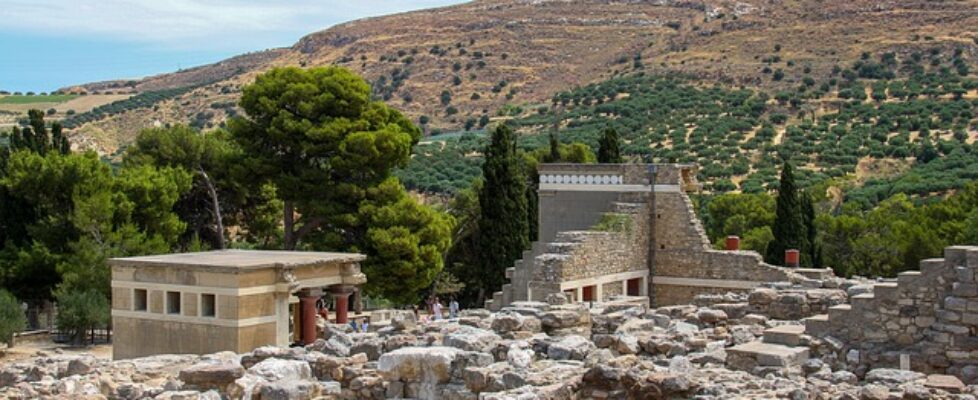
Located just a few kilometers south of the modern capital, Irakleio, Knossos is the largest and most famous of the Minoan palaces. It spans approximately 20,000 square meters and was the ceremonial and political heart of the Minoan world. See our full guide to Knossos.
- Key Features: The site is famous for its “Throne Room,” the Central Court used for public gatherings, and the vibrant (though reconstructed) frescoes like the Bull-Leaping Fresco and the Prince of the Lilies.
- Innovation: Knossos featured advanced engineering, including multi-story buildings, light wells for natural illumination, and a sophisticated terracotta pipe drainage system that provided running water and sanitation.
- Mythology: This is the legendary site of the Labyrinth, designed by Daedalus to hold the Minotaur, and the seat of the powerful King Minos.
2. Phaistos: The Architect’s Jewel

Situated on a hill overlooking the fertile Messara Plain in southern Crete, Phaistos is often praised for having the most impressive architectural layout and the most beautiful natural setting of all the palaces. See our full page on Phaistos.
- Key Features: The palace is organized around a grand central courtyard with monumental staircases. Unlike Knossos, Phaistos has not been extensively reconstructed with concrete, allowing visitors to see the original stone masonry as it was found.
- Discovery: This is where the famous Phaistos Disc was discovered—a clay disc featuring 241 symbols in a spiral, which remains one of the world’s most famous undeciphered scripts.
- History: The site shows two distinct phases: the “Old Palace,” destroyed by an earthquake around 1700 BCE, and the “New Palace” built directly on top of the ruins.
3. Malia: The Commercial Crossroads

Located on the northern coast, Malia is the third-largest palace and provides a clearer look at how a Minoan town functioned, as the ruins of the surrounding residential neighborhoods are well-preserved. Don’t miss our full Malia page.
- Key Features: Malia is known for its massive pithoi (giant storage jars) and its industrial areas. A unique feature is the Kernos of Malia, a large circular stone table with small cups around its edge, likely used for liquid offerings or religious rituals.
- Artifacts: The world-famous “Gold Bees of Malia” pendant, a masterpiece of Minoan jewelry, was found in a nearby necropolis.
- Role: Its proximity to the sea suggests it was a vital hub for maritime trade and the collection of agricultural surplus from the surrounding plains.
4. Zakros: The Gateway to the East

Tucked away in a remote bay at the easternmost tip of Crete, Zakros was the last of the four major “classic” palaces to be discovered. Because it was never looted in antiquity, it has yielded an incredible wealth of artifacts.
- Key Features: The palace is smaller than the others but follows the same sophisticated plan. It is unique for its “Lustral Basin”—a sunken room used for ritual cleansing—and its royal apartments that feature built-in drainage.
- Trade Hub: Excavations here revealed luxury items from ancient Egypt and the Near East, such as ivory, elephant tusks, and precious stones, proving that Zakros was Crete’s primary gateway for eastern Mediterranean trade.
- Environment: It is located at the end of the “Valley of the Dead,” a gorge where the Minoans buried their deceased in caves.
5. Kydonia: The Urban Mystery
Kydonia is unique because the ancient Minoan palatial center lies directly beneath the modern, bustling city of Chania. Specifically, the site is located on the Kastelli Hill overlooking the old Venetian harbor.
- Key Features: Much of the site remains unexcavated because it is covered by modern buildings, but the portions that have been uncovered show monumental walls and high-quality masonry.
- The “Seal of the Ruler”: One of the most important finds here is a seal impression showing a powerful male figure standing atop a multi-story building, which has provided deep insights into Minoan leadership.
- Linear B: Kydonia was a major center in the later “Post-palatial” period, and numerous clay tablets with Linear B script have been found here, linking the site to the later Mycenaean administration.
6. Zominthos: The Mountain Stronghold
High in the foothills of Mount Psiloritis (Mount Ida) at an altitude of nearly 1,200 meters, Zominthos is the only Minoan palace located in a mountainous region rather than a coastal plain.
- Key Features: It is a massive, well-preserved multi-story building with over 100 rooms. The architecture is exceptionally sturdy to withstand the harsh mountain winters, utilizing local stone and thick timber beams.
- Religious Significance: Zominthos likely served as a seasonal administrative center and a “way station” for pilgrims traveling from Knossos to the Ideon Andron (the sacred cave where Zeus was said to be born).
- Economics: The site was a hub for managing mountain resources, specifically wool production from sheep and the harvesting of medicinal mountain herbs and timber.
The Tentative List
While they are not yet full World Heritage Sites, Greece has officially proposed the following for future inclusion:
- The Fortress of Spinalonga: A Venetian fortress that later became one of Europe’s last active leper colonies. It is praised for its historical architecture and its poignant human story.
- Samaria Gorge: Currently a Biosphere Reserve, but undergoing the process to be listed as a natural World Heritage Site due to its unique biodiversity and geological importance.
Best Crete Guides and Maps


RECENT POSTS